

Philadelphia Criminal Defense Blog

Get a Probation Detainer Lifted in Philadelphia
In many cases, it may be possible to lift a probation detainer. Our Philadelphia criminal defense lawyers can help by filing a Motion to Lift the Detainer. Learn more.


Motion to Lift Detainer: Frequently Asked Questions about Probation Detainers in Philadelphia, PA
Philadelphia Criminal Defense Attorney Zak T. Goldstein, Esquire explains probation detainers and the motion to lift a detainer.
The Philadelphia criminal defense attorneys of Goldstein Mehta LLC may be able to help you get a probation detainer lifted. Our attorneys have represented clients who have been arrested for new charges while on probation. In some cases, we have been able to get the probation judge (“the back judge”) to quickly lift the detainer by filing a motion to lift the detainer. If you do not take action, you will remain in custody until your case is resolved, which could take a year or more. Call 267-225-2545 today for a complimentary criminal defense strategy session and to discuss the possibility of getting a detainer lifted while you are still facing new charges.
As criminal defense attorneys, we frequently receive questions from clients about probation issues. Some of the most common questions we receive are:
1) What is a probation detainer?

Demetra Mehta, Esq. - Philadelphia Probation Lawyer
A probation detainer is an order from the defendant’s probation judge directing the prison system not to release the defendant until the defendant sees the judge. When a person who is on probation for a previous offense is arrested on new charges, in most cases, the defendant’s probation officer will lodge a detainer when the defendant goes through preliminary arraignment. The order prevents the defendant from being released even if the defendant is able to make bail. If the defendant does not retain counsel to address the probation issue first, the judge's order will remain in effect and the defendant will remain in custody until the new case is resolved. If the defendant beats the new case, then the defendant will likely be released without a hearing if there are no other probation violations. If the defendant is found guilty of something in the new case, then the defendant will have a probation violation hearing scheduled within a few weeks in front of the probation judge. At that hearing, the judge will find the defendant in violation and decide on a new sentence for the violation. The sentence could range from more probation to jail time.
2) How do I get a detainer lifted?
In some cases, it is possible to have the probation judge lift the detainer order and allow the defendant to fight the new charges while out on bail. Once a probation detainer has lodged against the defendant, the defendant's probation officer typically cannot lift it without the supervising judge's permission. Therefore, getting a detainer lifted will typically require retaining counsel to file a motion to lift the detainer. The motion to lift the detainer is a written motion which will set out the history of the defendant’s probation, the allegations in the new case, and the reasons why the defendant should be permitted to fight the charges from the street instead of from custody.

Judges are often reluctant to lift probation detainers because they are only lodged against defendants who were already on probation when they were arrested for a new case. However, our attorneys may be able to gather enough mitigation information about you or your loved one or information that shows that the Commonwealth’s evidence in the new case is weak that we can convince the judge to lift the order pending trial. For example, if a defendant who is on probation for drugs is arrested for a new misdemeanor drug case, we may be able to convince a judge to release the defendant if we can show that the defendant was working, supporting family members, and attending drug treatment. This is even more likely if we are able to arrange for the defendant to enter a program upon his or her release. Each case is different, and our attorneys offer a free criminal defense strategy session at which we can discuss the likelihood of success in filing a motion to get a detainer lifted.
3) How long does it take to get a detainer lifted?
Once we are retained to file a motion to lift a detainer, there is no set time period in which the probation judge must schedule a hearing on the motion. Our probation lawyers will typically be able to file the motion within a day or two of being retained. The rest of the time table is then dependent on the court system. The probation judge could deny the motion without a hearing, schedule a hearing, or lift the detainer without a hearing. In most Philadelphia cases, it is often possible to get a hearing scheduled within a week or two. If the motion to lift the detainer is successful and the judge agrees to lift the order, then the defendant could be released on the day of the hearing. In the suburban counties, it could take one or two months to schedule a detainer hearing. Each judge is different, and the judges have a significant amount of discretion in terms of if and when they schedule probation cases. However, in many cases, we are able to convince the judge to schedule a hearing quickly and hear the case on the merits.
4) Will the judge lift the detainer?

Zak T. Goldstein, Esq. - Philadelphia Detainer Lawyer
There is never any guarantee as to whether a judge will lift a detainer. Typically, when either the probation case or new case is for charges which are not particularly serious or when there is some compelling mitigation evidence in the defendant’s background, the odds of winning a motion are greater. If the defendant has a lot of community support and friends and family who will attend the hearing, then the odds of getting a detainer lifted substantially increase. Likewise, if we can show that the defendant was working, attending some kind of treatment, or has health issues, those are all factors that could lead to a successful motion. The likelihood of success depends on the defendant’s background, the nature of the new and old charges, and also on the judge who is supervising the defendant’s probation. We can never guarantee that a detainer will be lifted, but in many cases, it is worth filing the motion and asking the judge for a hearing. In many cases, the probation judge will release the defendant pending trial if the defendant retains counsel and files a motion.
5) What if the judge won’t lift my detainer?
If the judge will not lift the detainer, then the defendant will remain in custody until the new charges are resolved or the defendant serves the maximum possible sentence on the probation case. In some instances, if there is a significant change in circumstances during the course of the case, then it may be possible to ask the back judge to reconsider. For example, if felony charges are later dismissed and the defendant is left facing only misdemeanor charges, it may be worth asking the probation judge to reconsider an initial ruling denying a motion to lift a detainer. Although we cannot guarantee that a motion will be successful, we can guarantee that if you do not file one, you will remain in custody until the new case is over.
6) Should I pay my bail if I have a detainer?
If you have a detainer, you should not pay your bail. If you pay your bail, you will not receive any time credit for the time spent in custody on the new case. You will receive time credit only for the probation case, meaning that if you are ultimately convicted of the new case and sentenced to a period of incarceration, you will not receive any credit for the time which you spent in custody prior to sentencing. If you pay your bail and you have a detainer or warrant from a different jurisdiction, you would typically be transferred to the other jurisdiction, which could make it more difficult to resolve the new case as there are often transportation issues.
7) What are the odds that the judge will lift the detainer?
It is never possible to guarantee that any particular detainer will be lifted, and it is often difficult to make a prediction as to the exact chances of success. However, our attorneys have represented numerous clients in probation matters and successfully had detainers lifted in a number of cases. Examples of successful probation case outcomes include:
Commonwealth v. A.W. - Motion for Reconsideration of Custdoail VOP Sentence Granted; Client Immediately Paroled to Treatment
The judge found A.W. in technical violation of probation for theft and drug possession while a different attorney represented A.W.. The judge sentenced A.W. to 11.5 - 23 months in the county jail. The client retained Goldstein Mehta LLC within ten days of the sentence, and our attorneys immediately filed a motion to reconsider the VOP sentence within ten days as required by the rules. The back judge quickly scheduled a hearing on the Motion to Reconsider, and prior to the hearing, we were able to work with the client's family to locate a treatment facility which A.W. could attend if released. Once our attorneys presented the judge with alternative treatment options, the judge reconsidered the sentence and granted immediate parole to treatment. We were able to help A.W. avoid a lengthy jail sentence in the county jail.
Commonwealth v. Z.B. – Detainer Lifted and Client Sentenced to Time Served on Section 17 Detainer
The client previously pleaded no contest to misdemeanor drug charges as part of a Section 17 diversionary program in Montgomery County. After getting arrested again in a different jurisdiction, the Montgomery County probation officer took Z.B. into custody and lodged a probation detainer. The client retained Goldstein Mehta LLC, and our defense attorneys immediately filed a Motion to Lift the Detainer, arguing that Section 17 probation does not give the judge the authority to lodge a probation detainer. Instead, the judge must schedule a hearing and either continue the probation or impose a judgment of sentence.
In this case, the judge had already scheduled a hearing that was still months away. After receiving the motion and recognizing that the law was unclear as to whether Section 17 probation provides the authority to lodge a detainer, the judge quickly moved the probation violation hearing up by two months. The client then stipulated to the probation violation in exchange for a time served sentence and was released shortly thereafter. By filing a creative motion on the client’s behalf, our defense lawyers were able to save the client months in the county prison.
Commonwealth v. J.B. – Probation Detainer Lifted, Full Acquittal Obtained in Domestic Assault Case
Police charged J.B. with Simple Assault, Terroristic Threats, Recklessly Endangering Another Person, and other related charges in the Philadelphia Municipal Court for allegedly assaulting his girlfriend. J.B. was on probation for similar charges, so the probation officer took him into custody and lodged a probation detainer. If J.B. had done nothing, he would have had to stay in jail for months until the new case was resolved. Fortunately, J.B. retained Zak T. Goldstein, Esq., and our defense lawyers promptly filed a Motion to Lift the Probation Detainer with the client’s back judge. By putting together a thorough mitigation packet which showed J.B.'s exemplary work record, successful compliance with probation other than the new charges, and extensive family and community ties, we were able to have J.B. released so that he could fight the case from the street.
Attorney Goldstein then obtained a full acquittal for J.B. at trial. By cross-examining the complainant on the inconsistencies between her testimony at trial and the statement she had given to police and showing that she had a motive to lie, our attorneys were able to convince the trial judge that the complainant should not be believed. This was particularly true in light of the complainant’s lack of visible injuries and the fantastical nature of her allegations. Accordingly, our criminal defense attorneys successfully had the client’s probation detainer lifted and then obtained a full acquittal at trial.
Commonwealth v. M.M. - M.M. was arrested on a potential technical probation violation. Attorney Goldstein filed a motion to lift the detainer and had a hearing scheduled within a week. At the hearing, our defense lawyers convinced M.M.'s back judge to find that M.M. had not violated the terms of his supervision. The client was immediately released the same day.
Our Philadelphia Detainer Lawyers Can Help

Probation Detainer Lawyers
If you or are loved one are dealing with the consequences of a probation detainer, call 267-225-2545 today for a free 15-minute criminal defense strategy session with one of our Philadelphia criminal defense lawyers. We have successfully defended thousands of cases and successfully moved to have detainers lifted on numerous occasions. Do not just assume that you or your loved one must remain in jail until the new case is resolved. We can help you evaluate the merits and likelihood of success in filing a motion, and we may be able to help you or your loved one get out of jail.
Speak with a Philadelphia Criminal Defense Lawyer Today


Can My Probation Officer Search My Cell Phone?
A probation officer must have reasonable suspicion in order to search a probationer or parolee's cell phone.
Probation and Parole Searches of Cell Phones
The Pennsylvania Superior Court has just decided the case of Commonwealth v. Murray, rejecting the defendant’s challenge to his conviction on corpus delicti grounds and holding that a probation officer or parole agent may search a probationer’s cell phone without a search warrant.
Commonwealth v. Murray
In Murray, the defendant was charged with possession of a firearm by a prohibited person in violation of 18 Pa.C.S. § 6105. Murray’s Pennsylvania State Parole Agent became suspicious that Murray may have been involved in criminal activity after the Agent visited Murray’s group home for a home visit and Murray was not present. When Murray next reported to the parole office, the agent asked him about his living situation and why he had moved without permission. Murray explained that he had been threatened by a housemate with a gun. Murray told the agent that he wrestled the gun away from the housemate and gave it to another acquittance.
Because Murray admitted to possessing a firearm, the agent took him into custody and proceeded to read the text messages on his cell phone. The agent found two incriminating text messages which had been sent right before Murray reported. One told a friend: “Yo, Kel if you didn’t hear from me by tonight I am locked up. So, my stuff is over 1247 West Huntingdon Street.” The other stated: “And the thing I was telling you about that I took from the bully is in the bathroom right under the tub.”
Of course, parole agents went to search the group home at 1246 West Huntingdon Street and found a gun under the tub in the bathroom. The agents then called the police and gave the gun to the police. The police then charged Murray with possessing a firearm as a felon.
Murray moved to exclude the statements made to the parole agent regarding the gun and also moved to suppress the results of the warrantless search of his cell phone. The trial court denied both motions. Murray was convicted of the gun charge and sentenced to 4.5 – 9 years in prison.
On appeal, Murray raised two main issues. First, he argued that the Commonwealth failed to satisfy the corpus delicti rule because it failed to show that a crime had been committed prior to introducing the statements made by Murray. Second, he argued that the parole agent should have been required to get a warrant before searching his cell phone.
The Corpus Delicti Rule
The Superior Court rejected both arguments. First, the Superior Court rejected the corpus delicti challenge. The corpus delicti rule is a rule of evidence which prohibits the prosecution from introducing an incriminating statement against the defendant unless the prosecution can first show that a crime has occurred. The prosecution does not have to prove the crime beyond a reasonable doubt, but it must show that the evidence is more consistent with a crime than with an accident. The corpus delicti, latin for “body of the crime,” may be proven by circumstantial evidence.
Here, the parole agents found a gun in a group home where Murray and numerous other parolees lived. The gun was hidden inside a plastic bag under a bathtub in the only bathroom in the boarding house. Therefore, the Court concluded that because the gun was hidden in such a way, it was more likely than not that the person to whom the gun belonged possessed it illegally. Accordingly, Murray’s statement about possessing the gun did not violate the corpus delicti rule.
Probation Officers May Search a Cell Phone Without a Warrant
Second, the Superior Court rejected Murray’s challenge to the warrantless search of his cell phone. In many situations, the police may search a person’s belongings when they take that person into custody as part of an arrest. This is known as the search incident to arrest exception to the warrant requirement. For many years, this exception permitted the police to search an arrestee’s cell phone. Recently, in Riley v. California, the United States Supreme Court held that in general, police must obtain a warrant before searching a cell phone. The Superior Court, however, distinguished Riley by finding that parolee’s and probationer’s have a reduced expectation of privacy. Riley did not involve the cell phone of a suspect who was on probation or parole. Because probation officers and parole agents may conduct a search of a probationer’s house with reasonable suspicion and without having to obtain a warrant, the Superior Court held that the same rule should apply to a cell phone. Thus, a probation officer or parole agent must only have reasonable suspicion in order to search a cell phone.
The Court concluded that the agent has reasonable suspicion to search the phone because Murray admitted to possessing the firearm and giving it to someone else. The agent had reasonable suspicion that the phone could contain text messages discussing the gun or photos of Murray with the gun. Therefore, the Court affirmed the trial court’s decision to deny the Motion to Suppress.
Philadelphia Criminal Defense Lawyers for Gun Charges

Philadelphia Criminal Defense Lawyer Zak T. Goldstein, Esq.
If you are charged with a VUFA offense, you need an attorney who has the knowledge and expertise to fight your case. Our award-winning Philadelphia criminal defense lawyers have successfully fought countless cases at trial and on appeal. We offer a 15-minute criminal defense strategy session to any potential client. Call 267-225-2545 to discuss your case with an experienced and understanding criminal defense attorney today.

Conviction for Possession of Firearm with Obliterated Serial Number Requires Intentional Modification of Serial Number
The prosecution must show more than the absence of a serial number. Instead, they must show that the defendant intentionally removed or modified the serial number on the gun.
The Pennsylvania Superior Court has just announced its decision in Commonwealth v. Ford, holding that a defendant may not be found guilty of 18 Pa.C.S. § 6110.2 (Possession of Firearm with Altered Manufacturer’s Number) when the numbers were altered through natural corrosion instead of intentional action. This decision protects individuals who own older firearms which have faded serial numbers. In Philadelphia, firearms offenses are taken very seriously, and prosecutors will often pursue severe sentences for defendants convicted of gun charges. If you are charged with possessing a firearm with an obliterated serial number or any offense involving a gun, it is crucial that you contact an attorney who is familiar with the law and is willing to fight for you.
Commonwealth v. Ford
In Ford, Philadelphia Police Officers received radio calls for a person bleeding and a person with a gun at 2010 Wilmot Street. The officers went to the backyard of that address, but no one was there. As they proceeded through an alleyway onto Ditman Street, the officers were then directed by bystanders to 4663 Ditman Street. While standing on the porch of that address, one of the officers heard screaming coming from inside the house. Based on the screaming, the high crime level in the neighborhood, and the radio call, the officers decided to knock on the door. When no one answered, the police entered the property without a warrant.
Once inside, the officers saw the defendant put an object which turned out to be a gun on the kitchen chair next to him. Officers promptly arrested the defendant after recovering the .38 caliber silver handgun. When officers looked at the gun, they could not see the manufacturer’s serial number. Because all modern firearms are required by law to have a serial’s number, the officers arrested the defendant and charged him with various Violations of the Uniform Firearms Act, including 18 PA C.S.A. § 6110.2 (possession of a firearm with an obliterated or altered serial number) and 18 PA C.S.A. § 6105 (possession of a firearm by a felon).
The defendant filed a Motion to Suppress, alleging that the gun should be suppressed because the police did not have a warrant when they entered the property. The Commonwealth responded that the officers were acting under the exigent circumstances exception. The exigent circumstances exception permits police to enter a house without a warrant under very limited circumstances – essentially, there must be a bonafide emergency or they must be in hot pursuit of a fleeing felon. After the officers testified to the reasons for entering without a warrant and argument from counsel, the trial court denied the Motion to Suppress. On appeal, the Superior Court affirmed, finding that though the police officers did not obtain a search warrant to enter the defendant’s home, the officers had probable cause and that there were exigent circumstances that warranted police entering his home given the radio call, the screaming, and the high crime nature of the area.
After the Motion to Suppress was denied, the defendant proceeded to trial by way of bench trial. Both the Commonwealth and the defense agreed that the serial number of the firearm had been obscured by corrosion as opposed to having been intentionally obliterated by the defendant. Nonetheless, the trial court found the defendant guilty of both possession of a gun by a felon and possession of a gun with an obliterated serial number, and the court sentenced him to a lengthy state sentence. The defendant appealed, arguing both that the trial court should have granted the Motion to Suppress and that the obliterated firearm statute does not make it illegal to possess a firearm where the serial number naturally wore away over the years and was not intentionally removed.
What is § 6110.2 (possession of a gun with an obliterated serial number)?
§ 6110.2 is one of several statutes that collectively form the Pennsylvania Uniform Firearms Act. In Philadelphia, charges brought under the Act are commonly referred to as VUFA charges, or Violations of the Uniform Firearms Act. § 6110.2 makes it illegal to possess a firearm which has the manufacturer’s number integral to the frame or receiver altered, changed, removed or obliterated.” Further, unlike some of the other VUFA statutes, § 6110.2 does not require that the firearm be operable. Also, it is not a defense to § 6110.2 that the defendant possessed the gun at his or her residence or place of business, making the statute very different from § 6106 (possessing a concealed firearm or a firearm in a car without a license to carry) and § 6108 (possessing a firearm on the streets of Philadelphia). Further, § 6110.2 has recklessness as its mens rea, making it easier for prosecutors to prove as this is a lesser mens rea than other offenses (i.e. specific intent, where a defendant specifically intended to commit a particular crime) and thus easier for the Commonwealth to prove. So, typically, § 6110.2 can be difficult to defend if a defendant is not successful at the suppression hearing.
The Superior Court Restricts § 6110.2
The issue in Ford was whether possessing a firearm with the serial number that had merely corroded would be sufficient for a conviction under § 6110.2. The Superior Court concluded that it would not. In making its decision, the Superior Court employed statutory interpretation to determine what the General Assembly intended when it passed § 6110.2. As previously stated, it is illegal to possess a firearm when the manufacturer’s number is either altered, changed, removed or obliterated. Throughout Ford, the Superior Court emphasized that it would not “add” to § 6110.2, by quoting Commonwealth v. Johnson, 26 A.3d 1078, 1090 (Pa. 2011) holding that “although one is admonished to listen attentively to what a statute says; one must also listen attentively to what it does not say.”
The Superior Court began its analysis by consulting the Crimes Code. § 6102 is the definitions section of the VUFA statutes, however “altered,” “changed,” “removed” or “obliterated” are not defined in this section. The Superior Court then turned to Webster’s Dictionary for guidance. They summarized their findings as follows:
[W]e consult[ed] the dictionary, which defines (1) “alter” as “to cause to become different in some particular characteristic (as measure, dimension, course, arrangement, or inclination) without changing it into something else,” (2) “change” as “to make different . . . in some particular but short of conversion into something else . . . [or] to make over to a radically different form, composition, state, or disposition,”; (3) “remove” means “to get rid of as by moving” as in eradicate or eliminate, and is synonymous with erase; and (4) “obliterate” as “1 : to remove from significance and bring to nothingness : as a: to make undecipherable or imperceptible by obscuring, covering, or wearing or chipping away . . . b: to remove utterly from recognition . . . or c (1): to remove from existence : make nonexistent : destroy utterly all traces, indications, significance of . . . (2) to cause to disappear[.]”
Based on this analysis, the Superior Court held that natural corrosion did not fall within the definitions of altered, changed, removed, or obliterated. Therefore, the defendant should not have been found guilty of § 6110.2. Because the defendant’s conviction for § 6110.2 ran concurrent to his § 6105 conviction and was identical to it, the Superior Court then vacated the defendant’s sentence for § 6110.2, but did not remand it for resentencing.
VUFA Cases and Weapons Offenses

Goldstein Mehta LLC Philadelphia Criminal Defense Lawyers
If you are charged with a VUFA offense, you need an attorney who has the knowledge and expertise to fight your case. Our award-winning Philadelphia criminal defense lawyers have successfully fought countless cases at trial and on appeal. We offer a 15-minute criminal defense strategy session to any potential client. Call 267-225-2545 to discuss your case with an experienced and understanding criminal defense attorney today.

PA Superior Court Limits Deadly Weapon Used Sentencing Enhancement in Burglary Cases
The Deadly Weapon Used Enhancement does not apply unless the defendant used the deadly weapon while entering the building during a Burglary.
The Pennsylvania Superior Court has just decided the case of Commonwealth v. Tavarez. This decision limits the “Deadly Weapon Enhancement” for individuals convicted of burglary when a deadly weapon is involved. It requires that a sentencing court determine whether a deadly weapon was used in the commission of the burglary or whether a defendant merely possessed the deadly weapon at the time the defendant entered the building or occupied structure.
Commonwealth v. Tavarez
In Tavarez, the defendant pleaded guilty to one count each of aggravated assault, burglary, robbery, impersonating a public servant, and conspiracy. As part of his guilty plea, Mr. Tavarez stipulated to the following factual summary:
[O]n or about November 17th, 2015, shortly after 1:00 in the morning at 49 Mill Road in Oley Township, Berks County, Pennsylvania, you along with your accomplices and co-conspirators Edward Martinez, Brandon Smith, and Erick Green went to that residence; the plan even before - you arrived at the residence was to rob the people there; you believed that there were illegal drugs and money[] there to be gained; all four of you agreed to do that. When you got there, as was your intention all along, you and Edward Martinez entered the residence, there were people present. This was a residence. It was not open to the public at that time. You had no license or privilege to be there.
Once inside, you were yelling, [“]Police. Freeze[.”] in [an] attempt to compel the homeowners to do what you wanted them to do, thereby impersonating a public servant. Although you attempted to commit a robbery and you did so with firearms, nothing was actually taken.
When you confronted the homeowner, Eric Wegman, in the upstairs bedroom, he pulled his own handgun and fired, hitting both you and Mr. Martinez. Eric Wegman was also shot in the leg at that point.
Based on these facts, the trial court sentenced Mr. Tavarez to a 10 ½ to 30 years. The trial court did this, in part, by applying the “Deadly Weapon Used” enhancement to all of the charges, including the burglary charge. After he was sentenced, Mr. Tavarez filed a timely appeal. One of the issues Mr. Tavarez raised on appeal was whether the trial court erred in applying the “Deadly Weapon Used” enhancement to his burglary conviction.
What are the Sentencing Guidelines?
In Pennsylvania, an individual’s sentence will usually be determined by where the person falls on the sentencing matrix. The purpose of the sentencing matrix is to provide consistency in sentencing across the state. It is important to note that judges are not required to follow the guidelines and are free to depart from them when they see fit.
The first step in determining where a defendant falls on the sentencing matrix is to figure out what the individual’s Prior Record Score (“PRS”) is. A defendant’s PRS is based on their prior convictions. Specifically, a court will “add” up the prior record score points of each conviction. The more serious the offense, the more “points” it is worth. For example, if an individual’s sole conviction is for an Aggravated Assault where Serious Bodily Injury results, that person will have a PRS of 4. However, if an individual has two prior misdemeanor convictions, that are not specifically delineated by the General Assembly, then that individual will only have a PRS of 1.
The lowest PRS an individual can have is a 0. The highest PRS an individual can have is a 5. However, some individuals with multiple felony convictions can be classified as a REFEL, while some repeat violent offenders may be classified as a REVOC. These classifications will subject you to more severe guidelines. If you have previous convictions it is imperative that you have an attorney who understands how your PRS is calculated because it can have significant consequences on your sentence.
After the Prior Record Score is determined, the court must then determine the Offense Gravity Score (“OGS”) of the particular offense. The Pennsylvania General Assembly assigned an OGS for each offense listed in the Pennsylvania Crimes Code. The range of OGS is from 1-14, with 1 being the least serious, while 14 being the most serious.
In Tavarez, the defendant had a prior record score of 2. Additionally, the Burglary charge that Mr. Tavarez pleaded guilty to had an OGS of 9. Thus, if this was the only charge that Mr. Tavarez had pleaded guilty to his guidelines would have been 24-36 plus or minus 12. In Pennsylvania, a judge must sentence an individual to a minimum and maximum sentence. Assuming there were no additional enhancements (i.e. the “Deadly Weapon Enhancement”) and the court had sentenced him to a 2-4 year sentence that would have been a “guideline” sentence. However, because Mr. Tavarez agreed that he used a firearm, the court could, and did, apply the “Deadly Weapon Enhancement” to his case.
What is a Deadly Weapon Enhancement?
If someone commits a crime with a deadly weapon, a court must apply the “Deadly Weapon Enhancement.” This enhancement requires the court to look at additional matrixes to determine a sentence for the defendant. There are two types of deadly weapon enhancement charts: “Possession of a Deadly Weapon” and “Use of a Deadly Weapon.” The “Deadly Weapon Used” matrix will always recommend a more severe sentence than the “Deadly Weapon Possessed” matrix.
In Mr. Tavarez’s case, using his PRS of 2 and the OGS of 9 of the Burglary offense, the “Deadly Weapon Possessed” matrix had a guideline range of 33-45 plus or minus 12, while the “Deadly Weapon Used” matrix has a guideline range of 42-54 plus or minus 12. As such, there is a nine-month difference between the two guidelines which is very consequential.
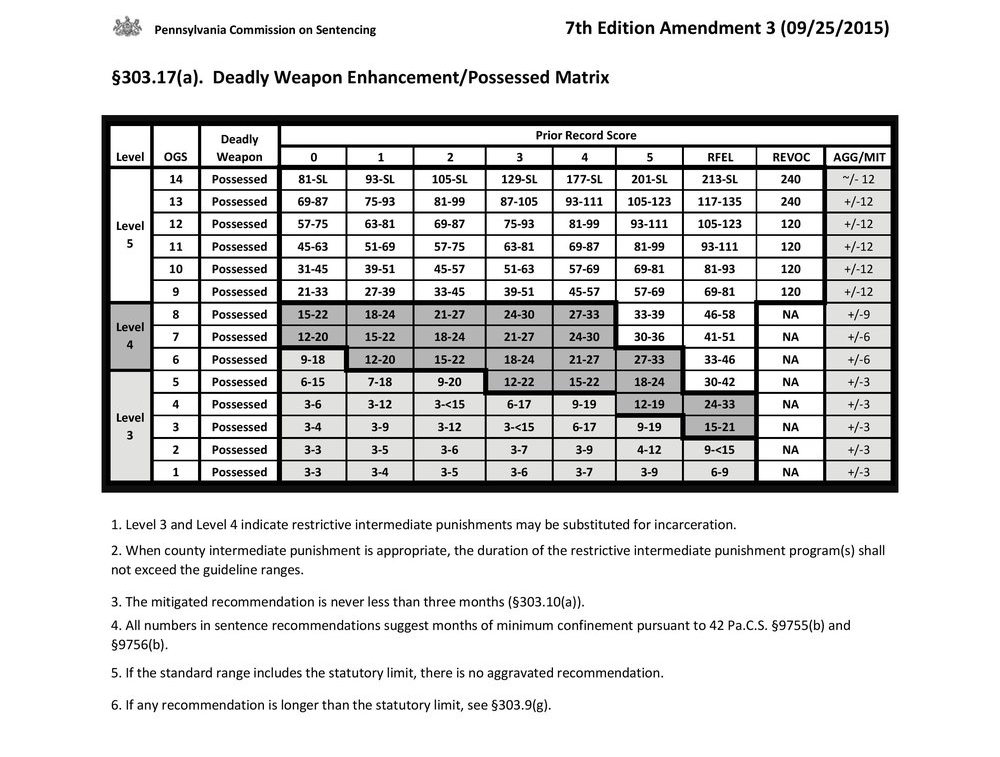

The Superior Court holds that only the “Possessed” Matrix applies to Tavarez's Burglary Conviction.
Part of Tavarez's plea deal was to stipulate to a factual summary. After he filed his appeal, the Pennsylvania Superior Court reviewed the transcript and was limited to the facts that were on record. In Mr. Tavarez’s case, the record did not state that Mr. Tavarez used the firearm to commit the burglary. Further, in Pennsylvania, the crime of burglary ends once the felon breaks into the building because burglary is defined as breaking and entering a building or occupied structure with the intent to commit a crime therein. Therefore, the burglary is over once a defendant has entered a building even if the defendant goes on to commit other crimes once inside. Here, Tavarez admitted to using the firearm to rob the complainant after he had entered the residence. Consequently, the trial court was correct in applying the “Deadly Weapon Used” enhancement for the robbery and other offenses that he pleaded guilty to. However, because Mr. Talvarez had already completed the crime of burglary when he entered the complainant’s residence and did not use the firearm in the commission of the burglary, it was incorrect for the trial court to apply the “Deadly Weapon Used” enhancement for the burglary conviction. Because of this error by the trial court, the Superior Court remanded Mr. Talvarez’s case for resentencing.
Call the Award-Winning Criminal Defense Lawyers of Goldstein Mehta LLC if You Are Charged With a Criminal Offense

Philadelphia Criminal Defense Lawyers
As shown by Tavarez, the details in a case matter. If you are charged with any offense or under investigation by the authorities, you need a defense attorney who pays attention to the details that will make or break your case. Our award-winning Philadelphia criminal defense lawyers have successfully fought countless cases at trial and on appeal. We offer a 15-minute criminal defense strategy session to any potential client. Call 267-225-2545 to discuss your case with an experienced and understanding criminal defense attorney today.