

Philadelphia Criminal Defense Blog

Attorney Goldstein Wins Dismissal of First Degree Murder Charges

Philadelphia Criminal Defense Lawyer Zak Goldstein
Philadelphia Criminal Defense Lawyer Zak T. Goldstein, Esquire recently obtained the complete dismissal of first degree murder charges in the case of Commonwealth v. D.R..
In D.R., prosecutors alleged that the decedent, who was wheelchair bound, was returning home just before midnight. The decedent’s friend happened to be driving by, and he stopped to help the decedent get into the house. As the friend was helping the decedent up into the house, two men approached, pulled out guns, and began walking quickly towards the decedent. The decedent managed to get into the house and close the door, but one of the men kicked the door open and fatally shot the decedent. The decedent’s friend began to run, and the men began firing in his direction, striking him one time in the leg. The friend survived his injuries. The two men then fled the scene. Prosecutors eventually arrested and charged D.R. with first degree murder for the killing of the decedent and Attempted Murder for the shooting of the decedent’s friend.
Fortunately, D.R. quickly retained Attorney Goldstein, and Attorney Goldstein began investigating the case. It was clear that there was something strange about the case right away. First, D.R. had no motive to kill the decedent or even ties to that particular neighborhood in Philadelphia. Second, two witnesses had apparently identified D.R. as the killer in police-administered photo arrays, but those photo arrays were not conducted until months after the murder when police supposedly received an anonymous tip identifying D.R. as the shooter. Third, police had not uncovered any other evidence beyond these unusually-delayed witness identifications which would connect D.R. to the homicide.
The first step in most Pennsylvania state court cases, including homicides, is a preliminary hearing. Attorney Goldstein was successfully able to move for a lineup with respect to one of the eyewitnesses – the decedent’s friend who had been shot and survived. When considering whether to grant a lineup, the court should consider the witness’s opportunity to observe, whether the witness knew or had seen the defendant before, and the overall strength of the case and whether there is other corroborating evidence against the defendant. In this case, the surviving victim had never seen D.R. before, had not had a great opportunity to observe the shooters, and had not made an identification for months. There was also no other evidence against D.R. other than the two eyewitness identifications. Accordingly, the Municipal Court granted the motion for a lineup with respect to the surviving victim, but the court denied it with respect to the other alleged eyewitness because he claimed that he had previously seen D.R. in the neighborhood.
When Attorney Goldstein and D.R. attended the lineup, the surviving victim told detectives that he recognized D.R. as the person he had identified in the photo array, but after seeing him in person, he believed that he was not the person who killed his friend. He testified similarly at the preliminary hearing. On cross-examination by Attorney Goldstein, he admitted that detectives had suggested that he identify D.R. and that he had gone along with it because detectives assured him that they had lots of other evidence and D.R.’s eyes looked similar to the eyes of the shooter. However, the other eyewitness, one of the decedent’s neighbors from across the street, testified that he had seen D.R. in the neighborhood in the days before the shooting, that he had witnessed the shooting itself, and that he recognized D.R. as the shooter. Therefore, the case was held for court based on the one witness’s in-court identification, and the court subsequently scheduled the matter for trial.
Attorney Goldstein, believing in his client’s innocence, continued investigating the case. He was eventually able to obtain phone records, including cell site location data, which showed that it was unlikely that D.R. had ever been in the neighborhood of the shooting and that D.R. was probably too far away to have committed the murder on the night in question. Attorney Goldstein’s private investigator also spoke with the neighbor/purported eyewitness from across the street. That witness eventually recanted his statement and admitted that he had not really gotten a good look at the shooter. Like the surviving victim who attended the lineup, that witness also admitted that police detectives had also told him that he should identify D.R. when they conducted the photo array.
Attorney Goldstein immediately provided prosecutors with the witness’s statement admitting that he had not told the truth about D.R. being the shooter. Now that both witnesses gave statements indicating that detectives had told them who to identify and faced with cell phone data showing that D.R. was probably too far away to have committed the murder, the Commonwealth asked D.R. to submit to a lie detector test. D.R. agreed and took the test. Following the completion of the test, prosecutors agreed to withdraw all charges, and D.R. was immediately released. Instead of facing life without parole on First Degree Murder charges, D.R. is now home with his family and enjoying his freedom. This case illustrates the importance of making strategic pre-trial motions such as a motion for a lineup, thoroughly cross-examining Commonwealth witnesses, and fully investigating a case prior to trial. By doing these three things, Attorney Goldstein was able to win freedom for D.R.
Facing criminal charges? We can help.
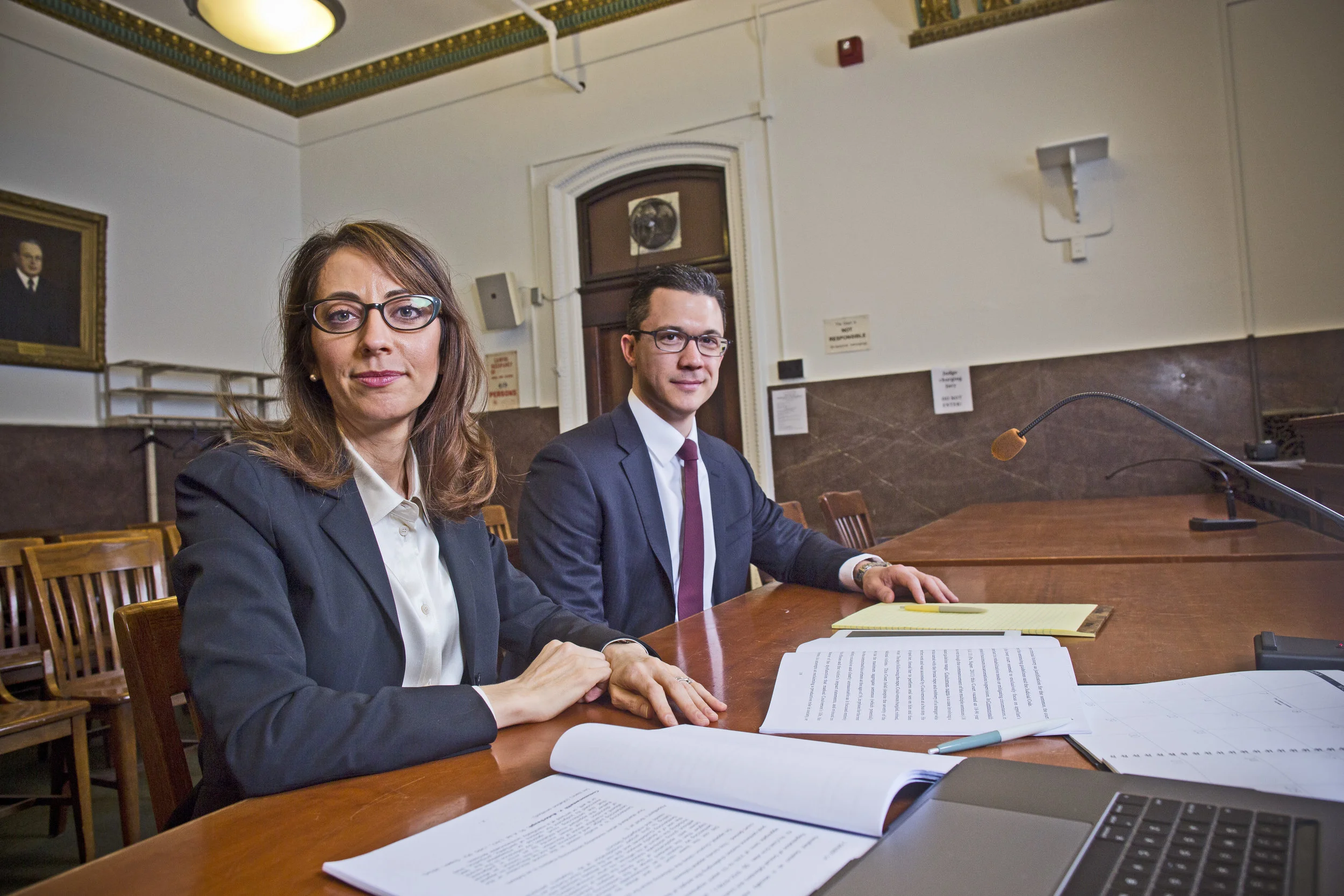
Philadelphia Criminal Defense Lawyers Demetra Mehta and Zak Goldstein
If you are facing criminal charges or under investigation by the police, we can help. We have successfully defended thousands of clients against criminal charges in courts throughout Pennsylvania and New Jersey. We have successfully obtained full acquittals in cases involving charges such as Conspiracy, Aggravated Assault, Rape, and Murder. Our award-winning Philadelphia criminal defense lawyers offer a free criminal defense strategy session to any potential client. Call 267-225-2545 to speak with an experienced and understanding defense attorney today.

PA Superior Court: Sentencing Gradation of Unlawful Contact with Minor Charge Must Take Acquittal on More Serious Charges Into Account

Philadelphia Criminal Defense Lawyer Zak Goldstein
The Pennsylvania Superior Court has decided the case of Commonwealth v. Pope, holding that the gradation of an unlawful contact with minor charge must take an acquittal on more serious charges into account. This is because the unlawful contact with a minor provides that unlawful contact shall either be graded as a felony of the third degree or the same as the most serious sexual offense that the defendant is alleged to have committed. In this case, the defendant was acquitted of first-degree-felony Attempted Involuntary Deviate Sexual Contact, and therefore the trial court erred in grading the unlawful contact with a minor charge as a felony of the first degree at sentencing.
The Facts of Pope
In Pope, the Commonwealth alleged that the minor complainant lived with her mother and her mother’s boyfriend, the defendant, from the age of three years old until she turned thirteen. At some point, the complainant began dating someone her own age. The complainant accused the defendant of extorting her for sexual favors in exchange for permission to visit her boyfriend. Specifically, she testified that she had to give the defendant a hand job for a two hour visit, two hand jobs for a four hour visit, or a blow job for a full day visit with her boyfriend. She testified that this happened on numerous occasions. She also claimed that on one occasion, the defendant attempted to have anal sex with her.
The complainant eventually told a friend that this had been happening, and her father eventually learned of the allegations. Her father took her to the police station to make a report. Police eventually charged the defendant with attempted involuntary deviate sexual intercourse (“IDSI”), aggravated indecent assault, indecent assault, one count of unlawful contact with a minor, and one count of corruption with minors. Following a jury trial, the defendant was convicted of unlawful contact with a minor and corruption of minors. The jury acquitted him of the other offenses. At sentencing, the trial court graded the unlawful contact with minors charge as a felony of the first degree and sentenced the defendant to 62-124 months’ incarceration. The defendant appealed, and the Superior Court denied the appeal.
PCRA Challenge to the Illegal Sentence
After the Superior Court denied the appeal, the defendant filed a timely Post-Conviction Relief Act Petition, eventually alleging, among other things, that his trial and appellate attorneys provided the ineffective assistance of counsel in failing to challenge the F1 gradation of the unlawful contact with minors charge. The trial court dismissed the petition, and the defendant appealed the denial of the PCRA to the Pennsylvania Superior Court. This time, the Superior Court granted relief.
The Superior Court Appeal
Initially, the defendant claimed that he had received the ineffective assistance of counsel because his prior attorneys failed to challenge the gradation of the unlawful contact charge. The Superior Court, however, concluded that it had the power to correct an illegal sentence even on the direct appeal of a timely PCRA Petition and that it did not have to reach the issue of whether the prior attorneys were ineffective. Instead, the Superior Court simply agreed with the defendant.
Section 6318 of the Pennsylvania Crimes Code defines unlawful contact with a minor as follows:
(a) Offense defined.--A person commits an offense if he is intentionally in contact with a minor, or a law enforcement officer acting in the performance of his duties who has assumed the identity of a minor, for the purpose of engaging in an activity prohibited under any of the following, and either the person initiating the contact or the person being contacted is within this Commonwealth:
(1) Any of the offenses enumerated in Chapter 31 (relating to sexual offenses).
(2) Open lewdness as defined in section 5901 (relating to open lewdness).
(3) Prostitution as defined in section 5902 (relating to prostitution and related offenses).
(4) Obscene and other sexual materials and performances as defined in section 5903 (relating to obscene and other sexual materials and performances).
(5) Sexual abuse of children as defined in section 6312 (relating to sexual abuse of children).
(6) Sexual exploitation of children as defined in section 6320 (relating to sexual exploitation of children).
(b) Grading.--A violation of subsection (a) is:
(1) an offense of the same grade and degree as the most serious underlying offense in subsection (a) for which the defendant contacted the minor; or
(2) a felony of the third degree; whichever is greater.
Thus, the key issue in the appeal was what the most serious underlying offense in subsection (a) for which the defendant contacted the minor would be following the jury’s acquittal on the most serious charge of IDSI. In general, the Commonwealth does not even have to charge a defendant with other offenses in order to pursue a prosecution for unlawful contact. Instead, the Commonwealth would simply allege unlawful contact with a minor, and if the prosecution could prove that the contact was for the purpose of committing IDSI (for example by obtaining oral or anal sex), then the unlawful contact would be properly graded as an F1.
The analysis changes, however, when a jury acquits the defendant of specific charges. Where the jury acquits the defendant of more serious charges, the sentencing court is not permitted to guess which offense the defendant sought to commit when he contacted the minor. Instead, the sentencing court should apply the default gradation of a felony of the third degree. Further, the jury instructions did not provide any clarification in this case as to which offense the jury found the defendant had attempted to commit. Therefore, the Superior Court reversed the sentence and found that the defendant should have been sentenced on unlawful contact with a minor as a felony of the third degree. The defendant will receive a new sentence, and it will necessarily be shorter because the maximum sentence for a felony of the third degree is 3.5-7 years’ incarceration.
FACING CRIMINAL CHARGES? WE CAN HELP.

Criminal Defense Lawyers Demetra Mehta and Zak Goldstein
If you are facing criminal charges or under investigation by the police, we can help. We have successfully defended thousands of clients against criminal charges in courts throughout Pennsylvania and New Jersey. We have successfully obtained full acquittals in cases involving charges such as Conspiracy, Aggravated Assault, Rape, and Murder. Our award-winning Philadelphia criminal defense lawyers offer a free criminal defense strategy session to any potential client. Call 267-225-2545 to speak with an experienced and understanding defense attorney today.

PA Superior Court: Commonwealth May Amend Bills of Information to Include New Victim on Day of Trial Unless Defendant Shows Prejudice

Philadelphia Criminal Defense Lawyer Zak Goldstein
The Pennsylvania Superior Court has decided the case of Commonwealth v. Jackson, holding that the trial court properly permitted the prosecution to amend the Bills of Information to include new victims on the morning of trial because the defendant was on notice of those victims and failed to show any prejudice due to the amendment.
The Facts of Jackson
In Jackson, the defendant was charged with Terroristic Threats (M1) in Philadelphia for allegedly threatening various co-workers at his federal job. The defendant had a number of telephone conversations and left a number of voice mails in which he used racial slurs, threatened co-workers, and said other generally distasteful and unsettling things. The majority of these phone calls, however, involved making these threats towards other co-workers to a specific co-worker with whom he was more friendly. He did not really, however, threaten the one co-worker to whom he made the majority of his comments.
Can the Commonwealth Amend the Bills of Information on the Day of Trial?
Prior to trial, the Commonwealth filed Bills of Information. The Bills of Information generally identify the charges which a defendant will face as well as the name of the victim, the date on which the crime allegedly occurred, and the gradation of the charges. The Commonwealth may later move to amend the Bills of Information, but if the Commonwealth has failed to prove the charges as identified in the Bills by the end of the trial, then the court should find insufficient evidence to convict a defendant. In this case, the original Bills of Information listed only the co-worker who he did not really threaten as the victim. Instead, the defendant had made a number of threatening remarks about other co-workers to that co-worker. Realizing this error, the Commonwealth moved to amend the Bills of Information on the day of the bench trial.
The defense attorney objected to the Commonwealth’s motion to amend the Bills, but the trial court permitted the amendment. The defendant then proceeded by way of bench trial and was found guilty of one count of Terroristic Threats. He was subsequently sentenced to three years of reporting probation, and he appealed to the Pennsylvania Superior Court.
The Superior Court Appeal
On appeal, the Superior Court affirmed the conviction. The defendant raised the issue of whether the trial court improperly permitted the Commonwealth to amend the Bills of Information on the day of trial, but the Superior Court rejected this argument.
First, the Court reasoned that the majority of the defendant’s argument had been waived by the defendant’s failure to make specific objections on the day of trial and by the defense attorney’s sloppy drafting of the Statement of Errors. Further, the Court concluded that even if the arguments were not waived, they should be rejected.
The Court reasoned that under Pa.R.Crim.P. 564:
The court may allow an information to be amended, provided that the information as amended does not charge offenses arising from a different set of events and that the amended charges are not so materially different from the original charge that the defendant would be unfairly prejudiced. Upon amendment, the court may grant such postponement of trial or other relief as is necessary in the interests of justice.
The purpose of the rule is to make sure that the defendant knows what he is charged with and does not have to devise a new defense on the day of trial. In deciding whether to grant an amendment, a court should consider the following factors as to whether the defendant was prejudiced:
Whether the amendment changes the factual scenario,
Whether new facts, previously unknown to the defendant were added,
Whether the description of the charges changed,
Whether the amendment necessitated a change in defense strategy,
And whether the timing of the request for the amendment allowed for ample notice and preparation by the defendant.
Here, the Court court concluded that the defendant failed to show any prejudice which would have justified denying the motion to amend the Bills of Information. The alleged victims were clearly identified at the preliminary hearing and in the pre-trial discovery provided by the Commonwealth, and the complaint also put the defendant on notice of the threats with which he was charged. Therefore, amending the bills to add the additional co-workers did not prejudice the defendant as he already knew what he was charged with doing. The Court denied the appeal, and it found sufficient evidence to uphold the defendant’s conviction for Terroristic Threats.
Facing criminal charges? We can help.

Philadelphia Criminal Defense Lawyers
If you are facing criminal charges or under investigation by the police, we can help. We have successfully defended thousands of clients against criminal charges in courts throughout Pennsylvania and New Jersey. We have successfully obtained full acquittals in cases involving charges such as Conspiracy, Aggravated Assault, Rape, and Murder. Our award-winning Philadelphia criminal defense lawyers offer a free criminal defense strategy session to any potential client. Call 267-225-2545 to speak with an experienced and understanding defense attorney today.

PA Superior Court: Failure to Properly Investigate Alibi and File Accurate Alibi Notice May Be Ineffective Assistance of Counsel

Philadelphia Criminal Defense Lawyer Zak Goldstein
The Pennsylvania Superior Court has decided the case of Commonwealth v. Shaw, holding that a defendant may be entitled to a new trial where the defense attorney provided the ineffective assistance of counsel by failing to properly investigate an alibi defense and by filing an erroneous notice of alibi which was later used to impeach the defendant’s testimony. This case is important because it emphasizes the defense attorney’s both to fully investigate potential alibi defenses and to take care to file an accurate notice of alibi where one is appropriate. It also allows for a defendant to be impeached through the use of the notice of alibi, which was filed by the defendant’s lawyer, in addition to any statements made by a defendant.
Commonwealth v. Shaw
In Shaw, the prosecution alleged the following: on November 30, 2009, the complainant saw the defendant and his accomplice hanging around his apartment building. The complainant spoke with them. When the conversation concluded, the complainant went into his apartment where he was entertaining guests. The defendant and his accomplice came to the door and asked the complainant if he had change for a $100 bill. The complainant accommodated them and then returned to his guests, but he heard another knock a short time later. Assuming it was a food delivery, the complainant opened the door. However, it was the defendant and his accomplice and they forced their way into the complainant’s home. After they entered, they demanded money from the complainant. They then assaulted him and shot him in the chest and the thigh. The complainant’s guests, who were hiding in the bathroom, called 911.
Police and paramedics arrived a short time later. The complainant was taken to the hospital where he was treated for his injuries. While en route to the hospital, the complainant stated that one of the assailants was a small, dark-skinned, black man wearing a grey hoodie. He could not give a description of the other individual.
After he recovered from his injuries, the police showed the complainant a photo array, and he identified the defendant and his accomplice. The complainant stated that the medication he was on in the hospital did not hamper his ability to make an identification and that he was positive the defendant was the one who shot him. The police were also able to locate multiple witnesses to this incident, including a neighbor who would later testify that he saw the defendant and his accomplice in the area earlier in the day. A female guest ultimately testified that she saw the defendant punch the victim.
Police arrested the defendant charged him with attempted murder, robbery, various charges under the Uniform Firearm Act, burglary, possession of an instrument of a crime, aggravated assault, and criminal conspiracy. Prior to his trial, his attorney did not file a motion to suppress the victim’s identification of him. However, his attorney did file an alibi notice. Specifically, the notice of alibi alleged that the defendant was with his girlfriend and another woman in Philadelphia on the day this robbery occurred. However, the defendant’s attorney only spoke to the girlfriend and only called her to testify at his trial. He never spoke with the other woman or called her as a witness. The Commonwealth then used the defendant’s alibi notice to impeach the witness during cross-examination. Based on the notice of alibi, the assistant district attorney asked why the defendant said he was with two women when his girlfriend did not testify to that.
After a jury trial, the defendant was found guilty of all charges and received a 15-30 years sentence. The defendant then filed a timely appeal which was denied and a timely PCRA petition. In his PCRA petition, the defendant raised several arguments as to why his trial attorney was ineffective in representing him. Specifically, the defendant argued that his attorney was ineffective because he did not try to suppress the complainant’s identification of him, he did not request a Kloiber charge, and that he failed to amend his alibi notice prior to trial. He also alleged that the attorney who handled his PCRA claim was ineffective for not raising the issue on appeal. The PCRA court denied his petition, and then the defendant filed this timely appeal.
Can You Suppress a Witness’s Identification?
Sometimes. A defense attorney may file a motion to suppress a witness’s identification if it was unduly suggestive. In other words, if a police officer’s actions during the identification are so egregious that it gives rise to a irreparably tainted misidentification, then a court may prevent that witness from making an in-court identification of the defendant or allowing the Commonwealth to present that pre-trial identification in its case-in-chief.
For example, assume that a woman was robbed and an eyewitness saw the robbery. The police ask him for a description of the assailant and he describes the person as a 5’10, Hispanic male with a beard. The next day, the police provide a photo array and ask the witness if they see anyone they recognize in the photo array. The photo array has six pictures. Five of them are white men with no facial hair, and there is one picture of a Hispanic male with a beard. The eyewitness then identifies this Hispanic male as the person who committed the robbery. Assuming this man went to trial, he could have a strong argument for suppressing the eyewitness’s identification because the photo array was unduly suggestive. There was only one photo of a person who matched the description he gave to the police. The other five pictures were not even close to resembling the perpetrator of the robbery. Thus, it would be clear that the police were trying to make the eyewitness pick the defendant, thereby tainting the identification.
What is a Kloiber Charge?
A Kloiber charge is a jury instruction that is given when the witness did not have the opportunity to clearly view the defendant, equivocated in his identification of the defendant, or had difficulty in making an identification in the past. In the instant case, the defendant argued that because of the complainant’s discrepancies in his initial claim, a Kloiber charge was warranted. The Superior Court rejected this claim. However, a Kloiber charge can be very helpful because it instructs the jury to give less weight to a questionable identification where appropriate.
Can the prosecutor impeach the defendant with the notice of alibi?
Yes. As shown in the instant case, a defendant may be impeached with his or her alibi notice. It was also of no consequence that the defendant did not testify. In other words, the Commonwealth can use the defendant’s alibi notice to impeach the alibi witness that the defense calls. However, and this is very important, if a defendant decides to withdraw his alibi notice prior to trial, the defective notice cannot be used against him or her. The Commonwealth also may not use a withdrawn notice of alibi as evidence of a defendant’s lack of truthfulness at sentencing. Therefore, it is extremely important that a defense attorney thoroughly investigate an alibi and only file a notice of alibi where the defense has merit and the notice will be accurate. If further investigation reveals defects in the notice of alibi, then it should be withdrawn prior to trial.
The Superior Court’s Decision
The Superior Court held that the defendant’s trial attorney was not ineffective for failing to try to suppress the complainant’s out-of-court identification of him or for not requesting a Kloiber charge. The Court, however, also found that the defense attorney was ineffective for failing to amend the alibi notice to accurately reflect the witnesses he intended to call at trial. As the Superior Court stated, it is common knowledge that the Commonwealth can impeach a witness and use the defendant’s alibi notice against him or her if it is not accurate. In the defendant’s case, the trial attorney should have known this because he should have spoken with his witness and realized that the other witness was unlikely to appear for court, and he should have amended his alibi notice to reflect the witnesses he intended to call and what they would actually say. The attorney should have removed the name of the one witness he did not intend to call. If he had done this, the Commonwealth could not have impeached the witness with the erroneous alibi notice. The defense attorney, however, testified that he did not realize that the witness could be impeached with the alibi notice. Therefore, the Superior Court found that there was no reasonable strategy for failing to amend the notice.
The Superior Court also found that the defendant was prejudiced by the attorney’s failure to amend the notice. Alhough the identifications of the defendant were not unconstitutional, they were not the most reliable. Additionally, there was no physical evidence that tended to corroborate these identifications. Consequently, because of this failure by his attorney to amend his alibi notice, the defendant will get a new trial.
Facing criminal charges? We can help.

Philadelphia Criminal Defense Lawyers Demetra Mehta and Zak Goldstein
If you are facing criminal charges or under investigation by the police, we can help. We have successfully defended thousands of clients against criminal charges in courts throughout Pennsylvania and New Jersey. We have successfully obtained full acquittals in cases involving charges such as Conspiracy, Aggravated Assault, Rape, and Murder. Our award-winning Philadelphia criminal defense lawyers offer a free criminal defense strategy session to any potential client. Call 267-225-2545 to speak with an experienced and understanding defense attorney today.