

Philadelphia Criminal Defense Blog

Third Circuit Rejects De Facto Life Sentences for Most Juvenile Offenders
Third Circuit Rejects De Facto Life Sentences for Most Juvenile Offenders.
The United States Third Circuit Court of Appeals has just announced its decision in United States v. Grant, rejecting effective life imprisonment sentences for most juveniles as unconstitutional. Although other federal circuits had already addressed this issue, this was a case of first impression for the Third Circuit which will have dramatic consequences for juvenile offenders who are tried as adults in Pennsylvania and those who are already serving what would effectively be life sentences without parole.
United States v. Grant

Goldstein Mehta LLC Criminal Defense Attorneys
In March 1987, local law enforcement in Elizabeth, New Jersey became aware of an organized group of teenagers that referred to themselves as The E-Port Posse (“The Posse”). The Defendant was a member of The Posse. The Posse operated a narcotics network that sold cocaine in Elizabeth and would routinely use threats and physical violence to further its enterprise.
An example of this is occurred in August 1989. The defendant, who was 16 years old at the time, encountered a group of rival drug dealers while delivering drugs for The Posse. The defendant spoke to one of these dealers and told him not to be in the Posse’s territory. The rival drug dealer refused to leave. In response, The defendant struck him in the head with a gun while another Posse member assaulted him. The rival drug dealer fled and the defendant and his associate shot him in the leg. The rival drug dealer survived the incident.
Later that month, the defendant encountered the rival drug dealer’s brother, who was also a drug dealer. The defendant warned the brother not to sell in Posse territory. The defendant confronted the brother in an apartment courtyard where he tried to get the brother to go into an apartment. The brother escaped, but the defendant ordered his associate to shoot the brother to prevent said escape. The associate killed the brother.
In 1991, a superseding indictment charged the defendant with RICO offenses; Racketeering; Conspiracy to Possess with the Intent to Distribute cocaine; two counts of Possession with the Intent to Distribute cocaine; and two counts of Possession of a Weapon in Relation to a Crime of Violence or Drug Trafficking. Although the defendant was not specifically charged with murder, the attempted murder of the rival drug dealer and the actual murder of his brother were the predicate offenses for the racketeering charge.
The defendant was tried as an adult even though he was under the age of 18 when these crimes were committed. A jury came back with a split verdict, but found the defendant guilty of RICO, racketeering, and drug and gun possession counts. The jury found that the defendant attempted to murder the rival drug dealer, and murdered his brother. At sentencing, the defendant was sentenced to the mandatory sentencing guidelines of life without parole (hereinafter “LWOP”) on the RICO counts, as well as a concurrent forty-year term of imprisonment on the drug-trafficking counts, and a five-year consecutive term of imprisonment on the gun possession count. The convictions and sentence were affirmed on direct appeal.
The defendant caught a break with the United States Supreme Court’s decision in Miller v. Alabama, which held that mandatory Life Without Parole (LWOP) sentences for juvenile homicide offenders violates the Eighth Amendment of the United States Constitution prohibition on cruel and unusual punishment. Consequently, the defendant received a new sentencing hearing.
At the resentencing hearing, the District Court determined that because of the defendant’s upbringing, debilitating characteristics of youth, and post-conviction record, he was not incorrigible, and thus an LWOP sentence was not appropriate. However, the District Court imposed a term of sixty years imprisonment to run concurrently with the drug charges which resulted in a new effective sentence of sixty-five years without parole. Based on this sentencing, the defendant would have been eligible for release when he reached the age of 72 years old. He appealed again.
Adolescent Development and the Supreme Court
Over the past two decades, adolescent brain development has been an important issue in United States Supreme Court jurisprudence. This began with its decision in Roper v. Simmons which banned the death penalty for juvenile offenders. In its decision, the Roper Court utilized science and social science to reason that juveniles lack maturity, have an underdeveloped sense of responsibility, and are more vulnerable or susceptible to negative influences and outside pressures. In other words, the United States Supreme Court has found that children’s brains are not as developed as those of an adult and thus they should not be held to the same moral standard when addressing criminal conduct and sentencing.
The United States Supreme Court further expanded on its jurisprudence in the subsequent years. In Graham v. Florida, the Court held that life without parole is unconstitutional for juvenile offenders who commit crimes other than homicide. In Miller v. Alabama, the Court held that that mandatory LWOP even in homicide cases is unconstitutional. Most recently, in Montgomery v. Louisiana, the Court held that Graham and Miller apply retroactively (in other words, if someone was sentenced to LWOP prior to the Court’s rulings in Graham and Miller, then they would be entitled to a new sentencing hearing).
It is important to note that the United States Supreme Court never held that a juvenile cannot be sentenced to LWOP for a homicide offense. However, the bar was set very high to impose such a sentence. As the Grant court stated in its opinion “[o]nly those who are permanently incorrigible may receive such a sentence.” This logic is part of the reason why the defendant in this case challenged his sentence. The trial court essentially sentenced him to life without the possibility of parole.
Third Circuit Rejects Effective Life Without Parole Sentences for Juvenile Offenders as Unconstitutional
The defendant appealed, arguing that because he would not be eligible for parole until he was 72 years old and that his life expectancy was also 72 years, he had been sentenced to a de facto life without parole sentence. Remember, the sentencing court previously found that he was not incorrigible, and thus, under the logic of Miller, he should receive a parole hearing before he is expected to die. The Third Circuit agreed with the Defendant.
In its decision, the Third Circuit focused on the Miller ruling which held that juvenile life without parole is only for incorrigible juveniles. Further, the Court extrapolated from the previously mentioned Supreme Court decisions that de-facto life without parole cannot be reconciled with Graham and Miller’s holdings that sentencing judges most provide non-incorrigible juvenile offenders “with a meaningful opportunity to obtain release based on their demonstrated maturity and rehabilitation” and that LWOP has “diminished penological justification.” The Third Circuit also looked to other circuit court decisions (i.e. the 7th, 9th and 10th) which held that term-of-years sentences, in those respective cases, violated the holdings of Graham and Miller.
Ultimately, the Third Circuit established new requirements for a sentencing court before it imposes a term-of-years sentence on a non-incorrigible juvenile offender. First, the sentencing judge must conduct an individualized evidentiary hearing to determine the non-incorrigible juvenile homicide offender’s life expectancy before sentencing him to a term-of-years sentence. Next, the sentencing court must “shape a sentence that properly accounts for a meaningful opportunity to be released.” The Third Circuit concluded that this is before the age of retirement. The Court chose retirement because “society accepts the age of retirement as a transitional life stage where an individual permanently leaves the work force after having contributed to society over the course of his or her working life.” The Court said that juvenile offenders should have an opportunity to “reconcile with society and achieve fulfillment outside prison walls.” Nonetheless, the sentencing court must also consider the § 3553(a) factors (i.e. the seriousness of the offense, public safety, deterrence, etc.) too, and though a non-incorrigible juvenile offender should be presumptively sentenced below the age of retirement, there may be legitimate reasons why a juvenile offender should not be released before the age of retirement.
Facing Criminal Charges or Considering an Appeal? We Can Help.

Criminal Defense Attorneys Zak Goldstein and Demetra Mehta
If you are facing criminal charges or deciding whether to appeal a conviction or sentencing , we can help. We have successfully defended thousands of clients in jurisdictions throughout Pennsylvania and New Jersey. We can also provide advice on the merits of pursuing an appeal or post-conviction relief act petition. We offer a free 15-minute criminal defense strategy session to each potential client. Call 267-225-2545 to speak with an experienced and understanding criminal defense attorney today.

PA Superior Court Limits Deadly Weapon Used Sentencing Enhancement in Burglary Cases
The Deadly Weapon Used Enhancement does not apply unless the defendant used the deadly weapon while entering the building during a Burglary.
The Pennsylvania Superior Court has just decided the case of Commonwealth v. Tavarez. This decision limits the “Deadly Weapon Enhancement” for individuals convicted of burglary when a deadly weapon is involved. It requires that a sentencing court determine whether a deadly weapon was used in the commission of the burglary or whether a defendant merely possessed the deadly weapon at the time the defendant entered the building or occupied structure.
Commonwealth v. Tavarez
In Tavarez, the defendant pleaded guilty to one count each of aggravated assault, burglary, robbery, impersonating a public servant, and conspiracy. As part of his guilty plea, Mr. Tavarez stipulated to the following factual summary:
[O]n or about November 17th, 2015, shortly after 1:00 in the morning at 49 Mill Road in Oley Township, Berks County, Pennsylvania, you along with your accomplices and co-conspirators Edward Martinez, Brandon Smith, and Erick Green went to that residence; the plan even before - you arrived at the residence was to rob the people there; you believed that there were illegal drugs and money[] there to be gained; all four of you agreed to do that. When you got there, as was your intention all along, you and Edward Martinez entered the residence, there were people present. This was a residence. It was not open to the public at that time. You had no license or privilege to be there.
Once inside, you were yelling, [“]Police. Freeze[.”] in [an] attempt to compel the homeowners to do what you wanted them to do, thereby impersonating a public servant. Although you attempted to commit a robbery and you did so with firearms, nothing was actually taken.
When you confronted the homeowner, Eric Wegman, in the upstairs bedroom, he pulled his own handgun and fired, hitting both you and Mr. Martinez. Eric Wegman was also shot in the leg at that point.
Based on these facts, the trial court sentenced Mr. Tavarez to a 10 ½ to 30 years. The trial court did this, in part, by applying the “Deadly Weapon Used” enhancement to all of the charges, including the burglary charge. After he was sentenced, Mr. Tavarez filed a timely appeal. One of the issues Mr. Tavarez raised on appeal was whether the trial court erred in applying the “Deadly Weapon Used” enhancement to his burglary conviction.
What are the Sentencing Guidelines?
In Pennsylvania, an individual’s sentence will usually be determined by where the person falls on the sentencing matrix. The purpose of the sentencing matrix is to provide consistency in sentencing across the state. It is important to note that judges are not required to follow the guidelines and are free to depart from them when they see fit.
The first step in determining where a defendant falls on the sentencing matrix is to figure out what the individual’s Prior Record Score (“PRS”) is. A defendant’s PRS is based on their prior convictions. Specifically, a court will “add” up the prior record score points of each conviction. The more serious the offense, the more “points” it is worth. For example, if an individual’s sole conviction is for an Aggravated Assault where Serious Bodily Injury results, that person will have a PRS of 4. However, if an individual has two prior misdemeanor convictions, that are not specifically delineated by the General Assembly, then that individual will only have a PRS of 1.
The lowest PRS an individual can have is a 0. The highest PRS an individual can have is a 5. However, some individuals with multiple felony convictions can be classified as a REFEL, while some repeat violent offenders may be classified as a REVOC. These classifications will subject you to more severe guidelines. If you have previous convictions it is imperative that you have an attorney who understands how your PRS is calculated because it can have significant consequences on your sentence.
After the Prior Record Score is determined, the court must then determine the Offense Gravity Score (“OGS”) of the particular offense. The Pennsylvania General Assembly assigned an OGS for each offense listed in the Pennsylvania Crimes Code. The range of OGS is from 1-14, with 1 being the least serious, while 14 being the most serious.
In Tavarez, the defendant had a prior record score of 2. Additionally, the Burglary charge that Mr. Tavarez pleaded guilty to had an OGS of 9. Thus, if this was the only charge that Mr. Tavarez had pleaded guilty to his guidelines would have been 24-36 plus or minus 12. In Pennsylvania, a judge must sentence an individual to a minimum and maximum sentence. Assuming there were no additional enhancements (i.e. the “Deadly Weapon Enhancement”) and the court had sentenced him to a 2-4 year sentence that would have been a “guideline” sentence. However, because Mr. Tavarez agreed that he used a firearm, the court could, and did, apply the “Deadly Weapon Enhancement” to his case.
What is a Deadly Weapon Enhancement?
If someone commits a crime with a deadly weapon, a court must apply the “Deadly Weapon Enhancement.” This enhancement requires the court to look at additional matrixes to determine a sentence for the defendant. There are two types of deadly weapon enhancement charts: “Possession of a Deadly Weapon” and “Use of a Deadly Weapon.” The “Deadly Weapon Used” matrix will always recommend a more severe sentence than the “Deadly Weapon Possessed” matrix.
In Mr. Tavarez’s case, using his PRS of 2 and the OGS of 9 of the Burglary offense, the “Deadly Weapon Possessed” matrix had a guideline range of 33-45 plus or minus 12, while the “Deadly Weapon Used” matrix has a guideline range of 42-54 plus or minus 12. As such, there is a nine-month difference between the two guidelines which is very consequential.
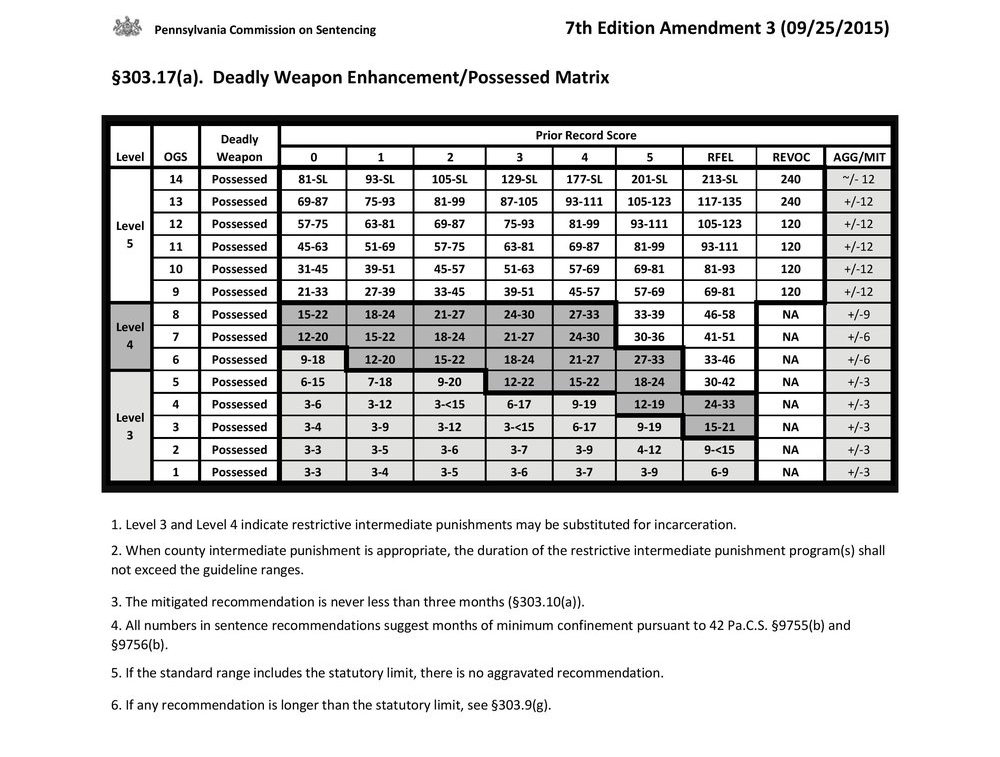

The Superior Court holds that only the “Possessed” Matrix applies to Tavarez's Burglary Conviction.
Part of Tavarez's plea deal was to stipulate to a factual summary. After he filed his appeal, the Pennsylvania Superior Court reviewed the transcript and was limited to the facts that were on record. In Mr. Tavarez’s case, the record did not state that Mr. Tavarez used the firearm to commit the burglary. Further, in Pennsylvania, the crime of burglary ends once the felon breaks into the building because burglary is defined as breaking and entering a building or occupied structure with the intent to commit a crime therein. Therefore, the burglary is over once a defendant has entered a building even if the defendant goes on to commit other crimes once inside. Here, Tavarez admitted to using the firearm to rob the complainant after he had entered the residence. Consequently, the trial court was correct in applying the “Deadly Weapon Used” enhancement for the robbery and other offenses that he pleaded guilty to. However, because Mr. Talvarez had already completed the crime of burglary when he entered the complainant’s residence and did not use the firearm in the commission of the burglary, it was incorrect for the trial court to apply the “Deadly Weapon Used” enhancement for the burglary conviction. Because of this error by the trial court, the Superior Court remanded Mr. Talvarez’s case for resentencing.
Call the Award-Winning Criminal Defense Lawyers of Goldstein Mehta LLC if You Are Charged With a Criminal Offense

Philadelphia Criminal Defense Lawyers
As shown by Tavarez, the details in a case matter. If you are charged with any offense or under investigation by the authorities, you need a defense attorney who pays attention to the details that will make or break your case. Our award-winning Philadelphia criminal defense lawyers have successfully fought countless cases at trial and on appeal. We offer a 15-minute criminal defense strategy session to any potential client. Call 267-225-2545 to discuss your case with an experienced and understanding criminal defense attorney today.

PA Superior Court Finds Sexually Violent Predator Classification Unconstitutional
In Commonwealth v. Butler, the PA Superior Court found that the procedure used for classifying a defendant as a Sexually Violent Predator is unconstitutional.
More Changes for Pennsylvania's Unconstitutional Megan's Law Statute
The Pennsylvania Superior Court has just decided the case of Commonwealth v. Butler, finding that Pennsylvania's system of classifying certain sex offenders as Sexually Violent Predators is unconstitutional. The Court held that that 42 Pa C.S.A. § 9799.24(e)(3), the section of the Sexual Offender Registration and Notification Act (“SORNA) that deals with designating an individual as a Sexually Violent Predators (“SVP”), is unconstitutional. This decision could impact thousands of individuals throughout Pennsylvania. Further, this is yet another case where an appellate court has found a section of the SORNA statute unconstitutional. If you are charged with a SORNA offense, it is imperative that you contact an attorney who is familiar with this rapidly evolving area of law.
Commonwealth v. Butler
In Butler, the defendant was a 21-year-old man who repeatedly engaged in sexual intercourse with a 15-year-old girl. In September of 2014, Butler was charged with statutory sexual assault, criminal use of a communication facility, manufacturing child pornography, and corruption of minors. In July of 2016, he pleaded guilty to statutory sexual assault and corruption of minors. As a result of pleading guilty to corruption of minors, Pennsylvania law required that he undergo an assessment by the Sexual Offender Assessment Board (“SOAB”) to determine whether or not he fit the classification as an SVP. § 9799.24(a) of SORNA requires that every defendant who is convicted of a sex offense undergo the SOAB evaluation before sentencing for a SORNA offense. The SOAB concluded that Butler was a Sexually Violent Predator, leading to a hearing before the trial judge on the issue. After the SVP hearing, the trial judge found that the Commonwealth met its burden, and the judge classified Butler as a Sexually Violent Predator. Butler also received a sentence of 12 to 30 months of incarceration and 90 months of probation. He appealed.
How Does Someone Get Labeled AN SVP?
As stated above, after a conviction for a SORNA offense an individual must be assessed the SOAB to determine whether they meet the classification as an SVP. According to § 9799.12 of the SORNA, an individual who is an SVP is a person with “a mental abnormality or personality disorder that makes the individual likely to engage in predatory sexually violent offenses.” In making its assessment, the SOAB will look at 15 factors to determine whether someone meets the classification as an SVP. § 9799.24 lists factors that the SOAB will consider including: the specific facts of the underlying case, the age of the defendant, the age of the complainant, the prior criminal record of the defendant, drug use, whether the defendant has any mental health illnesses.
If the SOAB makes its determination that an individual meets the requirements for SVP classification, the District Attorney must then file a praecipe to have a hearing before a judge to determine whether or not the defendant should be labeled an SVP. Notably, the Commonwealth must meet this burden by clear and convincing evidence. This is a lesser standard than the beyond a reasonable doubt standard which is required to convict someone of a criminal offense. Further, a defendant does not have the right to have a jury determine whether the defendant is an SVP.
At the SVP hearing, the Commonwealth will present its case as to why the court should find the defendant an SVP. Typically, this involves testimony from the SOAB evaluator who assessed the defendant. The defendant would have the opportunity to cross-examine any witnesses the Commonwealth presents, and the defendant may also present evidence as to why he or she does not meet the characteristics of an SVP. For example, a defendant may call an expert witness to testify that based on an independent assessment of the relevant facts, it is their expert opinion that the defendant is not an SVP. After all the evidence is presented, the statute permits the judge to make a determination, using the clear and convincing evidence standard, as to whether or not the Commonwealth proved that the defendant is a Sexually Violent Predator.
It is important to note that the SVP procedure can result in even defendants who were convicted of relatively minor sex offenses like misdemeanor Indecent Assault being labeled as SVPs. In most cases, Indecent Assault results in a defendant being required to register as a Tier I Sex Offender. Tier I Sex Offenders face the fewest restrictions in terms of registration requirements and only have to register for fifteen years. However, the SVP procedure can result in someone who would normally be a Tier I Sex Offender being required to register for life subject to the most severe restrictions as a Sexually Violent Predator.
What Are the Consequences of Being Labeled an SVP?
If a court finds that an individual is an SVP, there are several consequences. First, the defendant must register for life. Further, the victim of the underlying offense must be notified of where the defendant lives and works; the community also receives notification about where the individual lives, works, eats, attends school, spends his or her leisurely time; and the person is subjected to lifetime counseling. As such, this designation carries serious collateral consequences beyond just a period of incarceration or probation.
For a considerable period of time, Pennsylvania courts held that these registration requirements were civil, rather than punitive in nature. However, this all changed with the Pennsylvania Supreme Court’s landmark decision in Commonwealth v. Muniz, 164 A.3d 1189 (Pa. 2017).
The Pennsylvania Superior Court Finds § 9799.24 Unconstitutional
In Muniz, the Pennsylvania Supreme Court held that the SORNA registration requirements were punitive and not civil. This is significant because the United States Supreme Court in Alleyne v. United States held that any fact that increases the mandatory minimum for a sentence must be proven beyond a reasonable doubt. In other words, the state must prove every element of the offense (including facts that increase a sentence) beyond a reasonable doubt.
In Butler, had there been no SVP hearing, appellant would have had to register for 15 years. However, because he was classified as an SVP, he had to register for life. Thus, the Butler Court held that this punishment was illegal because the court did not make its determination based on the beyond a reasonable doubt standard and because the statute allows the judge to make the determination instead of giving the defendant the right to a jury.
The Pennsylvania Superior Court did not limit its ruling to Butler's specific case. Instead, it halted all future SVP hearings. The Court reasoned that because § 9799.24 is inherently flawed, trial courts are no longer allowed to hold SVP hearings until the General Assembly revises the statute to make it compliant with both the Pennsylvania and United States Constitutions.
Award-Winning Philadelphia Criminal Defense Lawyers for Sex Crimes and SORNA Offenses

Philadelphia Criminal Defense Lawyers
SORNA cases can be very complicated, and there is no question that the consequences are dramatic. If you are charged with a SORNA offense, you need an attorney who has the knowledge and expertise to defend your case. Likewise, if you are improperly classified under the SORNA statute, you need an attorney who can help you fix your registration tier. It is not clear whether the Commonwealth will appeal the decision in Butler or whether defendants who have already been classified as SVPs will be required to file a PCRA Petition within sixty days of the decision. Thus, it is important to act quickly in order to avoid waiving any rights to re-classification. Our award-winning Philadelphia criminal defense lawyers have successfully fought countless cases at trial and on appeal. We offer a free 15-minute criminal defense strategy session to any potential client who is under investigation or facing active criminal charges, and we offer a $100 Megan's Law/SORNA consultation on whether we may be able to help you change your registration tier. Call 267-225-2545 to discuss your case with an experienced and understanding criminal defense attorney today.

PA Superior Court: Child Porn Convictions Arising Out of Same Case Do Not Trigger Lifetime Megan’s Law Registration
The Pennsylvania Superior Court has just decided the case of Commonwealth v. Leonard. In Leonard, the Court found that the trial court erred when it required the defendant to register as a Tier III, lifetime Megan’s Law offender after the defendant pleaded guilty to multiple counts of distribution of child pornography, possession of child pornography, and criminal use of a communication facility. Because distribution of child pornography, which was the most serious charge in terms of SORNA registration, is only a Tier II offense, the trial court should have required the defendant to register as a Tier II offender for 25 years.
In Leonard, the defendant pleaded guilty to various counts of distributing and possessing child pornography as well as criminal use of a communications facility (“CUCF”). At sentencing, the defense attorney argued that the defendant should be treated as a Tier II sex offender because all of the convictions arose from the same criminal episode and the defendant was convicted of all offenses on the same date. The court ruled that defendant would be sentenced as a Tier III, lifetime offender under the SORNA provision which finds that if the defendant “has two or more convictions of offenses listed as Tier I or Tier II sexual offenses,” the defendant becomes a Tier III offender and must register for life. The court did allow the defendant to preserve the issue for appeal.
The defendant was sentenced and filed a notice of appeal. While the appeal was pending, the Pennsylvania Supreme Court decided the case of A.S. v. Pennsylvania State Police, holding that the previously mentioned language dealing with multiple convictions requires separate convictions. Thus, in A.S. (and the companion case of Commonwealth v. Lutz-Morrison), the Supreme Court held that a defendant who had been convicted of multiple counts of Tier I possession of child pornography at the same time must only register for fifteen years as a Tier I offender.
In Leonard, the Superior Court held that the same rule applies for when multiple Tier II and Tier I offenses are combined as part of the same case and are part of an ongoing course of conduct. Therefore, the Court remanded the case for re-sentencing with an order that the trial court require the defendant to register only as a Tier II offender. The Court rejected the prosecution’s argument that the defendant improperly challenged his registration by filing a notice of appeal directly to the Pennsylvania Superior Court. The prosecution argued that the defendant should have challenged his registration classification by filing suit against the Pennsylvania State Police in the Commonwealth Court as the Commonwealth Court has jurisdiction over lawsuits against state agencies. The Superior Court rejected this argument, finding that because the defendant was still in the process of serving his sentence and had filed a timely direct appeal, the Superior Court could review the issue of whether the trial court had imposed a legal sentence. Accordingly, the Superior Court remanded the case so that the trial court could re-sentence the defendant as a Tier II offender.
AWARD-WINNING Philadelphia Criminal Defense Attorneys

Philadelphia Sex Crimes Defense Lawyers
If you are facing criminal charges or believe you may have been improperly required to register under Megan’s Law, we can help. We offer a free criminal defense strategy session to any potential client who is under investigation or facing active criminal charges. We also offer a $100 Megan's Law consultation if you believe that you may be improperly classified under SORNA. Call 267-225-2545 to speak with one of our award-winning Philadelphia Criminal Defense Lawyers.