

Philadelphia Criminal Defense Blog

PA Supreme Court: Defendant Has Right To Introduce Evidence That Someone Else Did It
The Pennsylvania Supreme Court has decided the case of Commonwealth v. Gill, holding that the Superior Court erred when it reversed the trial court’s ruling that permitted the defendant to introduce evidence of other burglaries in an attempt to show that someone else had committed the burglary in this case.

Philadelphia Criminal Defense Lawyer Zak T. Goldstein, Esquire
The Pennsylvania Supreme Court has decided the case of Commonwealth v. Gill, holding that the Superior Court erred when it reversed the trial court’s ruling that permitted the defendant to introduce evidence of other burglaries in an attempt to show that someone else had committed the burglary in this case. This is an important decision both because it re-affirms that a defendant has the right to try to prove that someone else could have committed the crime charged and because it limits the Superior Court’s ability to reverse an evidentiary decision of the trial court permitting a defendant to introduce that evidence.
The Facts of Gill
In 2013, a Pennsylvania State Police Trooper was assigned to investigate an alleged burglary that had recently occurred at a residence owned by the complainant in French Creek Township, Pennsylvania. The complainant reported to the trooper that someone had stolen $40,000 in $100 bills from a bag inside of a lockbox in his basement. He also stated that the money was still in the lockbox on July 26, 2013, when he placed his monthly deposit into the bag.
The complainant stated that he did not observe any signs of a forced entry into the home and that he suspected that the person who had stolen the money entered his home by way of the keypad on his garage door. According to the complainant, there were only two people who knew the code and where he kept his money: the defendant and his neighbor. He did not suspect the neighbor because he had known her for over 25 years and trusted her. He stated that he suspected the defendant because he had only known him for a few years and that the defendant was having financial problems, including a recent bankruptcy.
The trooper subsequently interviewed the defendant. The defendant confirmed that he knew about the complainant’s money, where the money was kept, and where the complainant stored the key to his lockbox. The trooper also learned that the defendant recently bought a truck and paid for the truck in $100 bills. The trooper then filed a criminal complainant charging the defendant with burglary, theft by unlawful taking, receiving stolen property and criminal trespass.
The defendant subsequently filed a document entitled “Motion for Release of Investigatory Files/Omnibus Pretrial Motion.” In the motion, the defendant averred that he became aware that the complainant accused another unknown person of burglarizing his home, on two separate occasions, and stealing money from a safe located in his home between May 1, 2016 and June 23, 2016. The trial court granted the defendant’s motion to allow him access the State Police’s investigatory file concerning the 2016 incident. Based on this review, the defendant subsequently filed a Motion in Limine asking the trial court to allow the admission of this evidence at trial to show that someone else could have committed the burglary.
According to the defendant’s motion, the allegations against him and the subsequent allegations made by the complainant were almost identical. Specifically, both allegations alleged that approximately $40,000 was stolen, the money was stolen from a lockbox, one of the incidents did not show signs of forced entry, and the perpetrator had knowledge about the safe/lockbox. The defendant argued that he should be allowed to introduce this evidence at his trial. Additionally, he filed another Motion in Limine to introduce the testimony of the complainant’s daughter. Per the defendant, she would testify that the complainant previously accused her of breaking into his home and stealing $30,000. Additionally, she would testify that the complainant previously accused two other individuals of breaking into his home and stealing tools. The defendant wanted to introduce this testimony to show that the complainant has a penchant for accusing people of burglary and that someone else may have committed this crime.
The trial court held a hearing on the motions. At the conclusion of the hearing, the court granted his motion in part and denied it in part. The court permitted the defendant from presenting evidence of the subsequent 2016 burglaries but denied his motion to allow the complainant’s daughter to testify. In the same order, the court directed the Commonwealth to provide all reports, statements, and investigatory files regarding the 2016 incident. The Commonwealth then filed an interlocutory appeal to the Superior Court.
In a published opinion, the Superior Court granted the Commonwealth’s appeal and issued an order barring the defendant from introducing the evidence of the other burglaries at trial. In its appeal, the Pennsylvania Superior Court held that the 2013 and 2016 burglaries were not “so similar, distinctive, or unusual as to suggest that they are the handiwork of one individual.” The Superior Court stated that “the fact the burglaries involved the same residence, and the victim reported to have similar amounts stolen in the 2013 and…2016[] burglaries” were insufficient factors to conclude that both burglaries were done by the same individual. The defendant then appealed to the Pennsylvania Supreme Court.
Can I present evidence that someone else did the crime?
Maybe. Attorneys are always permitted to try to present evidence at trial, but the evidence must be admissible under the rules of evidence. The rules of evidence can be very restrictive, but usually these rules are to the defendant’s advantage. Why? Because it is the Commonwealth’s burden to provide enough evidence to convict a defendant beyond a reasonable doubt, so it is usually the Commonwealth that is presenting the majority of the evidence and struggling to get that evidence admitted. The defense often does not present any evidence at all.
One well-known example of a rule of evidence that often benefits the defense is the rule against hearsay. The rules of evidence prohibit the use of hearsay in a criminal trial, and this is usually to the defendant’s advantage because it forces the Commonwealth to bring the actual witnesses of an alleged crime to court rather than relying on a police officer who would merely testify to what these witnesses told him. However, as shown in Gill, the defense can also be hamstrung by the rules of evidence. In Gill, the defense attorney was prohibited by the Superior Court from calling the complainant’s daughter to testify because of an evidentiary ruling made by the trial court.

Nonetheless, the defendant’s attorney was successful in convincing the trial court to permit him to introduce evidence from the other burglary. This allowed him to show not only that someone other than the defendant may have committed these crimes, but also that there are issues with the complainant’s credibility and memory (the complainant appeared to have quite the bad luck by getting burglarized and having $40,000 repeatedly stolen from him). More importantly, however, the defendant was now able to show that other people have burglarized his home using the keypad. Thus, because the complainant’s home continued to be burglarized in this highly specific way (when presumably the defendant could show that he did not commit these subsequent burglaries) then this would be evidence that the defendant did not commit the 2013 burglary.
It may go without saying, but the facts in Gill are unique. Nonetheless, there are other ways to introduce evidence that someone else committed a crime. For example, let’s assume that you are stopped in a car and the police then search the car and find drugs. Let’s also assume that you are not the only occupant of the vehicle and one of the people in the car has a prior conviction for possessing a controlled substance. If you are charged with possessing those drugs, you can file what is called a Thompson motion. This motion would allow you to bring the passenger’s prior convictions for possession and would give you additional support that those drugs did not belong to you. If you are arrested and charged with any type of crime, you need an experienced attorney who knows the rules of evidence so that you can be properly defend your case.
Ultimately, all evidence must be relevant in order to be admissible. If evidence is not relevant, then a trial court may properly exclude the admission of the evidence. In this case, the issue was simply whether the defendant’s proffered evidence of the subsequent burglaries would be relevant to show whether or not he had committed the crime. In making that determination, the court had to look at how similar the burglaries were in order to determine whether they would be exculpatory for the defendant. The trial court concluded that they were sufficiently similar to suggest that the defendant may not have committed the first burglary. The Superior Court, however, disagreed.
The PA Supreme Court’s Decision
The Pennsylvania Supreme Court found that the Superior Court erred when it overturned the trial court’s decision to allow the defendant to introduce evidence from the subsequent burglary. The Supreme Court found that the Superior Court improperly conducted its own review of whether it thought that the evidence would be relevant instead of applying the correct “abuse of discretion” standard and evaluating whether the trial judge’s reasoning was properly based in law. What this standard means is that the Superior Court should not make its own ruling. Instead, if the trial court’s decision is arguably correct, then the Court should affirm the decision even if different judges could reasonably degree. The Supreme Court noted that it is “improper for an appellate court to step into the shoes of the trial judge and review the evidence de novo.” The Supreme Court also criticized the Superior Court for its evaluation of the evidence. The Supreme Court found that the Superior Court substituted its judgment for that of the trial court which is not permissible. Finally, the Supreme Court found that the trial court did not abuse its discretion when it granted the defendant’s motion and thus the trial court’s ruling will stand.
Facing Criminal Charges? We Can Help.

If you are facing criminal charges or under investigation by the police, we can help. We have successfully defended thousands of clients against criminal charges in courts throughout Pennsylvania and New Jersey. We have successfully obtained full acquittals and successful outcomes in cases involving charges such as Possession with the Intent to Deliver, Violations of the Uniform Firearms Act, Aggravated Assault, Rape, and Murder. Our award-winning Philadelphia criminal defense lawyers offer a free criminal defense strategy session to any potential client. Call 267-225-2545 to speak with an experienced and understanding defense attorney today.

PA Superior Court Finds Speculation Insufficient to Prove Mens Rea at Preliminary Hearing
The Pennsylvania Superior Court has decided the case of Commonwealth v. Wyatt, holding that the trial court properly dismissed involuntary manslaughter, homicide by vehicle, and related charges stemming from a fatal motor vehicle accident where the Commonwealth was able to show only that the defendant caused the accident without explaining how or why.
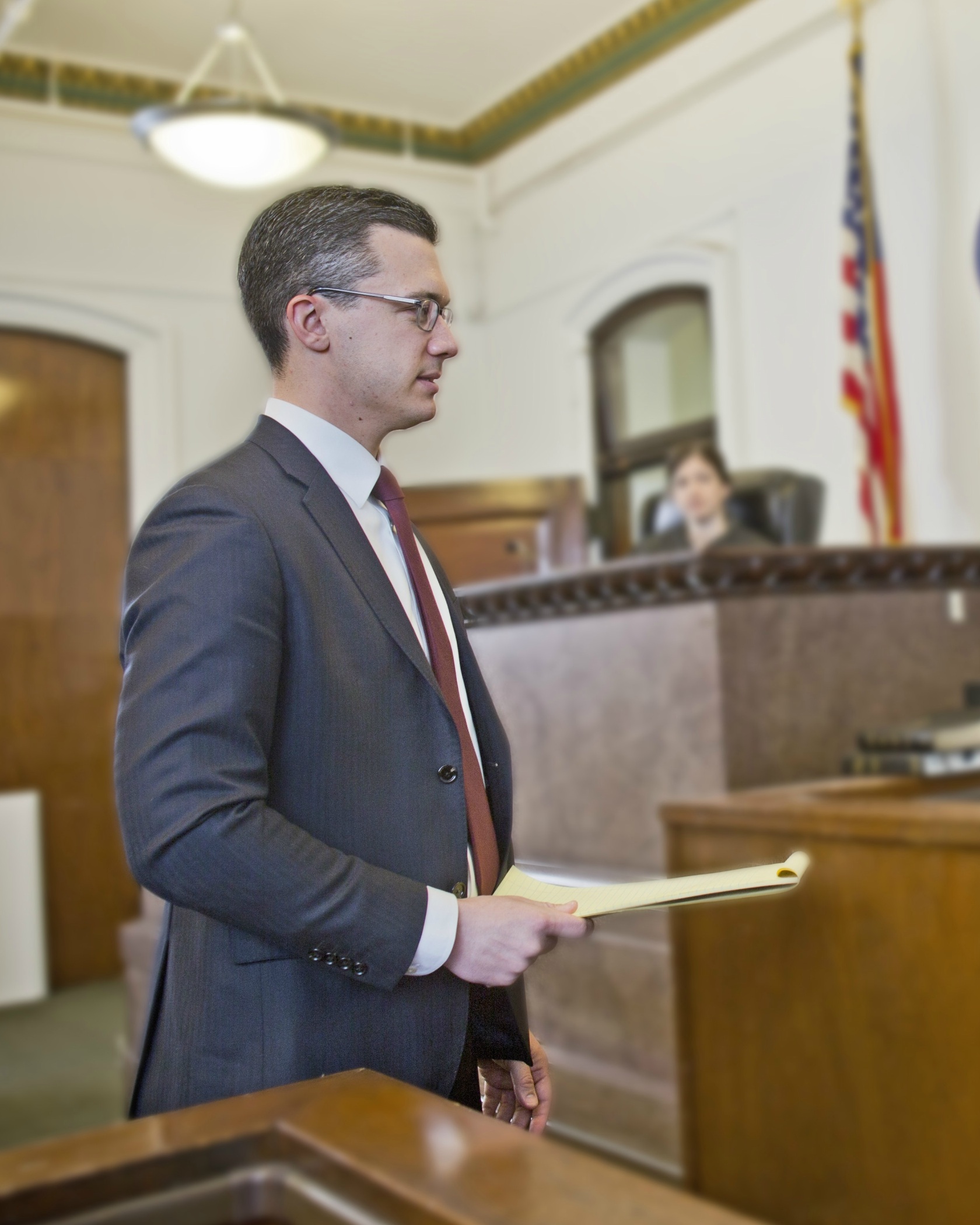
Criminal Defense Lawyer Zak Goldstein
The Pennsylvania Superior Court has decided the case of Commonwealth v. Wyatt, holding that the trial court properly dismissed involuntary manslaughter, homicide by vehicle, and related charges stemming from a fatal motor vehicle accident where the Commonwealth was able to show only that the defendant caused the accident without explaining how or why. The Superior Court held that the Monroe County Court of Common Pleas correctly granted the defendant’s Petition for Writ of Habeas Corpus (also known as a Motion to Quash in Philadelphia) because the Commonwealth failed to establish a prima facie case of the requisite mens rea. This is an excellent case which illustrates that the preliminary hearing is not a mere formality and that the Commonwealth must prove each element of an offense by a preponderance of the evidence. This includes a showing that the defendant acted with criminal intent where required by statute. It is not enough for the Commonwealth to simply prove that something bad happened and that the defendant was involved.
The Facts of Wyatt
In Wyatt, the defendant was driving a tractor-trailer southbound on Interstate 380. At around 10 am, the defendant’s truck crossed the median separating the north- and southbound lanes and crashed into oncoming traffic, causing the deaths of three people and serious injuries to five other people. The Commonwealth eventually charged the defendant with aggravated assault by vehicle, homicide by vehicle, involuntary manslaughter, recklessly endangering another person, and other motor vehicle code violations. The defendant waived his preliminary hearing, but he filed a petition for writ of habeas corpus when the case reached the Court of Common Pleas.
What is a petition for writ of habeas corpus?
The petition for writ of habeas corpus is the mechanism by which a defendant may ask the trial court to dismiss the charges prior to trial. It is essentially a motion to dismiss which asks the Court of Common Pleas judge to review the notes of testimony from the preliminary hearing and determine that the magisterial district justice in the counties or Municipal Court judge in Philadelphia improperly held the defendant for court on some or all of the charges. The Commonwealth may respond by introducing additional evidence at the hearing on the motion, but most motions rely primarily on the notes of testimony from the preliminary hearing.
In some cases, the petition for writ of habeas corpus results in the preliminary hearing taking place in the Court of Common Pleas instead of at the magisterial district justice level. In Philadelphia, it is unusual to waive the preliminary hearing. Outside of Philadelphia, however, it is not unusual in a serious case to waive the preliminary hearing at the magisterial district court and then litigate a petition for writ of habeas corpus in the Court of Common Pleas. Where the parties have agreed that the defendant may file a petition for writ of habeas corpus after a waiver of the preliminary hearing, the Court of Common Pleas judge will then essentially conduct a preliminary hearing, and the defense may ask the judge to dismiss the charges. That is what happened in this case.
In Philadelphia, the petition for writ of habeas corpus is more commonly called a Motion to Quash. It is essentially the appeal of the Municipal Court Judge’s ruling that the District Attorney’s Office met its burden at the preliminary hearing. The defendant may not argue at a hearing on a Motion to Quash or Habeas Petition that the witnesses were lying, but the defense may argue that the evidence was insufficient and that charges should be dismissed.
The habeas hearing
At the hearing on the habeas motion, the Commonwealth called the affiant, a Pennsylvania State Police Trooper. The Commonwealth proceeded under a theory that the defendant had acted recklessly in crossing into the wrong lane of traffic and causing the accident. Under Pennsylvania law, the Commonwealth cannot prove the mens rea of recklessness solely by showing that an accident occurred and the defendant may have been to blame. Instead, a person acts recklessly with respect to a material element of an offense when he consciously disregards a substantial and unjustifiable risk that the material element exists or will result from his conduct. The risk must be of such a nature and degree that, considering the nature and intent of the actor’s conduct and the circumstances known to him, its disregard involves a gross deviation from the standard of conduct that a reasonable person would observe in the actor’s situation.
The majority of the charges in this case such as homicide by vehicle and involuntary manslaughter required the Commonwealth to prove that the defendant at least acted recklessly. At the hearing on the motion, the Commonwealth argued that the defendant must have acted recklessly because the investigators were able to rule out most potential causes of the accident. For example, the trooper testified that the weather was fine and there was no evidence of a mechanical failure. The trooper also testified that the defendant had potentially received but not responded to text messages and that he had unrestrained dogs in the cabin of the truck. Other evidence showed that the defendant was not speeding, had not been driving erratically, and that he did not have any medical incidents and was not eating food or drinking at the time. The scene also did not reveal braking or skid-marks.
Accordingly, the Commonwealth argued that the lack of bad weather and mechanical failures, combined with the fact that the defendant had two dogs in the cabin, crossed into the other lane of traffic, and had potentially received text messages, circumstantially gave rise to an inference that the defendant must have acted recklessly. Without any concrete explanation as to why the defendant crossed into the wrong lane, the trial court found that prosecutors were merely guessing at the defendant’s intent and that they had failed to prove that the defendant acted recklessly - meaning they could not prove that he consciously disregarded a known risk.
The Superior Court Appeal
The Commonwealth appealed the dismissal of the charges to the Pennsylvania Superior Court. The Superior Court affirmed the dismissal of the charges on appeal. The court found that neither negligence nor the mere occurrence of an accident, even a fatal accident, without more, is sufficient to prove recklessness even at the preliminary hearing or habeas petition level. There was simply no evidence as to what caused the accident. The Commonwealth proved only that the defendant caused a tragic accident by crossing into the wrong lane of traffic; it completely failed to prove what caused him to do that. Therefore, the Commonwealth was unable to meet its burden of proving that the defendant did it with recklessness or any other level of criminal intent. Accordingly, the Superior Court affirmed the dismissal of the charges.
Does the Commonwealth have to prove a mens rea at the preliminary hearing?
There is often a rush to prosecute someone who may have caused a fatal accident solely because of the headlines and other media attention that this type of accident may receive. This case, fortunately, shows that automobile accidents generally do not give rise to criminal charges where the Commonwealth cannot show that something more than a true accident occurred. Crimes require both that the defendant did something and usually that the defendant acted with criminal intent, and this requirement applies both at the trial level and at a preliminary hearing. This case re-establishes that accidents are not always criminal and that the Commonwealth must provide some evidence of each element of an offense even with the reduced burden it must meet at the preliminary hearing or habeas hearing. It also illustrates the importance of speaking with an attorney prior to giving a statement to law enforcement. In this case, the defendant did not say anything to police that could have later been used against him. Had he admitted to texting, not paying attention, or driving while tired, the outcome of the case could have been very different.
Facing criminal charges? We can help.

Criminal Defense Lawyers Demetra Mehta and Zak Goldstein
If you are facing criminal charges or under investigation by the police, we can help. We have successfully defended thousands of clients against criminal charges in courts throughout Pennsylvania and New Jersey. In just the past few months, we have won motions to suppress in cases involving drug possession, gun possession, and Driving Under the Influence (“DUI”). We have also successfully obtained full acquittals, dismissals, and other successful results in cases involving charges such as Conspiracy, Possession with the Intent to Deliver, Aggravated Assault, Rape, and Homicide. Our award-winning Philadelphia criminal defense lawyers offer a free criminal defense strategy session to any potential client. Call 267-225-2545 to speak with an experienced and understanding defense attorney today.

PA Supreme Court: Concerns About Officer Safety Do Not Justify Suspicionless Seizure of Motorist
In the recent case of Commonwealth v. Adams, the Pennsylvania Supreme Court reiterated once again that police cannot conduct a stop without reasonable suspicion, and a stop occurs when a reasonable person would not feel free to leave due to some action taken by the officer.

Philadelphia Criminal Defense Lawyer Zak T. Goldstein, Esq.
It should go without saying that the police cannot stop, search, and interrogate people without a warrant or some prior observation of potential ongoing criminal activity. Nonetheless, trial and appellate courts throughout the state state of Pennsylvania often attempt to justify coercive police detentions which occurred without reasonable suspicion or probable cause by finding that the police did not actually “stop” the defendant for Fourth Amendment purposes.
If the court can find that the police conducted a mere encounter and had to take some common sense steps to ensure officer safety, the court may try to justify a decision denying a motion to suppress. Unfortunately, many of these opinions ignore the fact that when a police officer approaches a person and begins asking questions or issuing commands, that person would never reasonably feel free to terminate the encounter and leave without following the orders of the officer.
In the recent case of Commonwealth v. Adams, the Pennsylvania Supreme Court reiterated once again that police cannot conduct a stop without reasonable suspicion, and a stop occurs when a reasonable person would not feel free to leave due to some action taken by the officer. Further, there is no reasonable suspicion for a Terry stop when the suspect has done nothing more than park his or her car in a commercial parking lot late at night despite the fact that it may be a little bit unusual to park there. Instead, police must have specific, articulable facts from which they can conclude that criminal activity may be afoot, and those facts must be based on more than mere speculation. Only then may police conduct a stop and potentially take actions related to officer safety such as frisking the defendant or limiting the defendant’s freedom of movement in some way.
Commonwealth v. Adams
In the case of Commonwealth v. Adams, a Pleasant Hills, PA police officer was on routine patrol at around 3 am. He observed a white Dodge Dart enter a parking lot that served two closed businesses - a hobby store and a pizza shop. The car drove behind the buildings. The officer waited to see if the car came back and left the lot, but it did not. The officer then drove behind the parking lot to locate the vehicle because he wanted to “simply check why a car drove behind two dark, closed businesses” at 3 am. He testified at a motion to suppress hearing that he recognized the potential for drug activity or an attempted burglary.
After driving behind the buildings, the officer saw the car parked behind the pizza shop. The car was off. There were no “no parking signs” behind the building, but there were also no marked parking spaces. The officer did not believe that this area would generally be used as public parking. Instead, he believed that it could be an area for deliveries and employee parking.
Despite having seen nothing more than a car parking in a parking lot early in the morning, the officer pulled his marked police cruiser behind the car. He did not activate his lights or sirens, but he did call for backup. Prior to backup arriving, he exited his police car and walked up to the parked vehicle. He shined his flashlight into the vehicle as he approached. When he reached the driver’s side door, he knocked on the window. The defendant, who was seated in the driver’s seat, opened the car door. The officer physically closed the car door himself, preventing the defendant from getting out of the car. He instructed the defendant to lower the window, and the defendant explained that he could not do so because he did not have the keys to the car. The officer, however, could see the keys on the floor in the back of the car. The officer then remained outside of the car until backup arrived, which was approximately a minute later.
Once backup arrived, the officer opened the defendant’s door and began to speak with him. The defendant told him that he owned the pizza shop and had just come from inside. Obviously, this was not true. The officer smelled alcohol on the defendant’s breath and asked the defendant to perform field sobriety tests. The defendant complied and “failed.” From there, things deteriorated until the defendant was eventually formally arrested and charged with DUI.
The Motion to Suppress
Following the filing of DUI charges against him, the defendant filed a motion to suppress. He argued that the police officer violated his Fourth Amendment rights by stopping him without reasonable suspicion or probable cause. The trial court heard the motion to suppress and denied it, finding that the interaction between the defendant and the officer was only a mere encounter which did not require any level of suspicion. The court found that the officer was justified in preventing the defendant from opening the door by concerns about officer safety because the officer was alone, it was late at night, and the defendant was physically bigger than the officer. With the motion to suppress denied, the court found the defendant guilty at a bench trial of DUI and sentenced him to six months of probation.
The defendant appealed to the Pennsylvania Superior Court, and the Superior Court affirmed the denial of the motion to suppress. The Court agreed with the trial court, essentially finding that the police officer conducted only a mere encounter with the defendant and that even if it was a Terry stop, the officer had reasonable suspicion based on the defendant’s behavior and statements. The defendant filed a Petition for Allowance of Appeal to the Pennsylvania Supreme Court, and the Supreme Court agreed to accept the case.
What is a Petition for Allowance of Appeal?
The Pennsylvania Supreme Court does not hear most cases. When a defendant is convicted and wishes to appeal, the defendant’s appeal is generally to the Pennsylvania Superior Court. The Superior Court is required to consider all timely-filed appeals and address issues which were not waived in the trial court. If the Superior Court denies the appeal, then the defendant may then file a Petition for Allowance of Appeal to the Pennsylvania Supreme Court. Unlike Superior Court, the Supreme Court does not have to hear every case. Instead, the court chooses a limited number of cases in which it feels that there is an important or novel issue of law in question or where it believes the Superior Court has made a significant error. Thus, when a defendant loses in the Superior Court, the defendant may file a Petition for Allowance of Appeal to the Pennsylvania Supreme Court asking that court to review the ruling of the Superior Court. Most of these Petitions are denied, but in this case, the Pennsylvania Supreme Court agreed to accept the appeal.
The Court’s Ruling
The Pennsylvania Supreme Court found that both the trial court and Superior Court erred in finding that the police officer did not “stop” the defendant for Fourth Amendment purposes and that the officer had reasonable suspicion to conduct a stop. First, the Court explained the standards for the three types of encounters between police officers and members of the public. The lowest level of interaction is a mere encounter. A mere encounter does not require a warrant or any level of suspicion, and police may simply walk up to any person and try to talk to them. The police may not do anything to restrict the person’s freedom of movement or require compliance during a mere encounter, but nothing stops an officer from trying to talk to someone.
The second level of interaction is an investigative detention or Terry stop. This type of encounter is something less than an arrest, but it allows police to investigate potential criminal activity. A Terry stop occurs when the police do something to indicate that the person would not be free to leave. For example, telling someone to stop, frisking them, or restricting their freedom of movement could result in a Terry stop. A Terry stop must be relatively brief or it could turn into a full blown arrest and require probable cause. During a Terry stop, police may sometimes take precautions to ensure their own safety such as frisking a suspect or requiring the suspect to remain in his or her vehicle. However, police may not engage in a Terry stop or take these safety precautions unless they have reasonable suspicion for the stop. The reasonable suspicion standard requires police to show that they have specific, articulable facts which would indicate to a reasonable officer that criminal activity is afoot.
The most restrictive level of interaction is a custodial detention. A custodial detention is the functional equivalent of an arrest and must be supported by probable cause. A custodial detention also constitutes a seizure. A police encounter is more likely to be considered a custodial detention if it is prolonged, takes place at the police station, involves handcuffs, or if the police tell the suspect that he or she is under arrest.
In this case, the Pennsylvania Supreme Court ruled that the lower courts made a mistake in finding that the interaction between the officer and the defendant was only a mere encounter. Instead, the Court concluded that the defendant would not have felt free to leave, and in fact could not leave, when the officer parked behind him, exited his car, shined his flash light into the defendant’s car, and physically closed the defendant’s door when the defendant attempted to get out of the car. Thus, in addition to not feeling free to leave, the defendant physically could not leave because the officer prevented him from doing so.
Because the Court concluded that the officer conducted an investigative detention by seizing the defendant and preventing him from exiting the car, the subsequent observations of the officer would be admissible as evidence at trial only if the officer had reasonable suspicion to conclude that the defendant was engaged in criminal activity prior to the officer’s decision to shut the defendant’s car door. The Court concluded that there was no reasonable suspicion because the officer had seen the defendant do nothing more than park in a public parking lot. While it was slightly unusual that the defendant chose to park in an empty lot behind two buildings at 3 am, it was not necessarily criminal. There was no evidence in the record that the parking lot was closed to members of the public at that time, and so the officer was not justified in believing that the defendant was going to commit a crime such as engage in a drug transaction or commit a burglary. Therefore, the Court ruled that the lower courts should have granted the motion to suppress.
This decision is particularly important because the Court stressed the fact that not every police action can be justified by merely reciting the magic words “officer safety.” If the officer had reasonable suspicion for the stop, then the officer might have been justified in physically closing the door and restricting the defendant to his car. But the officer safety issue only comes into play after it has been determined that police have reasonable suspicion. Concerns about officer safety do not transform an otherwise illegal stop into a legal one. Thus, whether police may frisk a defendant or take other steps out of concerns for officer safety is a two-part test. First, the police must actually have reasonable suspicion. Second, they must reasonably believe that some action like a frisk or closing the car door is necessary for safety reasons. If they cannot satisfy both parts of this test, then the subsequently-obtained evidence should be suppressed as fruit of the poisonous tree. This is a great opinion for privacy rights because it establishes that police cannot just stop and detain people on a whim or a mere hunch. They must be able to point to actual evidence of criminal activity, and simply reciting the phrase officer safety does not transform a constitutional violation into a legitimate stop.
Facing Criminal Charges? We Can Help.

Criminal Defense Lawyers Zak Goldstein and Demetra Mehta
If you are facing criminal charges or under investigation by the police, we can help. We have successfully defended thousands of clients against criminal charges in courts throughout Pennsylvania and New Jersey. In just the past few months, we have won motions to suppress in cases involving drug possession, gun possession, and Driving Under the Influence (“DUI”). We have also successfully obtained full acquittals, dismissals, and other successful results in cases involving charges such as Conspiracy, Possession with the Intent to Deliver, Aggravated Assault, Rape, and Homicide. Our award-winning Philadelphia criminal defense lawyers offer a free criminal defense strategy session to any potential client. Call 267-225-2545 to speak with an experienced and understanding defense attorney today.

PA Superior Court Limits Collateral Estoppel Defense
The doctrine of collateral estoppel is a part of the Fifth Amendment’s guarantee against Double Jeopardy. It is important to note that the collateral estoppel clause does not automatically bar subsequent prosecution of a defendant. It only bars the re-litigation of a particular issue that has already been decided by a court. What this means is that if an issue of law, fact, or evidentiary ruling has already been decided by a prior court order, the issue cannot be re-litigated in a future lawsuit.

Zak Goldstein - Criminal Defense Lawyer
Pennsylvania law provides a potential defense to some criminal charges called collateral estoppel. Collateral estoppel may apply to bar a second trial in limited circumstances where the defendant has been acquitted of closely related charges in a first trial. The doctrine is somewhat limited in Pennsylvania because juries are not asked to provide an explanation for what they think happened; instead, jurors simply find a defendant guilty or not guilty of charges. The defense may then argue that a re-trial should be barred because a defendant has been acquitted of charges which required the same conduct with which the defendant is again charged in order for the jury to find the defendant guilty in a second trial.
The recent Pennsylvania Superior Court case of Commonwealth v. Winchester provides an example of this potential defense. In Commonwealth v. Winchester, the PA Superior Court found that the Commonwealth was not collaterally estopped from retrying a defendant for human trafficking charges after an acquittal for related robbery and theft charges because the human trafficking charges were significantly different from the related robbery and theft charges.
The Facts of Commonwealth v. Winchester
In Winchester, prosecutors alleged that the defendant contacted the complainant on backpage.com. The complainant offered sexual services through an advertisement on this website. The defendant then also contacted the complainant through text messages to set up an appointment. When the defendant arrived at the complainant’s apartment, he was let inside. The complainant was wearing a robe when she answered the door.
When the complainant went to take off her robe, the defendant pulled out a gun and pointed it at her face. The defendant then threatened her with a weapon, zip-tied her, and stole $2,700 from her. The defendant then told her that she could have her money back if she worked for him. The defendant then left her residence and told her he would return by 11:30. After he left, the complainant was able to free herself, and she called the police. The defendant then returned and was promptly arrested. When he was arrested, zip ties were found in his car matching those used to restrain the victim.
The Commonwealth filed a criminal information charging the defendant with robbery, theft by unlawful taking, terroristic threats, trafficking in individuals, and attempted involuntary servitude. At the trial, the complainant testified to the above-stated facts. The defendant also testified. He testified that he and the complainant had a prior relationship and that his communications with her, after finding her on the website, was an effort to confirm his own suspicion that the complainant was prostituting herself. The defendant testified that he called her a “whore,” which upset the complainant. This, arguably, was the reason why the complainant made up these allegations against him. The defendant denied binding her, robbing her, or telling her that he would “pimp” her out. He also testified that the zip ties in his car were related to his construction work.
Following the trial, the jury found the defendant not guilty of robbery, theft by unlawful taking, and terroristic threats. The jury did not reach a verdict on trafficking in individuals and attempted involuntary servitude. On June 5, 2017, the defendant filed a motion for dismissal, arguing that the Commonwealth intended to retry him on the charges of trafficking in individuals and attempted involuntary servitude, but the trial court should apply the doctrine of collateral estoppel and dismiss the remaining charges. A hearing was held on June 26, 2017. On August 14, 2017, the court issued an order granting the defendant’s dismissal motion. The Commonwealth then filed a timely appeal.
What is Collateral Estoppel?
The doctrine of collateral estoppel is a part of the Fifth Amendment’s guarantee against Double Jeopardy. It is important to note that the collateral estoppel clause does not automatically bar subsequent prosecution of a defendant. It only bars the re-litigation of a particular issue that has already been decided by a court. What this means is that if an issue of law, fact, or evidentiary ruling has already been decided by a prior court order, the issue cannot be re-litigated in a future lawsuit.
In Pennsylvania, courts will apply the collateral estoppel doctrine if the following threshold requirements were met: 1) the issues in the two actions are sufficiently similar and sufficiently material to justify invoking the doctrine; 2) the issue was actually litigated in the first action; and 3) a final judgment on the specific issue in question was issued in the first action. For collateral estoppel purposes, a final judgment includes any prior adjudication of an issue in another action that is sufficiently firm to be accorded conclusive effect. If the previous adjudication was based on a resolution of an issue in a manner favorable to the defendant with respect to a remaining charge, the Commonwealth is precluded from attempting to re-litigate that issue in an effort to resolve it in a contrary way at a future trial.
This sounds confusing, and it can be. To give a simple example of how collateral estoppel would prevent the Commonwealth from retrying a defendant, let’s assume that a defendant is charged with murder, aggravated assault, and simple assault. The facts of this hypothetical case are that a defendant beats a victim to death with his bare hands. Let’s further assume that after a trial, the jury is unable to reach a verdict on the murder charge, but finds the defendant not guilty of the simple assault charge. Because of the doctrine of collateral estoppel, the Commonwealth would be precluded from prosecuting the defendant on the murder charge because he was found not guilty of the simple assault charge. The reason is because the simple assault was a constituent element of the homicide charge. As such, there was already a finding that the defendant did not assault the victim and consequently the Commonwealth would be precluded from retrying the defendant on the homicide charge.
PA Superior Court Rejects Collateral Estoppel Defense Because of Differences in Statutes
Here, the Pennsylvania Superior Court overturned the trial court’s order granting the defendant’s motion to dismiss. The Superior Court concluded that the defendant’s acquittal of the robbery and theft charges did not negate the necessary elements to potentially convict him of the involuntary servitude or trafficking charges. In other words, a jury could believe that the defendant did not rob the complainant, but he did intend to force her into the sex trade. In making its decision, the Superior Court reviewed the trafficking and involuntary servitude statutes. Based on this review, the Superior Court held that the defendant’s acquittal of the robbery and theft charges did not preclude a subsequent prosecution of the trafficking and involuntary servitude offenses because robbing or stealing from her were not predicate elements of these respective charges. In other words, the defendant could have been trafficking her without robbing her or stealing from her. Therefore, the Commonwealth can retry the defendant on these remaining charges.
Facing Criminal Charges? We Can Help.
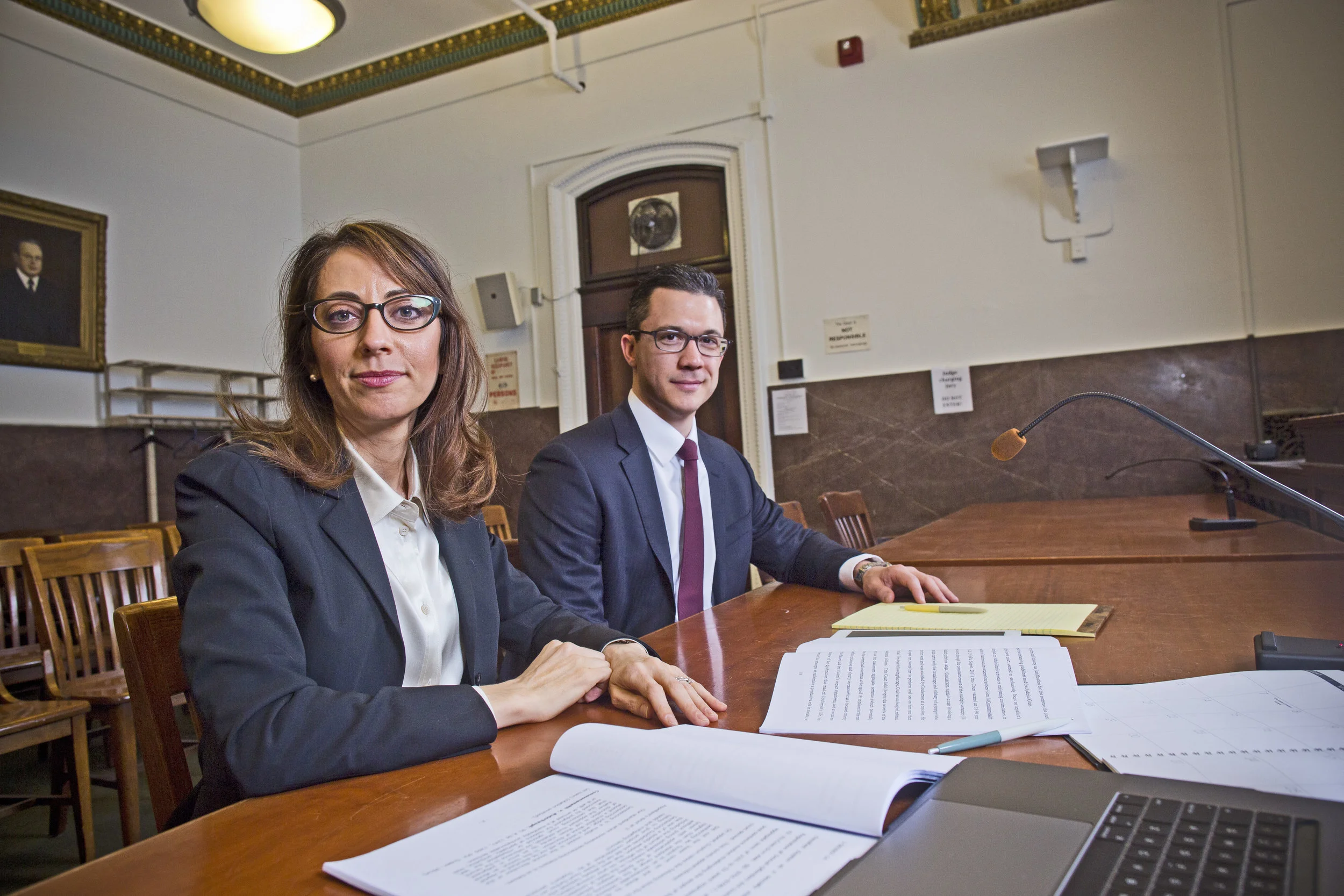
Goldstein Mehta LLC Criminal Defense Lawyers
If you are facing criminal charges or under investigation by the police, we can help. We have successfully defended thousands of clients against criminal charges in courts throughout Pennsylvania and New Jersey. We have successfully obtained full acquittals and dismissals in cases involving charges such as Conspiracy, Aggravated Assault, Rape, and Attempted Murder. Our award-winning Philadelphia criminal defense lawyers offer a free criminal defense strategy session to any potential client. Call 267-225-2545 to speak with an experienced and understanding defense attorney today.