

Philadelphia Criminal Defense Blog
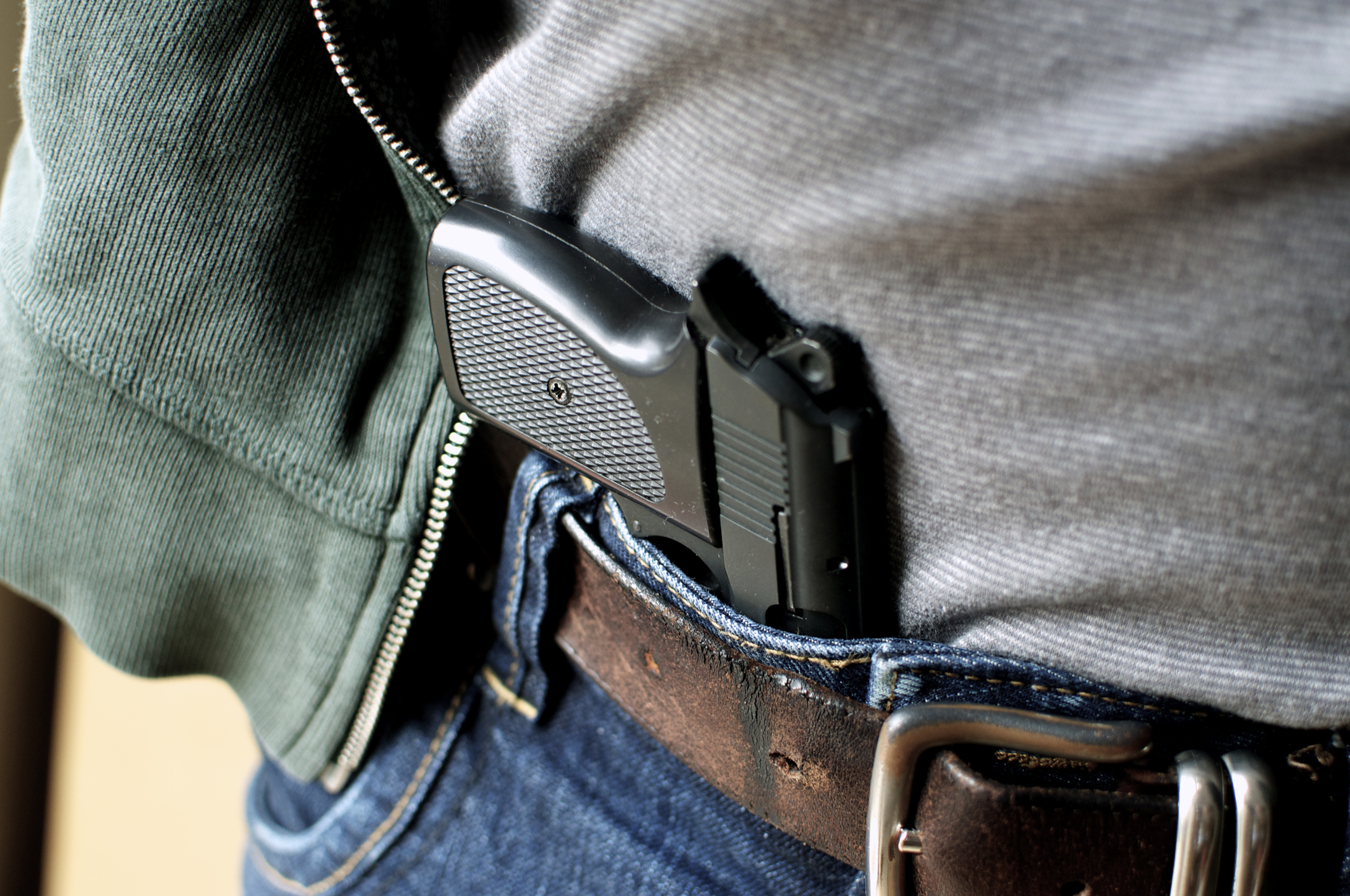
PA Superior Court: Even Partial Concealment of Firearm Requires Concealed Carry Permit

Criminal Defense Attorney Zak Goldstein
The Pennsylvania Superior Court has decided the case of Commonwealth v. Montgomery, finding that even partial concealment of a gun in a defendant's waistband establishes a prima facie case of a violation of VUFA 18 Pa.C.S. Sec. 6106 (firearms not to be carried without a license) for purposes of a preliminary hearing. Whether the defendant intended to conceal the firearm is likely an issue for trial, but the presence of the gun in the defendant's waistband, even though part of it was still visible, was enough to show concealment at a preliminary hearing. This is a bad case for the defense which makes it even easier for the Commonwealth to prove Violations of the Uniform Firearms Act.
The Facts of Commonwealth v. Montgomery
Montgomery was arrested and charged with various violations of the uniforms firearms act. This case focused on whether or not the evidence presented at his preliminary hearing was sufficient to show that he had concealed the firearm in violation of 18 Pa.C.S. Sec. 6106. The Commonwealth called only witness at the preliminary hearing - the Philadelphia Police Officer who had arrested the defendant. At the hearing, the officer testified that he drove by the defendant and saw him “messing with” what the officer believed to be “the handle of a gun in his waistband.” The officer also testified that he could not see the entire gun. He could only see the the handle.
The defendant then walked into a nearby store. The officer stopped his police car in front of the store and watched the defendant walk out of the store. The officer testified that the defendant saw him and then immediately walked back into the store. The officer exited his vehicle and went into the store. he stopped the defendant in the store, searched him, and did not find the gun. He did locate a gun several feet away on top of a rack of potatoes. The only other person in the store at the time was the cook, who was not very close to the gun.
The officer arrested the defendant and charged him with violations of § 6106 and 18 Pa.C.S. § 6018 (Carrying Firearms on Public Streets or Public Property in Philadelphia). At the preliminary hearing, the Philadelphia Municipal Court Judge dismissed the § 6106 charge because, according to the court, the Commonwealth did not establish at a prima facie level that the defendant concealed the gun.
The Commonwealth then re-filed the complaint (which it is allowed to do under Rule 544 of the Pennsylvania Rules of Criminal Procedure). In Philadelphia, re-filed criminal complaints are typically heard by a Common Pleas Judge who sits in Motions Court. That judge will review the transcript from the preliminary hearing and hear any new evidence or testimony which the Commonwealth wishes to present. That judge will then make a decision as to whether the charges should be held for court or whether the Municipal Court Judge correctly dismissed the charges. Notably, the Superior Court indicated in a footnote that this procedure is not technically correct as the re-filed complaint should be heard by the same Municipal Court Judge who dismissed the case. Alternatively, if the Commonwealth files a motion seeking a different judge for the second preliminary hearing, the case should be heard by a different Philadelphia Municipal Court judge. In this case, neither party objected to the usual procedure of the case being heard in the Court of Common Pleas, so the Superior Court did not do anything to disturb that procedural route. Nonetheless, it may be possible to object to this procedure in the future in order to keep a case in the Municipal Court. Nonetheless, the Commonwealth did not present any new evidence for the Court of Common Pleas Judge, and that judge also agreed that the Commonwealth failed to establish concealment of the firearm. The prosecution appealed to the Superior Court.
What is VUFA § 6106?
VUFA § 6106 basically makes it a crime to carry a concealed gun on your person or in a car without a concealed carry permit. There are some limited exceptions. The statute provides “[a]ny person who carries a firearm in any vehicle or any person who carries a firearm concealed on or about his person, except in the place of abode or fixed business, without a valid and lawfully issued license” commits a felony of the third degree. In other words, a person cannot have a gun without a valid license and conceal that gun or he or she will be in violation of § 6106.
As such, there are several elements to this charge. First, the defendant must have a gun. Second, the person must not have a valid license to possess the gun. Third, the person must not be in his home or fixed place of business. And finally, a defendant must conceal the gun.
When is a gun concealed?
According to the Pennsylvania Supreme Court, any concealment, including a partial concealment, is sufficient to establish the concealment element for § 6106. However, concealment is a fact-specific inquiry. For example, suppose someone is walking down the street in broad daylight with a pistol in his hand. This person is holding the gun up in his hand and tossing it up in the air. The police come and tell him to drop the gun and he puts the gun in his waistband. In this particular fact pattern, the defendant has probably not committed § 6106. Why? Because he made no attempt to conceal the gun. He made it very clear that he had a gun on his person.
Now let’s change the fact pattern. Let’s suppose that someone is walking down the street and he has a gun in his waistband. A concerned bystander then notifies a police officer that this person has a gun. When the police officer approaches this person, he immediately tells the officer that he has a gun and gives it to him. This person has probably committed § 6106 because even though he was honest with the officer and cooperated with him, the gun was technically concealed for purposes of § 6106.
Does the concealment element require the Commonwealth to prove a mens rea (mental state)?
The answer to this question is yes, the Commonwealth must prove that the defendant was at least reckless in concealing the gun. As discussed in our December 9, 2017 blog (unlawful possession of a concealed firearm requires intentional concealment), the Superior Court held in the case of Commonwealth v. Scott that concealment is not established per se just because the gun is in the waistband. This might seem contradictory. However, it is important to remember at what stage each of these cases were decided. In Scott, the Superior Court reached its decision after a trial, and there was evidence in the record to suggest that the gun in that became concealed by accident. In the instant case, the defendant had not yet gone to trial. His case was only at the preliminary hearing level. The burden of proof is much lower at a preliminary hearing than at trial, where the prosecution must prove the case beyond a reasonable doubt.
Thus, in the context of VUFA § 6106, the Commonwealth must prove beyond a reasonable doubt that a defendant intentionally, knowingly, or recklessly concealed the gun. However, the Commonwealth does not have the same burden at a preliminary hearing. At a preliminary hearing, the Commonwealth only needs to establish a prima facie case of guilt. Additionally, the Commonwealth is entitled to all reasonable inferences in its favor. In other words, it is a much lower burden for the Commonwealth to prevail at a preliminary hearing. If a gun is even remotely concealed, then according to the Superior Court, this will be sufficient to establish the element of concealment at a preliminary hearing. That does not mean the defendant will be convicted at trial; only that the defendant should be required to stand trial. In a gun case, there may be other defenses, including a motion to suppress for an illegal stop as well also officer credibility.
The Superior Court Finds that the Commonwealth Proved Concealment
In a relatively short opinion, the Superior Court held that because the defendant had the gun in his waistband, the Commonwealth established concealment at the preliminary hearing. The Court further explained that the defendant's subsequent actions also showed that he intended to conceal the gun. Specifically, his decision to go back into the store and try to discard the gun indicated an intent to conceal the weapon. Therefore, the Superior Court held that the evidence was sufficient to establish concealment at a preliminary hearing. Consequently, the Defendant now must stand trial for § 6106.

Philadelphia Criminal Defense Lawyers
Facing Criminal Charges? We Can Help.
If you are charged with the illegal possession of a gun or any other criminal charge, you need an experienced criminal defense attorney to evaluate your case, investigate for potential defenses, and provide you with all of the options. There are often defenses to gun charges ranging from motions to suppress, constructive possession arguments, and accidental concealment defenses. Our award-winning criminal defense lawyers have successfully defended thousands of clients in state and federal courts throughout Pennsylvania and New Jersey. Call 267-225-2545 now for a complimentary 15-minute criminal defense strategy session.

PA Superior Court Finds Police Command to Remove Hands from Pockets Requires Reasonable Suspicion

Criminal Defense Attorney Demetra Mehta, Esq.
The Pennsylvania Superior Court recently decided the case of Commonwealth v. Hemingway, and it has significant repercussions for criminal defendants who want to litigate a motion to suppress.
The Facts of Commonwealth v. Hemingway
The facts of this case were as follows: Altoona Police Department patrolmen Joseph Detwiler and Derek Tardive responded to a noise complaint “in a high crime area.” No information or description was given regarding any person involved in the noise complaint. Once at the location, officers observed Mr. Hemmingway and another man speaking with two women in a car. Mr. Hemmingway had his hand in his pocket, and neither he nor the man he was with were inside the building where the noise complaint originated. Despite the fact that the noise complaint came from inside the building and the men were distinctly outside of the building, the officers decided to investigate the men because they were concerned that “if they responded to the noise complaint first, the men would not be there when they got outside."
Officer Detwiler ordered Mr. Hemingway to remove his hand from his pocket. Officer Tardive ordered Mr. Hemingway to put his hands on his head and stated that he would be conducting a pat-down search. Rather than comply, Mr. Hemingway immediately fled on foot. After the foot chase, the officers recovered Mr. Hemingway’s shoe. Near the shoe, they found four bags of a white powdery substance, later identified as cocaine. Mr. Hemingway was arrested and charged with possession with intent to deliver a controlled substance (“PWID”), resisting arrest, escape, and disorderly conduct.
The Motion to Suppress
In November 2016, Mr. Hemingway’s defense attorney filed a suppression motion, arguing police officers did not have reasonable suspicion to justify their initial attempt to stop and frisk. This motion argued Mr. Hemingway’s mere presence in a high crime area and the fact that he had his hand in his pocket did not reasonable suspicion make. In February 2017, the suppression court convened a hearing at which Officer Detwiler testified, and at which Officer Tardive’s preliminary hearing testimony was read into the record.
On March 17, 2017, the suppression court granted the motion to suppress, finding that Mr. Hemmingway was subjected to an unlawful investigative detention as the officers lacked reasonable suspicion that criminal activity was afoot.
The Criminal Appeal
Not liking this opinion, the Commonwealth appealed, seeking relief by arguing the following points: 1) the suppression court erred in concluding that Officers Detwiler and Tardive did not possess reasonable suspicion that criminal activity may be afoot and that the defendant was armed and dangerous, and 2) the suppression court erred in suppressing controlled substances that were not found pursuant to a search of defendant, but were discarded by him before or during his struggle with police.
In support of its arguments, the Commonwealth cited the following facts: 1) that the time of the encounter was 2:00 a.m.; 2) the area was a high crime area; 3) Appellee’s interactions with the vehicle were consistent with drug transactions; 4) Appellee “shoved his hand into his pocket when he made eye contact with the officers.
Before delving into its analysis of the sort of encounter Mr. Hemingway had with these officers the court noted: “ [t]here are three types of encounters between law enforcement officials and private citizens.” 1) A “mere encounter” which need not be supported by any level of suspicion but carries no official compulsion to stop or respond. 2) An “investigative detention” which must be supported by reasonable suspicion and subjects the suspect to a stop and a period of detention, but it does not have the coercive conditions that would constitute an arrest. (The courts determine whether reasonable suspicion exists by examining the totality of the circumstances.) 3) An arrest, or “custodial detention,” which must be supported by probable cause.
In Mr. Hemingway’s case, the court had to determine 1) the type of encounter and corresponding level of suspicion required to support that encounter; and 2) whether the facts supported said level of suspicion.
Previously the Superior Court has found that “to determine whether a mere encounter rises to the level of an investigatory detention, [it] must discern whether, as a matter of law, the police conducted a seizure of the person involved. To decide whether a seizure has occurred, a court must consider all the circumstances surrounding the encounter to determine whether the demeanor and conduct of the police would have communicated to a reasonable person that he or she was not free to decline the officer’s request or otherwise terminate the encounter.” Commonwealth v. Reppert, 814 A.2d 1196, 1201–1202 (Pa. Super. 2002). Therefore, the focal point of its inquiry in this case would be if, considering the circumstances surrounding the incident, a reasonable person innocent of any crime, would have thought he was being restrained had he been in the defendant’s shoes.
Now, a mere encounter is a “request for information.” It does not need supported by any level of suspicion and, carries no official compulsion to stop or respond. However, in order to conduct a pat-down of a person, police must have reasonable suspicion: A police officer is entitled to conduct a limited search of an individual to detect weapons if the officer observes unusual and suspicious conduct on the part of the individual which leads the officer to reasonably believe that criminal activity is afoot and that the person may be armed and dangerous.
In Pennsylvania, there is some precedent regarding police requests that defendants remove their hands from their pockets, and the level of encounter resulting from such orders. However, in this case, the Court concluded that although it could draw from such precedent, every incident is a fact-specific inquiry and partially dependent on the timing of the request. In Martinez, two police officers in an unmarked vehicle pulled up alongside the defendant, requested that she come over to them, turn around, take her hands from her jacket, and put them on the car. See Martinez, 588 A.2d at 515. The officers exited the vehicle and approached Martinez from either side, preventing her from leaving. Id. The Martinez Court thus concluded that she had been seized for Fourth Amendment purposes and that reasonable suspicion was necessary to justify the stop. Id. at 515-16.
The Pennsylvania Superior Court has previously stated in the case of Commonwealth v. Carter that if, during a mere encounter, an individual on his own accord, puts his hands in his pocket, he or she has created a potential danger to the safety of a police officer, the officer may justifiably reach for his side arm and order the individual to stop and take his hand out of his or her pocket. Such reaction by a police officer does not elevate the mere encounter into an investigative detention because the officer’s reaction was necessitated by the individual’s conduct.
The Pennsylvania Supreme Court, in Commonwealth v. Zhahir, has also recognized that when police officers are investigating an allegation of narcotics trafficking in a high crime area, they are justified in asking a defendant, who matches a police description, to remove his hands from his pockets. Similarly, in Commonwealth v. Coleman, police officers were dispatched to a robbery in progress involving two black males wearing green hooded jackets covered by black coats. Police saw a man who they believed matched the flash description, and the officer inquired if he had a gun. In response, Coleman fumbled with his hands in his pockets. The officer then ordered Coleman to take his hands out of his pockets. Coleman refused, so the police took him to a police van, and two knives were recovered from his pockets. In this case, the court concluded that the officer’s request did not constitute a seizure and that the combination of 1) the description of the robber and 2) Coleman’s refusal to remove his hands from his pockets was sufficient to justify an investigative detention and protective frisk.
This is different when a police officer creates his own dangerous situation and then uses that self-created danger as a basis for escalating the encounter into a seizure. See Carter, 779 A.2d at 594 (noting that telling suspect to put his hands in his pockets, then ordering him to take them out, police officer manufactured danger himself.)
In Mr. Hemingway’s case, the Superior Court decided that the initial interaction between officers and the defendant was not a mere encounter. Because, as noted above, a mere encounter constitutes a request for information and carries no official compulsion to stop and respond. As noted above the police may not manufacture their own dangerous situation to escalate a mere encounter into a seizure. Here, the defendant already had his hands in his pockets when the officers initiated the encounter. The Superior Court ruled that the interaction commenced with Officer Detwiler’s command that the defendant remove his hands from his pocket. Thus, the initial interaction was not a “mere encounter,” but was, instead, an investigative detention that must be supported by reasonable suspicion.
In this case the officers had no description of any suspects; they only had a complaint about noise. There was no report that anyone was armed with a weapon, nor was Mr. Hemingway’s behavior particularly suspicious. When the police arrived, Mr. Hemingway was speaking to two women, and his hands happened to be in his pockets. For these reasons the Superior Court declined to overturn the findings and rulings of the trial court.
As I wrote above this case does have some repercussions for defendant’s hoping to successfully litigate a motion to suppress. First, it re-establishes that the police may not manufacture a crisis and then use that to escalate their interaction with a suspect. Second, absent other indicators of danger, a suspect having his or her hands in his or her pockets when the police first encounter them is not, by itself an indication of danger. That written, the court was clear that these interactions are to be treated on a case-by-case basis.

Goldstein Mehta LLC Criminal Defense Attorneys
What that means for anyone facing a possessory crime is that they should immediately contact an attorney in order to prepare a defense. Once an issue like this is missed, it is very difficult to revive on appeal or even though a PCRA. If you are facing criminal charges, we can help. We offer a free criminal defense strategy session to every potential client. Call 267-225-2545 to speak with an award-winning defense attorney today.

PA Superior Court Affirms Denial of Motion to Suppress Identification

Criminal Defense Attorney Zak Goldstein
The Superior Court has decided the case of Commonwealth v. Milburn, finding that the trial court properly denied the defendant’s Motion to Suppress identification. In Milburn, the court ultimately concluded that the police had reasonable suspicion to stop the defendant, thereby defeating his Fourth Amendment suppression claim. They also found that police did not conduct an improperly suggestive “show up” procedure, and so the trial court properly rejected his due process claim.
The Facts of Commonwealth v. Milburn
On May 4, 2015, the complainant was robbed at gunpoint on North Broad Street in Philadelphia. The robber took the complainant’s iPhone and a backpack containing clothing and medication. This incident took place under a streetlight that was approximately five feet away from the complainant, and he alleged that he was able to see the assailant clearly. After the incident, the assailant instructed the complainant to walk away, which he did. However, he did see the assailant leave the scene in a vehicle with another individual.
The complainant immediately called 9-1-1 and gave the dispatcher a description of his assailant as African American, with a muscular build, medium complexion, and facial hair, and the complainant noted that the robber was wearing black jeans or sweat pants and a gray hoodie sweatshirt. Police arrived on scene and spoke with the complainant. The officers then began to survey the neighborhood while accompanied by the complainant. They utilized the complainant’s “Find My iPhone” application and attempted to locate his phone. However, they were not immediately successful.
A short time later, the officers tried using the “Find My iPhone” application again. This time, they received a notification that the complainant’s phone was in the area of 5th and Erie Avenue in Philadelphia. The officers proceeded to that area and found an A-Plus Mini market. The officers saw a van driving northbound through the gas station parking lot, but there were not any individuals on foot in that area. The van proceeded to exit the lot, but the officers felt that it was driving erratically. The officers then activated their lights. When the van stopped, the officers exited their vehicles and approached with their guns drawn.
As the officers approached the vehicle, they ordered the driver and front seat passenger, the defendant, to place their hands on the steering wheel and dashboard. The driver complied, but the defendant did not. One of the officers claimed that he saw the defendant place a small semiautomatic handgun under his seat. The officers retrieved the gun and placed the defendant in handcuffs. Inside the vehicle, the officer saw a backpack, medication, clothing, and three additional occupants.
As the officers walked the defendant towards the back of the van, the complainant began jumping in his seat in the police car, pointing at the defendant, and nodding his head to indicate that he recognized the defendant as the perpetrator. Police arrested the defendant, conducted a search incident to arrest, and found the complainant’s phone in the defendant’s pocket. The defendant claimed that he had just purchased the phone for ten dollars. The complainant also identified one of the backseat passengers as the second robber. The police obtained a search warrant for the van, and in the van, they found the complainant’s work uniform and name tag. Prosecutors charged the defendant with Robbery, various gun charges, Possession of an Instrument of Crime (“PIC”), Conspiracy, and related charges.
The Motion to Suppress
The defendant filed a motion to suppress the physical evidence as well as the complainant’s post-incident identification. The trial court denied both the motion to suppress the physical evidence and the complainant’s identification. The defendant elected to proceed by way of jury trial, and the jury found him guilty of Robbery, Firearms Not to be Carried Without a License, Carrying a Firearm in Public in Philadelphia, and PIC. The court sentenced him to 7 ½ to 20 years’ incarceration. He appealed to the Superior Court.
What is a Motion to Suppress an Identification?
Although not as common as motions to suppress physical evidence or statements, a motion to suppress a post-incident identification may be an important tactic in the defense of a criminal case, particularly cases involving Robbery and Burglary charges. However, over the years, Pennsylvania appellate courts have made these motions difficult to win. In general, there are two types of motion to suppress identification. First, the defense may move to exclude a post-incident identification if the circumstances of the identification are such that the identification is so unreliable that the witness should not be allowed to testify to it. These types of motions typically involve unduly suggestive police procedures and complainants who did not have a great opportunity to observe the perpetrator of the crime. Second, the defense may also move to exclude an identification where the police illegally stopped or arrested the defendant and the identification procedure only took place because the defendant was unlawfully in custody. In this situation, the identification would violate the defendant’s Fourth Amendment rights as it would be the fruit of the poisonous tree of the unlawful stop. The court would then exclude the out-of-court identification and conduct a separate analysis of whether there is an independent basis for the witness to make an in-court identification of the defendant.
Generally, an unlawfully obtained pretrial identification will only be excluded from trial if it was obtained by a procedure so unnecessarily suggestive and conducive to irreparable mistaken identification or if it was tainted by illegal police conduct as to deny the accused due process of law. If a defendant challenges the identification by filing a motion to suppress, the Commonwealth must prove that the identification procedure did not violate the accused’s right to due process or the right to counsel.
In determining whether to admit contested identification evidence when the issue is not whether the Fourth Amendment was violated, the trial court must consider: 1) the opportunity of the witness to view the perpetrator at the time of the crime; 2) the witness’ degree of attention; 3) the accuracy of his prior description of the perpetrator at the confrontation; 4) the level of certainty demonstrated at the confrontation; and 5) the time between the crime and confrontation. Suggestiveness in the identification process is a factor to be considered, but it is not dispositive. In other words, courts often will not prohibit a post-incident identification merely because it was suggestive. As noted in Milburn, the most important factor in addressing the reliability of an identification is the witness’s opportunity to observe the perpetrator at the time of the crime.
To give an extreme example of an impermissible post-incident identification, let’s assume that a defendant is accused of punching a complainant in the back of the head and stealing her purse. This is a robbery. The incident happens in a matter of seconds and the complainant was only able to see the back of her assailant and determine that he was Caucasian, wearing a white shirt and blue jeans. The police then, two hours later, bring two people, but only one is in handcuffs. One is a Caucasian wearing a white shirt and blue jeans, while the other is also a Caucasian man, and is wearing a white shirt, but instead of blue jeans is wearing gym shorts. The one wearing blue jeans is in handcuffs. Neither of these individuals have the complainant’s purse on them. The officer then proceeds to tell the complainant that one of these two is the perpetrator. Consequently, the complainant proceeds to pick the one wearing blue jeans and in handcuffs.
In this hypothetical, the defendant would have a very good chance of suppressing the post-incident identification. Why? First, the defendant has a strong argument that there was no probable cause or reasonable suspicion to stop him. A Caucasian man wearing a white t-shirt and blue jeans is not very descriptive and arguably lots of people who would match that description. As such, the defendant in this hypothetical would have a good chance of suppressing the identification on these grounds alone.
However, this is not his only ground to exclude the identification. The defendant could also argue that it should be suppressed because it was suggestive and the complainant had a limited opportunity to observe the assailant. The whole incident only lasted a matter of seconds. Additionally, the hypothetical complainant was not able to see her assailant’s face and was able to give, at best, a very vague description. Finally, the tactics used by the police were highly suggestive. The officer only brought two people to the identification, and only one fit the general description of the assailant. Further, only one of them was in handcuffs. Additionally, the officer told the complainant that one of these people was the one who robbed her and thus suggested that it was the one wearing handcuffs. Thus, this defendant would have strong grounds for suppressing the identification both on Fourth Amendment and Due Process grounds.
Most cases, however, are not this egregious. And over the years the Pennsylvania Superior Court has rarely ruled in favor of the defense. The Superior Court has given great deference to the witness’s supposed opportunity to observe, while ignoring very relevant facts that can skew and taint that person’s memory. For example, if a suspect is in handcuffs during the identification, that does not make it per se impermissibly suggestive even though a reasonable person may believe that because the suspect is in handcuffs, that must be the person who committed the crime.
The Court’s Analysis in Milburn
In Milburn, the Superior Court held that the post-incident identification was not unduly suggestive. The court focused on the complainant’s ability to observe the defendant during the incident. Specifically, the court found that the complainant had ample opportunity to view the defendant’s face during the commission of the crime. The court also focused on the close proximity between the defendant and the complainant, the time between the incident and when Appellant was arrested (three minutes), and how the complainant reacted when he first saw Appellant. The court gave little significance to the fact that Appellant was the only person handcuffed during the identification. Thus, the court found that the identification was not unduly suggestive. Likewise, the Court found that the police had reasonable suspicion to stop the van. The police received information from Find my iPhone, which they had successfully used before on numerous occasions, traveled to the area, which was a high crime area, and saw the van driving erratically as if the driver was not focused on the road. Given the close proximity to the scene of the crime, this gave the police reasonable suspicion to stop the van, and once they stopped the van, they had probable cause to arrest the defendant because they saw the gun in plain view. Therefore, the court also denied the motion to suppress on Fourth Amendment grounds, as well.
Milburn is an illustration of the type of case in which the defendant is unlikely to win a motion to suppress identification. However, it is likely that the law in this area may shift back at least somewhat in the favor of the defense given the rise in police body cameras. Prior to the advent of body worn cameras, the trial court could simply take a witness’s word for it that the witness had a great view of the perpetrator and was certain that he or she had picked out the right person. As the witness tells the story and testifies numerous times ranging from the statements to police to the preliminary hearing to the motions hearing, the witness becomes more and more certain that he or she has in fact picked out the right person. The body cameras, however, often show that at the time of the incident, the witness was not so sure. For example, the witness may not have been able to give a detailed or accurate description to police. Or the camera could show that the police were not particularly neutral in asking the witness to make an identification. In these cases, appellate courts may begin to show less deference to a witness’s claim of certainty when the witness is on video stating something different. Therefore, this is an area of law that is extremely likely to be affected as police increasingly wear body cameras.
Facing criminal charges? We can help.

Goldstein Mehta LLC Philadelphia Criminal Defense Lawyers
If you are facing criminal charges, we can help. Our award-winning Philadelphia criminal defense attorneys have successfully defended thousands of clients. We have litigated all types of pre-trial motions to suppress and litigated cases involving charges such as Robbery, Burglary, Aggravated Assault and Attempted murder to verdict before judges and juries throughout Pennsylvania and New Jersey. We offer a free 15-minute criminal defense strategy session to any potential client. Call 267-225-2545 to speak with a defense attorney today.

SCOTUS: Defendant May Waive Double Jeopardy by Moving to Sever Felon in Possession of Firearm Charge

Philadelphia Criminal Defense Lawyer Zak Goldstein
The United States Supreme Court has decided the case of Currier v. Virginia, holding that a defendant may waive double jeopardy protections by consenting to the severance of criminal charges and moving for separate trials on different charges. Specifically, the defendant may waive his or her double jeopardy rights by moving to sever a felon in possession of a firearm charge from the other charges in a criminal case.
The Facts of Currier v. Virginia
In Currier, prosecutors charged the defendant with burglary, grand larceny, and unlawful possession of a firearm by a convicted felon in Virginia. Coincidentally, the defendant was not eligible to possess a gun because he had prior convictions for burglary and grand larceny. Because the defendant was charged with unlawful possession of a firearm by a convicted felon, prosecutors would have been allowed to introduce his prior convictions for burglary and grand larceny in his trial as the existence of those prior convictions is an element of the statute. This would have been detrimental to his case because the jury would have heard both that he had prior convictions in general and that he had prior convictions for the exact same thing with which he was charged.
Accordingly, the defendant and the Government agreed to sever the charges and hold two separate trials. As discussed in the Court’s opinion, there is no universal way to handle this issue and each jurisdiction is different. In Virginia, a defendant can have two trials: one for the unlawful possession of a firearm by a convicted felon and a second trial for the other charges. In this case, Petitioner elected to have two trials. This is not the normal procedure in Philadelphia. In Philadelphia, the prosecutors will ordinarily proceed against the defendant on the non-felon in possession charges first. If the prosecution obtains a conviction on all of the charges other than the felon in possession charge, then the defense will typically allow the trial judge to make the decision on the remaining gun charge. If the jury acquits on all of the other charges, then the prosecution will usually move to nolle prosse the remaining gun charge. In some cases, the prosecution does still insist that the jury hear the felon in possession case after it has ruled on the other charges. However, Philadelphia does not typically conduct two separate trials in these types of cases.
The first trial, for the charges of grand larceny and burglary, went very well for the defendant. He was acquitted of both charges. When he appeared for his second trial, his defense attorneys moved to dismiss the gun charge. They argued that it would violate his constitutional right against Double Jeopardy. In the alternative, he asked that the prosecution not be allowed to introduce any evidence pertaining to the grand larceny and burglary charges because he was acquitted of those charges. The trial court denied the defense's request, and the jury found him guilty of the gun charge. The court sentenced him to a lengthy period of incarceration. He appealed through the Virginia state appellate system, and both the Virginia Court of Appeals and the Virginia Supreme Court affirmed the denial of his double jeopardy motion. He appealed to the United States Supreme Court, and the Supreme Court granted certiorari and agreed to hear the case.
What is Double Jeopardy?
The Fifth Amendment of the United States Constitution prohibits a defendant from being tried twice for the same crime after he or she has been acquitted or convicted of the crime. These situations can become more complicated than one would expect, but a simple example of double jeopardy is this: Imagine a defendant is charged with robbing a bank. The defendant goes to trial, and the jury acquits him of robbing the bank. The same jurisdiction cannot then re-try him again for robbing the bank, even if prosecutors later uncover more evidence that would have likely led to a different verdict.
It is important to note that under the federal constitution and subsequent case law, this protection only applies to the particular jurisdiction that tried the defendant. In other words, just because a defendant is acquitted of a crime at the federal level does not mean that the state government cannot prosecute for the crime too. However, the rules governing this depend on the jurisdiction. Pennsylvania offers much broader Double Jeopardy protections in comparison to other states. Thus, if a defendant is acquitted in federal court, Pennsylvania prosecutors cannot then bring charges. The reverse, however, is not true - if a defendant is acquitted in Pennsylvania court, the federal government can still bring charges. Click here to learn more about double jeopardy in general.
The Double Jeopardy Clause also has a collateral estoppel component to it. What this means is that the government cannot re-litigate a fact that was decided in a defendant’s favor. To give a basic example of this, let’s assume that a defendant punched a person in the face and took their phone. This is technically a robbery, but it is also a simple assault. Let’s also assume that at trial, the government chooses only to proceed on the robbery charge and the defendant is found not guilty. The doctrine of collateral estoppel prevents the government from re-arresting the defendant for simple assault because he was already found not guilty of an essential fact of the case (i.e. punching the complainant) in the robbery trial.
This idea of collateral estoppel, as discussed in Currier, is not a universally accepted idea by legal jurists and remains controversial. However, as the justices noted in their opinion, collateral estoppel was not the issue in this case, though it is a little confusing (as discussed below). The issue in Currier, according to the justices, was whether a defendant can waive his Double Jeopardy protections by seeking a severance of the charges filed against him.
The Court Holds that a Defendant Can Waive His Double Jeopardy Protections When He Agrees to Severance of the Charges
In Currier, the Supreme Court held that a defendant may waive his Double Jeopardy protections when he elects to have two trials. In making its decision, the Court looked at its prior decisions that addressed the issue. In its research, the Court concluded that when a defendant elects to have two trials, he is no longer entitled to Double Jeopardy protections. The Court stated that the Double Jeopardy Clause was designed to protect against government oppression, not from the consequences of a defendant’s voluntary choice.
The defendant, of course, argued that he had no real choice. If he had not elected to sever his cases, than the jury would have heard that he had prior convictions for the same offenses, and he would not have received a fair trial. However, the Supreme Court noted that though he was entitled to have separate trials under Virginia law, it was not a constitutional right to have separate trials. Thus, he was not forced to give up one constitutional right to secure another. Additionally, the Court held that because the defendant consented to the severance of the cases, the prosecution could still introduce evidence relating to the charges for which he had already been acquitted.
This decision will likely prove confusing and frustrating for criminal defendants because even though the defendant was found not guilty of the burglary and the grand larceny charges, the prosecution was allowed to introduce evidence for those crimes in his second trial. The Court made clear that its decision was based on the text of the Fifth Amendment and therefore held that the Double Jeopardy Clause only prohibits re-litigating offenses, not issues or evidence. Consequently, the Court held that the normal rules of evidence apply and thus a trial court must decide whether to allow the introduction of evidence and facts from the prior trial.
Facing criminal charges? We can help.

Criminal Defense Attorneys Zak Goldstein and Demetra Mehta
If you are facing criminal charges in state or federal court, we can help. Our award-winning Philadelphia criminal defense lawyers have successfully defended thousands of criminal cases in trial and appellate courts throughout Pennsylvania and New Jersey. If you are under investigation or have been arrested, we offer a 15-minute criminal defense strategy session free of charge. Call 267-225-2545 to discuss your case with an experienced and understanding criminal defense attorney today.