

Philadelphia Criminal Defense Blog

PA Superior Court: Mental Health Issues Do Not Automatically Toll Deadline for Filing PCRA Petition

Criminal Defense Lawyer Zak Goldstein
The Pennsylvania Superior Court has decided the case of Commonwealth v. Shaw, finding that bare assertions of mental health issues do not automatically toll the deadline for filing a Post-Conviction Relief Act Petition.
Do mental health issues justify a delay in filing a Post-Conviction Relief Act Petition?
In Shaw, the defendant was convicted of third-degree murder and related charges. The trial court sentenced him to 36 to 72 years’ incarceration. The defendant appealed to the Pennsylvania Superior Court, which affirmed, and he also filed a Petition for Allowance of Appeal to the Pennsylvania Supreme Court. The Supreme Court denied allowance of appeal.
The defendant failed to file a timely PCRA Petition. Instead, he waited nearly seven years before filing a pro se Petition seeking a new trial. In most circumstances, PCRA Petitions must be filed within a year of the date on which the defendant’s sentence became final. When the defendant appeals to the Pennsylvania Supreme Court, the defendant has one year and three months from the date on which the Court denies the appeal to file a PCRA Petition. Because the defendant waited more than a year and three months to file, the trial court dismissed the Petition as untimely.
The defendant appealed after the trial court dismissed the Petition as untimely. The defendant argued that he was mentally incapacitated throughout the period during which he could have filed a timely PCRA Petition. He claimed that he had presented extensive testimony at trial relating to his mental health problems and that his mental disorders affected his capacity to initiate and participate in PCRA litigation. He claimed that he suffered from a diagnosed psychotic disorder and paranoia, and that he had previously been committed to Norristown State Hospital prior to trial. He therefore argued that the Court should have held an evidentiary hearing on whether he was completely mentally incompetent during the one year and three-month period for filing a timely PCRA such that the delay should be excused.
What are the exceptions to the PCRA’s deadlines?
The Superior Court rejected the defendant’s arguments. The Court noted that there are three statutory exceptions to the one-year deadline for filing a PCRA. In order to qualify for an exception, a petitioner must show:
(i) the failure to raise a claim previously was the result of interference by government officials with the presentation of the claim in violation of the Constitution or laws of this Commonwealth or the Constitution or laws of the United States;
(ii) the facts upon which the claim is predicated were unknown to the petitioner and could not have been ascertained by the exercise of due diligence; or
(iii) the right asserted is a constitutional right that was recognized by the Supreme Court of the United States or the Supreme Court of Pennsylvania after the time period provided in this section and has been held by that court to apply retroactively.
Further, under current law, a petitioner asserting a timeliness exception must file the petition within sixty days of when the claim could first have been presented.
The Superior Court’s Decision
In general, broad claims of mental illness do not satisfy an exception to the PCRA time-bar. However, in Commonwealth v. Cruz, the Pennsylvania Supreme Court found that although the PCRA does not include an exception for mental incapacity, there are some circumstances in which a PCRA Petitioner’s mental incompetence may qualify under the statutory newly-discovered fact exception. The general rule, however, remains that mental illness or psychological condition, without more, is not enough to get around the time bar.
Therefore, the Court rejected the PCRA Petition. It agreed with the trial court that unlike the defendant in Cruz, who had been effectively lobotomized, the defendant here had shown nothing more than a history of mental illness and a learning disability. This did not rise to the same level as the issues in Cruz, and therefore, the petition was properly dismissed for lack of jurisdiction. If the defendant had shown that his mental health problems got worse while in custody, then he may have been entitled to relief, but he was unable to do that.
Facing Criminal Charges? We Can Help.

Philadelphia Criminal Defense Lawyers
If you are facing criminal charges or under investigation by the police, we can help. We have successfully defended thousands of clients against criminal charges in courts throughout Pennsylvania and New Jersey at trial and on appeal. We have successfully obtained full acquittals in cases involving charges such as Conspiracy, Aggravated Assault, VUFA, PWID, Rape, and Murder. Our award-winning Philadelphia criminal defense lawyers offer a free criminal defense strategy session to any potential client. Call 267-225-2545to speak with an experienced and understanding defense attorney today.

Attorney Mehta Wins New Trial For PCRA Client Serving 20-Year Illegal Gun Sentence

Criminal Defense Lawyer Demetra Mehta
Philadelphia criminal defense attorney Demetra P. Mehta, Esquire recently won a new trial for her client in the case of Commonwealth v. C.F.
C.F. had been sentenced to 10 to 20 years of incarceration following a jury trial for gun possession charges. However he will now be given a new trial following a successful challenge of his conviction through the Post-Conviction Relief Act.
PENNSYLVANIA’S POST-CONVICTION RELIEF ACT
Pennsylvania’s Post-Conviction Relief Act allows petitioners to challenge their conviction for a number of reasons. Generally, PCRAs take place at the conclusion of a direct appeal if the direct appeal has been unsuccessful and addresses trial counsel’s ineffective assistance. Petitioners may also use the PCRA when the law has changed retroactively, for the discovery of new evidence which would have changed the outcome at trial or the decision to enter into a plea deal, and to test DNA evidence that was previously untested. The rules governing the PCRA are not simple, the statute is complicated and there are a number of procedural hurdles that often condemn a petition to failure with no regard as to the merits of the claim.
In this case, C.F. had gone to trial on a gun possession charge while represented by different counsel. The facts at trial were as follows:
While at home, he and his wife got into an argument that was loud enough that it attracted the attention of neighbors. A neighbor actually came over to the house to investigate and would later testify that she saw C.F. with a gun. Once the fight was over, C.F. left his home and was confronted by the police a short time later out in the street.
At trial, the neighbor testified that she had seen C.F. with a firearm. This witness also had her own Federal drug possession case at the time of C.F.’s arrest, but it had been resolved by time of trial. A gun had been recovered in the general area at the time of C.F.’s arrest, but there was no forensic evidence to link C.F. to that firearm.
C.F.’s wife testified that C.F. did not have a gun the day of their argument and his arrest. There was an additional witness that was not called because the trial attorney did not reach out to that witness. This witness was also present on the day of the argument, but between C.F.’s arrest and trial, the witness had joined the military and was out of the state of Pennsylvania.
C.F.’s trial attorney testified at the PCRA hearing that he did not subpoena this witness because he did not think she could come to court because she was out of state and in the military. At that same hearing, the witness testified that she had made her command aware of the situation and only needed a subpoena to get leave to come to the trial.
In its ruling, the PCRA court concluded that the witness was available and credible and, had she been subpoenaed, that her testimony may have changed the course of the trial. The court additionally ruled that the trial attorney had been ineffective for not subpoenaing the witness.
PCRAs are highly technically and require an experienced attorney who will look at the record and put forward your best chance to overturn a conviction. To do, this you need someone who has filed PCRAs in the past and had success with them.
Facing criminal charges? We can help.

Philadelphia Criminal Defense Lawyers Zak Goldstein and Demetra Mehta
If you are facing criminal charges or under investigation by the police, we can help. We have successfully defended thousands of clients against criminal charges in courts throughout Pennsylvania and New Jersey at trial and on appeal. We have successfully obtained full acquittals in cases involving charges such as Conspiracy, Aggravated Assault, VUFA, PWID, Rape, and Murder. Our award-winning Philadelphia criminal defense lawyers offer a free criminal defense strategy session to any potential client. Call 267-225-2545 to speak with an experienced and understanding defense attorney today.

PA Superior Court: A Shed Counts as a Building under the Burglary Statute

Criminal Defense Lawyer Zak Goldstein
The Pennsylvania Superior Court has decided the case of Commonwealth v. Reed, holding that a detached shed counts as a “building for purposes” of Pennsylvania’s Burglary statute even where the complainant does not provide a detailed description of the structure at trial.
In Reed, the complainant rented the upstairs apartment at a given address to the defendant and his girlfriend. The property consisted of a house divided into an upstairs apartment and a downstairs apartment, a basement, and two outdoor sheds situated on off-street parking next to the house. The former tenant of the upstairs apartment which the defendant eventually rented stored his property in the smaller of the two sheds even after moving out. The owner of the property and his brother stored some of their belongings in the larger shed. When new tenants would move in, the owner of the property would inform them not to use the sheds and that they should instead store their belongings in the basement as necessary. The downstairs tenant also testified that tenants were not supposed to use or go into either shed.
On February 8, the downstairs tenant saw the defendant and his female roommate messing around inside the larger shed at 2am. Likewise, a neighbor from across the street witnessed the defendant and a female in the shed at around the same time. The neighbor approached the defendant and told him that he was not supposed to be in the shed. The defendant and the female responded that they had permission to be in the shed from the former tenant. The neighbor responded that they did not have permission and that it was not the former tenant’s shed. The defendant and the female left, but a couple of hours later, the neighbor saw them in the shed again.
Both the downstairs tenant and the neighbor told the owner of the property that people had been in the shed. Based on this information, the owner called the police and spoke with an officer. The owner told the officer that she believed that the property had been burglarized. The owner then texted a friend and asked a friend to go check on the shed. The friend did so and found that the handle and lock on the shed were broken and that there was a new, unfamiliar padlock on the right-hand side of the shed. They also reported that a truck tire and window previously inside the shed were now outside of the shed.
On some later date, the police officer, owner of the property, and owner’s friend went and visited the shed together. They discovered that about 26 items which had previously been stored in the shed were missing. These items included clothing and power tools. The owner of the property located some of these items for sale on a Facebook page. The police contacted the owner of that page and learned that the operator of the page had purchased those items from the defendant’s girlfriend.
Armed with this information, police arrested the defendant and charged him with Burglary, Criminal Trespass, and conspiracy. The defendant proceeded by way of jury trial and was found guilty. The trial court sentenced him to ten days’ to twelve months’ incarceration followed by a year of probation. The defendant appealed.
Is breaking into a shed a burglary in Pennsylvania?
On appeal, the defendant challenged the burglary and criminal trespass convictions by arguing that the shed did not qualify as a “building” or “occupied structure” under the Burglary statute. The second-degree felony burglary statute provides: a person commits burglary "if, with the intent to commit a crime therein, the person enters a building or occupied structure, or separately secured or occupied portion thereof that is not adapted for overnight accommodations in which at the time of the offense no person is present.
Likewise, a criminal trespass occurs “if, knowing that he is not licensed or privileged to do so, [the defendant] breaks into any building or occupied structure or separately secured or occupied portion thereof.”
Neither statute defines burglary, and here, the Commonwealth conceded that the shed was not an occupied structure because it had not been adapted for overnight accommodations – meaning it was not set up so that someone could live in it. Therefore, the Superior Court turned to Black’s Law Dictionary for the definition of a building. The dictionary defines a building as “a structure with walls and a roof.” Here, the testimony provided that the shed was likely a structure with walls and a roof. Although no witness specifically testified that the shed had four walls and a roof, the fact that the complainant stored power tools and other belongings there and kept it padlocked suggested that it was likely fully enclosed. Therefore, the evidence supported the jury’s conclusion that the defendant had committed a burglary and a criminal trespass. Thus, in most cases, a shed will qualify as a building for purposes of the burglary statute even where the complainant does not thoroughly describe the dimensions of the shed.
Can you be convicted of burglary if you are not actually seen breaking into a building?
The defendant appealed on other sufficiency grounds, as well, but the Superior Court affirmed the conviction. For example, the defendant also argued for the criminal trespass conviction that no one had seen him “break in” as required by the statute. Instead, he had only been observed inside of the shed, suggesting that he could have arrived after someone else had already broken into it. The Court rejected this argument, however, finding that it was reasonable to infer from the evidence that he was the person who had broken the lock and stolen the items from the shed. Therefore, he will not receive a new trial.

Philadelphia Criminal Defense Lawyers Zak Goldstein
If you are facing criminal charges or under investigation by the police, we can help. We have successfully defended thousands of clients against criminal charges in courts throughout Pennsylvania and New Jersey. We have successfully obtained full acquittals in cases involving charges such as Conspiracy, Aggravated Assault, Rape, and Murder. Our award-winning Philadelphia criminal defense lawyers offer a free criminal defense strategy session to any potential client. Call 267-225-2545 to speak with an experienced and understanding defense attorney today.

Attorney Goldstein Wins Dismissal of DUI Case Due to Racist Police Facebook Posts

Philadelphia Criminal Defense Lawyer Zak T. Goldstein, Esquire
Philadelphia criminal defense attorney Zak T. Goldstein, Esquire recently won the case of Commonwealth v. R.J.when the Commonwealth agreed to withdraw the case due to the racist Facebook posts posted on social media by the arresting officer. In R.J., police established a DUI checkpoint on a Saturday night. R.J. was stopped at the checkpoint and ordered out of the car when the police determined that they smelled an odor of alcohol coming from the vehicle. They then performed field sobriety tests, which they claimed he failed, and placed him under arrest. Officers then detained R.J. in a holding pen for about an hour prior to administering a breathalyzer. The breathalyzer showed that R.J. had a BAC well above the legal limit, so police formally arrested him and charged him with DUI.
Attorney Goldstein filed a motion to suppress in the Municipal Court, and the motion was originally successful. Attorney Goldstein argued both that police had failed to follow the requirements of the Pennsylvania Constitution in determining the location of the checkpoint and that the Commonwealth failed to meet its burden at the motion because police did not call the officer who actually arrested R.J. to testify. Instead, they called his partner who was standing nearby when the arresting officer ordered R.J. out of the car. Thus, Attorney Goldstein argued that the officer that actually testified was basing his information about the arrest and odor of alcohol entirely on hearsay, and therefore the Commonwealth failed to prove at the evidentiary hearing on the motion that police actually had probable cause or reasonable suspicion to detain R.J..
The Municipal Court found that the checkpoint was constitutional but agreed that the Commonwealth was required to call the actual arresting officer to testify. Therefore, the Court granted the motion. The Commonwealth, however, appealed the granting of the suppression motion to the Court of Common Pleas. The Common Pleas judge found that the two officers were working together, and therefore the collective knowledge doctrine applied. The Court of Common Pleas reasoned that the partner was entitled to rely on the observations of the original arresting officer and that the Commonwealth had met its burden. Therefore, the Common Pleas judge reversed the granting of the motion and remanded the case for trial.
Attorney Goldstein and R.J. made the decision to continue fighting the case even after the Common Pleas Court reversed the suppression motion. Attorney Goldstein still planned to challenge whether police had properly observed R.J. for the twenty-minutes required by PennDOT regulations prior to conducting R.J.’s breath test. However, shortly before trial, the Commonwealth turned over records showing that the arresting officer, who they had not called to testify at trial, had posted dozens of extremely racist and anti-muslim messages on Facebook. The Commonwealth turned this over right before trial, so Attorney Goldstein moved for the court to dismiss the charges based on the fact that the Commonwealth had violated its discovery obligations under the Rules of Criminal Procedure and under the Pennsylvania Constitution. Essentially, the police had known about the messages for months, and therefore they constituted Brady material that should have been turned over prior to the motion to suppress. After Attorney Goldstein moved to dismiss the case due to the Brady violation and discovery violation, or in the alternative, re-open the motion to suppress for a new hearing at which the arresting officer would have to testify and be confronted with the horrific posts, the trial judge asked the Commonwealth to consider withdrawing the charges, and they eventually did. All charges against R.J. were dismissed and he will be eligible to have the arrest expunged.
Facing criminal charges? We can help.
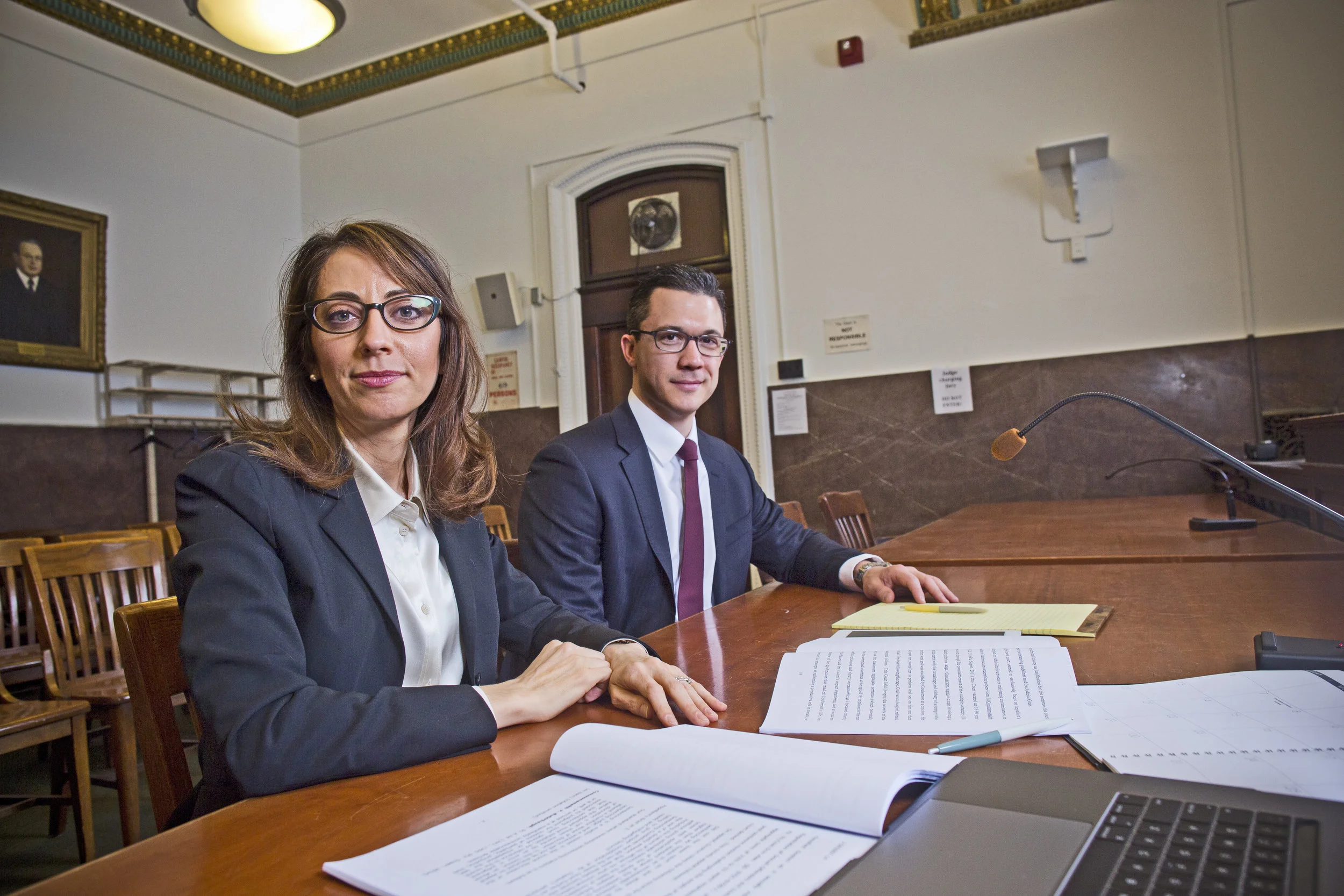
Philadelphia Criminal Defense Lawyers Demetra Mehta and Zak Goldstein
If you are facing criminal charges or under investigation by the police, we can help. We have successfully defended thousands of clients against criminal charges in courts throughout Pennsylvania and New Jersey. We have successfully obtained full acquittals in cases involving charges such as Conspiracy, Aggravated Assault, Rape, and Murder. Our award-winning Philadelphia criminal defense lawyers offer a free criminal defense strategy session to any potential client. Call 267-225-2545to speak with an experienced and understanding defense attorney today.