

Philadelphia Criminal Defense Blog

Speedy Trial Motion Granted in Prescription Fraud Case, Not Guilty Verdict in Domestic Assault Case, and Other Recent Case Results

Philadelphia Criminal Defense Attorney Zak T. Goldstein, Esq.
Our Philadelphia criminal defense attorneys have continued to obtain successful results in the courtroom. In the last two months, our defense attorneys have obtained acquittals and dismissals at trial and in preliminary hearings in criminal cases and successfully defended Protection from Abuse (PFA) Petitions. Some of our notable recent results include:
Commonwealth v. T.T. – Speedy Trial Motion Granted in Prescription Fraud Case Due to Delay in Arresting Defendant.
The client was arrested and charged with Forgery, Identity Theft, Possession With the Intent to Deliver, and related charges for allegedly forging Oxycodone and Percocet prescriptions and attempting to have them filled at local pharmacies. The magistrate judge initially set bail at $100,000, and the client’s family immediately hired Goldstein Mehta LLC. Attorney Goldstein moved for a bail reduction at the first listing of the preliminary hearing, and the Municipal Court judge promptly reduced bail to $25,000. Attorney Goldstein then renewed the bail motion in the Court of Common Pleas, and the Court of Common Pleas reduced bail even further, allowing the client to be released for a bail payment of $670.
Attorney Goldstein then defended the client at the preliminary hearing. At the preliminary hearing, an Agent for the Pennsylvania Attorney General’s Office testified that she had obtained records indicating that the defendant had attempted to fill forged prescriptions in various names on multiple occasions. However, the Agent had not actually viewed the defendant filling any prescriptions herself. Accordingly, the Municipal Court Judge held the case under advisement to determine whether the agent had sufficient personal knowledge of the allegations or whether the case should be dismissed because the Commonwealth’s entire case at the preliminary hearing was hearsay.
In addition to moving to dismiss the case due to the excessive hearsay, Attorney Goldstein also moved to dismiss the case for a violation of the client’s right to a speedy trial under Rule 600. Rule 600 requires that the Commonwealth bring a defendant to trial within 365 days from the filing of the criminal complaint. However, Rule 600 has a number of exceptions and is often not strictly enforced in cases where the Commonwealth can show that it was not the prosecution’s fault that trial was delayed. Here, the Agents conducted their investigation and filed the criminal complaint in 2014. When they first filed the complaint, they attempted to arrest the defendant, but he was not home. The police then failed to exercise due diligence in trying to find the defendant and bring him to trial, and he was not actually arrested until 2017. Accordingly, Attorney Goldstein moved to dismiss the case due to this pre-arrest delay. When police fail to arrest a defendant within 365 days from the filing of the Complaint, Rule 600 and the case of Commonwealth v. Webb require that the case be dismissed unless the Commonwealth can show that the police executed due diligence in trying to find the defendant and execute the arrest warrant. Here, there was no evidence that the police had diligently attempted to serve the warrant. Therefore, the Municipal Court judge dismissed the case with prejudice at the preliminary hearing for the speedy trial violation, meaning the Commonwealth cannot re-file the charges.
Commonwealth v. A.W. - Motion for Reconsideration of Probation Violation Sentence Granted
The client was found in technical violation of probation for theft and drug possession while represented by a different attorney. The probation judge sentenced A.W. to 11.5 - 23 months in custody. A.W. retained Goldstein Mehta LLC, and our attorneys immediately filed a motion to reconsider the sentence within ten days as required by the Pennsylvania Rules of Criminal Procedure. The client's back judge scheduled a hearing on the Motion to Reconsider, and prior to the hearing, we were able to work with the client's family to locate a drug treatment faciity which she could attend if released. Once our attorneys presented the probation judge with the treatment option, the judge reconsidered the sentence and granted immediate parole to treatment. Our defense attorneys were able to help the client avoid a lengthy jail sentence.
PFA Litigation – Protection from Abuse Petition Dismissed for Lack of Jurisdiction
Attorney Goldstein successfully moved to have a protection from abuse Petition dismissed at trial for lack of jurisdiction. The plaintiff alleged that she had had a sexual relationship with the defendant and that the defendant subsequently threatened her at a party. The PFA Act allows a plaintiff who claims that they were the victim of abuse to obtain an emergency ex parte protection from abuse order which prohibits the defendant from having any contact with the plaintiff. This order can be extremely problematic for a defendant as it can damage the defendant’s reputation, require the defendant to relinquish legally owned firearms, and can even require the defendant to be evicted from a shared residence. Although the initial order may be granted on an emergency basis without a hearing, the defendant has the right to a trial on whether the allegations are true and a final order is necessary. At the trial, the plaintiff must show that the PFA Court has jurisdiction, that abuse occurred, and that a restraining order is necessary to prevent abuse from occurring.
Here, Attorney Goldstein was able to have the Petition dismissed for lack of jurisdiction. Although the initial Petition alleged that the defendant and plaintiff had a consensual relationship, the defendant testified on cross-examination that the relationship had not been consensual. Knowing that the Superior Court has repeatedly held that PFA jurisdiction only exists in cases involving domestic partners, meaning household members, family members, and people in consensual, dating relationships, Attorney Goldstein immediately moved for dismissal of the Petition for lack of jurisdiction. The Family Court judge agreed and dismissed the Petition, thereby vacating the restraining order.
Commonwealth v. R.B. – Client was charged with various gun charges, including Violation of the Uniform Firearms Act Sec. 6106, 6108, and 6105. Our criminal defense lawyers successfully moved for the case to be dismissed after the Commonwealth was repeatedly not ready to proceed for the preliminary hearing.
Commonwealth v. R.T. – Unsworn Falsification Case Dismissed at Municipal Court Trial
The client was charged with Unsworn Falsification to Authorities for allegedly lying to police about being robbed in order to cover up a drug deal gone wrong. The police alleged that the defendant had not been robbed and had instead made up a story about being robbed at gunpoint in order to try to get money back which was stolen in a drug deal. The client retained Attorney Goldstein, who promptly requested all of the discovery in the case, including documents from Cherry Hill. The Commonwealth never successfully obtained the police reports from the other jurisdiction for two trial listings, so Attorney Goldstein moved to dismiss the charges. The Philadelphia Municipal Court judge dismissed the case for lack of prosecution.
Commonwealth v. Z.B. – Detainer Lifted and Client Sentenced to Time Served on Section 17 Detainer.
The client had previously pleaded no contest as part of a Section 17 pre-trial diversionary program to knowing and intentional possession of a controlled substance in Montgomery County. After getting arrested again for the same charge in a different jurisdiction, the probation officer took the client into custody and lodged a probation detainer. The client retained Goldstein Mehta LLC, and our defense attorneys immediately filed a Motion to Lift the Detainer, arguing that Section 17 probation does not give the sentencing judge the authority to lodge a probation detainer. Instead, the judge must schedule a hearing and either continue the probation or impose a judgment of sentence. In this case, the judge had not scheduled the probation violation hearing for months. After receiving the motion and recognizing that the law was unsettled as to whether Section 17 probation gives the authority to lodge a probation detainer, the judge moved the probation violation hearing up by two months. The client then stipulated to the probation violation in exchange for a sentence of roughly time served and was released shortly thereafter. By filing a creative motion on the client’s behalf, our defense lawyers were able to save the client months in jail.
Commonwealth v. J.B. – Probation Detainer Lifted, Full Acquittal Obtained in Domestic Assault Case
The client was charged with Simple Assault, Terroristic Threats, Recklessly Endangering Another Person, and other related charges in the Philadelphia Municipal Court for allegedly assaulting his girlfriend. The client was on probation for similar charges, so the probation officer took the client into custody and lodged a probation detainer. If the client had done nothing, he would have had to stay in jail until the new case was resolved. Fortunately, the client retained Goldstein Mehta LLC, and our defense lawyers promptly filed a Motion to Lift the Probation Detainer with the client’s back judge. By putting together a thorough mitigation packet showing the defendant’s exemplary work record, successful compliance with probation other than the new charges, and extensive family and community support, our lawyers were able to have the client’s probation detainer lifted so that he could fight the case from out of jail.
We were then able to obtain a full acquittal for the client at trial. By cross-examining the complaining witness on the inconsistencies between her testimony at trial and the statement she had given to police and showing that she had a motive to fabricate the allegations, our attorneys were able to convince the Municipal Court judge that the complainant should not be believed. This was particularly true in light of the complainant’s lack of visible injuries and the fantastical nature of her allegations. Accordingly, our defense attorneys successfully had the client’s probation detainer lifted and obtained a full acquittal at trial.
Commonwealth v. V.F. – Possession with the Intent to Deliver Charges Dismissed at Preliminary Hearing
V.F. was charged with Possession with the Intent to Deliver and Possession of a Small Amount of Marijuana. Philadelphia narcotics officers alleged that they observed the client receive money from another person in exchange for small objects, which is the typical testimony that officers provide to describe what they believe to be a drug transaction. When officers stopped the man who handed the money to the defendant, the man had marijuana in his possession. Officers then arrested the defendant and found money, but they did not find any matching marijuana. Attorney Goldstein argued that the felony PWID charge should be dismissed because there was insufficient evidence to show that the defendant had sold the marijuana. Instead, police simply could not say what the defendant had allegedly given to the man who had marijuana on him. Accordingly, the preliminary hearing judge dismissed the felony charge and remanded the case for a trial on the misdemeanor marijuana charge.
Commonwealth v. T.C. – PWID Charges Withdrawn at Trial after Seizure Analysis Showed Marijuana Fake.
AWARD-WINNING PHILADELPHIA CRIMINAL DEFENSE LAWYERS

If you are facing criminal charges, we can help. Our Philadelphia criminal defense lawyers have successfully defended thousands of clients at the trial level on appeal. We offer a complimentary 15-minute criminal defense strategy session to anyone who is under investigation or facing criminal charges. Call 267-225-2545 to speak with an experienced and understanding defense attorney today.

PA Superior Court Reverses Murder Conviction in Roosevelt Boulevard Drag Racing Case

Zak T. Goldstein, Esq. - Philadelphia Criminal Defense Attorney
The Pennsylvania Superior Court has just decided the case of Commonwealth v. Akhmedov, finding that the Commonwealth failed to prove the charge of third degree murder where the defendant crashed into and killed pedestrians during a drag racing incident on Philadelphia’s Roosevelt Boulevard. The Court’s opinion details the type of evidence necessary for the prosecution to prove a third degree murder charge in a case involving reckless driving, drag racing, or a car accident.
Commonwealth v. Ahkmedov
In Ahkmedov, the defendant was charged with multiple counts of third degree murder, involuntary manslaughter, homicide by vehicle, and recklessly endangering another person. The charges arose out of an incident which occurred on Roosevelt Boulevard. The defendant was driving southbound on the Boulevard, which has a speed limit of 40 miles per hour. At some point, the defendant began racing another driver. At each traffic light, the cars would rev their engines and race to the next light.
Police estimated that the cars traveled at around 70 miles per hour during the race. As the vehicles approached the intersection of the Boulevard and 2nd Street, the defendant began to travel at a minimum speed of 79 miles per hour. Although 79 miles per hour was nearly double the speed limit on that portion of the Boulevard, the evidence also showed that the intersection was not meant for pedestrian crossings. It did not have a crosswalk or signs warning drivers that pedestrians might be present. Unfortunately, Samara Banks and her three children were crossing the Boulevard as the defendant approached. The defendant attempted to swerve around them but was unable to do so. Instead, he struck Ms. Banks and her children, ultimately killing all four of them. The defendant remained at the scene and tried to render aid.
Murder Charges for Drag Racing
Police arrested the defendant and charged him with homicide and the related charges. The defendant proceeded by way of bench trial, and the trial judge convicted the defendant of third degree murder, involuntary manslaughter, homicide by vehicle, and recklessly endangering another person. On appeal, the defendant challenged a number of evidentiary issues as well as whether the evidence was sufficient for a conviction on the third degree murder charges. Specifically, the defendant argued that the evidence failed to show that he acted with the necessary malice required to sustain a conviction for third degree murder because he did not operate his vehicle under circumstances which almost assured that injury or death would ensue.
The Defendant's Appeal
The Superior Court agreed and reversed the conviction for third degree murder. The Court noted that third degree murder occurs when a person commits a killing which is neither intentional nor committed during the perpetration of a felony, but contains the requisite malice. The definition of malice is well established in Pennsylvania, and courts have defined malice as follows:
Malice exists where there is a wickedness of disposition, hardness of heart, cruelty, recklessness of consequences, and a mind regardless of social duty, although a particular person may not be intended to be injured. Where malice is based on a reckless disregard of consequences, it is not sufficient to show mere recklessness; rather, it must be shown the defendant consciously disregarded an unjustified and extremely high risk that his actions might cause death or serious bodily injury. A defendant must display a conscious disregard for almost certain death or injury such that it is tantamount to an actual desire to injure or kill; at the very least, the conduct must be such that one could reasonably anticipate death or serious bodily injury would likely and logically result.
Obviously, there was no real dispute as to whether or not the defendant acted recklessly. Driving twice the speed limit through an intersection as part of a drag race was clearly reckless. However, in order for recklessness to qualify as malice, Pennsylvania courts have required the prosecution to prove “sustained, purposeful recklessness” such that the defendant must have known of and consciously disregarded the risk that death or serious bodily injury was reasonably certain to occur.
Generally, this level of sustained, purposeful recklessness requires factors like a “near miss,” a warning from a bystander or passenger to slow down and a decision to ignore the warning, and evidence that the defendant clearly saw and recognized the dangers. Finally, in almost every case in which the defendant was properly convicted of third degree murder as a result of a car accident, the prosecution was able to show that the defendant was intoxicated.
Insufficient Evidence of Malice
In this case, the Court found that the prosecution did not establish the requisite level of recklessness. The defendant was reckless in driving at excessive speeds, but he did not have a near miss, he was not warned to slow down, and he was not intoxicated. He attempted to avoid hitting the victims but was unable to do so. Further, the pedestrians were crossing the road at an intersection where they should not have been crossing, and they were wearing dark clothes at night. Finally, the defendant stopped and attempted to assist them after he struck them.
Although the defendant had been pulled over for speeding as part of a road rage incident a week before, the prior traffic stop was not close enough in time to satisfy the “near miss” requirement or show that the defendant was aware of the likelihood of injuring a pedestrian at that particular location where the accident occurred. The Court concluded that the defendant’s recklessness satisfied the mens rea elements for the lesser included charges like manslaughter and recklessly endangering another person, but it did not satisfy the heightened mens rea requirement for murder.
Because the third degree murder charge was the most serious charge, the court remanded the case for a new sentencing hearing on the remaining charges. The court did not find that the Commonwealth failed to prove all of the charges; just that they failed to prove the third degree murder beyond a reasonable doubt. Thus, it is clear that murder requires something more than recklessness. Instead, it requires the prosecution to prove malice.
Philadelphia Criminal Defense Lawyers for Homicide Charges

Philadelphia Criminal Defense Lawyers
Our Philadelphia Criminal Defense Lawyers have the expertise necessary to challenge the government each step of the way. We have experience working with expert witnesses, challenging identifications, fighting forensic evidence, and thoroughly investigating cases in order to find exculpatory evidence that the police might have missed. We know the defenses, and we know how to challenge each part of the Commonwealth’s case at the preliminary hearing, through pre-trial motions, and at trial with a judge or a jury. We also have extensive experience in negotiating for better outcomes for our clients, and we have obtained great results even in cases in which the Commonwealth has a great deal of evidence. If you or a loved one are under investigation or facing homicide charges, you need an experienced criminal defense attorney in your corner. Call 267-225-2545 for a free strategy session with one of our top-rated defense lawyers today.

PA Supreme Court: Police May Not Search Car Parked in Driveway Without Warrant
The Pennsylvania Supreme Court has just decided the case of Commonwealth v. Loughnane, holding that the automobile exception to the warrant requirement does not apply to a car parked in a residential driveway.
Can The Police Search My Car Without A Warrant If It's In My Driveway?

Criminal Defense Attorney Demetra Mehta, Esq.
The Pennsylvania Supreme Court has just decided the case of Commonwealth v. Loughnane, holding that the automobile exception to the warrant requirement does not apply to a car parked in a residential driveway. This decision provides a commonsense limitation on the ability of the police to search private property in Pennsylvania and follows a recent trend of the Pennsylvania Supreme Court seeking to increase privacy protections for the Commonwealth's citizens.
Commonwealth v. Loughnane
In Loughnane, the defendant was charged with accidents involving death or serious injury. On July 24, 2012, a large dark-colored truck struck and killed the victim while she was outside of her apartment that she shared with her boyfriend in Wilkes-Barre, Pennsylvania. Her boyfriend witnessed the accident. When the boyfriend reported the accident to the police, he told them that the truck which hit the decedent was a large, dark-colored truck that had a distinctive sound.
A few weeks later, the boyfriend's father drove through a residential neighborhood and saw a truck that matched the description provided by his son parked in a residential driveway. He called his son, and his son came to this residence and identified the truck as the one he saw on July 24. The boyfriend then called the police. Later that day, police detectives went to the house, ran the truck's license plate, and determined that the truck belonged to the defendant. Detectives then unsuccessfully attempted to contact the defendant.
After failing to reach the defendant, police sought guidance from the local prosecutors. Apparently, at some point during the investigation, the lead detective learned that the keys to the truck were inside the automobile. Believing that it was about to rain and potential forensic evidence could be lost, the police decided to take action without obtaining a search warrant. They towed the truck to the Wilkes-Barre police garage. Four days later, they obtained a search warrant for the vehicle. The search did not result in the discovery of any evidence. However, they brought the boyfriend back to the police station to make a second identification of the truck. They also turned the truck on and revved the engine, and the boyfriend confirmed that the engine sounded the same as the engine on the truck that hit the decedent.
The defendant was arrested and charged with Accidents involving death or serious bodily injury (hit and run). The defense filed pre-trial Motions to Suppress. At the Motion to Suppress hearing, the defendant's defense lawyer successfully moved to suppress the boyfriend's police station identification of the vehicle. The suppression court granted the motion because the truck was taken from the defendant's private property and there were no exigent circumstances that justified the warrantless taking of the truck. The Commonwealth then filed an interlocutory appeal. The Superior Court reversed the decision of the trial court and ordered that the Commonwealth be allowed to use the results of the warrantless seizure. In its opinion, the Superior Court inexplicably ruled that a private driveway does not provide any reasonable expectation of privacy becasue it is not part of the curtilage of a home. This ruling was contradicted by dozens of cases in Pennsylvania, the federal courts, and other states. Therefore, the defendant then asked the Pennsylvania Supreme Court to review the Superior Court's decision, and the Supreme Court agreed.
Limits to the Automobile Exception
On appeal, the defendant asked the Pennsylvania Supreme Court to decide whether the automobile exception applies to automobiles parked in driveways of private residences. The defendant argued that the automobile exception does not apply to vehicles in private residential driveways. As a preliminary matter, the Pennsylvania Supreme Court corrected the Superior Court and held that a driveway is constitutionally protected curtilage. This was crucial because in order to have a valid constitutional claim, one must have a reasonable expectation of privacy in the person, place, or thing that the government searched or seized.
The Pennsylvania Supreme Court then addressed whether the automobile exception applies to cars parked in a residential driveway. In making its determination, the Pennsylvania Supreme Court analyzed federal and other state cases that addressed the automobile exception.
In its analysis, the Pennsylvania Supreme Court highlighted the fact that in cases that upheld the automobile exception, a deciding factor was that the automobile was in a public space. This is consistent with the United States Supreme Court’s justification for the automobile exception (the inherent mobility of motor vehicles and that an individual has a reduced expectation of privacy in a vehicle as compared to an individual’s home or office).
However, the Pennsylvania Supreme Court did not end its analysis there. It also reviewed federal circuit court and other states’ decisions that found the automobile exception inapplicable. In those cases, the courts consistently held that the automobile exception did not apply when the car was parked in a residential driveway. The Pennsylvania Supreme Court went on to say that “[because] none of the justifications for the automobile exception apply to vehicles parked in a residential driveway, there is no reason for the exception to apply.” Thus, the Pennsylvania Supreme Court adopted the rationale of these courts and held that the automobile exception does not apply to automobiles that are parked in residential driveways. If the Commonwealth searches or seizes an individual’s car without a warrant, the limited automobile exception applies and there must be both probable cause and exigent circumstances.
Motions to Suppress

Philadelphia Criminal Defense Attorney
Trials can be won and lost with a motion to suppress. If you are facing criminal charges, you need a defense attorney who has the knowledge and expertise to defend your case. Our award-winning Philadelphia criminal defense lawyers have successfully fought countless cases at trial and on appeal. We offer a 15-minute criminal defense strategy session to any potential client. Call 267-225-2545 to discuss your case with an experienced and understanding criminal defense attorney today.

PA Superior Court Limits Deadly Weapon Used Sentencing Enhancement in Burglary Cases
The Deadly Weapon Used Enhancement does not apply unless the defendant used the deadly weapon while entering the building during a Burglary.
The Pennsylvania Superior Court has just decided the case of Commonwealth v. Tavarez. This decision limits the “Deadly Weapon Enhancement” for individuals convicted of burglary when a deadly weapon is involved. It requires that a sentencing court determine whether a deadly weapon was used in the commission of the burglary or whether a defendant merely possessed the deadly weapon at the time the defendant entered the building or occupied structure.
Commonwealth v. Tavarez
In Tavarez, the defendant pleaded guilty to one count each of aggravated assault, burglary, robbery, impersonating a public servant, and conspiracy. As part of his guilty plea, Mr. Tavarez stipulated to the following factual summary:
[O]n or about November 17th, 2015, shortly after 1:00 in the morning at 49 Mill Road in Oley Township, Berks County, Pennsylvania, you along with your accomplices and co-conspirators Edward Martinez, Brandon Smith, and Erick Green went to that residence; the plan even before - you arrived at the residence was to rob the people there; you believed that there were illegal drugs and money[] there to be gained; all four of you agreed to do that. When you got there, as was your intention all along, you and Edward Martinez entered the residence, there were people present. This was a residence. It was not open to the public at that time. You had no license or privilege to be there.
Once inside, you were yelling, [“]Police. Freeze[.”] in [an] attempt to compel the homeowners to do what you wanted them to do, thereby impersonating a public servant. Although you attempted to commit a robbery and you did so with firearms, nothing was actually taken.
When you confronted the homeowner, Eric Wegman, in the upstairs bedroom, he pulled his own handgun and fired, hitting both you and Mr. Martinez. Eric Wegman was also shot in the leg at that point.
Based on these facts, the trial court sentenced Mr. Tavarez to a 10 ½ to 30 years. The trial court did this, in part, by applying the “Deadly Weapon Used” enhancement to all of the charges, including the burglary charge. After he was sentenced, Mr. Tavarez filed a timely appeal. One of the issues Mr. Tavarez raised on appeal was whether the trial court erred in applying the “Deadly Weapon Used” enhancement to his burglary conviction.
What are the Sentencing Guidelines?
In Pennsylvania, an individual’s sentence will usually be determined by where the person falls on the sentencing matrix. The purpose of the sentencing matrix is to provide consistency in sentencing across the state. It is important to note that judges are not required to follow the guidelines and are free to depart from them when they see fit.
The first step in determining where a defendant falls on the sentencing matrix is to figure out what the individual’s Prior Record Score (“PRS”) is. A defendant’s PRS is based on their prior convictions. Specifically, a court will “add” up the prior record score points of each conviction. The more serious the offense, the more “points” it is worth. For example, if an individual’s sole conviction is for an Aggravated Assault where Serious Bodily Injury results, that person will have a PRS of 4. However, if an individual has two prior misdemeanor convictions, that are not specifically delineated by the General Assembly, then that individual will only have a PRS of 1.
The lowest PRS an individual can have is a 0. The highest PRS an individual can have is a 5. However, some individuals with multiple felony convictions can be classified as a REFEL, while some repeat violent offenders may be classified as a REVOC. These classifications will subject you to more severe guidelines. If you have previous convictions it is imperative that you have an attorney who understands how your PRS is calculated because it can have significant consequences on your sentence.
After the Prior Record Score is determined, the court must then determine the Offense Gravity Score (“OGS”) of the particular offense. The Pennsylvania General Assembly assigned an OGS for each offense listed in the Pennsylvania Crimes Code. The range of OGS is from 1-14, with 1 being the least serious, while 14 being the most serious.
In Tavarez, the defendant had a prior record score of 2. Additionally, the Burglary charge that Mr. Tavarez pleaded guilty to had an OGS of 9. Thus, if this was the only charge that Mr. Tavarez had pleaded guilty to his guidelines would have been 24-36 plus or minus 12. In Pennsylvania, a judge must sentence an individual to a minimum and maximum sentence. Assuming there were no additional enhancements (i.e. the “Deadly Weapon Enhancement”) and the court had sentenced him to a 2-4 year sentence that would have been a “guideline” sentence. However, because Mr. Tavarez agreed that he used a firearm, the court could, and did, apply the “Deadly Weapon Enhancement” to his case.
What is a Deadly Weapon Enhancement?
If someone commits a crime with a deadly weapon, a court must apply the “Deadly Weapon Enhancement.” This enhancement requires the court to look at additional matrixes to determine a sentence for the defendant. There are two types of deadly weapon enhancement charts: “Possession of a Deadly Weapon” and “Use of a Deadly Weapon.” The “Deadly Weapon Used” matrix will always recommend a more severe sentence than the “Deadly Weapon Possessed” matrix.
In Mr. Tavarez’s case, using his PRS of 2 and the OGS of 9 of the Burglary offense, the “Deadly Weapon Possessed” matrix had a guideline range of 33-45 plus or minus 12, while the “Deadly Weapon Used” matrix has a guideline range of 42-54 plus or minus 12. As such, there is a nine-month difference between the two guidelines which is very consequential.
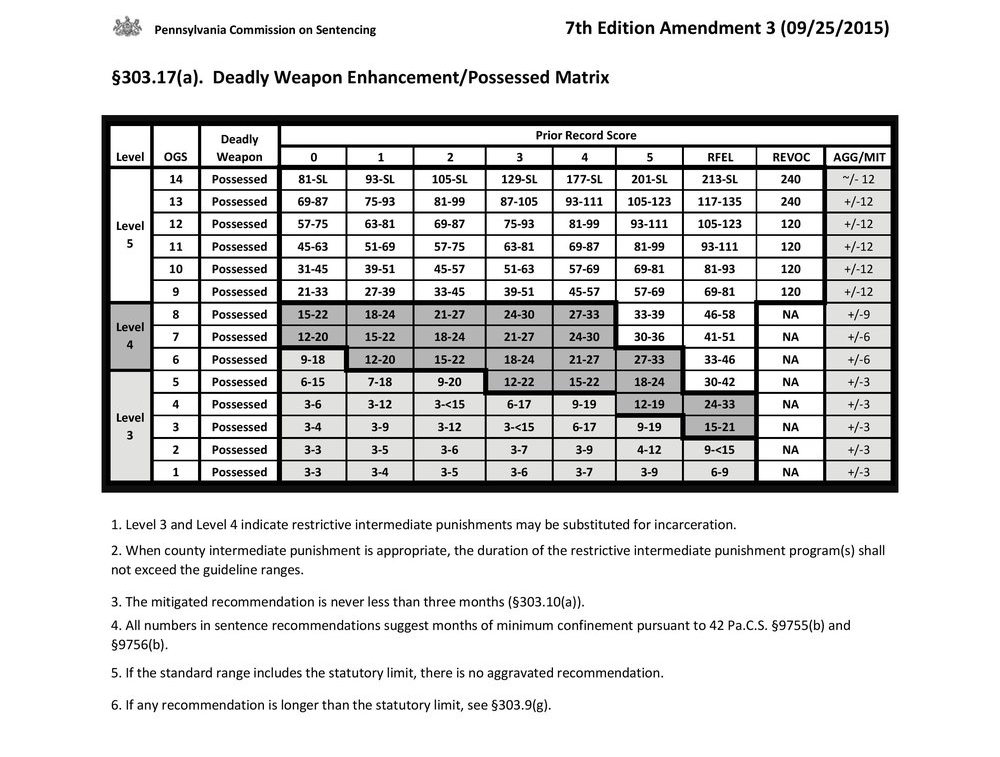

The Superior Court holds that only the “Possessed” Matrix applies to Tavarez's Burglary Conviction.
Part of Tavarez's plea deal was to stipulate to a factual summary. After he filed his appeal, the Pennsylvania Superior Court reviewed the transcript and was limited to the facts that were on record. In Mr. Tavarez’s case, the record did not state that Mr. Tavarez used the firearm to commit the burglary. Further, in Pennsylvania, the crime of burglary ends once the felon breaks into the building because burglary is defined as breaking and entering a building or occupied structure with the intent to commit a crime therein. Therefore, the burglary is over once a defendant has entered a building even if the defendant goes on to commit other crimes once inside. Here, Tavarez admitted to using the firearm to rob the complainant after he had entered the residence. Consequently, the trial court was correct in applying the “Deadly Weapon Used” enhancement for the robbery and other offenses that he pleaded guilty to. However, because Mr. Talvarez had already completed the crime of burglary when he entered the complainant’s residence and did not use the firearm in the commission of the burglary, it was incorrect for the trial court to apply the “Deadly Weapon Used” enhancement for the burglary conviction. Because of this error by the trial court, the Superior Court remanded Mr. Talvarez’s case for resentencing.
Call the Award-Winning Criminal Defense Lawyers of Goldstein Mehta LLC if You Are Charged With a Criminal Offense

Philadelphia Criminal Defense Lawyers
As shown by Tavarez, the details in a case matter. If you are charged with any offense or under investigation by the authorities, you need a defense attorney who pays attention to the details that will make or break your case. Our award-winning Philadelphia criminal defense lawyers have successfully fought countless cases at trial and on appeal. We offer a 15-minute criminal defense strategy session to any potential client. Call 267-225-2545 to discuss your case with an experienced and understanding criminal defense attorney today.