

Philadelphia Criminal Defense Blog

PA Superior Court: Trial Court May Hear from Variety of Witnesses in Deciding Whether Child Complainant May Testify Via Closed Circuit TV
Commonwealth v. Tyrrell

Criminal Defense Lawyer Zak Goldstein
The Pennsylvania Superior Court has decided the case of Commonwealth v. Tyrrell, rejecting the defendant’s challenge to his convictions for Rape of a Child and related charges. In this appeal, the Superior Court rejected the defendant’s arguments that 1) the trial court improperly permitted the complainant to testify via closed circuit television and 2) the trial court should have excluded the testimony of the minor complainant because the testimony was tainted.
The Criminal Charges
In Tyrrell, the defendant was charged with rape of a child, rape of a child resulting in serious bodily injury, indecent assault, unlawful contact with a minor, and corruption of minors for molesting S.B., his then 8-year-old daughter. The offenses allegedly occurred on April 2, 2014, and the defendant gave a statement confessing to the crimes on August 24, 2014. The defendant filed a motion to suppress his confession, opposed the Commonwealth’s motion to introduce the testimony of the complainant via closed circuit television, and also challenged the admissibility of the complainant’s testimony by arguing that the testimony had been tainted through the suggestions of others. The trial court rejected all three arguments, and the defendant was convicted. The court sentenced him to 50-100 years of incarceration followed by ten years of probation, and he appealed.
Pennsylvania's Tender Years Act – When May A Child Witness Testify Via Closed Circuit Television?
On appeal, the Superior Court also rejected the arguments. With respect to the closed circuit television issue, the defendant argued that the complainant should have been required to testify in open court in front of the jury. However, the Pennsylvania legislature has enacted a “Tender Years Act” which permits children who are 12 years old or younger to testify via closed circuit television under certain circumstances. When the prosecution moves that a child witness be permitted to testify via closed circuit television, the court must hold a hearing to determine, based on the evidence presented to it, whether requiring the child to testify in an open forum in the presence and full view of the jury and defendant will result in the child victim or child witness suffering serious emotional distress that would substantially impair the child victim or material witness’s ability to reasonably communicate.
The statute further provides: “in making this determination, the court may do all of the following:
1) Observe and question the child victim or child material witness, either inside or outside the courtroom.
2) Hear testimony of a parent or custodian or any other person, such as a person who has dealt with the child victim or child material witness in a medical or therapeutic setting.”
The statute makes it clear that the court must hold a hearing and either hear from the child or from a witness who can testify as to the emotional state of the child. If the court is satisfied that the child cannot testify without suffering from substantial emotional distress which will impair the child’s ability to communicate, then the court may permit the child to testify in a different room. Only the attorneys for the parties, the judge, the court reporter, an advocate for the child, and persons necessary to operate the recording equipment may be present in the room in which the child testifies. The defendant, the jury, the public, and any other court staff may not be present in the room.
Here, the defendant challenged the trial court’s determination that the complainant could testify via closed circuit television. In a pre-trial hearing, the Commonwealth presented the testimony of a licensed professional counselor. The counselor testified that in her expert opinion, she believed it would be traumatic for the complainant to testify in open court in front of her father and others. She believed that it would be traumatic because of how hard it was for the complainant to disclose the sexual assault and because many children still feel loyalty to their parents even after they report having been sexually assaulted.
The Commonwealth also presented the testimony of a caseworker for the county’s Children and Youth Services (called DHS in Philadelphia). The caseworker testified that the complainant suffered because the allegations against the defendant broke up her family. She had been placed in foster care, and she had been diagnosed with anxiety, depression, and PTSD. She had also told the caseworker how scared she was and that she was dreading the court date. The caseworker felt that the complainant was not ready to stand in a public courtroom and testify.
Based on this testimony, the trial court granted the Commonwealth’s motion to permit the child to testify from a different location, and the Superior Court approved of the trial court’s decision. The Superior Court reasoned that there is no specific requirement as to who or what kind of witness must testify in order to make the showing necessary under the Tender Years Act. The Tender Years Act does not require a current counselor, a medical doctor, or even a parent to testify in making the necessary showing. Instead, the plain language of the Act permits the Court to evaluate the child witness for itself and for the Court to hear from any adult witness who has the relevant knowledge of the effect that testifying would have on the child. The child does not necessarily have to testify, and the child’s current counselor or doctor does not have to testify. The Superior Court therefore held that the trial court properly permitted the complainant to testify via closed circuit television.
Tainted Testimony Is Not Admissible in Child Abuse Cases
The Superior Court also rejected the argument that the complainant’s testimony should have been excluded due to taint. In every case, witnesses must be competent to testify. Competency requires:
the ability to communicate,
the mental capacity to observe the occurrence itself and the capability of remembering what it is that the witness is called to testify about, and
3) a consciousness of the duty to tell the truth.
In prior decisions, PA appellate courts have recognized that child witnesses are particularly susceptible to the world of make-believe and of suggestions, and taint has been described as “the implantation of false memories or distortion of actual memories through improper and suggestive interview techniques.” Therefore, where there is evidence that the testimony of a child witness has been tainted, it may be possible to exclude the testimony of the witness because the witness does not have the capability of remembering what it is the witness is called to testify about.
A defendant may move prior to trial to exclude the testimony of a tainted witness. When the defendant makes such a motion, the defendant bears the burden of producing evidence of taint and the burden of proving that the witness was tainted by clear and convincing evidence. This means that a defendant must be able to show that the witness’s testimony stems from repetitive, suggestive, or coercive interview techniques either on the part of an interested party such as the other parent or on the part of investigators.
Here, the Superior Court rejected the defendant’s argument that the testimony of the complainant had been tainted. The first disclosure of the sexual assault took place in the victim’s journal which she later provided to a counselor. She also did not initially disclose the sexual assault to investigators during the forensic interviews. The court found that the defendant failed to show that anyone had suggested to the complainant that she make the allegations or that any of the questioning was inappropriate. The witnesses testified that they did not use leading questions or in any way coerce the witness into making the allegations, and both the trial court and Superior Court accepted that testimony. In this case, the Court found that the record simply did not support the defendant’s arguments that the complainant should have been required to testify in open court or that the complainant’s testimony was tainted by the investigators.
Challenging Tainted Testimony and Tender Years Act Motions in Sexual Assault Cases
Although the defendant did not win in this particular case, the Superior Court’s opinion explores two significant issues which often arise in sexual assault cases involving children. First, it is important to fight against any attempts on the part of the Commonwealth to take shortcuts and protect its witnesses from open cross-examination. The Confrontation clauses of the Pennsylvania and United States Constitutions give criminal defendants the right to confront the witnesses against them. These clauses have been interpreted as providing defendants the right to have their attorneys cross-examine adverse witnesses in open court with the idea that cross-examination is the best method for determining whether or not witnesses are telling the truth. When the Commonwealth can shield its witnesses from appearing in open court, it makes it easier for the witnesses to fabricate stories because it is easier to lie when you do not have to face the person that you are lying about. Therefore, it is important to challenge the Commonwealth’s motions in these types of cases and fight for open cross-examination. Second, it is critically important that the defense attorney fully investigate these cases and be extremely familiar with the discovery and contents of the forensic interviews that prosecutors typically rely upon. If it can be shown through the Commonwealth’s evidence or through the testimony of defense witnesses that the complainant has been coached and had his or her testimony tainted through the suggestions or coercion of others, then it may be possible to have the testimony excluded.
Award-Winning Philadelphia Criminal Defense Lawyers

If you are facing criminal charges, we can help. The Philadelphia criminal defense lawyers of Goldstein Mehta LLC have successfully defended thousands of clients. We are experienced and understanding defense attorneys who will use our skill, expertise, and knowledge of the law to fight for you. We offer a free 15-minute criminal defense strategy session to any potential client. Call 267-225-2545 to speak with a defense lawyer today.

PA Superior Court: You Should Not Bring Your Computer In For Repair If It Has Child Porn On It

Philadelphia Criminal Defense Lawyer Zak T. Goldstein, Esq.
Can Computer Repair Technicians Search A Computer For Child Porn?
The Pennsylvania Superior Court has decided the case of Commonwealth v. Shaffer. The Court held that police did not violate the Fourth Amendment by searching the defendant’s computer for child pornography where the child pornography was initially discovered by computer repair technicians at a local store. The Court relied on the doctrine of abandonment, finding that the defendant abandoned his reasonable expectation of privacy in the contents of his computer when he gave store employees permission to repair the computer.
Commonwealth v. Shaffer
In Shaffer, the defendant was convicted of possession of child pornography (18 Pa.C.S. Sec. 6312(d)) and Criminal Use of a Community Facility (18 Pa.C.S. Sec. 7512). The defendant’s troubles arose when he brought his computer to a store called CompuGig for repair. The defendant told the store employees that the computer’s internet had stopped working, the computer was displaying a lot of pop-ups, and that he thought it had spyware or a virus on it. He left it there for repair, and technicians eventually concluded that the hard drive was failing. The technicians obtained permission to replace the hard drive, and the defendant also authorized them to copy the contents of the old hard drive to a new drive if possible. During the course of attempting to copy the old drive, the technicians found child pornography on the computer. The technicians then called the police and showed the police what they had found. The police took possession of the computer, obtained a search warrant, and arrested the defendant.
The defendant moved to suppress the contents of the computer, arguing that the police violated his right to privacy in his computer when they looked at the contents of the computer prior to obtaining the search warrant. The trial court denied the motion to suppress, and the defendant was eventually convicted of the charges. The defendant appealed to the Superior Court and asked the Superior Court to review the denial of the motion to suppress.
The Appeal
The Superior Court upheld the trial court’s denial of the motion to suppress and found that the police acted lawfully in viewing the material on the computer. The Superior Court relied heavily on its prior decision in Commonwealth v. Sodomsky and found that the defendant effectively abandoned the computer when he brought it to the store and authorized strangers to work on it. The Court noted that the Fourth Amendment protects people, not places, and what a person knowingly exposes to the public loses its Fourth Amendment protection. Accordingly, when the defendant gave the store employees permission to work on his computer and copy files to a new drive, he lost any expectation of privacy that he would have had in the contents of the computer because he exposed them to the public. The Court further rejected the defendant’s argument that the store employees went beyond the scope of the job, finding that he was specifically told that the employees needed to transfer the data. Thus, the Court concluded that abandonment occurs when a person grants a thirty-party access to his computer’s contents.
The Superior Court applied a very broad version of the abandonment doctrine in this case, finding that the technicians had the right to view all of the files on the computer because the defendant had given them permission to copy the hard drive. However, it is possible that the outcome could differ in a case in which the defendant had expressly limited the portions of a hard drive which the technicians could access. Nonetheless, it is not advisable to bring a computer in for repair if it has evidence of a crime on it.
Award-Winning Philadelphia Criminal Defense Lawyers
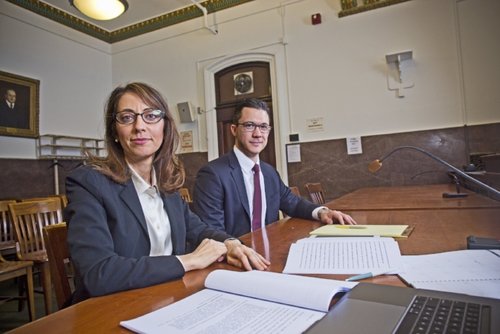
Criminal Defense Attorneys Demetra P. Mehta, Esq. and Zak T. Goldstein, Esq.
If you are facing criminal charges, we can help. Our Philadelphia criminal defense lawyers have successfully defended thousands of clients at the trial level on appeal. We offer a complimentary 15-minute criminal defense strategy session to anyone who is under investigation or facing criminal charges. Call 267-225-2545 to speak with an experienced and understanding defense attorney today.

Foregone Conclusion Doctrine Allows Government to Make Criminal Defendant Disclose Computer Password
Can The Police Make You Turn Over Your Computer Password?
Note: this article refers to a Superior Court case which has been overruled by the Pennsylvania Supreme Court. Click here to learn more
The Pennsylvania Superior Court has just decided the case of Commonwealth v. Davis, holding that the trial court properly ordered the defendant in a child pornography possession case to provide police with his computer password. Although the Third Circuit previously allowed prosecutors to obtain a similar order in a federal prosecution, Pennsylvania courts had not yet addressed the issue. Under this decision, prosecutors may now compel a defendant to produce the password to a computer or cell phone if the prosecution can satisfy the “foregone conclusion doctrine.”
In Davis, the defendant was charged with possession of child pornography and related offenses. Officers testified that they were able to download child pornography from the defendant using the eMule peer-to-peer file sharing network. As the officers were downloading the materials, they were able to determine the IP address of the computer that was uploading it. The officers then traced the IP address to the defendant’s internet account and house. They obtained a search warrant and executed the warrant at the defendant’s home. During the search, they seized a desktop computer which was protected by a special encryption software. The officers were unable to access the computer due to the encryption, and the defendant refused to provide them with the password.
The defendant did, however, make a number of inculpatory statements. He confirmed that he lived alone and that the computer was his. He told police he had prior arrests for child pornography, and he told them that he did not understand why it was illegal. He also stated that he liked 10, 11, 12, and 13 year olds, and he told police that the password was sixty-four characters and that he would not turn it over because “We both know what’s on there. It’s only going to hurt me.” The defendant then told the agents that he could not remember the password and that although the drive was encrypted, the agents already knew what was on the hard drive.
After the defendant was charged with two counts of distribution of child pornography and the criminal use of a communication facility, the Commonwealth filed a motion to compel the defendant to produce the password to the computer. The trial court granted the motion, and the defendant filed an interlocutory appeal to the Superior Court. Although a defendant may not ordinarily appeal a ruling on a pre-trial motion, the Superior Court permitted the defendant to appeal in this case under a limited exception to that general rule.
The Foregone Conclusion Doctrine
The Superior Court reached the merits of the appeal and concluded that the trial court properly ordered the defendant to produce the password under the foregone conclusion doctrine. The foregone conclusion doctrine is a limited exception to the general Fifth Amendment protection against self-incrimination. Ordinarily, a court may not compel a defendant to testify or say something that could incriminate him or her. For the Fifth Amendment to apply, however, the communication must be testimonial, incriminating, and compelled. Under the foregone conclusion doctrine, however, the courts have ruled that requiring a defendant to produce a password under certain circumstances is not testimonial because the government already knows that the defendant has the password. Thus, if the prosecution can show that the following three factors are present, a defendant may be compelled to produce a passcode to a phone or computer. The factors are:
The Government has knowledge of the existence of the evidence demanded,
The defendant possessed or controlled the evidence, and
The evidence is authentic.
The Government also must be able to describe with reasonable particularity the documents or evidence it seeks to compel.
Here, the Superior Court found that the foregone conclusion doctrine applied because it would not be testimonial for the defendant to give up the password. The Court found the police testimony showed that based on the investigation and the statements of the defendant, the Commonwealth knew the passcode existed, that it was within the control of the defendant, and that it was authentic. Further, based on the defendant’s incriminating statements, it was very likely that the computer would contain illegal child pornography. Therefore, the Court ruled that the trial court properly ordered the defendant to produce the password.
Fifth Amendment Implications of the Foregone Conclusion Doctrine
Clearly, the foregone conclusion doctrine drastically reduces the protections provided by the Fifth Amendment. By making a relatively limited showing that the defendant probably knows the password and the computer probably has illegal contraband on it, the Commonwealth may now essentially force a defendant to confess in that the act of providing the password further establishes that the defendant owns the computer and its contents.
This case also shows the importance of exercising your Fifth Amendment rights immediately when the police first show up and start asking questions. If the defendant had not admitted ownership of the computer, told police that he knew the password, and implied that police were correct in their assumption that the computer contained child pornography, the government may not have been able to satisfy the requirements of the foregone conclusion doctrine. It is absolutely critical that any suspect in a crime speak with an experienced criminal defense attorney before talking to the police as it is often very difficult for prosecutors to prove these types of cases without a confession.
Award-Winning Philadelphia Criminal Defense Lawyers

Philadelphia Criminal Defense Lawyers
If you are facing criminal charges, we can help. Our Philadelphia criminal defense lawyers have successfully defended thousands of clients at the trial level on appeal. We offer a complimentary 15-minute criminal defense strategy session to anyone who is under investigation or facing criminal charges. Call 267-225-2545 to speak with an experienced and understanding defense attorney today.

PA Superior Court Finds Sexually Violent Predator Classification Unconstitutional
In Commonwealth v. Butler, the PA Superior Court found that the procedure used for classifying a defendant as a Sexually Violent Predator is unconstitutional.
More Changes for Pennsylvania's Unconstitutional Megan's Law Statute
The Pennsylvania Superior Court has just decided the case of Commonwealth v. Butler, finding that Pennsylvania's system of classifying certain sex offenders as Sexually Violent Predators is unconstitutional. The Court held that that 42 Pa C.S.A. § 9799.24(e)(3), the section of the Sexual Offender Registration and Notification Act (“SORNA) that deals with designating an individual as a Sexually Violent Predators (“SVP”), is unconstitutional. This decision could impact thousands of individuals throughout Pennsylvania. Further, this is yet another case where an appellate court has found a section of the SORNA statute unconstitutional. If you are charged with a SORNA offense, it is imperative that you contact an attorney who is familiar with this rapidly evolving area of law.
Commonwealth v. Butler
In Butler, the defendant was a 21-year-old man who repeatedly engaged in sexual intercourse with a 15-year-old girl. In September of 2014, Butler was charged with statutory sexual assault, criminal use of a communication facility, manufacturing child pornography, and corruption of minors. In July of 2016, he pleaded guilty to statutory sexual assault and corruption of minors. As a result of pleading guilty to corruption of minors, Pennsylvania law required that he undergo an assessment by the Sexual Offender Assessment Board (“SOAB”) to determine whether or not he fit the classification as an SVP. § 9799.24(a) of SORNA requires that every defendant who is convicted of a sex offense undergo the SOAB evaluation before sentencing for a SORNA offense. The SOAB concluded that Butler was a Sexually Violent Predator, leading to a hearing before the trial judge on the issue. After the SVP hearing, the trial judge found that the Commonwealth met its burden, and the judge classified Butler as a Sexually Violent Predator. Butler also received a sentence of 12 to 30 months of incarceration and 90 months of probation. He appealed.
How Does Someone Get Labeled AN SVP?
As stated above, after a conviction for a SORNA offense an individual must be assessed the SOAB to determine whether they meet the classification as an SVP. According to § 9799.12 of the SORNA, an individual who is an SVP is a person with “a mental abnormality or personality disorder that makes the individual likely to engage in predatory sexually violent offenses.” In making its assessment, the SOAB will look at 15 factors to determine whether someone meets the classification as an SVP. § 9799.24 lists factors that the SOAB will consider including: the specific facts of the underlying case, the age of the defendant, the age of the complainant, the prior criminal record of the defendant, drug use, whether the defendant has any mental health illnesses.
If the SOAB makes its determination that an individual meets the requirements for SVP classification, the District Attorney must then file a praecipe to have a hearing before a judge to determine whether or not the defendant should be labeled an SVP. Notably, the Commonwealth must meet this burden by clear and convincing evidence. This is a lesser standard than the beyond a reasonable doubt standard which is required to convict someone of a criminal offense. Further, a defendant does not have the right to have a jury determine whether the defendant is an SVP.
At the SVP hearing, the Commonwealth will present its case as to why the court should find the defendant an SVP. Typically, this involves testimony from the SOAB evaluator who assessed the defendant. The defendant would have the opportunity to cross-examine any witnesses the Commonwealth presents, and the defendant may also present evidence as to why he or she does not meet the characteristics of an SVP. For example, a defendant may call an expert witness to testify that based on an independent assessment of the relevant facts, it is their expert opinion that the defendant is not an SVP. After all the evidence is presented, the statute permits the judge to make a determination, using the clear and convincing evidence standard, as to whether or not the Commonwealth proved that the defendant is a Sexually Violent Predator.
It is important to note that the SVP procedure can result in even defendants who were convicted of relatively minor sex offenses like misdemeanor Indecent Assault being labeled as SVPs. In most cases, Indecent Assault results in a defendant being required to register as a Tier I Sex Offender. Tier I Sex Offenders face the fewest restrictions in terms of registration requirements and only have to register for fifteen years. However, the SVP procedure can result in someone who would normally be a Tier I Sex Offender being required to register for life subject to the most severe restrictions as a Sexually Violent Predator.
What Are the Consequences of Being Labeled an SVP?
If a court finds that an individual is an SVP, there are several consequences. First, the defendant must register for life. Further, the victim of the underlying offense must be notified of where the defendant lives and works; the community also receives notification about where the individual lives, works, eats, attends school, spends his or her leisurely time; and the person is subjected to lifetime counseling. As such, this designation carries serious collateral consequences beyond just a period of incarceration or probation.
For a considerable period of time, Pennsylvania courts held that these registration requirements were civil, rather than punitive in nature. However, this all changed with the Pennsylvania Supreme Court’s landmark decision in Commonwealth v. Muniz, 164 A.3d 1189 (Pa. 2017).
The Pennsylvania Superior Court Finds § 9799.24 Unconstitutional
In Muniz, the Pennsylvania Supreme Court held that the SORNA registration requirements were punitive and not civil. This is significant because the United States Supreme Court in Alleyne v. United States held that any fact that increases the mandatory minimum for a sentence must be proven beyond a reasonable doubt. In other words, the state must prove every element of the offense (including facts that increase a sentence) beyond a reasonable doubt.
In Butler, had there been no SVP hearing, appellant would have had to register for 15 years. However, because he was classified as an SVP, he had to register for life. Thus, the Butler Court held that this punishment was illegal because the court did not make its determination based on the beyond a reasonable doubt standard and because the statute allows the judge to make the determination instead of giving the defendant the right to a jury.
The Pennsylvania Superior Court did not limit its ruling to Butler's specific case. Instead, it halted all future SVP hearings. The Court reasoned that because § 9799.24 is inherently flawed, trial courts are no longer allowed to hold SVP hearings until the General Assembly revises the statute to make it compliant with both the Pennsylvania and United States Constitutions.
Award-Winning Philadelphia Criminal Defense Lawyers for Sex Crimes and SORNA Offenses

Philadelphia Criminal Defense Lawyers
SORNA cases can be very complicated, and there is no question that the consequences are dramatic. If you are charged with a SORNA offense, you need an attorney who has the knowledge and expertise to defend your case. Likewise, if you are improperly classified under the SORNA statute, you need an attorney who can help you fix your registration tier. It is not clear whether the Commonwealth will appeal the decision in Butler or whether defendants who have already been classified as SVPs will be required to file a PCRA Petition within sixty days of the decision. Thus, it is important to act quickly in order to avoid waiving any rights to re-classification. Our award-winning Philadelphia criminal defense lawyers have successfully fought countless cases at trial and on appeal. We offer a free 15-minute criminal defense strategy session to any potential client who is under investigation or facing active criminal charges, and we offer a $100 Megan's Law/SORNA consultation on whether we may be able to help you change your registration tier. Call 267-225-2545 to discuss your case with an experienced and understanding criminal defense attorney today.