

Philadelphia Criminal Defense Blog

PA Supreme Court: Police May Not Search Car Parked in Driveway Without Warrant
The Pennsylvania Supreme Court has just decided the case of Commonwealth v. Loughnane, holding that the automobile exception to the warrant requirement does not apply to a car parked in a residential driveway.
Can The Police Search My Car Without A Warrant If It's In My Driveway?

Criminal Defense Attorney Demetra Mehta, Esq.
The Pennsylvania Supreme Court has just decided the case of Commonwealth v. Loughnane, holding that the automobile exception to the warrant requirement does not apply to a car parked in a residential driveway. This decision provides a commonsense limitation on the ability of the police to search private property in Pennsylvania and follows a recent trend of the Pennsylvania Supreme Court seeking to increase privacy protections for the Commonwealth's citizens.
Commonwealth v. Loughnane
In Loughnane, the defendant was charged with accidents involving death or serious injury. On July 24, 2012, a large dark-colored truck struck and killed the victim while she was outside of her apartment that she shared with her boyfriend in Wilkes-Barre, Pennsylvania. Her boyfriend witnessed the accident. When the boyfriend reported the accident to the police, he told them that the truck which hit the decedent was a large, dark-colored truck that had a distinctive sound.
A few weeks later, the boyfriend's father drove through a residential neighborhood and saw a truck that matched the description provided by his son parked in a residential driveway. He called his son, and his son came to this residence and identified the truck as the one he saw on July 24. The boyfriend then called the police. Later that day, police detectives went to the house, ran the truck's license plate, and determined that the truck belonged to the defendant. Detectives then unsuccessfully attempted to contact the defendant.
After failing to reach the defendant, police sought guidance from the local prosecutors. Apparently, at some point during the investigation, the lead detective learned that the keys to the truck were inside the automobile. Believing that it was about to rain and potential forensic evidence could be lost, the police decided to take action without obtaining a search warrant. They towed the truck to the Wilkes-Barre police garage. Four days later, they obtained a search warrant for the vehicle. The search did not result in the discovery of any evidence. However, they brought the boyfriend back to the police station to make a second identification of the truck. They also turned the truck on and revved the engine, and the boyfriend confirmed that the engine sounded the same as the engine on the truck that hit the decedent.
The defendant was arrested and charged with Accidents involving death or serious bodily injury (hit and run). The defense filed pre-trial Motions to Suppress. At the Motion to Suppress hearing, the defendant's defense lawyer successfully moved to suppress the boyfriend's police station identification of the vehicle. The suppression court granted the motion because the truck was taken from the defendant's private property and there were no exigent circumstances that justified the warrantless taking of the truck. The Commonwealth then filed an interlocutory appeal. The Superior Court reversed the decision of the trial court and ordered that the Commonwealth be allowed to use the results of the warrantless seizure. In its opinion, the Superior Court inexplicably ruled that a private driveway does not provide any reasonable expectation of privacy becasue it is not part of the curtilage of a home. This ruling was contradicted by dozens of cases in Pennsylvania, the federal courts, and other states. Therefore, the defendant then asked the Pennsylvania Supreme Court to review the Superior Court's decision, and the Supreme Court agreed.
Limits to the Automobile Exception
On appeal, the defendant asked the Pennsylvania Supreme Court to decide whether the automobile exception applies to automobiles parked in driveways of private residences. The defendant argued that the automobile exception does not apply to vehicles in private residential driveways. As a preliminary matter, the Pennsylvania Supreme Court corrected the Superior Court and held that a driveway is constitutionally protected curtilage. This was crucial because in order to have a valid constitutional claim, one must have a reasonable expectation of privacy in the person, place, or thing that the government searched or seized.
The Pennsylvania Supreme Court then addressed whether the automobile exception applies to cars parked in a residential driveway. In making its determination, the Pennsylvania Supreme Court analyzed federal and other state cases that addressed the automobile exception.
In its analysis, the Pennsylvania Supreme Court highlighted the fact that in cases that upheld the automobile exception, a deciding factor was that the automobile was in a public space. This is consistent with the United States Supreme Court’s justification for the automobile exception (the inherent mobility of motor vehicles and that an individual has a reduced expectation of privacy in a vehicle as compared to an individual’s home or office).
However, the Pennsylvania Supreme Court did not end its analysis there. It also reviewed federal circuit court and other states’ decisions that found the automobile exception inapplicable. In those cases, the courts consistently held that the automobile exception did not apply when the car was parked in a residential driveway. The Pennsylvania Supreme Court went on to say that “[because] none of the justifications for the automobile exception apply to vehicles parked in a residential driveway, there is no reason for the exception to apply.” Thus, the Pennsylvania Supreme Court adopted the rationale of these courts and held that the automobile exception does not apply to automobiles that are parked in residential driveways. If the Commonwealth searches or seizes an individual’s car without a warrant, the limited automobile exception applies and there must be both probable cause and exigent circumstances.
Motions to Suppress

Philadelphia Criminal Defense Attorney
Trials can be won and lost with a motion to suppress. If you are facing criminal charges, you need a defense attorney who has the knowledge and expertise to defend your case. Our award-winning Philadelphia criminal defense lawyers have successfully fought countless cases at trial and on appeal. We offer a 15-minute criminal defense strategy session to any potential client. Call 267-225-2545 to discuss your case with an experienced and understanding criminal defense attorney today.

PA Courts Adopt Public Servant Exception to Warrant Requirement
The Public Servant Exception to the Warrant Requirement

Zak T. Goldstein, Esq. - Criminal Defense Attorney
The Pennsylvania Supreme Court has just decided the case of Commonwealth v. Livingstone, holding that although Pennsylvania has a community caretaker and public safety exception to the warrant requirement, police officers must be able to provide specific and articulable facts for why a person may be in need of assistance prior to conducting an investigative detention. In other words, police officers may stop a person if they believe the person is in distress or that there is an emergency situation, but the police must be able to provide specific reasons for why they believe an emergency situation exists, they may not conduct a stop as a pretext to investigate criminal activity, and the stop may only as intrusive as the circumstances require.
Commonwealth v. Livingstone
In Livingstone, a Pennsylvania State Trooper in Erie County saw the defendant’s vehicle pulled over on the shoulder of the highway. The engine was running, but the hazard lights were not activated. The Trooper activated his emergency lights, and with his passenger side window down, pulled alongside the stopped vehicle. The Trooper then began to ask the defendant some questions, and he eventually reached the conclusion that she was under the influence of a controlled substance. Accordingly, he arrested the defendant and charged her with DUI.
Motion to Suppress
The defendant subsequently filed a pre-trial motion to suppress the results of the blood test, arguing that she was stopped without reasonable suspicion or probable cause when the Trooper pulled up next to her and activated his emergency lights. The trial court denied the motion and found that after the Trooper saw the vehicle on the side of the interstate, the Trooper had a duty to determine if the defendant was in need of help. The trial court also found that the Trooper engaged only in a “mere encounter,” meaning he did not need reasonable suspicion or probable cause. With the motion to suppress denied, the court found the defendant guilty of DUI and sentenced her to a period of house arrest.
The defendant appealed. After the Superior Court affirmed the trial court’s denial of the motion to suppress, the Pennsylvania Supreme Court granted review. On appeal, the Supreme Court recognized that the case presented two distinct issues: first, was the defendant seized when the Trooper pulled up next to her with his emergency lights on, and second, if the defendant was seized, was the Trooper justified in stopping her.
The Court found that the first issue was relatively simple; the defendant was seized when a marked State Police vehicle pulled up next to her, rolled the window down, and activated its overhead lights. The Court emphasized both that official driver’s license materials provided by PennDOT instruct motorists that they should not leave when a police officer activates his or her emergency lights and that Pennsylvania law makes it a felony to flee from a police officer after the officer signals for the motorist to stop. Because no reasonable person would feel free to leave when a State Police Trooper activates his or her emergency lights, the defendant was seized when the Trooper pulled up next to her and activated the lights.
Second, the Court found that the Trooper did not have the legal authority to make the stop because the Trooper lacked sufficient information to determine that the defendant was in need of assistance. Once a court determines that police have seized someone for purposes of the Fourth Amendment, the prosecution generally must show that the police had either reasonable suspicion or probable cause depending on how extensive the stop was. In order to support a Terry stop (“an investigate detention”), the police must have reasonable suspicion. In order to arrest someone, the police must have probable cause to make an arrest.
Here, the Trooper did not have reasonable suspicion or probable cause at the time of the stop because he had no indication that criminal activity was afoot or that a crime had occurred solely from the fact that the defendant had pulled over. However, the Court recognized a “community caretaking doctrine” or public safety exception. The community caretaking doctrine applies in three circumstances. First, there is an emergency aid exception. Second, there is an automobile impoundment/inventory exception, and third, there is a public safety exception. For any of these exceptions to apply, the officer must be acting out of a motivation to render aid or assistance rather than an attempt to investigate criminal activity.
The Public Safety Exception (Public Servant Exception)
Prior to this case, the Pennsylvania Supreme Court had never specifically addressed the public safety exception. The Court recognized that the police do not exist solely to investigate and prevent criminal activity. Instead, they are also charged with ensuring the safety and welfare of the Commonwealth’s citizens. At the same time, the Fourth Amendment requires that police officers not conduct warrantless searches without reasonable suspicion or probable cause. Therefore, the Court sought to employ a test for when police can conduct a seizure of this nature that would both allow the police to help members of the public and protect the privacy rights guaranteed by the Fourth Amendment.
Can The Police Conduct A Stop If They Think Someone Needs Help?
The Court held that in order for the public servant exception (public safety exception) to apply, the Commonwealth must be able to satisfy three requirements. First, police officers must be able to point to specific, objective, and articulable facts that would suggest to an experienced officer that a citizen is in need of assistance. Further, the Court found that the Trooper in this case could not do so because there were too many reasons why the defendant could have pulled over on the side of the road. The Court noted that the defendant could have needed to look at a map, answer or make a telephone call, send a text message, change an address in a navigation system, clean up a spill, or retrieve something from her purse or the glove compartment. Pulling over to the side of the road to do these types of things should be encouraged.
Second, in order for the exception to apply, the police caretaking action must be independent from the detection, investigation, and acquisition of criminal evidence. This does not mean that an officer must completely ignore the nature of his or her role in law enforcement, but it does mean that the courts must meticulously consider the facts and carefully apply the exception in a manner that mitigates the risk of abuse and ensures that police do not use the exception as a pretext for obtaining evidence without a warrant.
Third, the level of the intrusion must be commensurate with the perceived need for assistance. This requires the suppression court to evaluate the circumstances surrounding the seizure, including but not necessarily limited to, the degree of authority or force displayed, the lengthy of the seizure, and the availability of alternative means of assistance.
Here, the Court found that the Trooper did not have any reason to believe that the defendant needed assistance. He had not received a report that a motorist needed help, he did not observe anything that indicated there was a problem with her vehicle, the weather was fine, and the defendant did not have her hazard lights on. Accordingly, the Court reversed the decision of the trial court and ordered that the blood test and other evidence seized as a result of the illegal stop be suppressed.
CHARGED WITH A CRIME? SPEAK WITH A PHILADELPHIA CRIMINAL DEFENSE LAWYER TODAY

Goldstein Mehta LLC Philadelphia Criminal Defense Lawyers
If you are facing criminal charges or are interested in appealing a conviction, we can help. Our award-winning Philadelphia criminal defense lawyers have successfully resolved countless cases at trial and on appeal. We offer a 15-minute criminal defense strategy session to any potential client. Call 267-225-2545 to discuss your case with an experienced and understanding criminal defense attorney today.

PA Supreme Court: Parole Agents May Frisk You Even If You Are Not On Parole
The Pennsylvania Supreme Court has just decided the case of Commonwealth v. Mathis, holding that a parole agent may detain and frisk a non-parolee visitor to the parolee’s home while performing a routine home inspection if the parole agent acts on reasonable suspicion that the visitor is engaged in criminal activity and armed.
Commonwealth v. Mathis - Can a Parole Agent Search Someone Who Is Not On Parole During a Routine Home Visit?
In Mathis, parole agents conducted a routine check of a parolee’s home which was located in a high crime area in Dauphin County. When they arrived, they immediately recognized the strong odor of marijuana throughout the home. As they walked through the house, they observed the defendant, Mathis, receiving a hair cut from the parolee who they were there to check up on. The parolee identified the parole agents to the defendant, and the agents then questioned the parolee as to why the house smelled like marijuana. The agents also found an ashtray full of marijuana roaches in the front room, but they did not see anyone smoking marijuana.
While one of the agents questioned the parolee, the other agent monitored Mathis. Mathis repeatedly got up from his chair and walked to the kitchen, apparently checking text messages on his cell phone. The parole agents asked him to stop using the cell phone while they were there because he seemed nervous. They asked him to leave until they finished speaking with the parolee. Mathis began to leave, and as he gathered his belongings, one of the agents noticed that he picked up his jacket as if holding it up to his body like a football or a baby. Mathis appeared to try to put his body in between the agents and the jacket, and he continued to hold it in a strange manner. The agents also noticed a bulge coming from the jacket which was roughly the size and shape of a gun.
The agents became concerned for their safety, so they asked Mathis if they could pat him down. He refused, but one of the agents reached out and touched the jacket. The agent immediately felt what he believed to be a firearm. They then handcuffed Mathis, patted him down, recovered a bag of marijuana from between his feet, and recovered a handgun from the jacket. Because Mathis was prohibited from possessing a firearm due to his prior criminal record, the agents called the police. The police arrived, recovered the gun, and charged Mathis with gun charges, marijuana charges, and possessing drug paraphernalia.
Motion to Suppress
Mathis filed a pretrial motion to suppress the gun, arguing that the parole agents had no right to search him because he was not on parole. The trial court denied the motion to suppress, found him guilty of drug possession and gun possession, and sentenced him to thirty-two to sixty-four month’s imprisonment. Mathis appealed, and the Superior Court affirmed.
The Pennsylvania Supreme Court reviewed the case and upheld the decision of the Superior Court. The Court concluded that parole agents may conduct a Terry frisk under these circumstances for their own safety. Although parole agents may not act as police officers with respect to non-offenders or private citizens, they do have the right to protect themselves.
Parole agents are required to supervise offenders in part by conducting routine, unannounced home visits, thus risking exposure to a variety of potentially dangerous unknowns. Interactions with non-offenders are often going to occur during home visits, and parole agents have an obligation to make sure that the parolee is not living or associating with people who have been convicted of certain criminal offenses.
Parole agents are also legally classified as “peace officers,” giving them the power to make a lawful arrest upon reasonable suspicion of a felony and the authority to use deadly force to protect themselves and carry firearms. Because a parole agent has the authority to use deadly force for the protection of himself or herself and others, the agent has the authority to prevent the need for deadly force in the first place by conducting a Terry frisk when necessary.
Finally, the Court noted that the purpose of the Terry frisk is not to conduct an investigation or find evidence; instead, it is merely to check for deadly weapons so that the officer can do his or her job without fear of bodily injury. Accordingly, the Supreme Court concluded that a parole agent may conduct a frisk for weapons so long as the agent has reasonable suspicion to do so. Reasonable suspicion requires “specific and articulable facts” that criminal activity is afoot, and the authority to frisk also requires that the officer or agent have reason to believe that the suspect is armed and dangerous.
There Are Still Limits On Probation and Parole Searches
Unfortunately, the Mathis Court's decision serves to eliminate important privacy rights for anyone who associates with someone who is on state parole. If someone has the bad luck to be present at a parolee's residence when agents show up to conduct an unannounced search, that person will now be at risk of being searched by parole agents despite the fact that they are not even on parole. This is particuclarly true for anyone who lives with someone who is on state parole; that person will now have substantailly reduced privacy rights just by virtue of who they live with. However, some protections remain in that the parole agents are still required to have reasonable suspicion and cannot conduct a search for general investigatory purposes. Therefore, motions to suppress will likely still be brought in many of these cases.
Facing criminal charges? We can help.

Goldstein Mehta LLC Criminal Defense Attorneys
If you are facing criminal charges, we can help. Our Philadelphia Criminal Defense Lawyers have successfully defended thousands of cases. We offer a free, 15-minute criminal defense strategy session to any potential client. Call 267-225-2545 to speak with an experienced and understanding defense attoreny today.

Can My Probation Officer Search My Cell Phone?
A probation officer must have reasonable suspicion in order to search a probationer or parolee's cell phone.
Probation and Parole Searches of Cell Phones
The Pennsylvania Superior Court has just decided the case of Commonwealth v. Murray, rejecting the defendant’s challenge to his conviction on corpus delicti grounds and holding that a probation officer or parole agent may search a probationer’s cell phone without a search warrant.
Commonwealth v. Murray
In Murray, the defendant was charged with possession of a firearm by a prohibited person in violation of 18 Pa.C.S. § 6105. Murray’s Pennsylvania State Parole Agent became suspicious that Murray may have been involved in criminal activity after the Agent visited Murray’s group home for a home visit and Murray was not present. When Murray next reported to the parole office, the agent asked him about his living situation and why he had moved without permission. Murray explained that he had been threatened by a housemate with a gun. Murray told the agent that he wrestled the gun away from the housemate and gave it to another acquittance.
Because Murray admitted to possessing a firearm, the agent took him into custody and proceeded to read the text messages on his cell phone. The agent found two incriminating text messages which had been sent right before Murray reported. One told a friend: “Yo, Kel if you didn’t hear from me by tonight I am locked up. So, my stuff is over 1247 West Huntingdon Street.” The other stated: “And the thing I was telling you about that I took from the bully is in the bathroom right under the tub.”
Of course, parole agents went to search the group home at 1246 West Huntingdon Street and found a gun under the tub in the bathroom. The agents then called the police and gave the gun to the police. The police then charged Murray with possessing a firearm as a felon.
Murray moved to exclude the statements made to the parole agent regarding the gun and also moved to suppress the results of the warrantless search of his cell phone. The trial court denied both motions. Murray was convicted of the gun charge and sentenced to 4.5 – 9 years in prison.
On appeal, Murray raised two main issues. First, he argued that the Commonwealth failed to satisfy the corpus delicti rule because it failed to show that a crime had been committed prior to introducing the statements made by Murray. Second, he argued that the parole agent should have been required to get a warrant before searching his cell phone.
The Corpus Delicti Rule
The Superior Court rejected both arguments. First, the Superior Court rejected the corpus delicti challenge. The corpus delicti rule is a rule of evidence which prohibits the prosecution from introducing an incriminating statement against the defendant unless the prosecution can first show that a crime has occurred. The prosecution does not have to prove the crime beyond a reasonable doubt, but it must show that the evidence is more consistent with a crime than with an accident. The corpus delicti, latin for “body of the crime,” may be proven by circumstantial evidence.
Here, the parole agents found a gun in a group home where Murray and numerous other parolees lived. The gun was hidden inside a plastic bag under a bathtub in the only bathroom in the boarding house. Therefore, the Court concluded that because the gun was hidden in such a way, it was more likely than not that the person to whom the gun belonged possessed it illegally. Accordingly, Murray’s statement about possessing the gun did not violate the corpus delicti rule.
Probation Officers May Search a Cell Phone Without a Warrant
Second, the Superior Court rejected Murray’s challenge to the warrantless search of his cell phone. In many situations, the police may search a person’s belongings when they take that person into custody as part of an arrest. This is known as the search incident to arrest exception to the warrant requirement. For many years, this exception permitted the police to search an arrestee’s cell phone. Recently, in Riley v. California, the United States Supreme Court held that in general, police must obtain a warrant before searching a cell phone. The Superior Court, however, distinguished Riley by finding that parolee’s and probationer’s have a reduced expectation of privacy. Riley did not involve the cell phone of a suspect who was on probation or parole. Because probation officers and parole agents may conduct a search of a probationer’s house with reasonable suspicion and without having to obtain a warrant, the Superior Court held that the same rule should apply to a cell phone. Thus, a probation officer or parole agent must only have reasonable suspicion in order to search a cell phone.
The Court concluded that the agent has reasonable suspicion to search the phone because Murray admitted to possessing the firearm and giving it to someone else. The agent had reasonable suspicion that the phone could contain text messages discussing the gun or photos of Murray with the gun. Therefore, the Court affirmed the trial court’s decision to deny the Motion to Suppress.
Philadelphia Criminal Defense Lawyers for Gun Charges
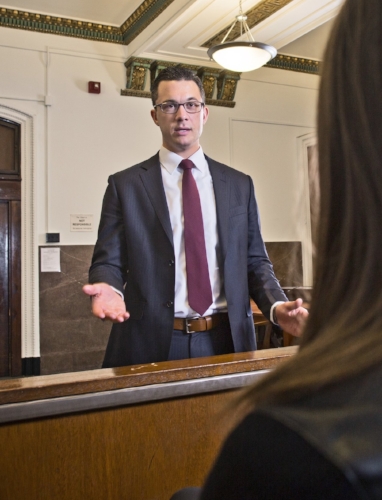
Philadelphia Criminal Defense Lawyer Zak T. Goldstein, Esq.
If you are charged with a VUFA offense, you need an attorney who has the knowledge and expertise to fight your case. Our award-winning Philadelphia criminal defense lawyers have successfully fought countless cases at trial and on appeal. We offer a 15-minute criminal defense strategy session to any potential client. Call 267-225-2545 to discuss your case with an experienced and understanding criminal defense attorney today.