Philadelphia Criminal Defense Blog
PCRA Court Grants New Trial for Attorney Goldstein’s Client in Cumberland County Sexual Assault Case Due to Trial Counsel’s Failure to Call Character Witnesses

Criminal Defense Lawyer Zak T. Goldstein, Esquire
Philadelphia criminal defense lawyer Zak T. Goldstein, Esquire, of Goldstein Mehta LLC recently won a new trial for a client in the case of Commonwealth v. J.R. In an opinion and order issued on June 9, 2026, the Cumberland County Court of Common Pleas granted J.R.’s Post-Conviction Relief Act petition, finding that trial counsel provided the ineffective assistance of counsel by failing to call character witnesses at J.R.’s trial on sexual assault charges. The court ordered a new trial and set unsecured bail, clearing the way for J.R.’s release after he had served nearly two years in state prison.
Commonwealth v. J.R.: The Allegations and the Trial
The case arose from a night out in March 2023. J.R. and three co-workers went out drinking after their shifts ended at the restaurant where they worked. At the end of the night, one co-worker drove the group home in his small two-door car. A second co-worker rode in the front passenger seat, while J.R. and the complainant sat in the back seat. The complainant became heavily intoxicated over the course of the evening and later alleged that J.R. forced the complainant to engage in sexual contact, including oral sex, during the drive. The front seat passenger testified that she heard the complainant say “help me” and turned to see J.R. holding the complainant’s hand against him. The driver testified that he did not observe any sexual contact. After J.R. was dropped off, the complainant disclosed the alleged assault to the two other co-workers, and they went to the police the following morning.
J.R. was arrested and proceeded to a jury trial in May 2024. He took the stand in his own defense and admitted that sexual contact occurred, but he testified that it was entirely consensual. The jury found him guilty of involuntary deviate sexual intercourse, sexual assault, and related offenses, and the trial court sentenced him to four and a half to nine years’ incarceration. The Superior Court affirmed the judgment of sentence on direct appeal in December 2025.
The PCRA Petition
J.R. retained Attorney Goldstein, who filed a timely Post-Conviction Relief Act petition on his behalf. The petition raised two claims of ineffective assistance of counsel: first, that trial counsel failed to impeach the driver, a Commonwealth witness, with his extensive history of crimen falsi convictions, and second, that trial counsel failed to call character witnesses on J.R.’s behalf even though several witnesses were available and willing to testify to his reputation for peacefulness and non-violence. The court held an evidentiary hearing in May 2026 at which trial counsel testified.
To win a new trial based on the ineffective assistance of counsel, a PCRA petitioner must prove that the underlying claim has arguable merit, that counsel had no reasonable strategic basis for the act or omission, and that counsel’s error prejudiced the petitioner, meaning there is a reasonable probability that the outcome of the trial would have been different. Under the Pennsylvania Supreme Court’s decision in Commonwealth v. Sneed, where the claim involves the failure to call a witness, the petitioner must also show that the witness existed, that the witness was available and willing to testify for the defense, and that counsel knew of or should have known of the witness.
The Court’s Ruling: Character Witnesses Were Critical in a He Said/She Said Case
At the hearing, it was uncontested that character witnesses existed, that they were available and willing to testify for the defense, and that trial counsel knew about them. Trial counsel testified that he chose not to call them because he did not want to distract the jury from his trial strategy, which was to argue that it would have been impossible for J.R. to sexually assault the complainant in the back seat of a small, moving car. He also acknowledged that he never consulted with J.R. about the decision.
The PCRA court rejected that explanation. As the court observed, the defense actually presented at trial was not impossibility. J.R. testified that the sexual contact was consensual, which made the trial a classic he said/she said credibility contest between J.R. and the complainant. Trial counsel himself recognized that the verdict would turn on the jury’s assessment of those two witnesses, yet he neither consulted his client about ways to bolster his credibility nor called any of the available character witnesses who could have done so. Calling character witnesses could not have undermined the defense theory because the defense theory hinged entirely on J.R.’s credibility.
Pennsylvania law treats character evidence as substantive evidence, not a mere formality. Evidence of a defendant’s good reputation may, by itself, create a reasonable doubt and require a verdict of not guilty. The principle carries particular weight in sexual assault cases. As the Pennsylvania Supreme Court explained in Commonwealth v. Weiss, in a case “where there are only two direct witnesses involved, credibility of the witnesses is of paramount importance, and character evidence is critical to the jury’s determination of credibility.” Relying on Weiss and the Superior Court’s recent decision in Commonwealth v. Alceus, the court concluded that trial counsel had no reasonable basis for failing to call character witnesses and that J.R. suffered prejudice as a result.
The court denied the separate claim concerning the impeachment of the driver. Although it agreed that the claim had arguable merit because trial counsel knew about the crimen falsi convictions and chose not to use them, the court found that counsel had a reasonable strategic basis for that decision and that no prejudice resulted. The driver did not witness the alleged assault, and his testimony was cumulative of the testimony of the other Commonwealth witnesses. The new trial was therefore granted on the character witness claim.
The Result
The court granted the PCRA petition and ordered a new trial. Because J.R. had previously posted $250,000 bail and had already served approximately twenty-two months of his fifty-four month minimum sentence, the court set bail at $250,000 unsecured pending the retrial, with the condition that he have no contact with the complainant. That ruling allows J.R. to be released from state prison while the case is pending.
This decision highlights the critical role that character evidence plays in Pennsylvania criminal trials. In a sexual assault case that comes down to the word of the complainant against the word of the defendant, evidence of the defendant’s reputation for peacefulness and non-violence may be the only corroboration the defense can offer, and the law recognizes that it may by itself create a reasonable doubt. Trial counsel must investigate potential character witnesses, consult with the client about whether to call them, and have a real strategic reason before leaving that evidence on the table. When counsel fails to do so, the PCRA may provide a path to a new trial.
Facing criminal charges or appealing a criminal case in Pennsylvania?

Criminal Defense Lawyer Zak T. Goldstein, Esquire
If you are facing criminal charges or under investigation by the police, we can help. We have successfully defended thousands of clients against criminal charges in courts throughout Pennsylvania and New Jersey. We have successfully obtained full acquittals and dismissals in cases involving charges such as Conspiracy, Aggravated Assault, Rape, Violations of the Uniform Firearms Act, and First-Degree Murder. We have also won criminal appeals and PCRAs in state and federal court, including the successful direct appeal of a first-degree murder conviction and the exoneration of a client who spent 33 years in prison for a murder he did not commit. Our award-winning Philadelphia criminal defense lawyers offer a free criminal defense strategy session to any potential client. Call 267-225-2545 to speak with an experienced and understanding defense attorney today.
Third Circuit: COVID-Era Courtroom Closure and Marshals Blocking the Defendants’ Mothers’ Entry Violated the Sixth Amendment, but Convictions Affirmed Anyway
Criminal Defense Lawyer Zak T. Goldstein, Esquire
The United States Court of Appeals for the Third Circuit has decided United States v. Girard and United States v. Harry, Nos. 24-2097 & 24-2148 (3d Cir. May 26, 2026), holding that the District Court violated the defendants’ Sixth Amendment right to a public trial twice during a federal racketeering trial in the U.S. Virgin Islands. On the first day of trial, the court required every spectator to watch from an overflow room rather than in the courtroom. On several later days, federal marshals stationed at the courtroom door kept the defendants’ mothers from coming in, even though there were seats available.
Despite finding two constitutional violations, the Court affirmed the convictions. The defendants had not thoroughly objected at the time (although their lawyers repeatedly expressed concerns), so the Court reviewed the issue for plain error. Under that more demanding standard, the Court concluded that a retrial was not warranted because the trial as a whole still had what it called the “publicity, neutrality, and professionalism” the Sixth Amendment is meant to protect.
The Facts
The defendant was the head of a violent drug-trafficking enterprise in the U.S. Virgin Islands. The co-defendant served as the enterprise’s armorer. A jury convicted the defendant of 22 counts of drug, firearm, racketeering, and other charges, and convicted the co-defendant of seven counts of racketeering and firearms charges.
The trial took place in March 2022, the day after the Chief Judge of the District Court of the Virgin Islands issued an order incrementally reinstating in-person proceedings that had been suspended during the COVID-19 pandemic. Because of ongoing concerns about the virus, the District Court restricted who could be inside the courtroom. The jury sat in the jury box, and the court set up an overflow room with an audiovisual feed for anyone who could not watch from inside the courtroom.
After the jury was selected, but before opening arguments, the defendant’s lawyer asked what arrangements had been made for the public, and asked that at least the defendant’s family be allowed in “to comply with the Constitution.” The trial judge initially refused, then agreed to allow some spectators in beginning the next day. For all of day one, however, every spectator, including the defendants’ mothers, was directed to the overflow room.
Things did not improve on the days that followed. The co-defendant’s lawyer reported the next morning that the co-defendant’s mother was still not in the courtroom. Several days later, defense counsel pointed to a newspaper article reporting that the overflow room had not opened until around 10:00 a.m. on one of the trial days. The judge called that an “inadvertent error.” A day after that, the co-defendant’s lawyer told the judge that federal marshals had again prevented the co-defendant’s mother from entering the courtroom that morning, and the judge said he would “deal with that.”
After the verdicts, both defendants moved for a new trial. The District Court held an evidentiary hearing and credited the testimony of the defendant’s mother, who said that for most of the trial, federal marshals had told her and the co-defendant’s mother to watch from the overflow room without ever explaining why. The District Court nevertheless denied the motions, finding that seats had been available in the courtroom on a first-come basis and that any technical problems with the audiovisual feed had been brief.
The Sixth Amendment Right to a Public Trial
The Sixth Amendment guarantees criminal defendants the right to a public trial. The Supreme Court has long recognized that this right is rooted in centuries of Anglo-American practice and that trials are presumptively “open to all who care to observe.” Richmond Newspapers, Inc. v. Virginia, 448 U.S. 555, 564 (1980) (plurality opinion). The right is not absolute, but courts can only close the courtroom in rare circumstances. Under Waller v. Georgia, 467 U.S. 39 (1984), a trial court has to identify an overriding interest that justifies closure, consider less restrictive alternatives, and make a record explaining its decision.
Excluding specific spectators, rather than closing the courtroom entirely, requires a less demanding showing, what the Third Circuit described as a “substantial reason.” But the trial court still has to consider alternatives and put its reasoning on the record. That requirement traces back to two older Third Circuit cases, U.S. ex rel. Laws v. Yeager, 448 F.2d 74 (3d Cir. 1971), and United States v. Kobli, 172 F.2d 919 (3d Cir. 1949).
The Court Finds Two Sixth Amendment Violations
Applying that framework, the Third Circuit identified two violations.
The first was the day-one closure of the courtroom. By directing every interested spectator to the overflow room, the District Court had effectively closed the courtroom, and it never explained why a less restrictive option, such as letting in a smaller, socially distanced audience, would not work. The Government argued that the closure was “trivial” because spectators could still watch through the audiovisual feed. The Third Circuit disagreed. One of the purposes of the public trial right is to keep judges, jurors, and lawyers conscious of the seriousness of what they are doing, and the physical presence of spectators serves that purpose more meaningfully than remote viewing. The closure also covered opening arguments and the start of evidence, which the Court considered substantial.
The Court did agree that protecting trial participants from COVID-19 can qualify as an overriding interest that justifies some courtroom restrictions, joining the Second, Ninth, and Tenth Circuits on that point. But because the trial court allowed in-person spectators with social distancing on every later day, the record gave no reason why day one had to be different.
The second violation came after the District Court reopened the courtroom. The Third Circuit found that, despite the formal reopening, federal marshals continued to turn away the defendants’ mothers for several days, even when seats were available. The Court rejected the District Court’s finding that seats had been available on a first-come basis as inconsistent with its own credibility determination favoring the defendant’s mother. And it held that the trial judge’s lack of personal awareness of the marshals’ exclusions did not cure the problem. Joining the First, Second, and Seventh Circuits, the Third Circuit held that exclusions by courtroom staff can violate the public trial right even when the judge does not know about them.
Why the Convictions Were Affirmed
The convictions still stood. Neither defendant had made a clear, contemporaneous objection to the closures, which meant the Court could only reverse on plain error. Under United States v. Olano, 507 U.S. 725, 732 (1993), a defendant who fails to object must show that there was an error, that the error was plain, that it affected substantial rights, and that it seriously affected the fairness, integrity, or public reputation of the proceedings.
The Court held that the first three requirements were either satisfied or could be assumed, but it declined to find that the errors affected the integrity of the proceedings. Drawing on its 2020 decision in United States v. Williams, 974 F.3d 320 (3d Cir. 2020), the Court explained that the trial as a whole retained the “publicity, neutrality, and professionalism” the public trial right protects. The public could observe the trial at all times, either inside the courtroom or through the audiovisual feed. The day-one closure was a good faith COVID measure rather than an attempt at secrecy. The trial judge fixed the marshals’ misconduct as soon as he learned about it. And the trial itself had run for three weeks, involved nearly 50 witnesses, and concluded more than four years before the appeal was decided. A retrial under those circumstances, the Court said, would be a “windfall inimical to the interests of justice.”
The Court also rejected the co-defendant’s separate due process and compulsory process claims. There was no evidence in the record of any off-the-record meeting between the trial judge and Harry’s codefendant witnesses, who had invoked the Fifth Amendment through their own counsel. The Court declined to require question-by-question invocation of the privilege where Harry had never disputed the witnesses’ entitlement to invoke it.
The Takeaway
Although the convictions were affirmed, Girard is an important decision on the public trial right. It confirms that even in the middle of a public health emergency, a federal trial court cannot simply close the courtroom without first considering less drastic ways to protect everyone. A blanket order sending every spectator to an overflow room, with no explanation of why a socially distanced audience would not work, is not enough.
It also makes clear that the Sixth Amendment reaches into how courtrooms are actually staffed. When a marshal or other court officer turns a family member away at the door, that exclusion counts, even if the trial judge has no idea it is happening. The Third Circuit has now joined the majority of circuits that treat those exclusions as part of the public trial inquiry.
At the same time, Girard is another illustration of how difficult it is to win on appeal when an objection was not made at trial. Even where the Court of Appeals agrees that a constitutional violation occurred, plain error review allows it to leave the conviction in place if the trial as a whole appears fair. That is one of the reasons that having an experienced criminal trial lawyer in the courtroom matters so much. Issues that are not raised at the right moment can be very hard to fix later.
Facing Criminal Charges? We Can Help.

Goldstein Mehta LLC Criminal Defense
If you or a loved one are facing criminal charges, serving a state or federal sentence, or considering a direct appeal, post-conviction petition, or federal habeas petition, we can help. We have successfully defended thousands of clients against criminal charges in courts throughout Pennsylvania and New Jersey, and we have won criminal appeals and PCRAs in state and federal court, including the successful direct appeal of a first-degree murder conviction and the exoneration of a client who spent 33 years in prison for a murder he did not commit. Our award-winning Philadelphia criminal defense lawyers offer a free criminal defense strategy session to any potential client. Call 267-225-2545 to speak with an experienced and understanding defense attorney today.

PA Supreme Court: ShotSpotter Alert Plus Furtive Movements and Walking Away Provides Reasonable Suspicion
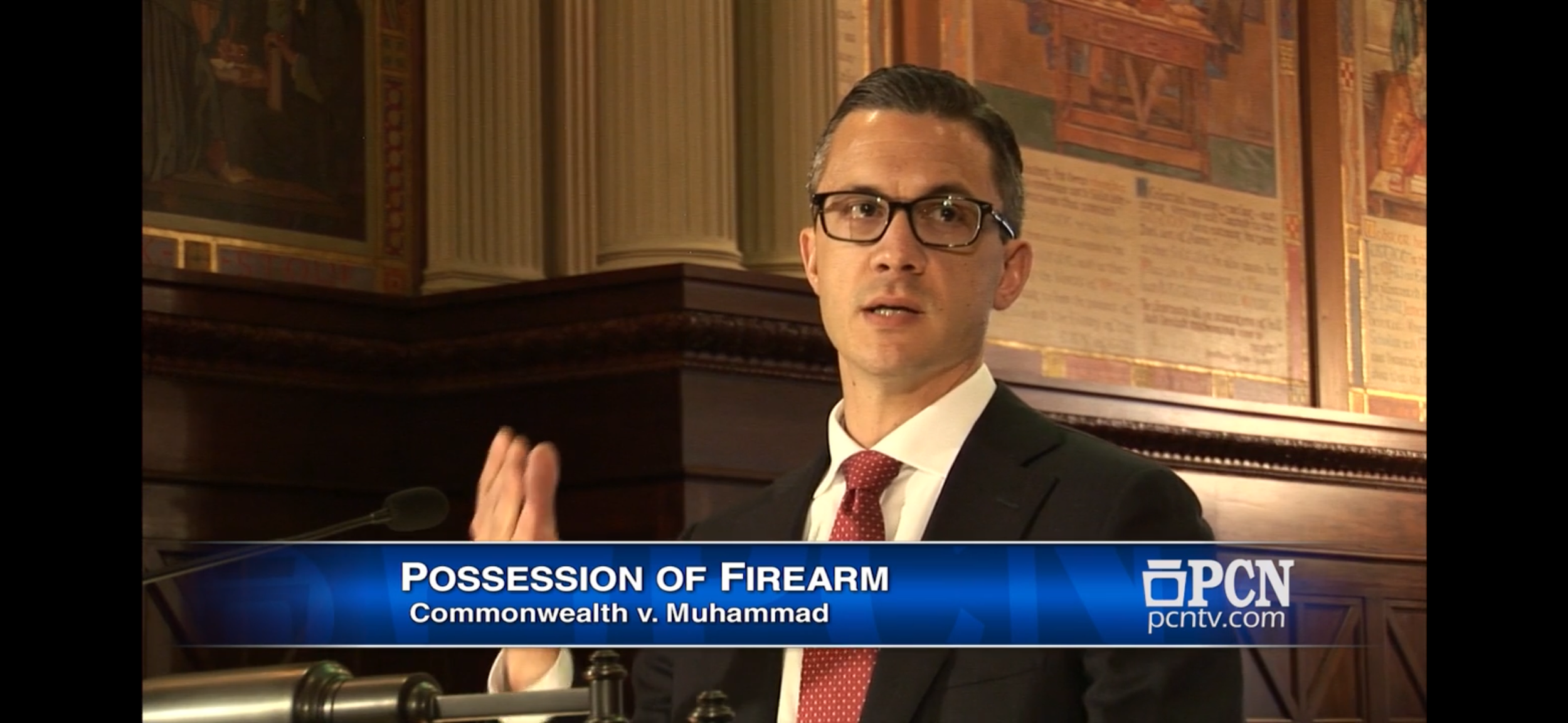
Philadelphia Criminal Defense Lawyer Zak T. Goldstein, Esquire
The Pennsylvania Supreme Court has decided Commonwealth v. Foster, No. 12 WAP 2024 (Pa. May 19, 2026), holding that the totality of the circumstances supported reasonable suspicion to detain the defendant after a ShotSpotter alert reported gunfire on a residential block at 2:00 a.m. The Court declined to address whether ShotSpotter alerts, standing alone, are reliable enough to support a Terry stop, treating the alert here as one factor among several.
There is also a meaningful win for the defense bar tucked inside the opinion. The Court refused to credit the Commonwealth’s “high-crime area” argument because the officer’s testimony was too vague and was not tied to the time of the stop. That portion of the decision reinforces last year’s ruling in Commonwealth v. Lewis, 343 A.3d 1016 (Pa. 2025), and gives defense counsel a usable tool at suppression hearings.
The Facts
At around 2:00 a.m. on September 17, 2019, a Pittsburgh police officer received a ShotSpotter alert reporting a single gunshot near 1439 Hoffman Street. A second alert reported four more shots at the same location while the officer was en route. He reached the intersection of Hoffman and Chateau Streets about ten to fifteen seconds after the second alert and saw a parked car with its headlights on. The defendant was in the driver’s seat. A woman was in the passenger seat. They were the only people on the street.
As the officer turned onto Hoffman Street and activated his overhead lights, the defendant got out of the car and walked toward a nearby residence. The officer testified that the female appeared to be “moving around in the car trying to grab things,” including her purse. The officer exited his cruiser and ordered the defendant to return to the street. When he did not comply, officers drew their weapons and forcibly handcuffed him.
After the seizure, officers recovered shell casings near the car and a firearm in the woman’s purse. The woman later admitted she had accidentally discharged the weapon inside the vehicle. The defendant meanwhile, smelled of alcohol and his eyes were glassy. He failed field sobriety testing, and his BAC came back at .200. He was charged with DUI and with driving while his operating privilege was suspended.
The defendant filed a motion to suppress, arguing that the seizure was not supported by reasonable suspicion. The trial court denied the motion, the defendant was convicted at a bench trial, and the Superior Court affirmed in an unpublished memorandum. The Supreme Court granted allocatur to address whether the lower courts placed too much weight on the defendant’s spatial and temporal proximity to the ShotSpotter alerts.
The Legal Framework
Article I, Section 8 of the Pennsylvania Constitution and the Fourth Amendment both prohibit unreasonable seizures. An investigative detention (a Terry stop) must be supported by reasonable suspicion of criminal activity. Reasonable suspicion is less demanding than probable cause but still requires “specific and articulable facts” supplying a “particularized and objective basis for suspecting the particular person stopped of criminal activity.” The stop must be “justified at its inception,” and facts that develop only after the seizure cannot retroactively support it.
The parties agreed that the seizure occurred when the officer exited his cruiser and ordered the defendant back to the street. The question was whether the totality of the circumstances at that moment supplied reasonable suspicion.
The Supreme Court’s Holding
The Court held that the totality of the circumstances supported reasonable suspicion. It identified four factors: (1) two ShotSpotter alerts indicating gunfire in a residential neighborhood in the middle of the night; (2) the officer’s rapid response, which left limited opportunity for a shooter to flee the immediate area; (3) the fact that the defendant and the woman were the only people present at the precise location of the alerts; and (4) what the Court characterized as the pair’s “furtive and evasive behaviors” when the officer arrived — the woman moving around inside the car as the cruiser approached with overhead lights activated, and the defendant getting out of the car and walking toward a private residence as the officer pulled up.
The Court declined to treat ShotSpotter alerts as the equivalent of anonymous tips. The defendant and amici — the ACLU, the Pennsylvania Innocence Project and PACDL, and the Allegheny County Public Defender’s Office — had urged the Court to adopt that framework and require independent corroboration of the alert before it could be used to justify a stop. The Court called the proposed framework one that would “unnecessarily complicate[ ] the straightforward legal issue presented,” and resolved the case on a totality-of-the-circumstances basis instead. Importantly, the Court did not actually decide whether ShotSpotter is reliable. It described the technology’s reliability as not properly preserved and ultimately immaterial on the record before it.
The High-Crime Area Argument Fails
The most useful part of the opinion for defense practitioners is the Court’s rejection of the Commonwealth’s “high-crime area” argument. The entirety of the proof was an officer’s answer to a leading question: asked whether the area was “known as a high-crime area,” he replied, “Manchester has its hot spots, yes,” and confirmed that the location “has been” a hot spot “in the past.”
Citing Lewis, the Court reiterated that “merely intoning buzzwords is never sufficient to prove an area is high in crime,” and that conclusory testimony characterizing an area “in broad generalities” does not establish the factor. The Commonwealth must also tie the testimony to the time of the stop, not to some unspecified moment “in the past.” The Court accordingly removed the high-crime area factor from the analysis.
Although the use of ShotSpotter as a factor is bad for the defense, the high crime analysis is helpful. The high crime area label has been doing a lot of heavy lifting in Terry stop cases for years, often supported by nothing more than an officer reciting the magic words on direct. After Lewis and now Foster, that testimony has to come with specifics: what kind of crime, how the officer knows, and a nexus to the time and place of the stop, or it does not count at all.
The Takeaway
Foster expands the set of circumstances in which a ShotSpotter alert can be used to justify an investigative detention in Pennsylvania. The Court did not hold that a ShotSpotter alert alone supports reasonable suspicion, and it expressly declined to decide whether ShotSpotter alerts are reliable enough to be treated like other evidence of crime. But it did hold that an alert, combined with the defendant’s presence at the reported location moments after the alert, the absence of any other people on the scene, and what the Court characterized as furtive and evasive behavior, is enough.
At the same time, the decision continues the Court’s push, begun in Lewis, to require more than buzzwords before an area can be treated as a high-crime area in the reasonable-suspicion analysis. A one-line answer from an officer that the location has been a “hot spot” in the past is no longer sufficient on its own.
Facing Criminal Charges? We Can Help.

Goldstein Mehta LLC Criminal Defense
If you or a loved one are facing criminal charges, serving a state sentence in Pennsylvania, or exploring a direct appeal or PCRA petition, we can help. We have successfully defended thousands of clients against criminal charges in courts throughout Pennsylvania and New Jersey, and we have won criminal appeals and PCRAs in state and federal court — including the successful direct appeal of a first-degree murder conviction and the exoneration of a client who spent 33 years in prison for a murder he did not commit. Our award-winning Philadelphia criminal defense lawyers offer a free criminal defense strategy session to any potential client. Call 267-225-2545 to speak with an experienced and understanding defense attorney today.

PA Supreme Court: Trial Courts May Reject a Nolle Prosse Motion Under the “Valid and Reasonable” Standard
Criminal Defense Lawyer Zak T. Goldstein, Esquire
The Pennsylvania Supreme Court has decided Commonwealth v. Harrison, holding that a trial court still gets the final say on whether a district attorney may abandon a case by entering a nolle prosequi or nolle prosse. The Court reaffirmed the old Reinhart test: the Commonwealth’s reason for dropping the case must be valid and reasonable, and refused to extend the much more deferential In re Ajaj standard, which only applies to a DA’s decision to disapprove a private criminal complaint at the front end of a case.
The Facts
In May 2018, the complainant walked into a Santander Bank in York and tried to withdraw money without ID. His mother later told police he had just been released from the hospital and seemed delusional. The complainant refused to leave, and the bank called 911.
The defendant, who was a police officer, responded. After the complainant would not leave, the defendant tried twice to Tase him without success. A second officer arrived, and the two of them wrestled the complainant to the ground, handcuffed him, and walked him out to the patrol car. When the complainant would not bend down to get into the back seat, the defendant said he was going to drive-stun the complainant in the thigh. Instead of drawing his Taser, he drew his Glock, put it against the complainant’s thigh, and pulled the trigger. The complainant yelled, “Dude why’d you shoot me?” He spent 17 days in the hospital.
The state police charged the defendant with one count of negligent simple assault, a second-degree misdemeanor. The magistrate held the case for court.
The DA Tries to Drop the Case — Twice
The York County DA never tried the case. Instead, it filed two motions to nolle prosequi or suspend/dismiss the charges.
The first motion argued that prosecution was no longer in the interests of justice. The defendant had a 16-year career, was remorseful, his department had been disbanded, and he had agreed to speak to police cadets about avoiding this kind of mistake. The DA said continued prosecution would be punishment for punishment’s sake. The trial court denied the motion. The complainant, the actual victim, testified that no one from the DA’s office had ever spoken to him and that he had learned about the motion from the newspaper.
The second motion took a different angle. A bank customer named Harry Harrington, who had witnessed the shooting, had died in March 2019. The DA now claimed Harrington was the only independent witness and that without him the Commonwealth could not meet its burden of proof. The trial court called the motion “quite lame.” Harrington had died before the DA filed the first motion, in which the DA did not even mention his death. There were other witnesses, including the bank cleaner, who had no connection to either the police or the victim and who had already testified at the preliminary hearing that she saw the defendant shoot the complainant.
The Superior Court affirmed. The DA appealed to the Supreme Court.
The Supreme Court’s Decision
Chief Justice Todd wrote for the majority, joined by Justices Donohue, Wecht, and Brobson. Justices Dougherty and Mundy concurred in part and dissented in part. Justice McCaffery did not participate.
The Court refused to give the DA the deference it wanted. Ajaj holds that a court may overturn a DA’s rejection of a private criminal complaint only for bad faith, fraud, or unconstitutionality. The DA argued the same narrow standard should apply when it wants to drop a case it already filed. The Court said no. Once the DA brings charges, gets a magistrate to hold them for court, and pulls the judiciary into the case, the trial court is not a rubber stamp. It can, and must, independently evaluate whether the DA’s reason for walking away is valid and reasonable.
The Court traced the rule back to an 1850 statute that has always required the trial court’s written approval before a DA can enter a nolle prosequi. That requirement now lives in the Judicial Code and in Pa.R.Crim.P. 585. The Court reaffirmed Reinhart: the trial court accepts the DA’s factual claims if they are supported by a preponderance of the evidence, and then makes its own legal judgment on whether the reason is good enough.
Applying that test, the Court agreed with the trial court that the DA’s second reason, Harrington’s death, was neither valid nor reasonable. Other witnesses could establish what happened, there was video from inside the bank, and the DA had not bothered to mention Harrington’s death in its first motion more than a year after he died.
Why It Matters
This decision keeps the trial court in the picture. A DA cannot get a case held for court and then unilaterally walk away because the office has changed its mind, especially when the victim opposes the dismissal. The reason has to hold up to actual scrutiny.
It is also a useful boundary on Ajaj, which Commonwealth offices have been trying to stretch into other contexts. Harrison confines it to the front end of a case — the decision to charge in the first place — and leaves Reinhart in charge of everything that comes after.
The case cuts both ways for the defense. A defendant who has negotiated a quiet nolle prosse cannot count on the trial court rubber-stamping it. But a defendant whose case the DA is trying to drop in a way that hurts the defense, for example, dropping then refiling, or dropping to avoid an unfavorable ruling, has real ammunition to insist that the court take an independent look at the reason.
Facing Criminal Charges? We Can Help.

Goldstein Mehta LLC Criminal Defense
If you or a loved one are facing criminal charges, serving a state sentence in Pennsylvania, or exploring a direct appeal or PCRA petition, we can help. We have successfully defended thousands of clients against criminal charges in courts throughout Pennsylvania and New Jersey, and we have won criminal appeals and PCRAs in state and federal court — including the successful direct appeal of a first-degree murder conviction and the exoneration of a client who spent 33 years in prison for a murder he did not commit. Our award-winning Philadelphia criminal defense lawyers offer a free criminal defense strategy session to any potential client. Call 267-225-2545 to speak with an experienced and understanding defense attorney today.