

Philadelphia Criminal Defense Blog

PA Supreme Court: Rule 600 Speedy Trial Motion Not Always Waived by Defendant’s Bench Warrant

Philadelphia Criminal Defense Lawyer Zak T. Goldstein, Esq.
The Pennsylvania Supreme Court has decided the case of Commonwealth v. Barbour, holding that a defendant does not waive the speedy trial protections of Rule 600 by failing to appear for court without cause after the 365-day period for bringing a defendant to trial has already expired. Barbour is the second recent pro-defense decision from the Pennsylvania Supreme Court in recent months, suggesting that the Court has finally recognized that recent decisions of the Superior Court had completely eviscerated the rule’s protections and allowed defendants to languish in prison for years without trials through no fault of their own.
The Issues in Commonwealth v. Barbour
The issue in Barbour was whether a defendant’s unexcused failure to appear for court waives the protections of Rule 600 even where the defendant’s 600 rights were already violated prior to the date on which the defendant failed to appear. As a general rule, Rule 600 of the Pennsylvania Rules of Criminal Procedure requires the Commonwealth to bring a criminal defendant to trial within 365 days of the filing of the complaint. If the Commonwealth fails to bring the defendant to trial within that time period, then the case should be dismissed with prejudice, meaning the Commonwealth cannot re-file the charges.
In theory, the rule seems simple. In practice, it is much more complicated for a number of reasons. First, time between court dates for which the defendant is responsible for the delay do not count towards the 365-day calculation. This means that if the defendant requests a continuance of a hearing, then the time until the next hearing does not count for Rule 600 purposes.
Second, over the years, the Superior Court has created all sorts of absurd exceptions for why time does not count against the Commonwealth even when it’s the Commonwealth’s fault that that the case was continued. For example, trial courts routinely fail to count time during which the prosecutor was “duly diligent” but nonetheless could not proceed to trial on a given date. These types of continuances which do not count against the Commonwealth could include periods of time during which the defendant was not brought to court from custody or police officers were sick or injured on duty, or even where the prosecution simply needed more time to investigate the case and prepare for trial. Additionally, where the prosecution is ready to proceed but the trial judge is busy hearing a different case, the time will often be excluded from the Rule 600 calculation.
Recent years have shown a marked trend of appellate courts forgiving every possible delay because of the reluctance to dismiss serious criminal charges based on what many would view as a technicality. However, the failure to protect a defendant’s right to a speedy trial has real costs to both the defense and the prosecution. When a defendant remains in jail waiting for trial for a year or more, the defendant could lose his or her job, home, and contact with his or her family all while presumed innocent.
Likewise, the prosecution’s case generally does not get better with age; witnesses may move out of the jurisdiction or forget key details about the incident, police officers may retire or get indicted, and prosecutors and detectives may lose evidence. Thus, Rule 600 really protects both sides. It protects the accused, who should not have to deal with the threat of criminal charges or pre-trial incarceration for lengthy periods of time, and it protects the prosecution, who benefits from proceeding to trial in a reasonably prompt manner. After years of decisions excusing endless delay from the courts and prosecutors, the Pennsylvania Supreme Court has finally begun to enforce the protections of Rule 600.
In the prior cases of Commonwealth v. Steltz and Commonwealth v. Brock, the Supreme Court held that a defendant forever waives the protections of 600 by failing to appear for court as required. The rationale behind those decisions was that if a defendant fails to appear and obtains a bench warrant, then the defendant may then be brought to trial at the prosecution’s convenience.
In this case, the defendant obtained a bench warrant for failure to appear back in 2004. In 2014, the defendant was arrested on the bench warrant, and the court scheduled a new trial date. Prior to trial, the defendant moved to dismiss the charges pursuant to Rule 600. The defendant argued that this case was different from Steltzand Brock because in those cases, the defendants bench warranted prior to the expiration of the 365-day period. Here, however, the defendant’s bench warrant was issued after the Commonwealth had already failed to bring him to trial within 365 days. Thus, the defendant argued that he should not be able to waive Rule 600 where the Commonwealth had already violated the rule.
Ultimately, the Supreme Court agreed. It re-affirmed the rule of Brock and Steltz that a bench warrant prior to the expiration of the 365-day period waives Rule 600, but it also held that where the Commonwealth has already violated Rule 600 prior to the bench warrant, the defendant’s unexcused absence at trial does not waive the protections of the rule. This is a good, but narrow, decision which will make the waiver doctrine of Steltz and Brock slightly less punishing for those who have already had their rights violated.

Philadelphia Criminal Defense Attorneys
Facing criminal charges? We can help.
If you are facing criminal charges, we can help. Our award-winning Philadelphia criminal defense lawyers have successfully defended thousands of clients against all types of criminal charges in Pennsylvania and New Jersey. We offer a free criminal defense strategy session to each potential client. Call 267-225-2545 to speak with an experienced and understanding defense attorney today.

When is Simple Assault a misdemeanor of the third degree in Pennsylvania?

Philadelphia Criminal Defense Lawyer Zak Goldstein
The Pennsylvania Superior Court has decided the case of Commonwealth v. Hodges, holding that the defendant bears the burden of proving at sentencing that a “mutual combat” Simple Assault should be graded as a misdemeanor of the third degree instead of a misdemeanor of the second degree. This is an important decision because it makes it easier for the Commonwealth to obtain the conviction for the higher-graded Simple Assault, and that charge cannot be expunged or sealed.
What is the gradation of Simple Assault in PA?
Under Pennsylvania law, there are two types of Simple Assault. The most common variety of Simple Assault is a misdemeanor of the second degree. It simply involves knowingly, intentionally, or recklessly causing or attempting to cause bodily injury to another person. For example, punching someone in the face one time is usually going to be a Simple Assault unless very severe injuries occur. A misdemeanor of the second degree is punishable by up to two years in prison and a $5,000 fine. Simple Assault (M2) also cannot be expunged or sealed pursuant to a limited access order. Therefore, a conviction for Simple Assault as an M2 will stay on your record for life unless you obtain a pardon from the Governor.
Alternatively, Simply Assault can also be a misdemeanor of the third degree. The statute provides that when the Simple Assault was part of a mutual combat, then the court should instead grade Simple Assault as an M3. An M3 is punishable by up to one year in prison and a $2,000 fine. More importantly, Simple Assault (M3) is subject to Pennsylvania’s new limited access order law. This means that if you are convicted of Simple Assault (M3), you may petition the court to seal the conviction after ten years if you remain arrest-free during that period. Although this is not quite the same as an expungement, it drastically reduces the likelihood that potential employers are going to find out about the prior conviction. Law enforcement agencies and state licensing authorities will still have access to it, but the general public will not. Additionally, it is not possible to receive a state prison system for an M3, whereas an M2 could result in a state prison sentence because of the potential two year maximum.
Who has to prove whether the Simple Assault is an M3 or an M2?
The issue in Hodges is whether the Commonwealth or the defendant bears the burden of proving the degree of the Simple Assault. In Hodges, the defendant was convicted of Simple Assault by a jury. He appealed, arguing in the Superior Court that the trial court gave him an illegal sentence when it sentenced him on Simple Assault as a misdemeanor of the second degree because the Commonwealth never proved beyond a reasonable doubt that he had not engaged in a fight by mutual consent.
The Superior Court rejected this argument. It found that the issue of whether the charge should be graded as an M2 or an M3 is a sentencing issue which must be determined by the trial judge. Where the factfinder concludes beyond a reasonable doubt that the defendant has committed a Simple Assault, the default gradation is the misdemeanor of the second degree. However, the defendant may then introduce additional evidence or make argument at sentencing that the judge should reduce the gradation of the charge to the third-degree misdemeanor based on the mutual consent section. In Hodges, the defendant never made that argument at sentencing, and therefore, the claim was waived. Had the defendant made this argument at sentencing, it is possible that the court would have reduced the gradation of the charge. Unfortunately, his defense attorney did not.
Notably, the VUFA 6106 gun charge statute which prohibits carrying a concealed firearm without a license has a similar gradation scheme. By default, a violation of VUFA 6106 is a felony of the third degree. However, the appellate courts have held in prior cases that the defendant may ask the court to find that a VUFA 6106 conviction should be graded as a misdemeanor of the first degree if the defendant can show that he or she was otherwise eligible to obtain a concealed carry permit and was not facing any other charges at the same time. Thus, the Superior Court has held that it is the defendant's burden in these types of cases to show that the defendant is eligible for a reduction in gradation. It is extremely important that defense counsel be aware of this burden as it may be too late to make the argument on appeal as it was for Hodges.
Facing criminal charges? We can help.

Philadelphia Criminal Defense Lawyers
If you are facing criminal charges in PA or NJ, we can help. We have successfully defended thousands of clients in assault cases and against all types of criminal charges. We offer a free 15-minute criminal defense strategy session to each potential client. Call 267-225-2545 to speak with an experienced and understanding criminal defense attorney today.

PA Superior Court: Violation of Philadelphia Police Directives Does Not Require Suppression of Drugs

Philadelphia Criminal Defense Lawyer Zak T. Goldstein, Esquire
The Pennsylvania Superior Court has decided the case of Commonwealth v. McCleary, holding that suppression of the evidence is not required when Philadelphia Police Officers violate their own police department’s directives. In McCleary, the Court reversed the decision of the trial court and ruled that drugs recovered by the police officers may be admissible at trial even though police did not follow department protocol related to obtaining consent to a search of a private home.
The Facts of Commonwealth v. McCleary
In McCleary, Philadelphia police officers responded to a radio call for a burglary in progress at a certain address. When they arrived at that address, they walked into the eventual-defendant’s house through an open door. In the living room, they found the defendant speaking with two other police officers. The arriving officers relieved the two who had already arrived and tried to figure out what was going on.
The defendant told the police officers that a woman who was present on the scene had tried to break into his home and that he had a valid Protection from Abuse (“PFA”) order against her. The woman responded that she lived there, had the right to be present in the home, and that she had belongings in the second-floor bedroom which would prove that she lived there. The officers did not take any steps to verify if the defendant in fact had a valid PFA.
Instead, the officers asked the defendant if they could see if the woman had belongings in the second-floor bedroom. The defendant twice told them that they could. The officers then walked upstairs to the bedroom. In the bedroom, they found in plain view a scale, a sandwich bag with marijuana, a box of unused drug packaging, eleven bags of crack cocaine, and clear plastic Ziploc bags. The defendant told the officers that the drugs belonged to him. The officers arrested him and charged him with Possession with the Intent to Deliver.
Motion to Suppress the Drugs
The defendant filed an omnibus pre-trial motion to suppress his statements and the drugs. The trial court held a hearing on the motion to suppress and ultimately granted the motion to suppress. The trial judge found that police violated with Philadelphia Police Department Directive 5.7, Sections 12 through 16, which address the procedure by which Philadelphia Police Officers are expected to obtain valid consent to search a home. The court found that the officers violated their own police directives by failing to obtain signed consent, failing to inform the defendant of his right to refuse consent, failing to consult with a supervisor, and failing to verify the defendant’s valid PFA and arrest the woman who was alleged violating it. The trial court granted the motion to suppress and ruled that the evidence would be inadmissible at trial, thereby essentially excluding the Commonwealth’s entire case.
The Commonwealth’s Appeal
The Commonwealth appealed to the Superior Court. In the appeal, the Commonwealth argued that Philadelphia Police Directives do not have the force of law. The Commonwealth argued that because police are not required by law or the constitution to follow them, the remedy for a violation of the directives should not be suppression of the evidence.
The Superior Court agreed with the Commonwealth’s arguments. It found that exclusion of the evidence via a successful Motion to Suppress is only required where the Government has violated a person’s right to be free from an unreasonable search and seizure as provided by the Fourth Amendment to the United States Constitution and Article I Section 8 of the Pennsylvania Constitution. Exclusion is not automatically warranted simply because the police failed to comply with a Rule of Criminal Procedure or the police department’s directives or regulations. Instead, suppression is only required when the police violate the constitution or certain statutes.
When can police search a home without a warrant?
The Superior Court held that the question was not whether police violated their directives; instead, the question which the trial court should have addressed was whether the police obtained constitutionally valid consent to search the property. Although law enforcement officers must ordinary obtain a search warrant prior to searching a home, there are some exceptions to this rule. One of the main exceptions to the warrant requirement is consent. If you tell the police that they can search your house, then they do not have to get a warrant prior to doing so.
How will a court decide if police voluntarily obtained consent to search a home?
In evaluating consent, previous appellate decisions have suggested that courts consider the following factors:
the presence or absence of police excesses;
whether there was physical contact;
whether police directed the citizen’s movements;
police demeanor and manner of expression;
the location and time of the interdiction;
the content of the questions and statements
the existence and character of the initial investigative detention, including its degree of coerciveness;
the degree to which the transition between the traffic stop/investigative detention and the subsequent encounter can be viewed as seamless, thus suggesting to a citizen that his movements may remain subject to police restraint; and
whether there was an express admonition to the effect that the citizen-subject is free to depart, which is a potent, objective factor.
Here, the Court evaluated the factors and found that there was nothing coercive about the police request to see the rest of the home. Certainly, they should have followed their directives, but their failure to do so did not rise to the level of a constitutional violation. Accordingly, the Superior Court reversed the decision of the trial court and ruled that the drugs may be admissible in the prosecution for Possession with the Intent to Deliver.
Notably, one of the three judges on this panel dissented, arguing that the trial court had in fact found that the police officers simply were not credible on the issue of whether they truly obtained consent. The trial court simply considered the violation of the directives as part of analyzing whether the police were telling the truth. This is important because once the defense files a motion to suppress in Pennsylvania, the Commonwealth must produce sufficient evidence to show that it is more likely than not that the police complied with the United States and Pennsylvania Constitutions during the search and/or interrogation. If the trial judge finds that the police are not credible, then the judge may grant the motion to suppress for that reason even if what the police claim they did was legal. Thus, on remand, the defense may still argue that the judge found that the police were not credible and that the judge should clarify his or her opinion. However, it is clear that as a matter of law, a violation of the Philadelphia Police Department’s Directives does not automatically result in suppression of the evidence.
Facing criminal charges? We can help.

Philadelphia Criminal Lawyers
If you are facing criminal charges, we can help. We have successfully defended thousands of clients at the trial and appellate level in courts throughout Pennsylvania and New Jersey. We know the law and the defenses that will work in your case, and we recognize the types of defenses and arguments that are going to withstand appellate scrutiny. We offer a free 15-minute criminal defense strategy session to each potential client. Call 267-225-2545 to speak with an experienced and understanding defense attorney today.
PA Superior Court: Even Partial Concealment of Firearm Requires Concealed Carry Permit

Criminal Defense Attorney Zak Goldstein
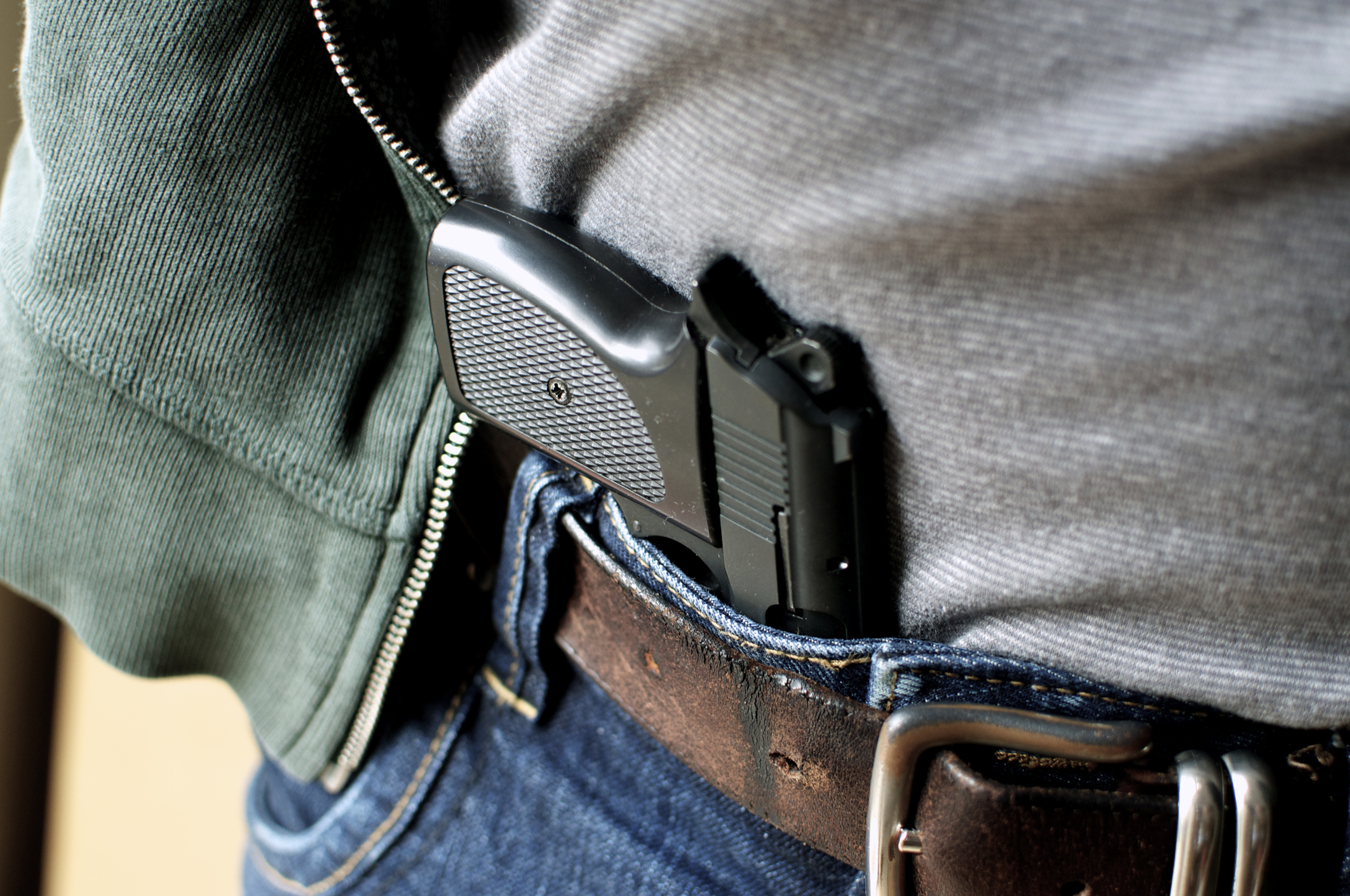
The Pennsylvania Superior Court has decided the case of Commonwealth v. Montgomery, finding that even partial concealment of a gun in a defendant's waistband establishes a prima facie case of a violation of VUFA 18 Pa.C.S. Sec. 6106 (firearms not to be carried without a license) for purposes of a preliminary hearing. Whether the defendant intended to conceal the firearm is likely an issue for trial, but the presence of the gun in the defendant's waistband, even though part of it was still visible, was enough to show concealment at a preliminary hearing. This is a bad case for the defense which makes it even easier for the Commonwealth to prove Violations of the Uniform Firearms Act.
The Facts of Commonwealth v. Montgomery
Montgomery was arrested and charged with various violations of the uniforms firearms act. This case focused on whether or not the evidence presented at his preliminary hearing was sufficient to show that he had concealed the firearm in violation of 18 Pa.C.S. Sec. 6106. The Commonwealth called only witness at the preliminary hearing - the Philadelphia Police Officer who had arrested the defendant. At the hearing, the officer testified that he drove by the defendant and saw him “messing with” what the officer believed to be “the handle of a gun in his waistband.” The officer also testified that he could not see the entire gun. He could only see the the handle.
The defendant then walked into a nearby store. The officer stopped his police car in front of the store and watched the defendant walk out of the store. The officer testified that the defendant saw him and then immediately walked back into the store. The officer exited his vehicle and went into the store. he stopped the defendant in the store, searched him, and did not find the gun. He did locate a gun several feet away on top of a rack of potatoes. The only other person in the store at the time was the cook, who was not very close to the gun.
The officer arrested the defendant and charged him with violations of § 6106 and 18 Pa.C.S. § 6018 (Carrying Firearms on Public Streets or Public Property in Philadelphia). At the preliminary hearing, the Philadelphia Municipal Court Judge dismissed the § 6106 charge because, according to the court, the Commonwealth did not establish at a prima facie level that the defendant concealed the gun.
The Commonwealth then re-filed the complaint (which it is allowed to do under Rule 544 of the Pennsylvania Rules of Criminal Procedure). In Philadelphia, re-filed criminal complaints are typically heard by a Common Pleas Judge who sits in Motions Court. That judge will review the transcript from the preliminary hearing and hear any new evidence or testimony which the Commonwealth wishes to present. That judge will then make a decision as to whether the charges should be held for court or whether the Municipal Court Judge correctly dismissed the charges. Notably, the Superior Court indicated in a footnote that this procedure is not technically correct as the re-filed complaint should be heard by the same Municipal Court Judge who dismissed the case. Alternatively, if the Commonwealth files a motion seeking a different judge for the second preliminary hearing, the case should be heard by a different Philadelphia Municipal Court judge. In this case, neither party objected to the usual procedure of the case being heard in the Court of Common Pleas, so the Superior Court did not do anything to disturb that procedural route. Nonetheless, it may be possible to object to this procedure in the future in order to keep a case in the Municipal Court. Nonetheless, the Commonwealth did not present any new evidence for the Court of Common Pleas Judge, and that judge also agreed that the Commonwealth failed to establish concealment of the firearm. The prosecution appealed to the Superior Court.
What is VUFA § 6106?
VUFA § 6106 basically makes it a crime to carry a concealed gun on your person or in a car without a concealed carry permit. There are some limited exceptions. The statute provides “[a]ny person who carries a firearm in any vehicle or any person who carries a firearm concealed on or about his person, except in the place of abode or fixed business, without a valid and lawfully issued license” commits a felony of the third degree. In other words, a person cannot have a gun without a valid license and conceal that gun or he or she will be in violation of § 6106.
As such, there are several elements to this charge. First, the defendant must have a gun. Second, the person must not have a valid license to possess the gun. Third, the person must not be in his home or fixed place of business. And finally, a defendant must conceal the gun.
When is a gun concealed?
According to the Pennsylvania Supreme Court, any concealment, including a partial concealment, is sufficient to establish the concealment element for § 6106. However, concealment is a fact-specific inquiry. For example, suppose someone is walking down the street in broad daylight with a pistol in his hand. This person is holding the gun up in his hand and tossing it up in the air. The police come and tell him to drop the gun and he puts the gun in his waistband. In this particular fact pattern, the defendant has probably not committed § 6106. Why? Because he made no attempt to conceal the gun. He made it very clear that he had a gun on his person.
Now let’s change the fact pattern. Let’s suppose that someone is walking down the street and he has a gun in his waistband. A concerned bystander then notifies a police officer that this person has a gun. When the police officer approaches this person, he immediately tells the officer that he has a gun and gives it to him. This person has probably committed § 6106 because even though he was honest with the officer and cooperated with him, the gun was technically concealed for purposes of § 6106.
Does the concealment element require the Commonwealth to prove a mens rea (mental state)?
The answer to this question is yes, the Commonwealth must prove that the defendant was at least reckless in concealing the gun. As discussed in our December 9, 2017 blog (unlawful possession of a concealed firearm requires intentional concealment), the Superior Court held in the case of Commonwealth v. Scott that concealment is not established per se just because the gun is in the waistband. This might seem contradictory. However, it is important to remember at what stage each of these cases were decided. In Scott, the Superior Court reached its decision after a trial, and there was evidence in the record to suggest that the gun in that became concealed by accident. In the instant case, the defendant had not yet gone to trial. His case was only at the preliminary hearing level. The burden of proof is much lower at a preliminary hearing than at trial, where the prosecution must prove the case beyond a reasonable doubt.
Thus, in the context of VUFA § 6106, the Commonwealth must prove beyond a reasonable doubt that a defendant intentionally, knowingly, or recklessly concealed the gun. However, the Commonwealth does not have the same burden at a preliminary hearing. At a preliminary hearing, the Commonwealth only needs to establish a prima facie case of guilt. Additionally, the Commonwealth is entitled to all reasonable inferences in its favor. In other words, it is a much lower burden for the Commonwealth to prevail at a preliminary hearing. If a gun is even remotely concealed, then according to the Superior Court, this will be sufficient to establish the element of concealment at a preliminary hearing. That does not mean the defendant will be convicted at trial; only that the defendant should be required to stand trial. In a gun case, there may be other defenses, including a motion to suppress for an illegal stop as well also officer credibility.
The Superior Court Finds that the Commonwealth Proved Concealment
In a relatively short opinion, the Superior Court held that because the defendant had the gun in his waistband, the Commonwealth established concealment at the preliminary hearing. The Court further explained that the defendant's subsequent actions also showed that he intended to conceal the gun. Specifically, his decision to go back into the store and try to discard the gun indicated an intent to conceal the weapon. Therefore, the Superior Court held that the evidence was sufficient to establish concealment at a preliminary hearing. Consequently, the Defendant now must stand trial for § 6106.

Philadelphia Criminal Defense Lawyers
Facing Criminal Charges? We Can Help.
If you are charged with the illegal possession of a gun or any other criminal charge, you need an experienced criminal defense attorney to evaluate your case, investigate for potential defenses, and provide you with all of the options. There are often defenses to gun charges ranging from motions to suppress, constructive possession arguments, and accidental concealment defenses. Our award-winning criminal defense lawyers have successfully defended thousands of clients in state and federal courts throughout Pennsylvania and New Jersey. Call 267-225-2545 now for a complimentary 15-minute criminal defense strategy session.