

Philadelphia Criminal Defense Blog

New Strangulation Offense Increases Penalties for Domestic Violence
Strangulation - A New Crime in Pennsylvania

Philadelphia Criminal Defense Lawyer Zak Goldstein
The Pennsylvania Legislature recently enacted a new statute which increases the potential penalties in many domestic violence cases. Under the new strangulation statute, it is now often a felony to choke a family member or domestic partner. Previously, choking which did not cause serious bodily injury would often be graded as a misdemeanor Simple Assault instead of a felony Aggravated Assault. Therefore, the strangulation statute has the potential to drastically increase the consequences of a domestic assault allegation.
What is Strangulation?
Pennsylvania law defines strangulation as:
"knowingly or intentionally imped[ing] the breathing or circulation of the blood of another person by:
(1) applying pressure to the throat or neck; or
(2) blocking the nose and mouth of the person."
The statute specifically negates any requirement that the prosecution prove an actual physical injury. The law provides:
"Infliction of a physical injury to a victim shall not be an element of the offense. The lack of physical injury to a victim shall not be a defense in a prosecution under this section."
This makes it easier for the prosecution to prove strangulation than to prove Aggravated Assault. Aggravated Assault requires the Commonwealth to prove that the defendant caused or attempted to cause serious bodily injury. Thus, in Aggravated Assault cases where the prosecution alleged choking of some kind, it was often a defense to the charge that the defendant did not cause any injury. If the defendant did not cause injury despite the choking, then the defense could argue that the defendant likely was not attempting to cause serious bodily injury. Although this defense would still remain viable against an Aggravated or Simple Assault charge, a lack of injury does not provide a legal defense to strangulation.
What are the penalties for Strangulation?
A conviction for strangulation does not require a judge to impose a mandatory minimum sentence at sentencing. However, it is a serious charge because it is often a felony.
By default, strangulation is a misdemeanor of the second degree.
However, it becomes a felony of the second degree when the crime is committed against a family member, household member, or complainant with whom the defendant has had a sexual relationship.
It becomes a felony of the first degree when the defendant has a prior conviction for strangulation, if the defendant uses a weapon during the commission of the offense, or if the complainant has an active Protection From Abuse order against the defendant.
Misdemeanors of the second degree are punishable by up to two years in prison. Second degree felonies are punishable by ten years in prison, and first degree felonies may be punished by up to twenty years in prison. Because there is no mandatory minimum, the judge has a tremendous amount of discretion when deciding on a sentence for a strangulation conviction, and a sentence could range from probation to jail time. All convictions for domestic violence prohibit the defendant from possessing a firearm.
What are the defenses to strangulation charges?
Despite the reduced legal burden for the prosecution in terms of proving strangulation, there are still a number of potential defense to this charge. Many of the defenses are the same as the defenses available in all domestic violence cases. Depending on the circumstances of the case, potential defenses may include:
Pre-trial diversionary programs. In Philadelphia cases in which the complainant did not suffer serious injury, prosecutors often offer entry into pre-trial domestic violence diversionary programs which may result in the dismissal and expungement of charges if the defendant pays a fine, attends counseling sessions, completes community service, and stays out of trouble for six months.
Credibility. Although the Commonwealth may prove strangulation without proving that the complainant suffered some kind of actual injury, the absence of injuries is still relevant in terms of whether the complainant is telling the truth. If the complainant alleges that the defendant choked him or her for a lengthy period of time but the complainant does not have any marks around the throat, then it may be possible to show that the complainant has fabricated the story. Additionally, cross examination may reveal that the complainant has a motive to fabricate for reasons such as jealousy, financial gain, or to obtain lawful immigration status. Every defendant in Pennsylvania has the right to a trial by jury or a trial with a judge, and the Commonwealth must prove each element of a statute beyond a reasonable doubt. If the judge or jury do not believe the complainant, then that could lead to an acquittal despite the fact that the Commonwealth is not required to prove that an injury occurred.
Self-Defense. Self-defense could also be a defense in an assault case. If the defense can show that the complainant attacked the defendant first, then the defendant may have been justified in fighting back. If the defense introduces some evidence of self-defense, the Commonwealth must disprove self-defense beyond a reasonable doubt. If the Commonwealth cannot do so, then the defendant would be acquitted.
Philadelphia Criminal Defense Lawyers for Strangulation Charges

Philadelphia Criminal Defense Lawyers Zak T. Goldstein, Esq. and Demetra Mehta, Esq.
The Philadelphia criminal defense attorneys of Goldstein Mehta LLC have successfully represented hundreds of clients in domestic violence and domestic assault cases. We have already defended clients who are charged with strangulation and successfully moved to have these serious charges dismissed at preliminary hearings in courts throughout Pennsylvania. We are experienced and understanding defense attorneys who will fight for you. If you are facing domestic violence allegations or any other criminal charges, call 267-225-2545 for a free criminal defense strategy session.
Recent Criminal Defense Awards


Third Circuit Overturns PA Murder Conviction Due To Prosecutor’s Knowing Use Of Perjured Testimony
Prosecutors May Not Knowingly Introduce Perjured Testimony
Federal and state courts have previously held that prosecutors may not knowingly use perjured testimony or knowingly allow perjured testimony to go uncorrected. However, the standard of review on appeal and in post-conviction proceedings has not always been clear. In Haskell v. Superintendent Greene SCI, et al, the federal Third Circuit Court of Appeals has ruled that the knowing use of perjured testimony by the prosecution in a state criminal trial may lead to the reversal of a conviction in habeas litigation. In order to obtain relief, the defendant must show a reasonable likelihood that the perjured testimony affected the judgment of the jury.
Prosecutors charged Haskell with murder after a gunman shot and killed a man in a bar in Erie, Pennsylvania in December 1994. The primary issue at trial was whether authorities correctly identified Haskell as the gunman. In addition to some circumstantial evidence linking Haskell to the crime, the Commonwealth also presented four alleged eyewitnesses who claimed that Haskell was the shooter. Three of them had significant problems with their testimony. One witness recanted on the stand and testified he had identified Haskell solely in the hopes of getting out of jail on his own unrelated case, and two others denied being able to identify the shooter in earlier statements given to the police. Therefore, the testimony of the fourth eyewitness was important.
The fourth eyewitness consistently testified that Haskell was the shooter. However, she had a number of legal problems of her own. In addition to facing a parole violation in Erie County, she was also in jail on Simple Assault charges. In addition to her Erie County legal problems, she also faced numerous theft charges in Mercer County. She testified that she smoked marijuana with Haskell shortly before the shooting and witnessed him committing the crime. At the preliminary hearing, she denied having any pending charges and insisted that she was in custody solely due to the parole violation. She also insisted that she had not discussed cooperation with the prosecution. She stuck to that story at trial, again insisting that she was in jail for a parole violation and that she did not expect to receive anything in exchange for her testimony.
Of course, that was a lie. The detectives and prosecutors in Erie helped her with her pending charges both before her testimony at trial and afterwards. They wrote letters to the judges in her cases as well as the prosecutors in Mercer County, and the witness was eventually released with a suspended sentence due to the fact that she cooperated by testifying in a homicide. Despite knowing that the witness perjured herself by denying any cooperation or anticipated benefit, the prosecutor actually argued during closing argument that it was ridiculous to think she would receive any personal benefit from testifying against the defendant. That prosecutor then sent a letter to the judge in Mercer County explaining the importance of her testimony in the homicide.
Based on the circumstantial evidence and the testimony of the four witnesses, Haskell was convicted and sentenced to life in jail. He initially filed a Post-Conviction Relief Act Petition alleging that the fourth witness’s perjured testimony violated his right to due process. The state court dismissed the PCRA, finding that it was time-barred. He then filed a habeas corpus petition in federal court, and the Commonwealth conceded that the claim was not in fact time barred. The federal District Court held that the testimony was false and the prosecution knew or should have known it was false. However, the District Court denied the habeas petition, finding that the testimony would not have had a substantial effect on the jury’s verdict. Haskell appealed.
The Third Circuit Court of Appeals reversed the District Court. The Third Circuit recognized that a state violates the Fourteenth Amendment’s due process guarantee when it knowingly presents or fails to correct false testimony in a criminal proceeding. Consequently, the Supreme Court has consistently held that a conviction obtained by the knowing use of perjured testimony is fundamentally unfair, and must be set aside if there is any reasonable likelihood that the false testimony could have affected the judgment of the jury. Likewise, the same result must occur when the State, although not soliciting false evidence, allows it to go uncorrected when it appears. A conviction must be set aside even if the false testimony goes only to a witness’s credibility rather than the defendant’s guilt.
Accordingly, the Third Circuit recognized that in order to establish his claim, Haskell must have shown that
the fourth eyewitness committed perjury,
the Commonwealth knew or should have known that the testimony was false,
the false testimony was not corrected,
there is a reasonable likelihood that the perjured testimony could have affected the judgment of the jury.
The Third Circuit held that Haskell established all four prongs of this test. First, it was uncontested that the eyewitness had lied about not receiving favorable treatment in exchange for cooperation. Second, the Commonwealth knew about it because the prosecutors involved actually obtained that favorable treatment for her. Third, the prosecution failed to correct the perjured testimony and instead argued that it was ridiculous to believe she would receive any benefit. Finally, there is a reasonable likelihood that the false testimony could have affected the verdict. The Court noted that she was a key witness because all of the other witnesses had significant problems with their testimony. They either recanted or had given prior inconsistent statements in which they denied being able to identify the shooter. It was only the fourth eyewitness who claimed to know Haskell before the shooting and that she could therefore definitively identify him. Because her testimony was central to the case, the Court held that her perjured testimony posed a reasonable, and significant likelihood of affecting the verdict. Therefore, the Third Circuit reversed Haskell’s conviction.
Haskell should put prosecutors throughout the Third Circuit on notice of both their pre-trial discovery obligations and their duty to correct perjured testimony when they know about it. Every criminal defendant has a constitutional right to due process, and due process includes the right to a fair trial. It is impossible to have a fair trial when the prosecution is willing to introduce testimony that it knows to be false, and prosecutors simply may not hide exculpatory evidence from the defense.
FACING criminal CHARGES? SPEAK WITH A PHILADELPHIA CRIMINAL DEFENSE LAWYER TODAY

Goldstein Mehta LLC: Criminal Defense Lawyers in Philadelphia, PA
If you are facing criminal charges or are interested in appealing a conviction, we can help. Our award-winning Philadelphia criminal defense lawyers have successfully resolved countless cases at trial and on appeal. We offer a 15-minute criminal defense strategy session to any potential client. Call 267-225-2545 to discuss your case with an experienced and understanding criminal defense attorney today.

NOT GUILTY: Attorney Zak Goldstein Obtains Full Acquittal in Gunpoint Robbery Jury Trial
Philadelphia criminal defense attorneys Zak T. Goldstein, Esq. and Demetra Mehta, Esq. continue to obtain successful outcomes in the court room. This week, in the case of Commonwealth v. D.R., criminal defense lawyer Zak T. Goldstein obtained a full acquittal for D.R. in a case involving first degree felony gunpoint Robbery charges. After deliberating for approximately one hour, the twelve-person Philadelphia jury came back with a complete Not Guilty verdict for D.R.

Criminal Defense Lawyer Zak T. Goldstein, Esquire
D.R. was arrested and charged with the gunpoint robbery of a carwash in Philadelphia. Prosecutors alleged that D.R. previously worked at the car wash and had transferred to another location. On the day in question, D.R. allegedly attempted to steal approximately $200 from the tip jar and walk away. When one of the carwash employees grabbed D.R. by the jacket in an attempt to get the money back, D.R. pulled a gun on the employee. The employee let go, and D.R. fled the scene.
The employees called the manager of the carwash and provided police with D.R.’s name and contact information. D.R. was arrested shortly thereafter and charged with gunpoint robbery. The manager claimed that shortly before trial, D.R. approached him on the street and apologized for messing up. Believing that they had a strong case, prosecutors made a final plea offer of nearly a decade in prison in exchange for a guilty plea.
Fortunately, D.R. retained Attorney Zak Goldstein and decided to fight the case from the beginning. Through cross examination of the complaining witnesses at the preliminary hearing, Attorney Goldstein developed significant inconsistencies between the testimony of the complainants at the preliminary hearing and the statements which they had given to the police. For example, the main complainant gave conflicting descriptions as to the color of the gun, and the second complainant eventually admitted that although he had been able to see the whole incident, he was not sure if he had actually seen a gun. Further, the complainants admitted that they had only seen D.R.’s hands come out of the tip box, so they were unable to tell for certain if he had put any money in the box with which to make change.
Everyone involved admitted to knowing each other from working for the same company, so a misidentification defense was not viable. Instead, because police searched D.R. and his house and never found a gun, and the complainants contradicted themselves and each other at the preliminary hearing, Attorney Goldstein successfully argued to the jury that the complainants had fabricated the robbery. Instead, D.R. had simply been making change out of the tip jar, leading to a serious misunderstanding. Believing that they had been stolen from and disrespected, the complainants used the magic words to get someone locked up in Philadelphia – gun. When the stories of the witnesses changed even further at trial, Attorney Goldstein was able to show the jury that the witnesses simply could not be believed in such a serious case.
After the prosecution rested, the defense moved for a judgment of acquittal on the gun charges. A motion for judgment of acquittal asks the trial judge to rule that the prosecution has submitted insufficient evidence for a charge or case to even go to the jury for a verdict. It allows the trial judge to find the defendant not guilty of all or some charges before the jury is asked to come back with a verdict. In this case, the defense argued that because the complainant could not consistently describe the gun or provide any real details about what it looked like, the prosecution failed to provide any evidence that the defendant ever possessed an operable firearm. Operability is an element of many Pennsylvania firearms statutes.
The trial judge agreed, finding the defendant not guilty of VUFA Sec. 6108 (possessing a gun on the streets of Philadelphia) and VUFA Sec. 6106 (possessing a concealed gun without a license to carry). With the gun charges disposed of, the defendant remained charged only with Robbery (F1). After closing arguments, the jury deliberated for approximately one hour before finding D.R. Not Guilty of Robbery.

Criminal Lawyer Demetra Mehta, Esq.
Commonwealth v. J.W. – Attorney Demetra Mehta obtained a full acquittal following a bench trial on charges of Forgery, Access Device Fraud, and related misdemeanors. In this case, the prosecution alleged that J.W. had used a stolen credit card to book a hotel room in Center City. The hotel received a phone call from a complaining witness in Florida who claimed that she had just noticed her card had been used without her permission. The hotel determined that the card had been used to rent a room in J.W.’s name and called the police. When police arrived, they went to the hotel room and arrested J.W. Despite searching the room, police were unable to find the credit card which had allegedly been used. Attorney Mehta successfully persuaded the judge to find that reasonable doubt existed because police never found the credit card in J.W.’s possession and because the prosecution could not locate the clerk who actually provided the hotel room. Thus, there was no testimony in the record that J.W. had personally signed for the room or used a credit card at any time. Instead, the evidence showed only that the room had been put in his name, and anyone could have put the room in his name. The trial judge found J.W. Not Guilty of all charges.
Commonwealth v. C.R. – C.R. was charged with robbery, assault, and conspiracy for allegedly taking a complainant’s purse while the complainant was engaged in a fight with other people on the block. Bail was set at $125,000. Fortunately, Attorney Goldstein was able to obtain video from social media which showed that C.R. had nothing to do with the incident. Instead, he had at most been merely present on the block while the complainant fought with other people. Although some other person did in fact appear to take her purse, the video clearly showed that the complainant received her purse back and did not have anything stolen with her. After Attorney Goldstein showed the video to the assigned prosecutor, the prosecution immediately agreed to reduce the bail to Sign On Bond (meaning C.R. would not have to post bail to be released) while they investigated the complainant’s story. At the next listing, the prosecution withdrew all charges.
Commonwealth v. A.G. – Our defense attorneys convinced the prosecution to withdraw Possession with the Intent to Deliver charges at the preliminary hearing in a case where police arrested the defendant and found approximately thirty grams of marijuana, a scale, and packaging in the car. Our defense lawyers successfully convinced the prosecutor that he would be unable to prove that the marijuana was not for personal use, thereby resulting in the dismissal of all of the felony charges.
Commonwealth v. M.H. – Obtained entry into the ARD program for defendant charged with possession of marijuana and endangering the welfare of a child. After a short period of probation, all charges will be dismissed and eligible for expungement.
Commonwealth v. M.S. – Obtained entry into the ARD program for a defendant charged with a first-offense DUI. Our defense attorneys also advised M.S. through the process of dealing with the relevant State Professional Licensing Agency, resulting in a decision by the Agency to bring no disciplinary actions against M.S.’ professional license. All charges will be eligible for dismissal and expungement after a short period of probation.
Commonwealth v. B.M. – Successfully negotiated a short house arrest sentence and period of probation for defendant charged with Possession with the Intent to Deliver. Although the defendant was initially charged with selling both marijuana and PCP, Attorney Goldstein convinced the Municipal Court judge to dismiss the PCP distribution charge at the preliminary hearing, resulting in a much lower potential sentence under the sentencing guidelines and the ability to negotiate for house arrest.
Commonwealth v. K.J. – All charges dismissed in Burglary and Firearms case at the preliminary hearing.

Commonwealth v. N.D. – N.D. was charged with Aggravated Assault as a felony of the first degree. Our criminal defense lawyers were successfully able to negotiate a plea deal of probation on a misdemeanor Simple Assault charge, meaning that N.D. will avoid a felony conviction and any jail time. The prosecution had previously offered only years in state prison on the felony charge, but because our attorneys were prepared to take the case to trial in front of a jury, we were able to obtain the significantly better outcome for our client.
Commonwealth v. B.L. – Negotiated for client charged with domestic assault to be admitted to the Domestic Violence diversionary program. Charges were withdrawn after B.L. completed counseling sessions, community service, and paid a small fine. The charges are eligible to be expunged.
Charged With A Crime? Speak With A Philadelphia Criminal Defense Lawyer Today

Goldstein Mehta LLC: Philadelphia Criminal Defense Lawyers
If you are facing criminal charges or are interested in appealing a conviction, we can help. Our award-winning Philadelphia criminal defense lawyers have successfully resolved countless cases at trial and on appeal. We offer a 15-minute criminal defense strategy session to any potential client. Call 267-225-2545 to discuss your case with an experienced and understanding criminal defense attorney today.

K9 Searches | When Can Police Use Drug Sniffing Dogs in PA?
Both the Philadelphia Police Department and the Pennsylvania State Police frequently use trained canines to detect drugs and combat drug trafficking. When the police find drugs based on the alert of a drug sniffing dog, there are often issues as to whether the police had the right to conduct the search in the first place. In some cases, it may be possible to challenge the search and seek suppression of the evidence if the police conducted the canine search without reasonable suspicion or probable cause. Pennsylvania and Federal law differ on the level of suspicion which police must have in order to conduct a K9 search. However, both federal and state law provide substantial protections to individuals from unlawful searches.
Pennsylvania Law on Drug Detection Dogs
The Pennsylvania Supreme Court has repeatedly recognized that a canine search constitutes a search under Article I, Section 8 of the Pennsylvania Constitution. Therefore, if police conduct a canine sniff without the required level of suspicion, the results of the search could be suppressed.
Canine Sniffs of the Person
Under Pennsylvania law, police are required to have different levels of suspicion depending on whether the search was of a person or a car. When the police want to use a drug sniffing dog to detect whether a person has drugs on them, the police are required to have probable cause for the search. In Commonwealth v. Martin, the Pennsylvania Supreme Court recognized that “an invasion of one’s person is, in the usual case, a more severe intrusion on one’s privacy interest than an invasion of one’s property.” While reasonable suspicion may justify a canine sniff of a place or a car, reasonable suspicion is too low of a standard for the search of a person.
When the sniff is of a person, the police must have probable cause to believe that a canine search will produce contraband or evidence of a crime. Probable cause means that it is more likely than not that some evidence or illegal contraband will be found. This means that if the police conduct a canine sniff without probable cause, the results of the search could be suppressed in court by filling a Motion to Suppress.
Canine Sniffs of a Car
When the police want to conduct a canine sniff of a car, they are only required to have reasonable suspicion. Reasonable suspicion is a lower standard than probable cause. Reasonable suspicion permits an officer to detain an individual in order to conduct an investigation if the officer reasonably suspects that the individual is engaging in criminal conduct. When evaluating whether an officer had reasonable suspicion, the court will look at the totality of the circumstances and whether the officer can provide specific, articulable facts as to why the officer believed the suspect was engaged in criminal activity. If the officer has reasonable suspicion of criminal activity, then the officer may conduct a K9 sniff.
Recently, the Pennsylvania Superior Court approved of a canine sniff in the case of Commonwealth v. Green. In Green, the Court found reasonable suspicion for an investigative detention and canine sniff based on the following factors:
The defendant was overly nervous for a routine traffic stop,
The vehicle belonged to an absent third party,
The defendant stated he was returning from Philadelphia, and the Trooper believed Philadelphia to be a source location for narcotics trafficking,
The Trooper had prior contacts with the defendant during which the Trooper found drugs, and
The defendant had numerous arrests and convictions for both violent crimes and drug offenses
Federal Limits on Police Canine Sniffs
There are other limits on police canine sniffs in addition to the requirement that police have either reasonable suspicion or probable cause for the decision to employ a canine. For example, police must still have reasonable suspicion or probable cause for the initial stop of the defendant that leads to the subsequent search. If the police pull a car over without any evidence of a crime or traffic offense, the results of a search could be suppressed even if the police later developed reasonable suspicion or probable cause for the canine search. Suppression would be required because of the illegality of the initial stop.
Recently, in Rodriguez v. United States, the United States Supreme Court held that police extension of a traffic stop in order to conduct a dog sniff violates the Constitution’s protections against unreasonable seizures. In Rodriguez, police stopped a car for driving on the shoulder of the highway. When police spoke with the driver, Rodriguez, he told them that he had swerved to avoid a pothole. The officer obtained the Rodriguez' paperwork and asked him to come with him to the patrol car. Rodriguez asked if he had to do so, and the officer said no. The officer returned to the patrol car to run the paperwork. After doing so, he returned to Rodriguez’ car. The officer questioned the front seat passenger, took his paperwork, and conducted a records check on that person. The officer then wrote a written warning and returned to the car to give it to Rodriguez.
After giving Rodriguez the warning, the stop should have been over. Instead, the officer asked Rodriguez for permission to conduct a canine sniff. Rodriguez politely declined, and the officer detained him anyway while he waited for backup. Once backup arrived, the officer conducted a canine sniff, the dog alerted for drugs, and police then searched the car and found drugs. Approximately eight minutes elapsed between the time when the officer finished issuing the warning and when the officer conducted the canine sniff.
Under federal law, a canine sniff is not considered a search and does not require reasonable suspicion or probable cause. However, the United States Supreme Court found that the police did not have reasonable suspicion to detain Rodriguez for the additional eight minutes before they conducted the canine sniff. The Court concluded that police may not prolong an ordinary traffic stop in order to conduct a canine sniff without reasonable suspicion. Although police may decide whether to issue a traffic ticket and check the driver’s paperwork, the police may not detain the car for additional time without a basis for doing so. Therefore, the Court reversed the conviction and ordered that the drugs be suppressed.
The Effect of Canine “Alerts”
The courts have held that canine sniffs where the canine ‘”alerts” provide police with probable cause to conduct a full blown search of a person or vehicle. Under Pennsylvania and Federal law, police are not required to get a warrant prior to searching a vehicle. Instead, they are required only to have probable cause prior to conducting a search. Therefore, if a trained police dog alerts to the presence of drugs, police may search the car or person. However, as the case law illustrates, there are still significant limits on canine searches. The courts have held that the initial stop must still be justified by reasonable suspicion or probable cause and the Pennsylvania courts have found that police must have reasonable suspicion or probable cause for the search of a car or a person. If the police make an illegal stop, improperly extend a traffic stop, or conduct a canine sniff without the required level of suspicion, then the results of the search should be suppressed.
Philadelphia Criminal Defense Lawyers for Drug Cases
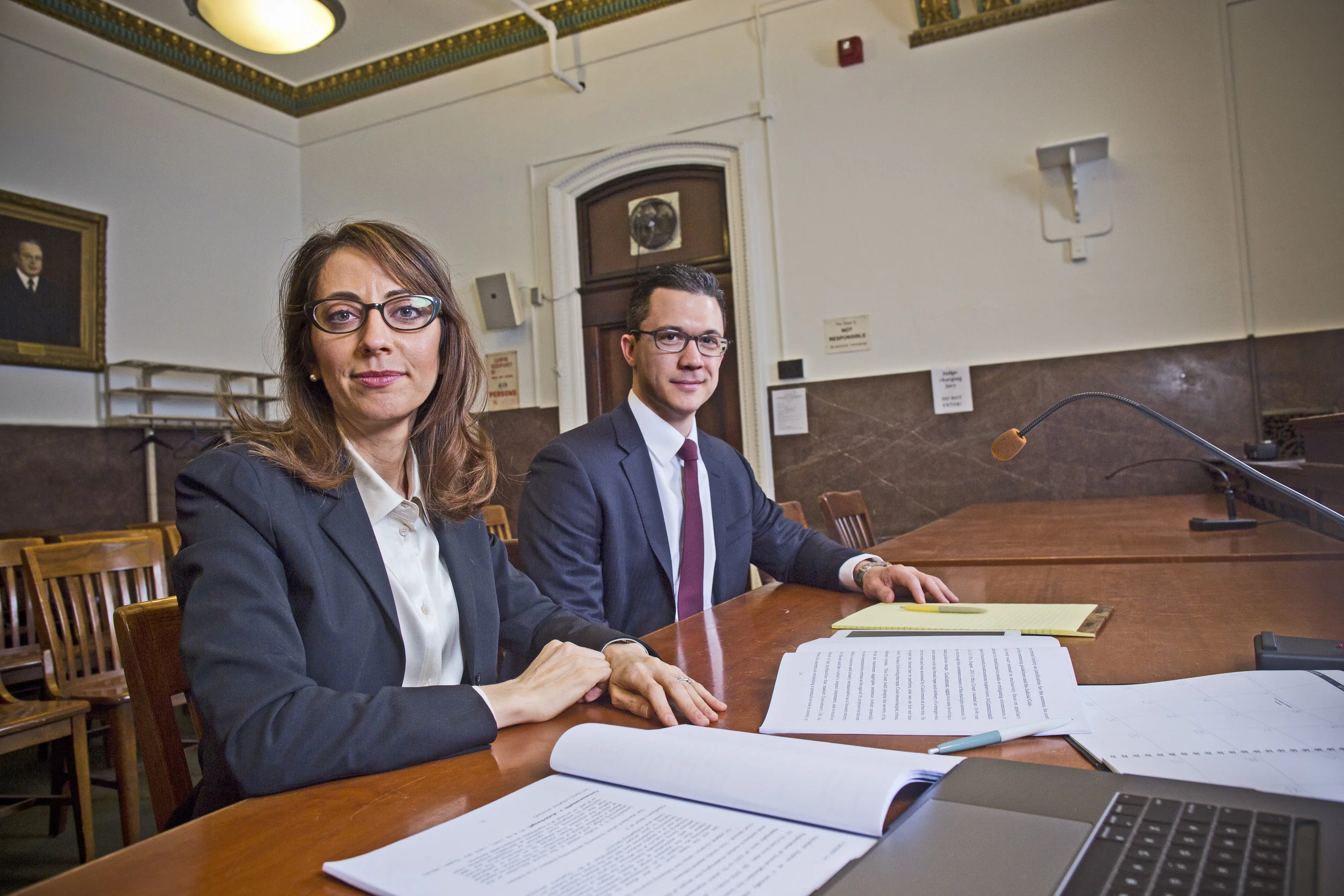
Philadelphia Criminal Defense Attorneys Zak T. Goldstein, Esq. and Demetra Mehta, Esq.
The Philadelphia criminal defense attorneys of Goldstein Mehta LLC have successfully represented hundreds of clients in drug possession and drug trafficking cases. We are experienced and understanding defense attorneys who will use our high level of skill and expertise on your behalf. We have successfully litigated pre-trial motions and obtained pre-trial dismissals and acquittals at trial. If you are facing drug possession charges, call 267-225-2545 for a free criminal defense strategy session.