

Philadelphia Criminal Defense Blog
Knowing Your Rights Could Be the Difference Between Decades in Prison and Freedom
In my last post, I wrote about the collateral consequences of a conviction. It is worth repeating that a conviction will follow you for the rest of your life. I feel that I left out an important fact: unlike many other laws dealing with criminal convictions there is no ex-post facto to save you. At any time the legislature can add a collateral consequence that is essentially retroactive. You can be convicted or plead guilty in one decade only to have new rights taken away from you in a different one. This is unlike any other area of criminal law.
That written, I want to add something that is less about law, consequences, or statues and more about your rights as a person when contacted by the police or any other agent of the state.
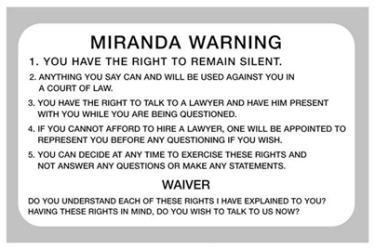
You have the right to remain silent.
Anything you say can and will be used against you in court.
You have the right to an attorney.
if you cannot afford one, one will be appointed to represent you.
Anyone who has ever watched a police thriller knows that litany. I just typed it out from memory because I’m on a train and there is no internet access (technically there is internet access, it is so slow and spotty it is worse than no internet access). I’m willing to bet good money that anyone reading this knows the litany I’ve written above. Why then do so many people make inculpatory statements to the police? They know they don’t have to, they’ve seen and heard that they have the right to remain silent on TV 1000s times. They know they have the right to an attorney, Law & Order said so.
Here’s the problem: most people want to be useful. They want to help. They think “if I just talk to the police all of this will be cleared up and I can go home.” Maybe - maybe that’s true, but the more likely scenario is that the police officer talking to you and the detective questioning you think you have committed a crime. Why are you helping them? To them this isn’t personal, you’re not their friend. This is business. To put it in the simplest possible terms: if the police had an airtight case - would they bother getting a statement from you. No, because they didn’t need it. Talking to them to “clear the air” will only hurt you.
As a criminal defense attorney, I have never been grateful that a client made a statement. Never, in all the years I have practiced law. Not once. It never helps. You do not have to talk to the police, you do not have to agree to a search of your person or a search of your vehicle, or a search of your home (if the police have warrant, that’s a different story - but you still don’t have to talk to them other than to agree you are who you are).
I can hear people telling me right now, “But Mrs. Mehta - the police told me they don’t need a warrant to search my car.” Technically this is true. In Pennsylvania it was once true that the police needed a warrant to search your vehicle, and then for various reasons, we will not get into here that law changed, but the standard to search your car or vehicle has remained the same, the police still need probable cause to search your car. But you don’t need to make it even easier for them by saying, “sure officer, feel free to search my car, I am absolutely, 100% sure none of my friends have left anything in there that might come back to bite me. I am 150% sure the car I borrowed from my friend, who is always in trouble, is clean.” Refusal to consent to a search does not give rise to probable cause, but just about anything else you say will start to help the police make a case that they had probable cause to search your car/house/person. The police officer might say, “he was being evasive, she seemed nervous, his story kept on changing, she was speaking rapidly.”
And frankly, most of that is probably true. I know when I see red and blue lights behind me on the highway I quickly suss through the last 20 years of my life and briefly wonder if there is some terrible sin I have forgotten or an unpaid ticket that finally made its way into a computer system somewhere.
So what are you to do?
Scenario 1
PO: Sir, we’d like to speak to you.
You: Officer, am I under arrest?
PO: No
You: Am I free to go?
Police: Yes
THEN GO.
And call an attorney.
Scenario 2
PO: Sir, we’d like to speak to you.
You: Officer, am I under arrest?
PO: Yes
You: I would like to speak to my attorney, here is their card.
I would not like to make a statement.
Don’t have a lawyer’s card? Print out mine, carry it with you, know your rights, and know to do when the rest of your life is on the line:


Collateral Consequences - the Impact of a Criminal Case on the Rest of Your Life
After a conviction, most people are not sent to jail. Most people are given probation or no further penalty. And yet, every contact with the criminal justice system is incredibly dangerous and needs to be taken seriously because besides the embarrassment of a criminal record following you around for the rest of your life, you can also lose important rights as a result of that conviction. For many, it isn't the conviction that is the most ruinous, it's the so-called, "collateral consequence."
After a conviction, most people are not sent to jail. Most people are given probation or no further penalty. And yet, every contact with the criminal justice system is incredibly dangerous and needs to be taken seriously because besides the embarrassment of a criminal record following you around for the rest of your life, you can also lose important rights as a result of that conviction. For many, it isn't the conviction that is the most ruinous, it's the so-called, "collateral consequence."
Collateral Consequences are nothing new. They have been a part of legal systems since at least the Ancient Greeks. The Greeks had ἀτιμία, the Romans infamia, and in early English Common law civiliter mortuus (civil death).
In early English Common law, the idea of civil death was pretty simple. You may be physically alive, but you were legally dead. That's to say, upon conviction the Crown completely severed all legal and civil rights. The complete loss of one's civil rights, probably made sense because there was often just one penalty for a felony in early English Common Law: death. Extinguishing the rights of a person might make sense when you were just aligning his (or her) legal rights with the physical rights of his soon to be dead body (that's to say none).
The loss of rights under civil death was total. A convict lost the right to enter into contracts, transmit property by inheritance and devise, marry (or, conversely - remain married as civil death also had the effect of dissolving the marriage), serve as a witness in any court case criminal or civil and vote. Civil death also had the effect of passing what property and estates a convict might have to his or her heirs upon sentencing (often not an issue because the Crown often took all the property) meaning a convicted person had no funds to appeal or fight his case after his conviction.
All in all civil death was harsh and unfair. Clearly, we know better today and civil death isn't a feature in modern American jurisprudence.
Or is it?
In an unending wail to "be tough on crime," simple imprisonment is not considered enough punishment by some. So many states, Pennsylvania in particular, have civil penalties in addition to the criminal ones. These civil penalties are not part of any sentence that is handed down by a court such as incarceration, fines, or probation. They are actions taken by the state and they encompass a wide array of life. And you may not be told anything about them other than, "there may be some consequences."
In Pennsylvania, these collateral consequences (the children of Civil Death) encompass adoption and foster care, child custody, restriction of a professional licenses (or complete loss of that license), loss of a driver's license, employment, the right to serve on a jury, the ability to obtain financial aid, the right to own a firearm, the ability to receive public benefits, the right to subsidized housing. These collateral consequences can even include your legal right to remain in this country or become a U.S. citizen. And while this list might seem broad, it in no way a comprehensive of all collateral consequences.
If, for example, you are convicted of Knowing and Intentional Possession of a Controlled Substance (also known as K&I in Philadelphia) under 35, § 780-113 et. seq. you will also have your driver's license suspended under 75 Pa. C.S. § 1532 for six months for even a first offense. For a third, you will lose it for two years. See: (http://www.legis.state.pa.us/cfdocs/legis/LI/consCheck.cfm?txtType=HTM&ttl=75&div=0&chpt=15&sctn=32&subsctn=0)
If you've been convicted of aggravated assault (18 Pa.C.S. § 2702), 18 Pa.C.S. § 6114 (relating to contempt for violation of order or agreement) or 75 Pa.C.S. Ch. 38 (DUI), the court shall consider these convictions if you are involved in a child custody proceeding. Nor is this a complete list; there are many other crimes that will interfere with your ability to keep custody of your children.
If you are convicted of various sex offenses you may not be allowed to live with your children, you may not be allowed to live in certain areas of the city, you may have to "register" with the state police, give your name, your identification, your living address. You may have to have this information posted on a publicly available website. You may be even be banned from taking certain jobs.
If you are convicted of a crime of domestic violence, you will never again be allowed to purchase a gun. This is true even for a misdemeanor conviction.
As you can see, the consequences of a criminal conviction go far beyond incarceration and “a record.” The long term effects are mind boggling and far reaching. You can not and should not go this road alone. If you are currently charged with or could be charged with a crime, then you should contact an attorney as soon as possible. Before you can make any decision you must know all the facts, and to know all the facts, you must speak to an experienced criminal defense attorney.
The Philadelphia Criminal Defense Lawyers of Goldstein Mehta LLC have extensive experience fighting all types of state and federal charges in Pennsylvania and New Jersey. We know the consequences of a conviction and will do everything in our power to prevent one. Call 267-225-2545 now for a free consultation.

Critical Mandatory Minimum Update

Critical Mandatory Minimum Update
Mandatory minimum sentencing laws in Pennsylvania may be about to change dramatically for the worse. For the past few years, the mandatory minimum sentences required by state law have been the subject of intense litigation, and most of them have been eliminated by opinions of the Pennsylvania Supreme and Superior Courts. Recently, the House passed a bill that would reinstate the previously stricken mandatory minimums by a vote of 146-46. The Philadelphia Inquirer reports that the Senate may also take up the legislation this week or next, and then the bill would be sent to the Governor for his signature.
Litigation Surrounding Mandatory Minimums
The litigation related to mandatory minimum sentences stems from the United States Supreme Court decision in Alleyne v. United States. In Alleyne, the Supreme Court held that because mandatory minimum sentences increase the penalty for a crime, any fact that increases the mandatory minimum is an “element” of the crime that must be submitted to the jury. For example, if the use of a firearm during the commission of a crime would trigger a mandatory minimum, as it previously did in Pennsylvania, then the fact that a gun was in fact used must be found by the jury at the end of trial instead of by the trial judge at sentencing.
Alleyne’s holding wreaked havoc on Pennsylvania’s mandatory minimum sentencing scheme. Instead of requiring that a jury rule on whether the facts which would trigger a mandatory minimum be submitted to the jury, Pennsylvania law specifically required the trial judge to determine if a mandatory minimum applied during sentencing. Further, the law permitted the sentencing judge to impose the mandatory minimum based on its own fact finding using a preponderance of the evidence standard instead of the much higher beyond a reasonable doubt standard required during a trial. For a defendant charged with selling drugs while in possession of a firearm, which previously triggered a five-year mandatory minimum, the sentencing judge could actually find that the mandatory minimum applied even if a jury had acquitted the defendant of possessing the gun but convicted the defendant of selling drugs.
The Pennsylvania sentencing scheme which gave this authority to the sentencing judge was in direct conflict with the Supreme Court’s holding in Alleyne. Therefore, in Commonwealth v. Hopkins, the Pennsylvania Supreme Court held that the Pennsylvania scheme was unconstitutional and struck down the vast majority of Pennsylvania mandatory minimum sentences.
Despite the rulings in Hopkins and Alleyne, a handful of significant Pennsylvania mandatory minimum sentences have survived. For example, mandatory minimums which are triggered based on the defendant’s prior record do not suffer from the same fatal flaw as the mandatory minimums surrounding the weight of drugs, the use of firearms, or other issues of that nature. Therefore, Pennsylvania’s three strikes law and DUI mandatory minimums continue to be enforced. In the case of the three strikes law, Pennsylvania imposes a mandatory minimum of 10-20 years of incarceration for certain second strikes and a sentence of 25 – 50 years for a third strike. The offenses which constitute strikes are listed in 42 Pa.C.S. § 9714 and include certain types of homicide, assault, robbery, burglary, and a number of sex offenses. Likewise, even a first offense DUI can trigger a 72-hour incarceration sentence when the defendant is not eligible for ARD. Because the sentencing judge must only be satisfied as to the fact that the defendant has a certain prior conviction, those mandatory minimum sentences have survived.
Although some mandatory minimums remain, most mandatory minimums were eliminated by Alleyne and Hopkins. For example, Pennsylvania previously had dozens of mandatory minimums for violent crimes committed with a firearm, based on the weight of drugs possessed with the intent to distribute, for selling drugs in a school zone, and for many sex offenses. This means that Pennsylvania had mandatory minimums not just for violent crimes, but also non-violent crimes like drug possession.
Problems with Mandatory Minimums
Mandatory minimums raise a number of serious problems. While most Americans probably believe that defendants properly convicted of serious violent felonies and sex crimes should receive prison time, mandatory minimums apply to all sorts of non-violent conduct such as the possession of narcotics. Further, mandatory minimums take a one-size-fits-all approach to sentencing which deprives the judge of the power to determine whether any given defendant is deserving of a break due to something in the defendant’s background. For example, even if the judge learns at sentencing that the defendant in a drug case is dying of cancer, the judge would be unable to impose anything less than the mandatory minimum of incarceration in a state prison.
Finally (and perhaps most importantly), mandatory minimums force innocent people to plead guilty in order to avoid the risk of facing the mandatory minimum. When a defendant is charged with a crime that would trigger 25-50 years in prison should the defendant lose at trial, the defendant is much more likely to take a deal if the prosecutor offers probation. This is true regardless of whether or not the defendant actually committed the crime. Thus, many people who are actually innocent plead guilty in order to avoid the mandatory minimum instead of taking the case to trial. This is a huge contributing factor to the fact that the overwhelming majority of criminal cases end in some form of plea deal. Mandatory minimums have likewise led to a huge increase in the prison population in Pennsylvania and the rest of the country.
What to Do
If you are a Pennsylvania citizen, it is not too late to contact your State Senator and Governor Wolf and ask them to oppose the enactment of mandatory minimum sentences. Defendants should not have to plead guilty to crimes that they did not commit because they cannot risk the imposition of a mandatory minimum sentence. Additionally, each defendant is different, and many defendants charged with mandatory minimum crimes simply are not deserving of incarceration. Mandatory minimums take the authority to figure out who may be rehabilitated with probation or house arrest away from a neutral judge and give that power to the prosecutor who may be more interested in obtaining convictions and lengthy sentences for political reasons.
Contact a Philadelphia Criminal Defense Lawyer Today
If you are currently charged with or could be charged with a crime, then you should contact an experienced criminal defense attorney immediately. When you are deciding how to attack the case, one of the first things you need to know is whether a mandatory minimum could apply to some of the charges you are facing. The Philadelphia Criminal Defense Lawyers of Goldstein Mehta LLC have extensive experience fighting all types of state and federal charges in Pennsylvania and New Jersey, and we will be able to evaluate your case, determine if a mandatory minimum applies, and provide you with the best options and advice on how to proceed. Call 267-225-2545 now for a free consultation.

What to Do if Police Are Asking About Illegal Pornographic Material on Your Computer
Getting Help With Megan's Law Allegations
Of all the crimes one may be charged with, sex crimes are especially scary, and perhaps none more so than possession, receipt, production, or distribution of child pornography. Even if eventually found not guilty in a court of law, the damage to your reputation can be life-altering. If found guilty, there may be serious jail time involved and decades on Megan's List.
Getting help is difficult. What kind of lawyer can you speak to? Will what you say to that lawyer be kept confidential given reporting laws? Will searching for a lawyer on the internet trigger suspicion from Google or the Government?
So first, some ground rules: yes, anything that you say to your lawyer, is confidential. There was a time when the legislature in Pennsylvania contemplated making lawyers mandatory reporters. Luckily, someone came to their senses and realized it would be impossible to represent those accused of such crimes from mounting a defense if they could not safely and confidentially tell their lawyer their side of the story.
Pennsylvania And Federal Child Pornography Laws
Second, child porn laws are far-reaching. When I was a kid (many, many years ago), a girl might show a boy she liked him by kissing him, holding hands, dating. Today, some kids do something a little dumber and far more permanent: they take pictures and send them to their new found loves on their smart phones (sexting). The law often treats these children as criminals; and more importantly, this "criminal activity" can have lifelong consequences requiring registration as a sex offender if the one who sends the material is over the age of 18. What was just a little fun has now become a serious, possibly federal case.
Worse, many people using the internet are not particularly tech-savvy. There was a time when to use the internet conferred a certain guarantee of technical know-how. Today, if you have a laptop, you're free to surf the information superhighway; with no safeguards in place, you can quickly become the victim of ransomware hackers.
Often parents allow their children free access to the internet and the home computer without thinking what kind of material their children may have access to. I've seen cases where a son downloads terabytes of movies off Russian servers only to infect the computer with computer viruses and child pornography. Or, teens, not thinking about long-term consequences go on to websites like Reddit or 4chan and access material they should not have touched.
In general, the law does not care how you came to be in possession of the material, the law only cares that you possessed it. Why, might be something that is sorted out later - but not before your reputation is destroyed and your name has been plastered all over the news.
What To Do If The Police Are Asking Questions
If you think you need legal assistance because of material you've encountered on the internet, you should contact a lawyer as soon as possible. If you receive any correspondence from a law enforcement agency, it is in your best interest to seek out a lawyer to ensure your rights will be safeguarded and you will be treated as fairly as possible.
Beyond a Reasonable Doubt
Remember: whenever the Government brings a criminal prosecution, the Government has to prove the defendant's guilt beyond a reasonable doubt. Even when prohibited images or videos are found on a computer, the Government may not be able to prove who downloaded them. Therefore, it is absolutely imperative that you do not speak with investigators without first consulting with an attorney.
A Philadelphia Criminal Defense Lawyer Can Help With Child Pornography Charges

Internet Crimes Lawyers - Philadelphia, PA
Child pornography cases can be incredibly complex and come with such serious consequences this is not the time to delay and see what happens. You must act quickly and aggressively to protect yourself and your family. Call 267-225-2545 for a free, confidential consultation.