

Philadelphia Criminal Defense Blog

Third Circuit: Loss in Fraud Cases Means Actual Loss, Not Intended Loss

Zak T. Goldstein, Esquire - Criminal Defense Lawyer
The United States Court of Appeals for the Third Circuit, which is the federal appellate court for Pennsylvania and New Jersey, has found that the loss amount in a fraud case must be calculated based on the actual loss inflicted on the victim. Despite suggestions in the commentary to the sentencing guidelines, loss means actual loss - not the intended, hypothetical loss that a defendant may have attempted to cause. This will drastically reduce the guideline range for sentencing purposes for many federal criminal defendants.
In this case, a jury convicted Banks of wire fraud, and the District Court sentenced him to 104 months’ incarceration and three years’ supervised release. On appeal, Banks argued multiple issues, but the issue of significance was whether the District Court erred in applying the loss enhancement, USSG §2B1.1, to the fraud guideline in the United States Sentencing Guidelines because there was no “actual loss.”
The Third Circuit concluded that the loss enhancement in the Guideline’s application notes impermissibly expands the word “loss” to include both intended loss and actual loss. Thus, the District Court erred when it applied the loss enhancement because Banks’s crimes caused no actual loss.
The facts of United States v. Banks
In January 2016, a federal grand jury indicted Frederick Banks for wire fraud, aggravated identity theft, and false statements. The wire fraud charges related to interlocking schemes carried out by Banks to fraudulently gain the money and property of others in relation to the FOREX.COM international exchange system by submitting phony registration information for himself and then using those registrations to execute bogus trades that would drop money into bank accounts that he had set up.
How do you calculate loss in federal fraud cases?
Banks was eventually convicted. He proceeded to sentencing. Before issuing a sentence in a federal case, the district judge must always carefully calculate the applicable sentencing guidelines. In fraud and theft cases, the guidelines are based very heavily on the amount of loss in question. Thus, stealing a small amount can lead to a recommended sentence of federal supervised release or a short jail sentence, while stealing a large amount can lead to a recommendation of an incredibly long amount of prison time. The issue becomes complicated because the definition of loss is not so clear. In this case, the issue was whether loss means the amount that the victims actually lost or instead included the amount that Banks tried to steal.
In computing a sentencing range, Banks’s offense level under the United States Sentencing Guidelines, as calculated by the district judge, included a special offense characteristic for the attempted loss Banks intended to inflict on Gain Capital. The attempted loss, based on fraudulent deposits, was $324,000. Therefore, the base offense level was increased by 12 levels because the attempted loss was greater than $250,000 but less than $550,000. USSG §2B1.1(b)(1)(G) (As a general rule, loss is the greater of actual loss or intended loss, pursuant to Application Note 3 to the sentencing guidelines).
The 12-level increase raised Banks’s adjusted offense level from 7 to 19. During sentencing, the District Court explained that the Sentencing Guidelines defined loss to not only include the actual loss, but to also include the intended loss. And the application notes indicate that the intended loss counts for purposes of calculating the loss amount even if it’s determined to be improbable or impossible that such a loss could have occurred. In this case, the victim suffered $0 in actual losses. The district court, however, used the intended loss amount, which was much higher than $0.
Recently, however, the Courts of Appeals have begun to question whether the application notes, which are essentially comments to the sentencing guidelines, are binding, or whether the court should be limited to using the guideline itself.
The district court used the intended loss figure, and the defendant appealed. On appeal, the Third Circuit reversed and remanded for a new sentencing, finding that loss means actual less. The Court of Appeals relied on Kisor v. Wilkie and Auer v. Robbins in interpreting the Guidelines. Under Kisor, a court must exhaust all the “traditional tools” of construction and consider the “text, structure, history, and purpose of a regulation.” Only then does a court apply Auer, which requires courts to defer to the Sentencing Commission’s commentary for a Guideline unless that interpretation is plainly erroneous or inconsistent with the Guideline.
The Court used a “plain text” analysis to see if there was ambiguity in the way the section was written. The Guideline does not mention “actual” versus “intended” loss; that distinction appears only in the commentary. That absence alone indicates that the Guideline does not include intended loss because there is nothing ambiguous about the term loss. Thus, the ordinary meaning of “loss” in the context of § 2B1.1 is “actual loss.
The Court also reviewed other sources for their definition of loss citing Webster’s New International Dictionary and the 1988 edition of Webster’s Ninth New Collegiate Dictionary. Both of which had matching definitions of “loss.” Next the Court reviewed sister jurisdictions on their conclusions and cited the Sixth Circuit which concluded the definition to be actual loss.
Because the commentary expanded the definition of “loss” by explaining that generally “loss is the greater of actual loss or intended loss,” the Court determined the commentary should have no weight. In other words, the commentary conflicted with the plain language of the guideline itself and so could not be applied.
Ultimately, the Third Circuit Court of Appeals held that “loss” in the context of U.S.S.G. § 2B1.1 is not ambiguous. Therefore, the Court vacated the judgment of sentence and remanded the case. The district court must re-sentence Banks without the additional levels for intended loss.
Facing criminal charges? We can help.

Goldstein Mehta LLC Criminal Defense Lawyer Zak Goldstein
If you are facing criminal charges or under investigation by the police, we can help. We have successfully defended thousands of clients against criminal charges in courts throughout Pennsylvania and New Jersey. We have successfully obtained full acquittals in cases involving charges such as Conspiracy, Aggravated Assault, Rape, and Murder. We have also won criminal appeals and PCRAs in state and federal court. Our award-winning Philadelphia criminal defense lawyers offer a free criminal defense strategy session to any potential client. Call 267-225-2545 to speak with an experienced and understanding defense attorney today.

PA Superior Court: Sentencing Court Must Determine at Time of Sentencing if Defendant Re-Entry Eligible

Criminal Defense Lawyer Zak T. Goldstein, Esquire
The Pennsylvania Superior Court has decided the case of Commonwealth v. Risoldi, holding that a sentencing court must determine at the time of sentencing whether a given defendant is “re-entry eligible.” The failure of the sentencing court to state on the record whether or not the defendant is re-entry eligible results in an illegal sentence which can be challenged on appeal.
This decision will benefit many defendants. Previously, a court’s failure to state that a defendant is re-entry eligible could be used by the Commonwealth to argue that the defendant was not in fact re-entry eligible and therefore that the defendant should not be eligible for early parole. Now, the sentencing judge is required to determine at the time of sentencing if the defendant is re-entry eligible, and a failure to do so will not automatically bar early parole.
The Facts of Risoldi
In Risoldi, the defendant was convicted of various offenses related to an insurance fraud scheme. The court sentenced her to 11.5 – 23 month’s incarceration along with $10 million in restitution. Risoldi appealed and challenged the restitution order. The Superior Court vacated the initial judgment of sentence and remanded the case for a new sentencing hearing. The trial court resentenced the defendant on the restitution portion of her sentence only and left the incarceration portion of the sentence intact. The court never stated whether the defendant was re-entry eligible. Risoldi appealed, arguing that her sentence was illegal.
What does re-entry eligible mean?
Under 42 Pa.C.S. § 9756(b)(3), “the court shall, at the time of sentencing, state whether or not the defendant is eligible to participate in a reentry plan at any time prior to the expiration of the minimum sentence or at the expiration of a specified portion of the minimum sentence.”
In practice, this is extremely important because a defendant who is re-entry eligible may be paroled early by the trial court even if the prosecution objects. If the defendant is not re-entry eligible, then the trial court may not be able to parole the defendant prior to the expiration of the minimum sentence. Thus, if a defendant receives a sentence of 11.5 – 23 month’s incarceration and is made re-entry eligible, the trial court may parole the defendant before 11.5 months. If the defendant is not re-entry eligible, then the Commonwealth could object to early parole before 11.5 months on that basis, and the trial court may not be able to grant parole. In Philadelphia, this rule is often not observed in practice, but an improper grant of early parole could be reversed on appeal.
The Superior Court’s Decision
In this case, the only issue was whether the sentence was illegal because the trial court failed to state whether the defendant was re-entry eligible at the time of sentencing as required by the statute. The defendant also argued that silence should be construed in her favor – meaning that where a court does not state anything on the record, the defendant should be presumed to be re-entry eligible. The Superior Court partially agreed with the defendant. It found that the statute contains a mandatory command for the trial court to determine eligibility at the time of sentencing. Therefore, the Superior Court remanded for the trial court to make that decision. If the trial court finds that the defendant is re-entry eligible, then she would be potentially eligible for early parole. The Court did not decide whether silence should make a defendant presumptively re-entry eligible, but fortunately, it does not make a defendant presumptively ineligible.
Facing criminal charges? We can help.
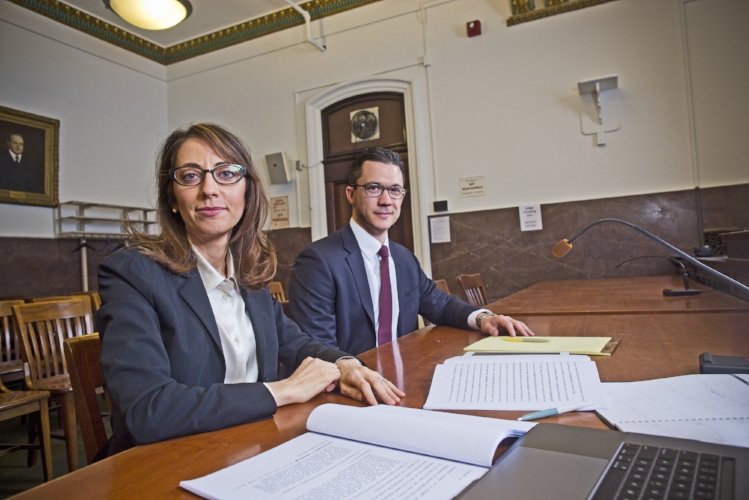
Criminal Defense Lawyers Zak T. Goldstein, Esquire and Demetra Mehta, Esquire
If you are facing criminal charges or under investigation by the police, we can help. We have successfully defended thousands of clients against criminal charges in courts throughout Pennsylvania and New Jersey. We have successfully obtained full acquittals in cases involving charges such as Conspiracy, Aggravated Assault, Rape, and Murder. Our award-winning Philadelphia criminal defense lawyers offer a free criminal defense strategy session to any potential client. Call 267-225-2545 to speak with an experienced and understanding defense attorney today.

PA Superior Court: Defendant Not Entitled to New Trial Where Jurors Made Racist Comments During Deliberations

Philadelphia Criminal Defense Lawyer Zak Goldstein
The Pennsylvania Superior Court has decided the case of Commonwealth v. Rosenthal, holding that the defendant was not entitled to a new trial solely because members of the jury that convicted him made racist comments during deliberations. This decision is troubling given that jurors in criminal trials should be completely impartial.
Commonwealth v. Rosenthal
The defendant was arrested for allegedly misappropriating money from various nonprofit organizations with which he was involved. Prosecutors charged him with theft by unlawful taking, receiving stolen property, theft by deception, forgery, and misapplication of entrusted property and property of government or financial institutions. A jury found him guilty of all charges.
The trial court sentenced him to 21 years’ probation and ordered that he pay a substantial amount of restitution. The defendant later filed a timely post-sentence motion claiming that he should have received a hearing to determine whether he was entitled to a new trial based on a letter that he received from one of the jurors who expressed concerns about jury deliberations. In this letter, the juror stated that he voted to convict the defendant because he was “worn down” from the other members of the jury. Additionally, the juror stated that he heard ethnic “jokes” from his fellow jurors and that some of the jurors uttered stereotypes about Italian and Irish men.
The trial court denied the defendant’s post-sentence motion. He then filed a timely appeal. In his appeal, the defendant argued that he was entitled to a hearing on whether he should have been granted a new trial because some of the jurors made statements that showed racial and national origin animus. Because of this allegation of racial animus, he argued that the court should find an exception to the “No Impeachment Rule” of jurors and that the trial court erred in not having a hearing on the matter.
What is the No Impeachment Rule?
The “No Impeachment Rule” is found in Rule 606 of the Pennsylvania Rules of Evidence. The rule states that “during an inquiry into the validity of a verdict, a juror may not testify about any statement made or incident that occurred during the jury’s deliberations; the effect of anything on that juror’s vote or another juror’s vote; or any juror’s mental processes concerning the verdict.”
The purpose of the “No Impeachment Rule” is to prevent juror testimony regarding what transpired in the jury room because it “would destroy the security of all verdicts and go far toward weakening the efficacy of trial by jury.” However, there are exceptions to this prohibition. A juror is allowed to testify about prejudicial information that was improperly brought to the jury’s attention and whether there was an outside influence that was brought to bear on any juror.
The United States Supreme Court has also weighed in on the “No Impeachment Rule,” too. The Supreme Court has held that if there is evidence of racial animus that motivates a jury’s finding of guilt, the “No Impeachment Rule” may not be applicable. However, there are limitations to this exception, too. According to the Supreme Court, not every “offhand” comment qualifies. In order to overcome the “No Impeachment Rule” on the basis of racial animus, a defendant must show that one or more jurors made statements exhibiting overt racial bias. Further, there must also be a showing that the racial animus was a significant motivating factor in the juror’s vote to convict.
The Superior Court’s Decision
The Superior Court affirmed the defendant’s conviction. The Court highlighted several reasons as to why it agreed with the trial court’s decision not to have a hearing on whether the comments made by the jurors warranted a new trial for the defendant. First, the Superior Court highlighted the fact that there was no evidence that these “jokes” were directed at the defendant. Additionally, the Superior Court emphasized that the record did not indicate that the defendant, his attorney or any of the defendant’s witnesses were either Italian or Irish. As such, according to the Superior Court, there was no evidence to show that racial animus was a significant motivating factor in the juror’s vote to convict. Consequently, the defendant will not receive a new trial, and he will be forced to serve his sentence.
Facing Criminal Charges? We Can Help.

Goldstein Mehta LLC Criminal Lawyers
If you are facing criminal charges or under investigation by the police, we can help. We have successfully defended thousands of clients against criminal charges in courts throughout Pennsylvania and New Jersey. We have successfully obtained full acquittals in cases involving charges such as Conspiracy, Aggravated Assault, Rape, and Murder. Our award-winning Philadelphia criminal defense lawyers offer a free criminal defense strategy session to any potential client. Call 267-225-2545 to speak with an experienced and understanding defense attorney today.

United States Supreme Court Reverses NJ “Bridgegate” Fraud Convictions
Philadelphia Criminal Defense Attorneys
The United States Supreme Court has decided the case of Kelly v. United States, reversing the defendants’ convictions for conspiracy, wire fraud, and federal program fraud. This was an extremely high profile case just a few years back in which New Jersey officials associated with then-Governor of New Jersey Chris Christie were accused of creating traffic jams on the George Washington Bridge in order to punish a local mayor who had refused to endorse Christie’s re-election campaign. The decision, while likely alarming to anyone who is against public corruption and the misuse of state resources to punish political opponents, continues a trend of narrowing the federal wire fraud statute’s applicability as a tool to prosecute state and local governmental corruption.
In Kelly, the defendants were Bridget Anne Kelly, the Governor’s deputy chief of staff, David Wildstein, a Port Authority Official, and Port Authority Deputy Executive Director William Baroni. David Wildstein cooperated with federal prosecutors and pleaded guilty, meaning his conviction will likely stand, while Kelly and Wildstein went to trial and were found guilty by a jury.
The basic scheme was that Governor Christie sought to obtain endorsements from both republican and democratic officials throughout the State of New Jersey for his re-election campaign. After the mayor of Fort Lee declined to endorse the governor, his staff conspired to retaliate against the mayor by causing traffic problems at the George Washington Bridge’s toll plaza by closing the lanes which were normally reserved for the residents of Fort Lee. The scheme was disguised as a “traffic study,” but the evidence overwhelmingly showed that it was meant to punish Fort Lee.
The defendants used Port Authority staff to close the lanes, and they had to pay an additional toll collector overtime so that that toll collector would be able to cover for the main toll collector when that person went on break. The scheme resulted in massive traffic jams for days, causing people to struggle to get to work and ambulances to have trouble picking up heart attack victims.
When the scheme came to light, the defendants were indicted by a federal grand jury in the District of New Jersey and charged with conspiracy, wire fraud, and federal program fraud. Wildstein cut a deal with the government and cooperated against the other two, who were convicted. They appealed to the Third Circuit, which affirmed the convictions. The United States Supreme Court then agreed to review the case.
The Supreme Court reversed the conviction, finding that fraud had not actually occurred because the defendants had taken no steps to convert government money or property for their own purposes.
What is federal wire fraud?
The federal wire fraud statute makes it a crime to effect (with the use of the wires) “any scheme or artifice to defraud, or for obtaining money or property by means of false or fraudulent pretenses, representations, or promises.” 18 U.S.C. Section 1343.
What is federal program fraud?
The federal program fraud bars obtaining by fraud the property (including money) of a federally funded program or entity.
What is conspiracy?
Conspiracy is an agreement between two or more people to commit a crime. It generally requires that two people agree that they are going to commit a crime and then that at least one of the two takes a substantial step (an overt act) towards the commission of that crime. Once that happens, a criminal defendant may be guilty of conspiracy as well as the underlying offense.
Here, the conspiracy charges were dependent on proper convictions for fraud, and both fraud charges required that the defendants actually gain some sort of money or property from the scheme. As the scheme did not encompass any attempt to gain money, the Court’s analysis hinged on whether they had actually attempted or successfully obtained property.
The Supreme Court’s Ruling
The Court reversed the convictions. It noted that the fraud statutes are limited in scope to the protection of property rights and do not authorize federal prosecutors to set standards of disclosure and good government for local and state officials. The government had made two arguments as to how the defendants had actually stolen property. First, the government argued that closing the lanes themselves involved actually taking control of the property of those lanes. Second, the government argued that the cost of paying the traffic engineers who reviewed the “study” and the backup toll collectors involved depriving the Port Authority of money.
The Court rejected both arguments. First, it found that the realignment of the access lanes was an exercise of regulatory power and that a scheme to alter a regulatory choice generally is not a taking of the government’s property, particularly where the move is temporary. Second, it found that while the costs in paying for the “study” and the toll collectors could qualify as property, in order to be relevant for purposes of wire fraud, they must be the object of the fraud. That means it must have been the actual goal of the conspiracy to steal that time and money. But those costs were merely incidental to the regulatory decision. Therefore, they were not the object of the conspiracy, and the defendants had not conspired to steal or stolen any property or money. Accordingly, the Court reversed the conviction.
Although this decision is unique in that it involved such a high-profile political situation, it will likely have lasting effects on the ability of federal prosecutors to file criminal charges based on state and local criminal corruption. The Court did not dispute that the evidence showed that the defendants had unethically used their positions to punish political rivals. The Court simply found that they had not stolen anything to do so. This decision, however, drastically limits the reach of the wire fraud and federal programs fraud statutes because it prevents federal prosecutors from filling charges to address local political corruption where the corruption does not actually involve bribery or theft. This leaves the prosecution of political corruption to state and local officials, who may not have the independence necessary to bring charges. It also leaves it to the voters, who may demand the resignation of corrupt political officials. However, federal prosecutors probably already have enough power, so anything that reins them in is usually a good thing.
Do you need a criminal lawyer in Philadelphia? We can help.

Philadelphia Criminal Lawyers
If you are facing criminal charges or under investigation by the police, we can help. We have successfully defended thousands of clients against criminal charges in courts throughout Pennsylvania and New Jersey. We have successfully obtained full acquittals in cases involving charges such as Conspiracy, Aggravated Assault, Rape, DUI, and Murder. Our award-winning Philadelphia criminal defense lawyers offer a free criminal defense strategy session to any potential client. Call 267-225-2545 to speak with an experienced and understanding defense attorney today.