

Philadelphia Criminal Defense Blog

Appealing PA Megan's Law Retroactivity Provisions
PA Megan's Law Retroactivity
As Attorney Zak Goldstein previously wrote, Pennsylvania has seen significant changes in the laws governing sex offender registration. Specifically, recent cases have provided some hope for a limited number of Megan's Law and SORNA registrants to downgrade from Tier III lifetime offenders to lower tiers depending on the circumstances of their cases and pleas. Registrants who meet very specific conditions may have the possibility of obtaining a reduced Tier if they can show that they either committed multiple Tier I or Tier II offenses as part of the same case or, in limited circumstances, that the Commonwealth has violated a plea bargain by retroactively requiring the offender to register at a higher tier.
Potential Ways to Lower Megan's Law Tier in PA
Aside from the issues written about in that previous post, there are other ways for a person, required to register under SORNA, to downgrade their registration status or even remove it completely, and that is to enforce the plea that was bargained for at the time of sentencing. It isn't unusual for us to see cases where a defendant has specifically bargained for Tier I registration as part of an agreement to plead guilty. Pennsylvania courts have upheld that such agreements are governed by contract law and enforceable under contract law. This means that, while the offense pleaded guilty to may require higher registration, even lifetime registration the agreement, made at the time of the plea, will often be the deciding factor on how long a someone will have to register. But we've often found when someone is released from prison or from supervision they've been told their registration status has been changed to lifetime registration or from Tier I to Tier III. It may be possible to challenge such a change to one's SORNA registration requirements. However, it can be expensive and difficult, and success is never guaranteed.
information on the Adam Walsh Act (SORNA)
As of 2012, Pennsylvania substantially implemented Title I of the Adam Walsh Act, the Sex Offender Registration and Notification Act (SORNA). SORNA requires that offenders register for a duration of time based on the tier of the offense of conviction. Specifically, SORNA requires Tier I offenders register for 15 years, Tier II offenders register for 25 years, and Tier III offenders register for life.
SORNA requires that offenders make in-person appearances at the registering agency based on the tier of the offense of conviction. Specifically, this Act requires that Tier I offenders appear once a year, that SORNA Tier II offenders appear every six months, and Tier III offenders appear every three months. SORNA requires that each jurisdiction maintain a public sex offender registry website and publish certain registration information on that website.
PENNSYLVANIA MEGAN'S LAW REGISTRATION TIERS
Pennsylvania has three categories of registrants for purposes of duration of registration requirements and frequency of reporting to law enforcement for verification:
Tier I offenders, who are required to appear annually to verify registration information and register for a period of 15 years.
Tier II offenders, who are required to appear every 180 days to verify registration information and register for a period of 25 years.
Tier III offenders, who are required to appear every 90 days to verify registration information and register for life.
SORNA Tier I requires offenders to register for a minimum of 15 years and annually verify registration information. The following offenses listed in Pennsylvania Statutes would require, at a minimum, Tier I registration requirements under SORNA:
18 Pa. C.S. § 2902 – Unlawful restraint (non-parental, victim under 18)
18 Pa. C.S. § 2903 – False imprisonment (non-parental, victim under 18)
18 Pa. C.S. § 2904 – Interference with custody of children (non-parental, victim under 18)
18 Pa. C.S. § 2910 – Luring a child into a motor vehicle or structure
18 Pa. C.S. § 3124.2 – Institutional sexual assault (adult victim)
18 Pa. C.S. § 3126 – Indecent assault where the offense is graded as a misdemeanor of the first degree or higher (if punishment less than one year)
18 Pa. C.S. § 6312[d] – Sexual abuse of children (possession of child pornography)
18 Pa. C.S. § 7507.1 – Invasion of privacy
SORNA Tier II requires offenders register for a minimum of 25 years and semiannually verify registration information. The following offenses listed in Pennsylvania Statutes would require, at a minimum, Tier II registration:
18 Pa. C.S. § 3124.2 – Institutional sexual assault (victim age 16-17)
18 Pa. C.S. § 3126 – Indecent assault where the offense is graded as a misdemeanor of the first degree or higher (if recidivist or punishment greater than one year)
18 Pa. C.S. § 5902[b] – Prostitution and related offenses, where the actor promotes the prostitution of a minor
18 Pa. C.S. § 5903[a] [3], [4], [5], or [6] – Obscene and other sexual materials and performances, where the victim is a minor
18 Pa. C.S. § 6312[b], [c] – Sexual abuse of children (production/distribution of child pornography)
18 Pa. C.S. § 6318 – Unlawful contact with minor
18 Pa. C.S. § 6320 – Sexual exploitation of children SORNA
Tier III Offenses requires lifetime registration and quarterly verifications. The following offenses listed in Pennsylvania Statutes would require, at a minimum, Tier III registration requirements under SORNA:
18 Pa. C.S. § 2901 – Kidnapping, where the victim is a minor (non-parental)
18 Pa. C.S. § 3121 – Rape • 18 Pa. C.S. § 3122.1 – Statutory sexual assault
18 Pa. C.S. § 3123 – Involuntary deviate sexual intercourse
18 Pa. C.S. § 3124.1 – Sexual assault • 18 Pa. C.S. § 3124.2 – Institutional sexual assault (victim under 16)
18 Pa. C.S. § 3125 – Aggravated indecent assault
18 Pa. C.S. § 3126 – Indecent assault where the offense is graded as a misdemeanor of the first degree or higher (if victim under 13 and punishment greater than one year)
18 Pa. C.S. § 4302 – Incest (victim under 13, or victim 13-18 years old, and offender more than 4 years older)
HOW OUR PENNSYLVANIA MEGAN'S LAW LAWYERS CAN HELP

Demetra Mehta, Esq. - PA Megan's Law Attorney
If you think you have been required to register for the wrong tier, please contact us to discuss your case. After a brief consultation, we may be able to advise you how to best move forward. If we think we can be of assistance we will investigate your case and offer an opinion on if a challenge to your registration requirements will be successful. We offer a free phone consultation in these matters, and if further investigation is warranted, we typically charge a reasonable initial fee to obtain court records and transcripts, investigate the case, and determine the likelihood of success.
Charged with a crime? Our award-winning Philadelphia criminal defense lawyers have successfully defended thousands of cases. Call 267-225-2545 for a complimentary 15-minute criminal defense strategy session.
Knowing Your Rights Could Be the Difference Between Decades in Prison and Freedom
In my last post, I wrote about the collateral consequences of a conviction. It is worth repeating that a conviction will follow you for the rest of your life. I feel that I left out an important fact: unlike many other laws dealing with criminal convictions there is no ex-post facto to save you. At any time the legislature can add a collateral consequence that is essentially retroactive. You can be convicted or plead guilty in one decade only to have new rights taken away from you in a different one. This is unlike any other area of criminal law.
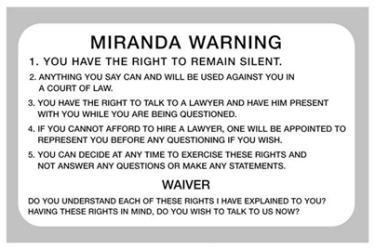
That written, I want to add something that is less about law, consequences, or statues and more about your rights as a person when contacted by the police or any other agent of the state.
You have the right to remain silent.
Anything you say can and will be used against you in court.
You have the right to an attorney.
if you cannot afford one, one will be appointed to represent you.
Anyone who has ever watched a police thriller knows that litany. I just typed it out from memory because I’m on a train and there is no internet access (technically there is internet access, it is so slow and spotty it is worse than no internet access). I’m willing to bet good money that anyone reading this knows the litany I’ve written above. Why then do so many people make inculpatory statements to the police? They know they don’t have to, they’ve seen and heard that they have the right to remain silent on TV 1000s times. They know they have the right to an attorney, Law & Order said so.
Here’s the problem: most people want to be useful. They want to help. They think “if I just talk to the police all of this will be cleared up and I can go home.” Maybe - maybe that’s true, but the more likely scenario is that the police officer talking to you and the detective questioning you think you have committed a crime. Why are you helping them? To them this isn’t personal, you’re not their friend. This is business. To put it in the simplest possible terms: if the police had an airtight case - would they bother getting a statement from you. No, because they didn’t need it. Talking to them to “clear the air” will only hurt you.
As a criminal defense attorney, I have never been grateful that a client made a statement. Never, in all the years I have practiced law. Not once. It never helps. You do not have to talk to the police, you do not have to agree to a search of your person or a search of your vehicle, or a search of your home (if the police have warrant, that’s a different story - but you still don’t have to talk to them other than to agree you are who you are).
I can hear people telling me right now, “But Mrs. Mehta - the police told me they don’t need a warrant to search my car.” Technically this is true. In Pennsylvania it was once true that the police needed a warrant to search your vehicle, and then for various reasons, we will not get into here that law changed, but the standard to search your car or vehicle has remained the same, the police still need probable cause to search your car. But you don’t need to make it even easier for them by saying, “sure officer, feel free to search my car, I am absolutely, 100% sure none of my friends have left anything in there that might come back to bite me. I am 150% sure the car I borrowed from my friend, who is always in trouble, is clean.” Refusal to consent to a search does not give rise to probable cause, but just about anything else you say will start to help the police make a case that they had probable cause to search your car/house/person. The police officer might say, “he was being evasive, she seemed nervous, his story kept on changing, she was speaking rapidly.”
And frankly, most of that is probably true. I know when I see red and blue lights behind me on the highway I quickly suss through the last 20 years of my life and briefly wonder if there is some terrible sin I have forgotten or an unpaid ticket that finally made its way into a computer system somewhere.
So what are you to do?
Scenario 1
PO: Sir, we’d like to speak to you.
You: Officer, am I under arrest?
PO: No
You: Am I free to go?
Police: Yes
THEN GO.
And call an attorney.
Scenario 2
PO: Sir, we’d like to speak to you.
You: Officer, am I under arrest?
PO: Yes
You: I would like to speak to my attorney, here is their card.
I would not like to make a statement.
Don’t have a lawyer’s card? Print out mine, carry it with you, know your rights, and know to do when the rest of your life is on the line:


What to Do if Police Are Asking About Illegal Pornographic Material on Your Computer
Getting Help With Megan's Law Allegations
Of all the crimes one may be charged with, sex crimes are especially scary, and perhaps none more so than possession, receipt, production, or distribution of child pornography. Even if eventually found not guilty in a court of law, the damage to your reputation can be life-altering. If found guilty, there may be serious jail time involved and decades on Megan's List.
Getting help is difficult. What kind of lawyer can you speak to? Will what you say to that lawyer be kept confidential given reporting laws? Will searching for a lawyer on the internet trigger suspicion from Google or the Government?
So first, some ground rules: yes, anything that you say to your lawyer, is confidential. There was a time when the legislature in Pennsylvania contemplated making lawyers mandatory reporters. Luckily, someone came to their senses and realized it would be impossible to represent those accused of such crimes from mounting a defense if they could not safely and confidentially tell their lawyer their side of the story.
Pennsylvania And Federal Child Pornography Laws
Second, child porn laws are far-reaching. When I was a kid (many, many years ago), a girl might show a boy she liked him by kissing him, holding hands, dating. Today, some kids do something a little dumber and far more permanent: they take pictures and send them to their new found loves on their smart phones (sexting). The law often treats these children as criminals; and more importantly, this "criminal activity" can have lifelong consequences requiring registration as a sex offender if the one who sends the material is over the age of 18. What was just a little fun has now become a serious, possibly federal case.
Worse, many people using the internet are not particularly tech-savvy. There was a time when to use the internet conferred a certain guarantee of technical know-how. Today, if you have a laptop, you're free to surf the information superhighway; with no safeguards in place, you can quickly become the victim of ransomware hackers.
Often parents allow their children free access to the internet and the home computer without thinking what kind of material their children may have access to. I've seen cases where a son downloads terabytes of movies off Russian servers only to infect the computer with computer viruses and child pornography. Or, teens, not thinking about long-term consequences go on to websites like Reddit or 4chan and access material they should not have touched.
In general, the law does not care how you came to be in possession of the material, the law only cares that you possessed it. Why, might be something that is sorted out later - but not before your reputation is destroyed and your name has been plastered all over the news.
What To Do If The Police Are Asking Questions
If you think you need legal assistance because of material you've encountered on the internet, you should contact a lawyer as soon as possible. If you receive any correspondence from a law enforcement agency, it is in your best interest to seek out a lawyer to ensure your rights will be safeguarded and you will be treated as fairly as possible.
Beyond a Reasonable Doubt
Remember: whenever the Government brings a criminal prosecution, the Government has to prove the defendant's guilt beyond a reasonable doubt. Even when prohibited images or videos are found on a computer, the Government may not be able to prove who downloaded them. Therefore, it is absolutely imperative that you do not speak with investigators without first consulting with an attorney.
A Philadelphia Criminal Defense Lawyer Can Help With Child Pornography Charges

Internet Crimes Lawyers - Philadelphia, PA
Child pornography cases can be incredibly complex and come with such serious consequences this is not the time to delay and see what happens. You must act quickly and aggressively to protect yourself and your family. Call 267-225-2545 for a free, confidential consultation.

SORNA/Megan's Law Update - PA Supreme Court Reduces Registration Requirements for Many First Time Offenders
The Court held that the Sex Offender Registration and Notification Act (“SORNA”) requires fifteen years of registration on Megan’s Law instead of lifetime registration for many first-time offenders convicted of multiple counts at the same time.
The Pennsylvania Supreme Court recently announced some important changes for defendants previously facing or subject to registration on “Megan’s Law” for certain non-violent sexual offenses such as possession of child pornography. The Court held that the Sex Offender Registration and Notification Act (“SORNA”) requires fifteen years of registration on Megan’s Law instead of lifetime registration for many first-time offenders convicted of multiple counts at the same time.
Previously, the State Police, who are responsible for implementing the registration component of SORNA, required first time offenders who were convicted of multiple counts of possession of child pornography or other Tier I or Tier II Sex Offender Registration and Notification Act (“SORNA”) offenses at the same time to register as Tier III offenders and to register for life. This interpretation of the statute had a tremendous impact on virtually all potentially Tier I defendants because police and prosecutors have enormous discretion in determining how many counts with which to charge any given defendant. For example, the prosecutor decides how many charges to bring against a defendant who possessed multiple prohibited images or multiple computers containing prohibited images. Prior to the Court’s ruling, if the prosecutor brought multiple counts, the defendant would potentially be subject to lifetime registration under the State Police’s interpretation of the Act. If the prosecutor brought only one count, then the defendant would be subject to fifteen years of registration. Prosecutors often could use this leverage to extract guilty pleas out of defendants with defensible cases by agreeing to allow the defendant to plead to only one count and thereby avoid lifetime registration in exchange for a guilty plea.
However, the Pennsylvania Supreme Court has just rejected the State Police’s interpretation of the statute. In the companion cases of Commonwealth v. Lutz-Morrison and A.S. v. PA State Police, the Supreme Court ruled that first time offenders without prior sex offense convictions are properly classified as Tier I or Tier II offenders (depending on the Tier of the offense) and subject only to fifteen or twenty-five year registration requirements regardless of how many counts the prosecutor chooses to file. The Court’s ruling hinges on language in the registration statute making someone with “[t]wo or more convictions of offenses listed as Tier I or Tier II sexual offenses” a Tier III offender." The Court held that because the SORNA law is a recidivist statute, meaning it is meant to provide an increasing level of punishment as an offender commits subsequent offenses, the statute “requires an act, a conviction, and a subsequent act to trigger lifetime registration for multiple offenses otherwise subject to a fifteen- or twenty-five-year period of registration.”
It appears likely that the Court’s interpretation will be applied retroactively, meaning that offenders who were already deemed lifetime offenders by the State Police may have the opportunity to be re-classified. It is not yet clear whether the State Police will require each offender to file suit, file some sort of paperwork with the State Police, or whether the State Police will re-classify offenders automatically. It is also possible that there may be statutory time limits on an offender’s ability to petition for reclassification. Therefore, it is critical that you contact an experienced criminal defense attorney immediately if you are facing potential sex offense charges or already subject to lifetime registration under these or similar circumstances.
The top-rated attorneys of Goldstein Mehta LLC have extensive experience representing individuals charged under Pennsylvania's SORNA and Megan's Law statutes. Our attorneys are extremely knowledgeable about recent developments in the law and able to use that knowledge to our clients' advantage. Call 267-225-2545 today for a free, confidential consultation.
Related Articles:
Appealing Retroactive Megan's Law Tier Increases
BREAKING NEWS: Retroactive Application of SORNA/Megan's Law Found Unconstitutional in Pennsylvania