

Philadelphia Criminal Defense Blog

PA Sentencing Guidelines | I got arrested. Am I going to jail?
The PA Sentencing Guidelines provide the sentencing judge with a range of minimum sentences to consider imposing following a conviction.
The Pennsylvania Sentencing Guidelines
Note: This article is based on the pre-January 1, 2024 guidelines. Any offense committed prior to January 1, 2024 will involve the guidelines discussed in this article. For a discussion of the new guidelines, please see this article.
One of the most common questions we get when meeting with a new client is, “What am I looking at if we lose? Am I going to go to jail?” The answer is almost always, “it depends.”

First, if the client has made the smart decision and hired one of our PA criminal defense attorneys, the client could very well be looking at winning the case or negotiating entry into a pre-trial diversionary program that will not result in a conviction or incarceration. The above question assumes that the client is going to lose and be convicted of the most serious charge, which is often not the case. There are many cases that can be won at preliminary hearing, through pre-trial motions, or at trial. Each case is different, but we regularly try and win cases. Even those cases that cannot be won can often be negotiated down to lesser charges, so even when the prosecution's evidence is strong, there is always the possibility of working out a good deal for the defendant. Therefore, there are lots of cases in which the client will ultimately not end up serving any kind of sentence or will eventually face a sentence on a less serious charge.
Second, although there are never any guarantees, it is usually possible to predict the best and worst case scenario by considering any applicable mandatory minimums, sentencing guidelines, and the sentencing practices of the judge. Even though it is never possible to predict an outcome or whether a defendant could go to jail with complete certainty, it is generally possible to have an idea of what the possible and most likely outcomes are for different types of charges.
Pennsylvania Mandatory Minimum Sentencing Laws
When considering what sentence you could get, the first place to start is to find out whether there are any mandatory minimums. Most Pennsylvania mandatory minimum sentences were eliminated by decisions of the United States and Pennsylvania Supreme Courts. However, a handful of mandatory minimums remain.
For example, there are still mandatory minimums for repeat offenders who are convicted of certain crimes of violence such as F1 Robbery, Aggravated Assault, Homicide, certain types of Burglary and Sex Crimes, and other serious “strike” crimes. There are also significant mandatory minimum sentences for DUI/DWI. Other mandatory minimums which apply to the sexual abuse or physical assault of children have also been reinstated and may call for significant periods of incarceration.
The Pennsylvania state legislature has considered reinstating the other mandatory minimums which were struck down by the courts such as those based on drug weights and gun possession while committing a crime of violence, but it has not yet done so. You can learn more about mandatory sentences here. There are also still a number of significant mandatory minimums for many federal charges. Therefore, the first step is to figure out if there are any mandatory minimums. If there is one, then the strategy will likely become avoiding a conviction for the charge or fact that would trigger the mandatory minimum. Any mandatory minimum will trump the sentencing guidelines, meaning that if the mandatory minimum is higher than the guideline range, the court must still sentence to the longer sentence called for by the mandatory minimum.
Calculating the Sentencing Guidelines in Pennsylvania
Second, once you and your defense attorney have determined whether there are any mandatory minimums which could apply to the offense, it is critical to calculate the Pennsylvania sentencing guidelines. The guidelines provide a good estimate of what type of sentence the defendant could receive if convicted. In both Pennsylvania and the federal system, the sentencing guidelines are not mandatory, meaning a judge can depart upward or downward from the guidelines if there is a good reason to do so. However, judges in both systems are required to correctly calculate the guidelines, strongly consider them, and provide sufficient reasons on the record for departing from them if they choose to do so. Departures from the guidelines are generally more common in state court than they are in federal court, but even in state court, the judges typically sentence based on the guidelines. In recent years, the guidelines have become less important in Philadelphia, but the judges must still calculate them accurately and consider them.
Under the Pennsylvania system, every sentence (except for extremely short sentences of a month or two) must have a minimum and a maximum. The maximum must always be at least double the minimum. If the maximum is two years or more, then the defendant will typically serve the sentence in a state prison. If the maximum is less than two years, then the defendant will serve the sentence in the county prison. There are some exceptions to this general rule for sentences under five years, particularly in cases involving Driving under the Influence. In those cases, the Commonwealth may agree to allow a defendant to serve even a two-year sentence in the county jail so long as the maximum is no greater than five years.
The Pennsylvania sentencing guidelines provide a recommended range for the minimum sentence. Once the judge picks a minimum, the judge is free to pick whatever maximum the judge feels is appropriate up to the statutory maximum for the offense. The recommended minimum range is calculated by determining the defendant’s Prior Record Score and the Offense Gravity Score of the charge. The Prior Record Score and Offense Gravity Score are then entered into a sentencing matrix, and the matrix provides a recommended minimum sentence. In many cases, the standard sentencing matrix will apply. However, if the prosecution can prove that the defendant possessed or used a deadly weapon during the commission of the crime, then an alternative matrix could apply which will recommend a more severe sentence.
The Offense Gravity Score
Each offense has an assigned numeric Offense Gravity Score. When the judge or pre-sentence investigator calculates the guidelines after a conviction or plea,they will do it for each offense. The judge will typically sentence based on the most serious charge, but a judge can always run sentences consecutively if the judge so chooses. It is often common to attach probation sentences to some of the less serious charges. For purposes of providing an example, possessing a concealed, loaded firearm without a license (which violates VUFA § 6106) carries an Offense Gravity Score of 9. The Offense Gravity Score for each offense can be found at http://www.pacode.com/secure/data/204/chapter303/s303.15.html.
Calculating the Prior Record Score
Once the Offense Gravity Score has been calculated, the next step is to determine the defendant’s Prior Record Score. Just as each charge has a corresponding Offense Gravity Score, each conviction also has a corresponding Prior Record Score. For example, Possession with the Intent to Deliver adds two points towards a defendant’s Prior Record Score. The Prior Record Score is calculated by adding up the points that correspond with each of the defendant’s prior convictions. The maximum Prior Record Score is 5, but there are two special categories for defendants with certain felony convictions. Defendants with prior convictions for F1 or F2 felonies which total more than 5 points have a prior record score of REFEL, and defendants with prior violent convictions for certain F1 felonies who are charged with additional violent offenses could have a prior record score of REVOC. It is also important to note that many adjudications of delinquency for juvenile offenders will count towards the Prior Record Score, but some will not. Many people mistakenly believe that juvenile records do not count in adult court, but depending on the offense and the defendant’s age at the time of the offense, the juvenile record may count towards the Prior Record Score. Even if it does not formally count, a judge will often be made aware of the conviction and will be free to consider it in deciding on as sentence. The Prior Record Score points for each offense are listed at http://www.pacode.com/secure/data/204/chapter303/s303.15.html.
The PA Sentencing Guidelines Matrix (Basic)
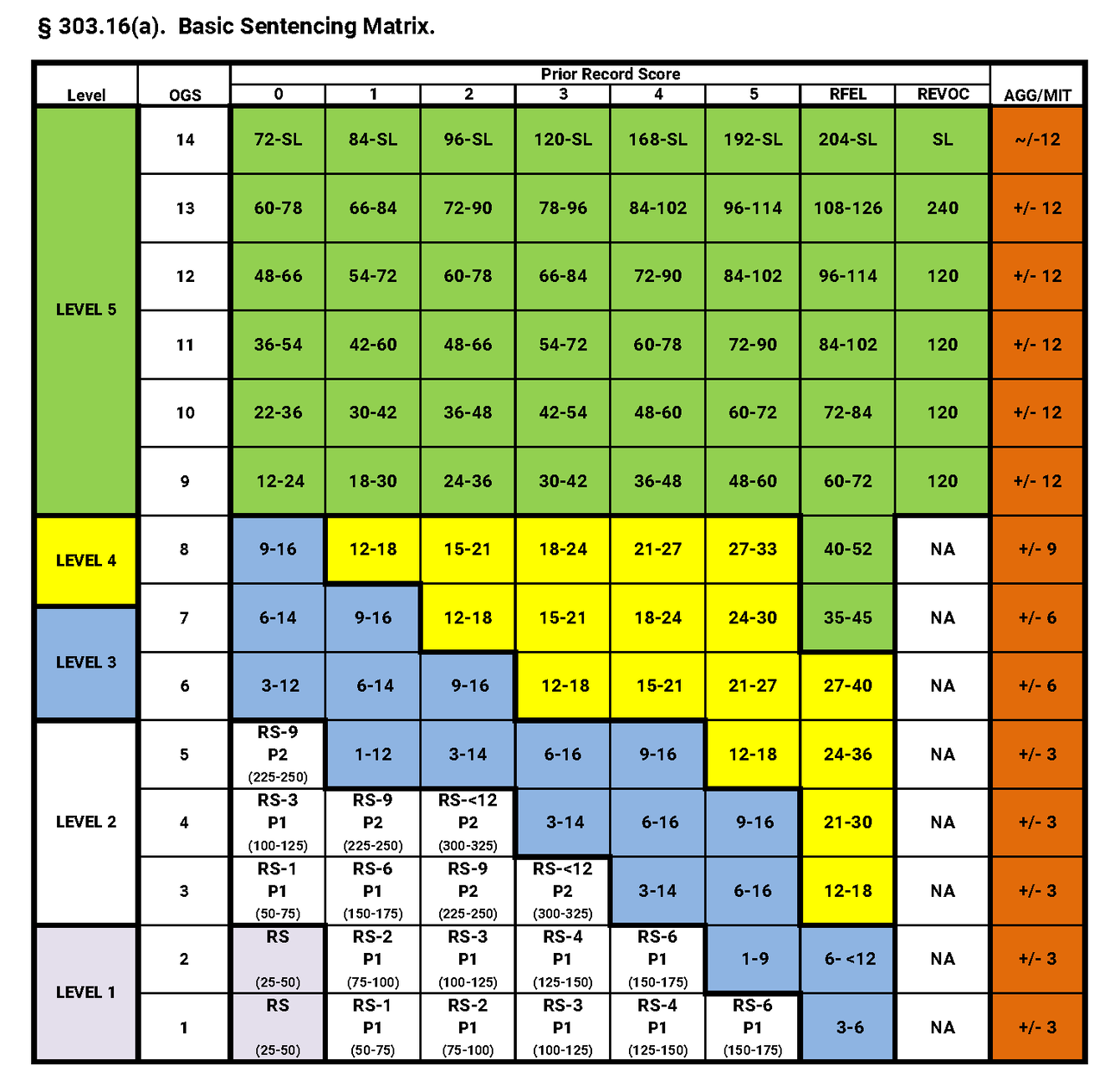
The Pennsylvania Sentencing Guidelines Matrix (Standard Range)
Sentencing Guidelines for Possessing a Concealed Firearm Without a License to Carry
Once the Offense Gravity Score and Prior Record Score have been calculated, the above sentencing matrix or chart can be used to determine the recommended minimum sentencing range. There are different matrices for crimes committed while in possession of a deadly weapon or where a deadly weapon was used, and there are also certain sentencing enhancements for certain offenses like possession of child pornography. However, the basic sentencing matrix above applies to most cases. As you can see, in the example above in which a defendant has a Prior Record Score of 2 for a PWID conviction and an Offense Gravity Score of 9 for a VUFA § 6106 charge, the recommended minimum sentence is 24 – 36 months plus or minus 12 months. This means a standard guideline sentence would have a minimum of somewhere between two and three years, but the judge can subtract 12 months if there is strong mitigation evidence or add 12 months if there are significant aggravating factors. The judge would then have to pick a maximum sentence which is at least double the minimum, so if the judge were to sentence the defendant to a minimum of 18 months of incarceration, the judge would have to make the sentence at least 18-36 months.
This leads to the last and possibly most important part of predicting what the defendant is looking at. As the example above illustrates, the judge has a tremendous amount of discretion in determining the sentence. For a VUFA 6106 conviction for a defendant with no record, which is an extremely common situation, the judge could sentence anywhere from probation to 3-6 years in state prison and still have imposed a guideline sentence.
It is very difficult to challenge a guideline sentence on appeal. The Superior Court is often reluctant to even review an above-guideline sentence. For this reason, it is extremely important to have a lawyer who understands not only the mandatory minimums and the applicable sentencing guidelines, but also the sentencing practices of the judge. If the lawyer knows from experience that the judge is likely to impose a mitigated sentence for an open (meaning non-negotiated) guilty plea, then the lawyer can advise a client to reject an offer from the Commonwealth which is not fully mitigated. Likewise, if the lawyer knows that the judge is likely to impose a low guideline sentence even after conviction at a bench trial, the lawyer may be able to provide advice that it is better to have a judge trial than a jury trial. Obviously, it is critically important that you hire a lawyer who knows the system, knows the law around sentencing, and has experience practicing before the judges who would ultimately impose sentence. It is even more important that you have a lawyer who understands the importance of sentencing and how to craft a persuasive mitigation argument for the judge in order to get the judge to impose a mitigated or below guideline sentence.
What factors does a judge consider at sentencing?
There are a number of different factors that a judge could consider at sentencing. For example, the judge will typically look at some of the following factors:
the seriousness of the offense,
whether the defendant has a prior criminal record,
whether the defendant has complied with the conditions of pre-trial release or participated in programs while in custody awaiting sentencing,
whether the defendant has a job,
and whether the defendant has community support and people who are willing to speak on his or her behalf.
A judge would also be required to consider any potential mandatory minimum sentence that could apply.
In order to obtain the best possible sentence for our clients, we often focus on obtaining proof of employment, character letters from friends, family, and community members, and proof of drug or alcohol treatment or other counseling as necessary. In some cases, it can be helpful to obtain an evaluation from a medical profession in order to prepare an expert report as to whether a defendant is likely to respond well to treatment.
Our Philadelphia Criminal Lawyers Can Help

Philadelphia Criminal Defense Attorneys
The Philadelphia Criminal Defense Lawyers of Goldstein Mehta LLC have the legal expertise and practical experience necessarily to properly advise and defend anyone facing criminal charges in Philadelphia and the surrounding counties. We know the law, we know the defenses, and we have experience practicing before the judges. We can evaluate your case and potential defenses and come up with a plan to minimize the consequences of an arrest – whether that means negotiating a better sentence or taking the case to trial for an acquittal. If you or a loved one are facing criminal charges, call 267-225-2545 today for a free, confidential consultation.


PA Sentencing Matrix (Deadly Weapon Possessed)
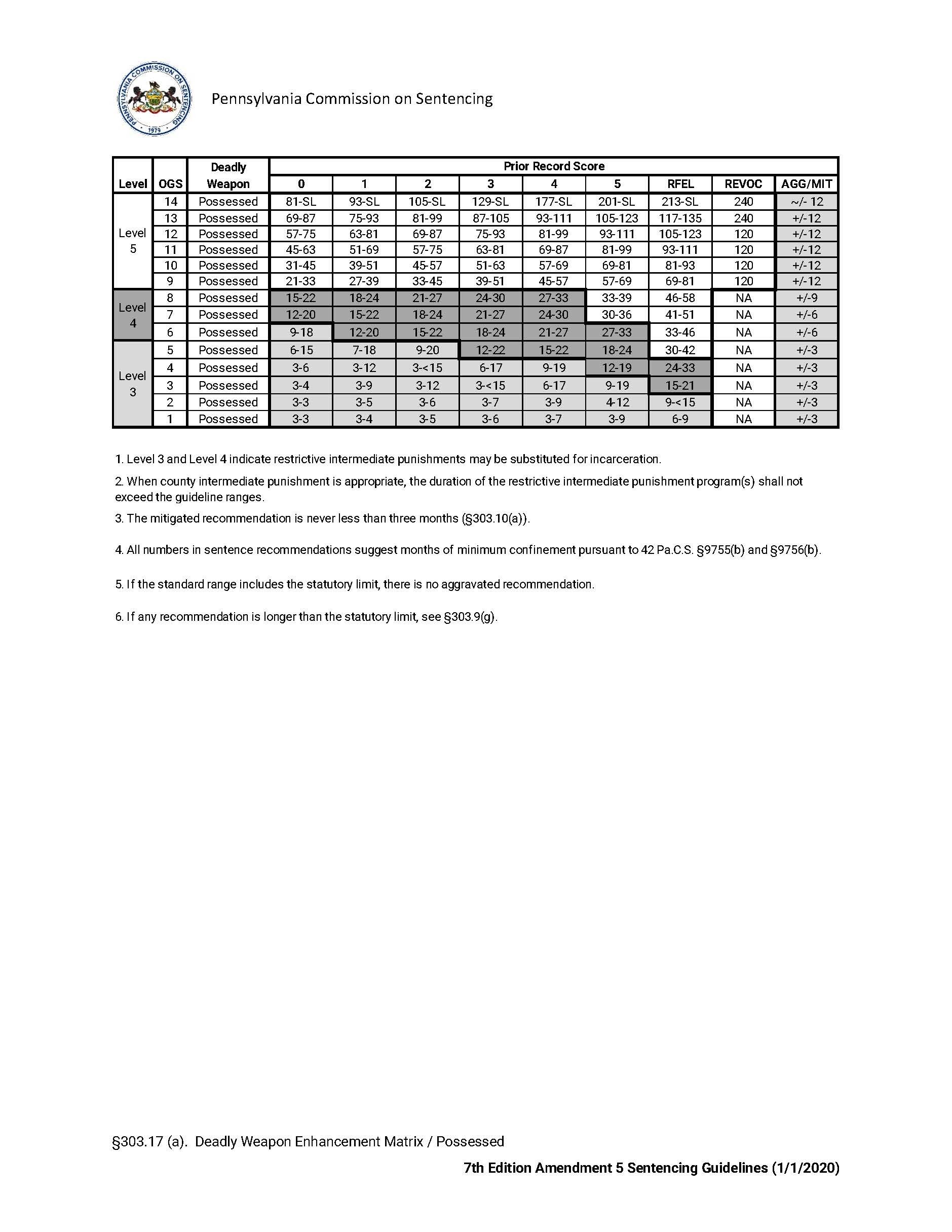
The Pennsylvania Deadly Weapon Possessed Guideline Matrix
PA Sentencing Matrix (Deadly Weapon Used)
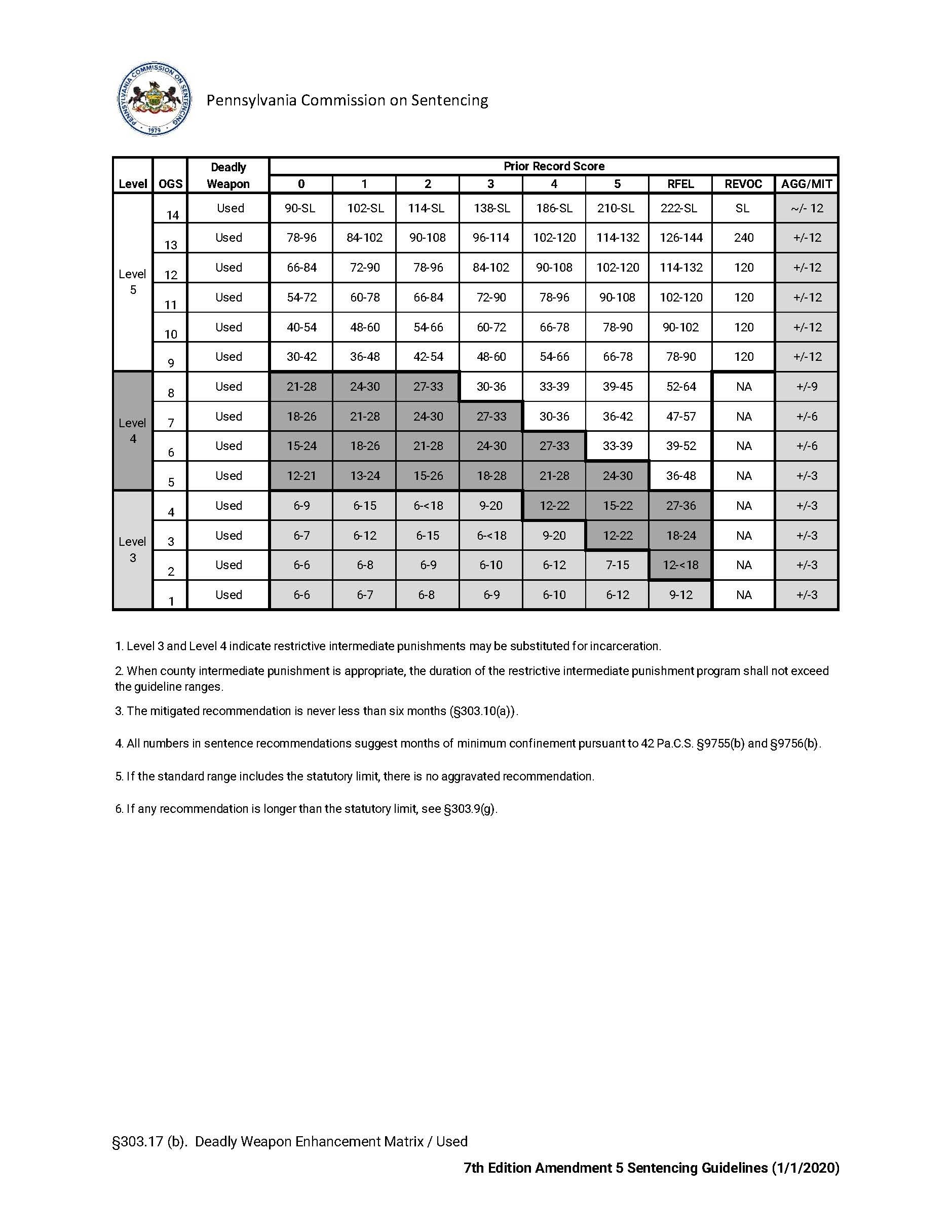
The Pennsylvania Deadly Weapon Used Guideline Matrix

Federal Sentencing Update: United States Sentencing Commission Proposes Limiting Use of Acquitted Conduct at Sentencing
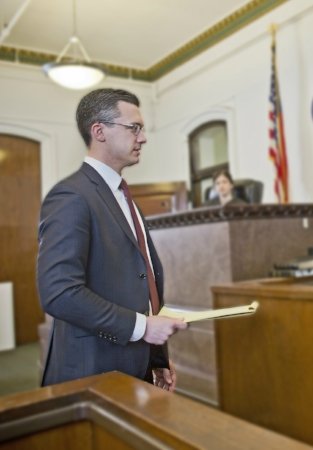
Criminal Defense Lawyer Zak T. Goldstein, Esquire
The United States Sentencing Commission recently proposed a major change to federal sentencing law, indicating that it may bar the use of acquitted conduct at sentencing where defendants have been acquitted of some charges but convicted of others. This would represent a major change in federal sentencing law. Currently, federal judges may sentence criminal defendants based on conduct for which the jury acquitted them. This is an incredibly unfair practice as it means that a defendant may go to trial on two charges, get acquitted by the jury of the more serious charge when the jury finds that the government could not prove the offense beyond a reasonable doubt, and then still be sentenced as if they had been convicted of the more serious charge.
Acquitted conduct is an offense for which the defendant was not convicted. For example, in many cases, defendant could be charged with guns and drugs at the same time. The penalties for federal drug offenses can be draconian on their own, but the presence or use of a firearm during the commission of the drug offense can result in mandatory minimums and federal sentencing guidelines that are exponentially higher. Federal judges take the guidelines incredibly seriously, so the guideline calculation is extremely important. Currently, there is nothing preventing federal judges from treating a defendant who has been convicted of a drug offense but acquitted of the firearm offense the same at sentencing as if the defendant had been convicted of both offenses. This can lead to a drastically longer sentence even though the jury partially acquitted. Federal judges also may often consider conduct for which the defendant was never charged.
Similar sentencing issues can arise in white collar cases, as well. For example, where a jury acquits a defendant of some counts related to a fraud scheme but convicts on others, the judge can currently sentence based on dollar amounts involved in the counts for which the defendant was acquitted. Because the loss amount involved is often the most important factor in the federal sentencing guideline calculation, this can have a significant impact on the resulting sentence.
Numerous defendants have attempted to challenge this practice as violating the Constitution in the United States Supreme Court, but the Supreme Court has rejected those challenges. The Supreme Court concluded in United States v. Watts that “a jury's verdict of acquittal does not prevent the sentencing court from considering conduct underlying the acquitted charge.” Some of the recently confirmed justices have previously signaled that they may reconsider that ruling, but so far, the Court has not accepted any petitions for certiorari on the issue.
The Sentencing Commission, however, could avoid the need for court action should it approve the proposed change. The proposed change would preclude courts from being able to consider acquitted conduct at sentenicng. The Sentencing Commission was created by Congress for the purpose of establishing the rules by which the guidelines are calculated. Ultimately, the guidelines produce a recommended sentencing range for the judge to consider when imposing sentencing. Until recently, the guideline range was actually mandatory and a judge could not sentence below the guidelines under most circumstances. The guidelines are no longer mandatory, but they are still extremely important.
The downside of the change being approved by the Sentencing Commission rather than the Court is that the change would almost certainly not be retroactive. However, this is an important change that strengthens the presumption of innocence and holds the government to its burden of proving a defendant guilty beyond a reasonable doubt. Criminal defendants should not be sentenced for things that the jury found that they did not do.
This change would only affect federal sentencing proceedings. It would not alter the current practice in the Pennsylvania state courts. The Pennsylvania state courts also use sentencing guidelines, but the guidelines are not quite as important as they are in federal court. The state courts are far more likely to depart from them. Further, it is relatively rare for courts to consider acquitted conduct or conduct for which a defendant was not charged in a state court sentencing proceeding. It is not necessarily prohibited at all times, but state court judges almost always agree that they should not hold alleged offenses for which a defendant was acquitted against them.
Facing criminal charges? We can help.
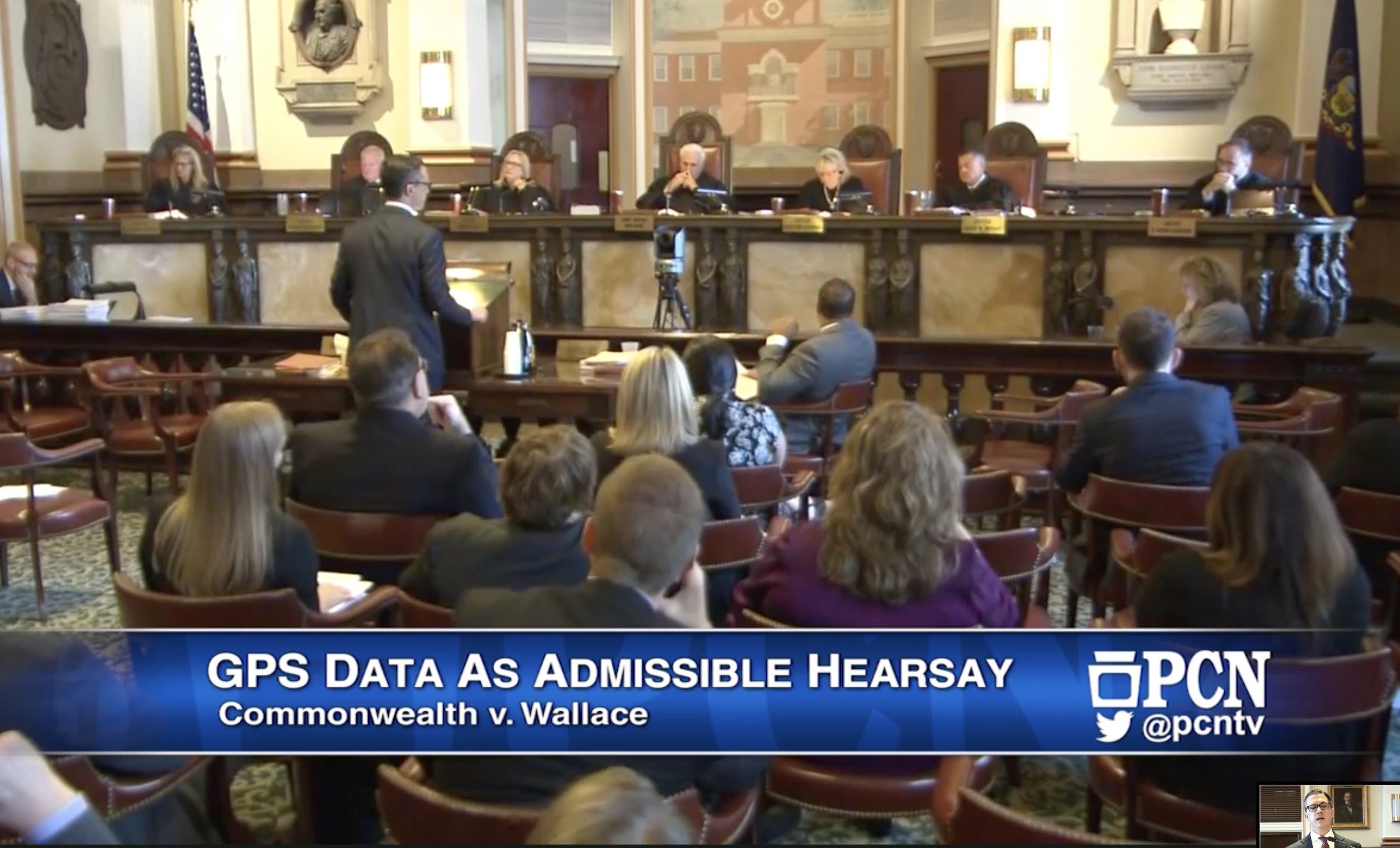
Federal Criminal Defense Lawyer Zak T. Goldstein, Esquire, at oral argument
If you are facing criminal charges or under investigation by the police, we can help. We have successfully defended thousands of clients against criminal charges in courts throughout Pennsylvania and New Jersey. We have successfully obtained full acquittals in cases involving charges such as Conspiracy, Aggravated Assault, Rape, and Murder. We have also won criminal appeals and PCRAs in state and federal court. Our award-winning Philadelphia criminal defense lawyers offer a free criminal defense strategy session to any potential client. Call 267-225-2545 to speak with an experienced and understanding defense attorney today.

PA Issues New Sentencing Guidelines for Probation Violations
The Pennsylvania Sentencing Commission recently issued new guidelines concerning violation of probation hearings (“VOP hearings”). The Sentencing Commission’s decision could dramatically change the way in which probation violations in Philadelphia and throughout the state are handled because the court no longer has unlimited discretion in fashioning a sentence.

Further, the Sentencing Commission has created the guidelines in such a way that they recommend significant prison sentences for most probation violations no matter how minor. It will take some time to see how seriously judges take the guidelines, and there has also been a recent push in the legislature to limit the unlimited discretion of judges to impose extreme prison sentences for probation violations which could lead to future changes. For now, however, the creation of these guidelines, which typically recommend jail time, appear to be a step in the wrong direction.
What is a Violation of Probation Hearing in Philadelphia?
A VOP hearing occurs when a defendant violates a judge’s probation. There are two types of potential violations: technical violations and direct violations. Technical violations occur when the defendant does not comply with some condition of his or her probation. For example, let’s assume that a condition of a defendant’s probation is that the defendant attend anger management classes. If the defendant does not go to the anger management classes, then the probation officer could recommend that the judge find the defendant in violation of his or her sentence. The judge, after holding a hearing, could then decide to revoke the defendant’s probation, impose a new period of probation, or even impose a period of incarceration on the defendant. This is just one example. Judges are given broad discretion in fashioning their sentences and thus can impose a variety of conditions on a defendant. This means that a defendant can be found in violation of probation and sentenced to prison without committing any new crimes.
Direct violations are usually more serious than technical violations. A direct violation occurs when a defendant is convicted of a new crime while on probation for another crime. Judges will often impose harsher sentences on defendants who have committed direct violations than on defendants who have committed technical violations, and potential direct violations often lead to probation detainers which prevent the defendant from being released until the new case has been resolved. Additionally, a defendant’s back judge can impose a sentence that is consecutive to the sentence the defendant received on his new case. Therefore, direct violations can cause great harm to a defendant.
What are the New Sentencing Guidelines?
The new sentencing guidelines affect both technical and direct violation hearings. If a defendant is found to be in technical violation, then the court is to consider the defendant’s original guidelines from the time of sentencing on the offense when deciding on a new sentence. For example, let’s assume that a defendant was serving a sentence on an Aggravated Assault that is graded as a felony of the first degree. Let’s also assume that when he was sentenced, he had a prior record score (“PRS”) of 1. As such, his guidelines were 42-60 months of incarceration, with the judge given the discretion to add or subtract 12 months to or from the sentence. Now let’s assume that this defendant was ordered to attend anger management classes, but he did not do so. At his VOP hearing, per the new sentencing guidelines, the court could sentence him to anywhere from 30-72 months for this technical violation. As such, a defendant can receive a worse sentence than what he originally received based on these new guidelines.
Things get worse if you are in direct violation on your probation based on the new sentencing guidelines. If you receive a direct violation, your new guidelines are most likely higher than they would be if you only had a technical violation. Instead of being sentenced to the original guidelines, if a defendant is found to be in direct violation, then the defendant will be resentenced on an increased PRS (the courts add one point for defendants with a prior PRS of 0-4, if a defendant is a 5, REVOC, or RFEL then no points are added).
To help explain this, let’s use our defendant from the previous example. Instead of not attending his anger management classes, he picks up a simple assault case which results in a conviction. At his Gagnon II hearing at which he is re-sentenced, the judge must now add a point to his PRS. So instead of being a 1, he is now a 2. Now his guidelines for resentencing are 48-66 months of incarceration plus or minus twelve months for aggravating or mitigating circumstances. Therefore, because of his new direct violation, his guidelines on his VOP range from 36-78 months. As one can see, these new guidelines are significant and can result in defendants spending more time incarcerated than they previously would have been. In many ways, this is actually worse than simply leaving it to the discretion of the judge as the rules require that the judge consider these guidelines when imposing a sentence and place any reasons for departing from them on the record.
The problem with these guidelines is that the sentencing guidelines call for jail in almost all cases. It can be almost draconian to impose a significant jail sentence on someone for not complying with a condition of their probation or even being convicted of a minor crime such as a misdemeanor. If fully implemented, these guidelines have the potential to worsen the mass incarceration problem instead of alleviating it.
Are The New Sentencing Guidelines Mandatory at a Probation Violation Hearing?
No. Just like the sentencing guidelines for the original conviction, courts are not required to impose guideline sentences. If a court imposes a sentence outside of the guidelines, then the judge must state in open court the reasons for the revocation and the sentence imposed. If a court imposes a sentence outside the guidelines, then the court must document the reasons why on the “Guideline Sentence Form” which then will be electronically submitted to the Pennsylvania Commission on Sentencing. This means that the guidelines are not binding on the court. But judges do tend to consider the guidelines and take them seriously when imposing sentence.
Facing Criminal Charges? We Can Help.

Philadelphia Criminal Defense Lawyers
If you are facing criminal charges or under investigation by the police, we can help. We have successfully defended thousands of clients against criminal charges in courts throughout Pennsylvania and New Jersey. We have successfully obtained full acquittals in cases involving charges such as Conspiracy, Aggravated Assault, Rape, and Murder. Our award-winning Philadelphia criminal defense lawyers offer a free criminal defense strategy session to any potential client. Call 267-225-2545 to speak with an experienced and understanding defense attorney today.

PA Superior Court: Sentencing Guidelines Are Not Binding

Philadelphia Criminal Defense Lawyer Zak Goldstein
The Pennsylvania Superior Court has decided the case of Commonwealth v. Conte, re-affirming that a trial court retains significant discretion in fashioning a sentence for a defendant following a trial. The court’s opinion illustrates the fact that the trial court is not bound by the Pennsylvania Sentencing Guidelines when deciding on a sentence. Further, the trial court may consider all of the allegations at issue even if the defendant has been acquitted by the jury of some of the more serious charges.
The Facts of Commonwealth v. Conte
The Pocono Mountain Police interviewed the complainant, the defendant’s daughter, in January 2016 about alleged sexual assaults. The complainant told the police that the defendant sexually assaulted her on numerous occasions when she was between the ages of four and eight years old. On January 29, 2016, a criminal complaint was filed that charged him with rape, involuntary deviate sexual intercourse, aggravated indecent assault, and endangering the welfare of children (“EWOC”).
Prior to trial, both parties litigated a number of pre-trial motions. The Commonwealth filed a 404(B) motion, which is commonly referred to as a Prior Bad Acts Motion, to introduce the testimony of T.F., who was an acquaintance of the defendant’s children. T.F. alleged that the defendant had asked her to join him in his car and had placed T.F.’s hand over his pants and on his penis. The trial court expressed hesitancy in allowing the Commonwealth to use the testimony of T.F. in its case-in-chief. As such, the Commonwealth stated that it would only use T.F. as a rebuttal witness if the defense were to present any evidence.
At trial, the Commonwealth called the complainant as well as her mother and her brothers as witnesses against the defendant. The defendant, as well as his current wife, testified at trial. According to the Superior Court, the trial testimony painted a very different picture of what occurred during these years than what the complainant originally stated to the police. In fact, according to the prosecution’s witnesses, the defendant treated the complainant like “a princess.” However, to the other children, the defendant was a “cruel, vindictive and violent man who harbored no dispute in the house and regularly meted out physical punishment.” The defense’s witnesses sought to counter this narrative by suggesting that although the defendant was a disciplinarian, the household itself was warm and a welcoming place for family and friends. The Commonwealth then called T.F. as a rebuttal witness.
At the conclusion of the trial, the defendant was convicted of a single count of EWOC. He was acquitted of all other charges. The pre-sentence investigation report was prepared and the defendant was sentenced on June 20, 2017. At his sentencing hearing, the defendant called multiple witnesses to testify on his behalf. The defendant also spoke at his sentencing and stated: “I really don’t know why I’m here today.” The defendant’s guidelines were Restorative Sanctions to 6 months’ incarceration, with an upward enhancement of three months for the aggravated range. The judge proceeded to sentence the defendant to the statutory maximum of two and a half to five years’ incarceration.
In justifying this maximum possible sentence, the judge stated that the defendant was responsible for “the disharmony of the family.” Further, the sentencing court gave great weight to the testimony of the complainant. The complainant testified at the sentencing about the harm that she endured because of the defendant’s actions. Specifically, that she had attempted to commit suicide twice and has had difficult with normal healthy sexual relationships. As required in order to challenge a sentence on appeal, the defendant filed post-sentence motions. Those were denied. He then filed a timely appeal. Specifically, the defendant appealed the length of his sentence, arguing that the trial court abused its discretion when it imposed the statutory maximum, especially considering that he was found guilty of only one charge and that the trial court allowed T.F. to testify as a rebuttal witness. For purposes of this blog, only the appeal of his sentence will be addressed.
Can I Appeal My Sentence?
Yes, but your rights are limited. Judges are given a significant amount of discretion in creating a sentence for a defendant. Further, a defendant’s sentence will not be overturned on appeal unless the sentencing court abused its discretion. This is a very high standard to meet, and thus a defendant’s sentence will remain undisturbed unless the trial court was excessively cruel. For an example of this, please see our blog post for Commonwealth v. Sarvey (https://goldsteinmehta.com/blog/unreasonable-sentence-for-pill-sale).
When fashioning a sentence, a judge is supposed to take into consideration several factors. As a preliminary matter, the sentencing court must consider the sentencing guidelines for a particular defendant. The sentencing guidelines analyze the severity of the offense (also known as the offense gravity score) and the criminal history of the defendant (also known as the prior record score). When a judge does this, they are able to determine the sentencing guidelines for the particular defendant. The purpose of this is to try and create uniformity with sentencings across the Commonwealth (i.e. someone who commits a particular offense with a particular criminal history in Harrisburg should get a similar sentence if that same person were to commit the same offense in Philadelphia).
However, it is important to note that the sentencing guidelines are not mandatory. Further, courts should also consider additional factors when they sentence a defendant. Courts consider things such as the age of the defendant; the facts of the case; whether the crime involved violence; whether the defendant is a threat to the community; the rehabilitative needs of the defendant; the defendant’s stated remorse or lack thereof; etc. In other words, a judge must consider the character of the defendant. Consequently, when one looks at the individual characteristics of a defendant, this can be justification for departing from the guidelines.
The Superior Court Affirms the Sentence
The Superior Court held that the trial court did not abuse its discretion when it sentenced him to the statutory maximum. The Court rejected the argument that the sentence was excessive despite the fact that the defendant had been acquitted of the more serious charges at trial and that the guidelines called for a much shorter sentence. The Superior Court highlighted that the trial court had justifiable reasons for giving him the sentence that he received. Specifically, according to the Superior Court, the defendant did not show any remorse for his actions. Further, the Superior Court highlighted the lingering harm suffered by the complainant and her family because of the defendant’s actions. Therefore, the Superior Court held that the trial court did not abuse its discretion. The defendant will not receive a new sentencing hearing.
Facing Criminal Charges? We Can Help.
If you are facing criminal charges or under investigation by the police, we can help. We have successfully defended thousands of clients against criminal charges in courts throughout Pennsylvania and New Jersey. We have successfully obtained acquittals and dismissals in cases involving charges such as Conspiracy, Aggravated Assault, Rape, and Attempted Murder. Our award-winning Philadelphia criminal defense lawyers offer a free criminal defense strategy session to any potential client. Call 267-225-2545 to speak with an experienced and understanding defense attorney today.