

Philadelphia Criminal Defense Blog

Goldstein Mehta LLC Defense Attorneys Obtain Successful Outcomes in Robbery, PWID, Gun, and Assault Cases


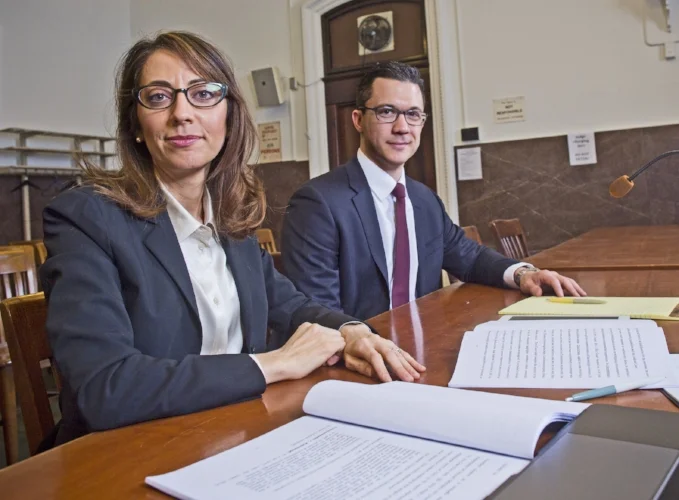
Criminal defense attorneys Demetra Mehta and Zak Goldstein continue to obtain successful results in and out of the courtroom. In the last few months, our defense attorneys have won cases involving drug charges, gun charges, assault allegations, and juvenile robbery charges. If you are facing criminal charges, call 267-225-2545 for a complimentary criminal defense strategy session with one of our award-winning defense attorneys. Some examples of our recent not guilty verdicts and successful motions to suppress include:
Commonwealth v. T.C. - Motion to Suppress Granted in Drug Delivery Case

Criminal Lawyer Demetra Mehta
Attorney Mehta focuses on getting the best results for her clients. In the case of Commonwealth v. T.C., she successfully moved for the suppression of 13 grams of crack cocaine. Attorney Mehta also beat the accompanying DUI charge. In this case, the government alleged Attorney Mehta's client was driving while intoxicated. The arresting police officer claimed that he pulled T.C. over because the head lights of T.C.'s vehicle were not on at night. But Attorney Mehta knew better. She recognized that this was a late-model car, and she quickly obtained proof that the car's headlights actually turn on automatically at night. Through skillful cross-examination, she was able to demonstrate this key fact to the trial judge during the motion to suppress. This led to not only the eventual suppression of the large quantity of drugs in the car but also all observations of her client, meaning the government could not proceed on the DUI charges, either. With the motion to suppress granted, prosecutors were forced to withdraw all charges. T.C. now faces no criminal record from this arrest!
Commonwealth v. G.R. – Not Guilty in Self-Defense Assault Case
G.R., the assistant manager of a local market, was charged with Simple Assault in Philadelphia for allegedly getting into a fight with a co-worker at work. Prosecutors alleged that G.R. punched a co-worker in the throat, fracturing his larynx, after the co-worker engaged in a verbal altercation with G.R. relating to work responsibilities. Although a broken bone can often lead to Aggravated Assault charges, prosecutors moved only to prosecute G.R. in the Philadelphia Municipal Court on the Simple Assault charge. Despite the fact that G.R. was charged only with misdemeanors, the stakes were high for G.R. because G.R. stood to lose his job in the event of a conviction relating to an assault of someone at work.
Attorney Goldstein defended G.R. and obtained a full acquittal in a trial before the Municipal Court Judge. Attorney Goldstein established that G.R. acted in self-defense by cross-examining the complainant on the size difference between the two men, the discrepancies, contradictions, and omissions in the complainant’s statement, and the complainant’s lack of medical records to show that he had actually sustained the injuries that he claimed.
Attorney Goldstein established that the complainant, a much bigger man, got in G.R.’s face, pushed him repeatedly, and made a movement consistent with lining up to throw a punch before G.R. ever responded with force. A background check of the complainant also revealed that he had prior convictions for conspiracy to commit homicide as a juvenile and simple assault as an adult. Mr. Goldstein successfully moved for the admission of those convictions into evidence in order to show that the complainant was actually the initial aggressor. Mr. Goldstein then called G.R. to the stand to testify that he had acted in self-defense and believed that the complainant was about to throw a punch. The judge rejected the complainant’s inconsistent testimony and promptly acquitted G.R. on self-defense grounds.
Commonwealth v. J.L. – Motion to Suppress Granted in Case Involving Drugs, Guns, and Cash
Our criminal defense lawyers recently won a motion to suppress of physical evidence in a case involving drug charges and gun charges in the Philadelphia Municipal Court. J.L. was pulled over by police one night as the passenger in a vehicle. Police claimed that the vehicle smelled like marijuana and that J.L. made furtive movements as they approached the car. Police also claimed that J.L. seemed very nervous and lacked identification when the police spoke with him.
Police decided to remove him from the car and frisk him based on these observations. The officer claimed to feel a pill bottle. Believing that the pill bottle would likely contain contraband, the officer then went into J.L.’s pockets, removed the pill bottle, and found crack cocaine in the bottle. The officer also claimed that J.L. had a large amount of cash in his pocket. Officers then searched the rest of the car and found more drugs and a gun in the trunk.
Prosecutors initially charged J.L. and the driver of the car with possession both of the drugs allegedly found in J.L.'s pocket as well as the larger quantity of drugs and guns in the trunk. Prosecutors listed the case for a preliminary hearing on the felony charges, and J.L. retained the criminal defense attorneys of Goldstein Mehta LLC for the preliminary hearing. Our attorneys were able to convince the prosecutor that they could not prove that J.L. constructively possessed the items in the trunk, including the larger quantity of drugs and the gun, because J.L. did not own the car and had never been seen accessing the trunk. Prosecutors agreed, withdrew the felony charges, and remanded the case to the Philadelphia Municipal Court only on the charges of possessing the crack cocaine in the pill bottle.
When the case was listed for trial, Attorney Goldstein moved to suppress the crack cocaine. In general, when police pull a car over in Pennsylvania, they may remove a passenger from the vehicle without any level of reasonable suspicion. However, in order to conduct a Terry frisk of the occupant of a car, the police must have reasonable suspicion both that the suspect is engaged in criminal activity and that the suspect is likely to be armed and dangerous. This means that police must be able to provide an articulable belief, consisting of real reasons, for why the officer believed that criminal activity was afoot and that the defendant was likely to have a weapon.
Here, the officer testified that he believed the defendant was likely concealing weapons or contraband in the car due to his furtive movements, nervousness, lack of identification, and the odor of marijuana in the car. He therefore decided to conduct a frisk. The officer failed to realize, however, that a Terry frisk is limited only to a cursory pat down for weapons. When an officer feels something that is plainly contraband during a frisk, the officer may then conduct a full search and remove the object for further inspection even when the officer does not believe the object is a weapon. But the officer must be immediately able to tell that the item in question is contraband. The officer cannot conduct a full search of a defendant’s pockets and the containers therein solely because the officer feels some kind of object and doesn’t know what it is or may contain.
After the officer testified that he could immediately tell that the item in question was a pill bottle, Attorney Goldstein provided the Court with Pennsylvania Supreme Court case law in which the Court held that a pill bottle cannot automatically be considered contraband. In most cases, it is perfectly legal to possess a pill bottle, and most pill bottles are not used to transport contraband. Accordingly, it is not immediately apparent that a pill bottle contains contraband. Based on this Supreme Court case, Attorney Goldstein successfully argued that the officer exceeded the scope of a lawful Terry frisk and that the pills should be suppressed. The judge agreed and granted the motion. The Commonwealth elected not to appeal and withdrew the charges.
Commonwealth v. W.D. – ARD Obtained in Possession with the Intent to Deliver Marijuana Case
W.D. was charged with selling a significant amount of marijuana from a car. Philadelphia Police conducted a narcotics surveillance targeting a block known for high drug activity. During the course of that surveillance, they were able to successfully have a confidential informant purchase drugs in a house on that block. Based on those controlled buys, police obtained a search warrant for the house and returned to execute the warrant. While they were preparing to execute the warrant, police allegedly observed W.D. selling marijuana to dozens of buyers from a car parked up the block. When police went to execute the search warrant, they also searched W.D. and the car in which he was sitting and found a quantity of marijuana and a large amount of money. Accordingly, police charged W.D. with Possession with the Intent to Deliver.
Fortunately, W.D. had no prior criminal record and was enrolled in college. Our defense attorneys worked with W.D. to put together a strong application for ARD on his behalf. We obtained proof of employment, college enrollment, and character letters from family members and friends. Using this mitigation packet, we were able to convince prosecutors to offer entry into the ARD program for the felony Possession with the Intent to Deliver charges. Prosecutors almost never offer ARD for PWID, but in this case, W.D. will have to complete a short period of probation, community service, and pay a small fine. Once those requirements have been completed, the charges will be dismissed and W.D. can have the entire case expunged with no admission or finding of guilt.
In Re: J.G. – Not Guilty Verdict Obtained in Juvenile Robbery Case

Criminal Defense Attorney Zak Goldstein
Attorney Goldstein successfully obtained a full acquittal in a juvenile delinquency Robbery case. In this case, J.G. was charged with strong-arm robbery and related theft charges for allegedly trying to steal the complainant’s cell phone. Prosecutors claimed that J.G. and a group of other juveniles had surrounded the complainant, held him down, and gone into his pockets, taking cash and trying to take a cell phone.
J.G. insisted on his innocence and our defense lawyers took the case to trial in Philadelphia Family Court. By cross-examining the arresting officer on the inconsistencies between the description of the robbers given by the complainant and the clothing that J.G. was actually wearing when arrested, and pointing out that J.G. had neither the complainant’s cell phone or money when arrested, Attorney Goldstein successfully convinced the Family Court judge that police had arrested the wrong person. Accordingly, the judge found J.G. Not Guilty of Robbery and all other charges. J.G. will continue to have no criminal record and may have all of the charges expunged.
FACING CRIMINAL CHARGES OR CONSIDERING AN APPEAL? WE CAN HELP.
If you are facing criminal charges or deciding whether to appeal a conviction or sentencing, we can help. We have successfully defended thousands of clients in jurisdictions throughout Pennsylvania and New Jersey. We can also provide advice on the merits of pursuing an appeal or post-conviction relief act petition. We offer a free 15-minute criminal defense strategy session to each potential client. Call 267-225-2545 to speak with an experienced and understanding criminal defense attorney today.

Attorney Goldstein Selected to List of Three Best Rated Criminal Defense Lawyers in Philadelphia, PA
Attorney Goldstein was recently selected by Three Best Rated to their list of the Three Best Rated Criminal Defense Lawyers in Philadelphia, PA.

From the website:
Three Best Rated® was created with a simple goal to find you the top 3 local businesses, professionals, restaurants and health care providers in your city. We display only businesses that are verified by our employees since customers deserve only the best.
That's not all... Businesses do not pay us to list them ever. You do not pay us for the listing any time. We believe that local businesses provide better and personal services locally. Local businesses know your city better since they live there too. Our policy is free to list because if you can pay to list, then is it really the best business?

NOT GUILTY: Criminal Defense Attorney Zak Goldstein Wins Attempted Murder Jury Trial in Philadelphia
Recent Case Results

Philadelphia Criminal Defense Lawyer Zak T. Goldstein, Esq.
In the past month, Philadelphia criminal defense lawyers Zak T. Goldstein, Esq. and Demetra Mehta, Esq. have continued to win outstanding results in the court room. This week, in the case of Commonwealth v. L.W., Attorney Goldstein obtained a full acquittal for L.W. in a case involving Attempted Murder charges. After deliberating for only five hours, the Philadelphia jury of twelve citizens returned an acquittal for L.W. on all charges.
L.W. was charged with Attempted Murder, Aggravated Assault, and illegal possession of a firearm for allegedly shooting the complainant in the head at a block party in Southwest Philadelphia. Prosecutors alleged that L.W. shot the complainant, but the bullet did not penetrate his skull. The complainant jumped up, ran to a nearby police car, and was transported to the hospital. The complainant consistently denied that the defendant had shot him, but shortly after the complainant arrived at the hospital, the complainant’s family members began to tell police that two of them had witnessed the incident. Two of his family members told detectives that they were standing with the complainant at the party when the defendant got mad, pulled a gun, and shot the complainant in the head. A third family member also testified that despite denying it to the police, the complainant told her that the defendant was the shooter. Finally, police detectives testified that when they attempted to arrest the defendant a few days later, he fled from a traffic stop and evaded arrest. They also tried to insist that the complainant was uncooperative and that they believed he was lying to them.
On paper, the case looked extremely difficult for L.W.. The Commonwealth claimed that two eyewitnesses implicated the defendant in the shooting and that a third witness would prove the complainant lied to police about not knowing who shot him. But once the jury was empaneled and the witnesses were under oath and subject to Attorney Goldstein’s withering cross examination, it became clear to the jury that the witnesses were lying. Attorney Goldstein got the witnesses to admit that they fabricated their original statements and had not in fact seen the shooting. The Commonwealth argued that the witnesses were recanting due to the no snitch culture in Philadelphia, but throughout the trial, Attorney Goldstein’s excellent presentation and grasp of the facts demonstrated to the jury that they were just untrustworthy witnesses.
After the Commonwealth saw the credibility of its witnesses destroyed by Attorney Goldstein, prosecutors tried to tip the scales by having multiple police detectives testify to their belief that the defendant was the shooter. Undeterred, Attorney Goldstein was able to highlight to the jury that the detectives based their entire case on hearsay from unreliable witnesses and failed to do any additional investigation. After Attorney Goldstein showed the jury that the Commonwealth had no physical evidence, biased and untrustworthy witnesses with a vendetta against his client, and that they had uncovered no evidence of any motive whatsoever, the jury fully acquitted L.W. of Attempted Murder, Aggravated Assault, and the related gun charges.
Commonwealth v. Z.S. – PCRA Results in Immediate Parole Eligibility for Man Originally Facing Illegal 30-Year-Sentence
We previously wrote about a PCRA Petition which successfully obtained a new Violation of Probation sentencing for client Z.S. Z.S. initially pleaded guilty to Possession with the Intent to Deliver (“PWID”) of a small amount of heroin. Pursuant to the initial guilty plea, Z.S. was sentenced to a short county sentence followed by probation. Z.S. violated the probation when he was convicted of a robbery, and he was sentenced to 7.5 – 20 years for the robbery. When Z.S. appeared for his violation of probation sentencing, the probation judge gave him an unfair sentence of 15-30 years in state prison consecutive to the initial 7.5 – 20 years. In most circumstances, judges have almost unlimited discretion in imposing a new sentence for a violation of probation. However, judges may not consider illegal factors when imposing a sentence.
In this case, the sentencing judge stated on the record that he found the defendant’s expression of remorse to be hollow because the defendant had refused to participate in the violation of probation sentencing by video. Instead, the defendant insisted on being present for this critical hearing. All defendants have a constitutional right to be present in court for sentencing hearings. Therefore, our defense attorneys were able to argue in a Post-Conviction Relief Act Petition that the judge violated Z.S.’s rights by explicitly punishing Z.S. for refusing to participate in the hearing by video and wanting to be present.
After the original VOP judge retired, a new judge was assigned to hear the PCRA Petition. The PCRA judge agreed with our attorneys and vacated the sentence. However, at the new sentencing hearing, the judge had the same authority to impose any type of sentence he saw fit. The judge could have re-sentenced the defendant to the same 15-30 year sentence or reduced the sentence to something substantially less. Due to the persuasive arguments of counsel and the compelling testimony from the defendant and his family members, the judge instead imposed a sentence of 3.5 – 7 years, which the defendant has already served. Accordingly, the defendant will become immediately eligible for parole instead of having to serve another 10 years before reaching parole eligibility.
Commonwealth v. R.P. – Burglary Charges Dismissed at Preliminary Hearing Due to Excessive Hearsay
We have written about the recent updates in Pennsylvania law surrounding the use of hearsay at preliminary hearings. Until recently, the rules have traditionally been that some hearsay is permitted, but preliminary hearings cannot be based entirely on hearsay evidence. In general, ownership and non-permission testimony, which is an element of any theft crime, can typically be shown through the use of hearsay. This allows the Commonwealth to proceed with a preliminary hearing based only on the testimony of a police officer in many theft cases. For example, where a defendant was pulled over in a stolen car, the police officer can testify to pulling the defendant over, and the Commonwealth can then introduce either hearsay testimony through a detective or an ownership and non-permission form (“ONP form”) identifying the owner of the vehicle and stating that the defendant did not have permission to drive the vehicle.
In recent cases, the Superior Court has adopted a permissive attitude towards hearsay and allowed cases to proceed to the Court of Common Pleas based on hearsay alone. The Supreme Court has not yet intervened, dismissing the appeal in Commonwealth v. Ricker as improvidently granted. However, the Supreme Court did recently decide to review this issue again in the case of Commonwealth v. McClelland. The Court has not yet ruled in that case. Nonetheless, many judges and magistrates, particularly in Philadelphia, will not allow the Commonwealth to proceed at a preliminary hearing with only hearsay testimony.
In this case, R.P. was charged with Burglary and related theft charges after police pulled him over as he exited a property that was being renovated. The officer stopped R.P. and his passenger, and the officer testified that he was able to see copper piping in the back of the car that R.P. was driving. The officer testified that R.P. told him that he had been scrapping and that the property from which R.P. exited was often the target of burglary attempts and that it was not well secured. The Commonwealth then introduced an ownership and non permission form stating that R.P. did not have permission to enter the property.
On cross-examination, Attorney Goldstein successfully showed that the officer did not know whether the copper piping actually came from inside the property. The officer had not inspected the premises to see if he could determine from where the pipe had been cut. Further, because the property had been repeatedly burglarized, including earlier that day, the damage to the back door could not be linked to R.P. Accordingly, with no evidence that the piping actually came from that property or that R.P. had actually entered the property, the Philadelphia Municipal Court judge dismissed all of the charges at the end of the preliminary hearing. The judge found that the evidence was insufficient and that any indication on the ONP form that R.P. had entered the property was excessive hearsay. This was particularly because the ONP form was not properly signed by the witness.
Facing Criminal Charges? We Can Help.
Goldstein Mehta LLC Criminal Defense Attorneys
The Philadelphia criminal defense lawyers of Goldstein Mehta LLC will fight for your rights at trial or on appeal. Our attorneys have successfully defended thousands of cases in Philadelphia and the surrounding counties, and we can help with all types of state and federal charges in Pennsylvania and New Jersey. We offer a free criminal defense strategy session to any potential client. Call 267-225-2545 to speak with an experienced and understanding criminal defense attorney today.

Speedy Trial Motion Granted in Prescription Fraud Case, Not Guilty Verdict in Domestic Assault Case, and Other Recent Case Results

Philadelphia Criminal Defense Attorney Zak T. Goldstein, Esq.
Our Philadelphia criminal defense attorneys have continued to obtain successful results in the courtroom. In the last two months, our defense attorneys have obtained acquittals and dismissals at trial and in preliminary hearings in criminal cases and successfully defended Protection from Abuse (PFA) Petitions. Some of our notable recent results include:
Commonwealth v. T.T. – Speedy Trial Motion Granted in Prescription Fraud Case Due to Delay in Arresting Defendant.
The client was arrested and charged with Forgery, Identity Theft, Possession With the Intent to Deliver, and related charges for allegedly forging Oxycodone and Percocet prescriptions and attempting to have them filled at local pharmacies. The magistrate judge initially set bail at $100,000, and the client’s family immediately hired Goldstein Mehta LLC. Attorney Goldstein moved for a bail reduction at the first listing of the preliminary hearing, and the Municipal Court judge promptly reduced bail to $25,000. Attorney Goldstein then renewed the bail motion in the Court of Common Pleas, and the Court of Common Pleas reduced bail even further, allowing the client to be released for a bail payment of $670.
Attorney Goldstein then defended the client at the preliminary hearing. At the preliminary hearing, an Agent for the Pennsylvania Attorney General’s Office testified that she had obtained records indicating that the defendant had attempted to fill forged prescriptions in various names on multiple occasions. However, the Agent had not actually viewed the defendant filling any prescriptions herself. Accordingly, the Municipal Court Judge held the case under advisement to determine whether the agent had sufficient personal knowledge of the allegations or whether the case should be dismissed because the Commonwealth’s entire case at the preliminary hearing was hearsay.
In addition to moving to dismiss the case due to the excessive hearsay, Attorney Goldstein also moved to dismiss the case for a violation of the client’s right to a speedy trial under Rule 600. Rule 600 requires that the Commonwealth bring a defendant to trial within 365 days from the filing of the criminal complaint. However, Rule 600 has a number of exceptions and is often not strictly enforced in cases where the Commonwealth can show that it was not the prosecution’s fault that trial was delayed. Here, the Agents conducted their investigation and filed the criminal complaint in 2014. When they first filed the complaint, they attempted to arrest the defendant, but he was not home. The police then failed to exercise due diligence in trying to find the defendant and bring him to trial, and he was not actually arrested until 2017. Accordingly, Attorney Goldstein moved to dismiss the case due to this pre-arrest delay. When police fail to arrest a defendant within 365 days from the filing of the Complaint, Rule 600 and the case of Commonwealth v. Webb require that the case be dismissed unless the Commonwealth can show that the police executed due diligence in trying to find the defendant and execute the arrest warrant. Here, there was no evidence that the police had diligently attempted to serve the warrant. Therefore, the Municipal Court judge dismissed the case with prejudice at the preliminary hearing for the speedy trial violation, meaning the Commonwealth cannot re-file the charges.
Commonwealth v. A.W. - Motion for Reconsideration of Probation Violation Sentence Granted
The client was found in technical violation of probation for theft and drug possession while represented by a different attorney. The probation judge sentenced A.W. to 11.5 - 23 months in custody. A.W. retained Goldstein Mehta LLC, and our attorneys immediately filed a motion to reconsider the sentence within ten days as required by the Pennsylvania Rules of Criminal Procedure. The client's back judge scheduled a hearing on the Motion to Reconsider, and prior to the hearing, we were able to work with the client's family to locate a drug treatment faciity which she could attend if released. Once our attorneys presented the probation judge with the treatment option, the judge reconsidered the sentence and granted immediate parole to treatment. Our defense attorneys were able to help the client avoid a lengthy jail sentence.
PFA Litigation – Protection from Abuse Petition Dismissed for Lack of Jurisdiction
Attorney Goldstein successfully moved to have a protection from abuse Petition dismissed at trial for lack of jurisdiction. The plaintiff alleged that she had had a sexual relationship with the defendant and that the defendant subsequently threatened her at a party. The PFA Act allows a plaintiff who claims that they were the victim of abuse to obtain an emergency ex parte protection from abuse order which prohibits the defendant from having any contact with the plaintiff. This order can be extremely problematic for a defendant as it can damage the defendant’s reputation, require the defendant to relinquish legally owned firearms, and can even require the defendant to be evicted from a shared residence. Although the initial order may be granted on an emergency basis without a hearing, the defendant has the right to a trial on whether the allegations are true and a final order is necessary. At the trial, the plaintiff must show that the PFA Court has jurisdiction, that abuse occurred, and that a restraining order is necessary to prevent abuse from occurring.
Here, Attorney Goldstein was able to have the Petition dismissed for lack of jurisdiction. Although the initial Petition alleged that the defendant and plaintiff had a consensual relationship, the defendant testified on cross-examination that the relationship had not been consensual. Knowing that the Superior Court has repeatedly held that PFA jurisdiction only exists in cases involving domestic partners, meaning household members, family members, and people in consensual, dating relationships, Attorney Goldstein immediately moved for dismissal of the Petition for lack of jurisdiction. The Family Court judge agreed and dismissed the Petition, thereby vacating the restraining order.
Commonwealth v. R.B. – Client was charged with various gun charges, including Violation of the Uniform Firearms Act Sec. 6106, 6108, and 6105. Our criminal defense lawyers successfully moved for the case to be dismissed after the Commonwealth was repeatedly not ready to proceed for the preliminary hearing.
Commonwealth v. R.T. – Unsworn Falsification Case Dismissed at Municipal Court Trial
The client was charged with Unsworn Falsification to Authorities for allegedly lying to police about being robbed in order to cover up a drug deal gone wrong. The police alleged that the defendant had not been robbed and had instead made up a story about being robbed at gunpoint in order to try to get money back which was stolen in a drug deal. The client retained Attorney Goldstein, who promptly requested all of the discovery in the case, including documents from Cherry Hill. The Commonwealth never successfully obtained the police reports from the other jurisdiction for two trial listings, so Attorney Goldstein moved to dismiss the charges. The Philadelphia Municipal Court judge dismissed the case for lack of prosecution.
Commonwealth v. Z.B. – Detainer Lifted and Client Sentenced to Time Served on Section 17 Detainer.
The client had previously pleaded no contest as part of a Section 17 pre-trial diversionary program to knowing and intentional possession of a controlled substance in Montgomery County. After getting arrested again for the same charge in a different jurisdiction, the probation officer took the client into custody and lodged a probation detainer. The client retained Goldstein Mehta LLC, and our defense attorneys immediately filed a Motion to Lift the Detainer, arguing that Section 17 probation does not give the sentencing judge the authority to lodge a probation detainer. Instead, the judge must schedule a hearing and either continue the probation or impose a judgment of sentence. In this case, the judge had not scheduled the probation violation hearing for months. After receiving the motion and recognizing that the law was unsettled as to whether Section 17 probation gives the authority to lodge a probation detainer, the judge moved the probation violation hearing up by two months. The client then stipulated to the probation violation in exchange for a sentence of roughly time served and was released shortly thereafter. By filing a creative motion on the client’s behalf, our defense lawyers were able to save the client months in jail.
Commonwealth v. J.B. – Probation Detainer Lifted, Full Acquittal Obtained in Domestic Assault Case
The client was charged with Simple Assault, Terroristic Threats, Recklessly Endangering Another Person, and other related charges in the Philadelphia Municipal Court for allegedly assaulting his girlfriend. The client was on probation for similar charges, so the probation officer took the client into custody and lodged a probation detainer. If the client had done nothing, he would have had to stay in jail until the new case was resolved. Fortunately, the client retained Goldstein Mehta LLC, and our defense lawyers promptly filed a Motion to Lift the Probation Detainer with the client’s back judge. By putting together a thorough mitigation packet showing the defendant’s exemplary work record, successful compliance with probation other than the new charges, and extensive family and community support, our lawyers were able to have the client’s probation detainer lifted so that he could fight the case from out of jail.
We were then able to obtain a full acquittal for the client at trial. By cross-examining the complaining witness on the inconsistencies between her testimony at trial and the statement she had given to police and showing that she had a motive to fabricate the allegations, our attorneys were able to convince the Municipal Court judge that the complainant should not be believed. This was particularly true in light of the complainant’s lack of visible injuries and the fantastical nature of her allegations. Accordingly, our defense attorneys successfully had the client’s probation detainer lifted and obtained a full acquittal at trial.
Commonwealth v. V.F. – Possession with the Intent to Deliver Charges Dismissed at Preliminary Hearing
V.F. was charged with Possession with the Intent to Deliver and Possession of a Small Amount of Marijuana. Philadelphia narcotics officers alleged that they observed the client receive money from another person in exchange for small objects, which is the typical testimony that officers provide to describe what they believe to be a drug transaction. When officers stopped the man who handed the money to the defendant, the man had marijuana in his possession. Officers then arrested the defendant and found money, but they did not find any matching marijuana. Attorney Goldstein argued that the felony PWID charge should be dismissed because there was insufficient evidence to show that the defendant had sold the marijuana. Instead, police simply could not say what the defendant had allegedly given to the man who had marijuana on him. Accordingly, the preliminary hearing judge dismissed the felony charge and remanded the case for a trial on the misdemeanor marijuana charge.
Commonwealth v. T.C. – PWID Charges Withdrawn at Trial after Seizure Analysis Showed Marijuana Fake.
AWARD-WINNING PHILADELPHIA CRIMINAL DEFENSE LAWYERS

If you are facing criminal charges, we can help. Our Philadelphia criminal defense lawyers have successfully defended thousands of clients at the trial level on appeal. We offer a complimentary 15-minute criminal defense strategy session to anyone who is under investigation or facing criminal charges. Call 267-225-2545 to speak with an experienced and understanding defense attorney today.