

Philadelphia Criminal Defense Blog

Can I Get a Gun Charge Expunged in Pennsylvania?

Philadelphia Criminal Defense Lawyer Zak T. Goldstein, Esquire
If you were arrested for a gun charge in Philadelphia or anywhere in Pennsylvania, one of your first concerns may be: “Can I get this off my record?” Whether you’re worried about a background check for a job, a professional license, or future firearm rights, understanding expungement laws is critical. The ability to get the case expunged once it’s over may be an important factor for you in deciding how you want to try to resolve the case.
Here’s what you need to know about expunging a gun arrest or conviction in Pennsylvania:
1. Expungement After a Dismissal or Acquittal
If your gun charge was dismissed, withdrawn, or you were found not guilty at trial by a judge or a jury, you are likely eligible for expungement under 18 Pa.C.S. § 9122. In general, a criminal defendant has an absolute right to the expungement of a case that ended in an acquittal in Pennsylvania. In most cases, it is also possible to have a case expunged if the case was withdrawn or dismissed. The Philadelphia District Attorney’s Office typically does not contest the expungement of a dismissed gun charge. If they do contest it, then the court would hold a hearing on whether the expungement should be granted, but most dismissed and withdrawn cases can be expunged.
2. Expungement After ARD (Pre-Trial Diversion)
In some rare gun cases—usually where the defendant has no prior record and the case does not involve violence—the DA may offer ARD in order to resolve the case. Successful completion of the ARD program will lead to the expungement of the charges as ARD does not result in a conviction. ARD requires the defendant to serve a period of probation and may involve some other conditions, but at the end of the case, the charges will be be dismissed and expunged.
Learn more about the ARD program in Philadelphia.
3. Convictions for Gun Charges Cannot Be Expunged
Pennsylvania does not allow for the expungement of criminal convictions for gun charges (or any other criminal charge) unless you were convicted of a summary offense or you obtain a Governor’s pardon. Convictions generally cannot be expunged. However, it may be possible to obtain a partial expungement if you were only convicted of some of the charges. For example, if you were charged with VUFA § 6106 (carrying a concealed firearm without a license, which is usually a felony) and VUFA § 6108 (carrying a firearm on the streets of Philadelphia, which is a misdemeanor), but you were only convicted of the misdemeanor, you may qualify to have the felony “redacted” or expunged. This could make your record better as the court would order the destruction of any reference to the fact that you were originally charged with a felony.
4. A Pardon May Be the Only Option After a Conviction
For convicted individuals, a pardon may be the only route to eventual expungement of the charges. Pardons are difficult to obtain and rarely granted, but if you were convinced of the charges in your case and the charges were were not summary offenses, then a pardon would be the only way to remove the charges from your record.
5. You May Still Be Eligible to Seal Some Non-Gun Offenses
Other non-violent misdemeanors might be sealable under the Clean Slate Law. Gun charges typically cannot be sealed, but other misdemeanor offenses (and even some low level felonies) may qualify for a limited access order. A limited access order is not quite as good as an expungement, but it does decrease the odds that your record will show up on a background check.
Don’t Guess—Get Legal Advice Before You File
Expungement is a powerful tool, but it’s not available in every case. If you’re unsure whether your gun charge qualifies—or if you want help getting it off your record—call us today. We’ll review your case for free and help you take the right steps.
Facing criminal charges or appealing a criminal case in Pennsylvania?

Goldstein Mehta LLC Criminal Defense Lawyers
If you are facing criminal charges or under investigation by the police, we can help. We have successfully defended thousands of clients against criminal charges in courts throughout Pennsylvania and New Jersey. We have successfully obtained full acquittals and dismissals in cases involving charges such as Conspiracy, Aggravated Assault, Rape, Violations of the Uniform Firearms Act, and First-Degree Murder. We have also won criminal appeals and PCRAs in state and federal court, including the successful direct appeal of a first-degree murder conviction and the exoneration of a client who spent 33 years in prison for a murder he did not commit. Our award-winning Philadelphia criminal defense lawyers offer a free criminal defense strategy session to any potential client. Call 267-225-2545 to speak with an experienced and understanding defense attorney today.
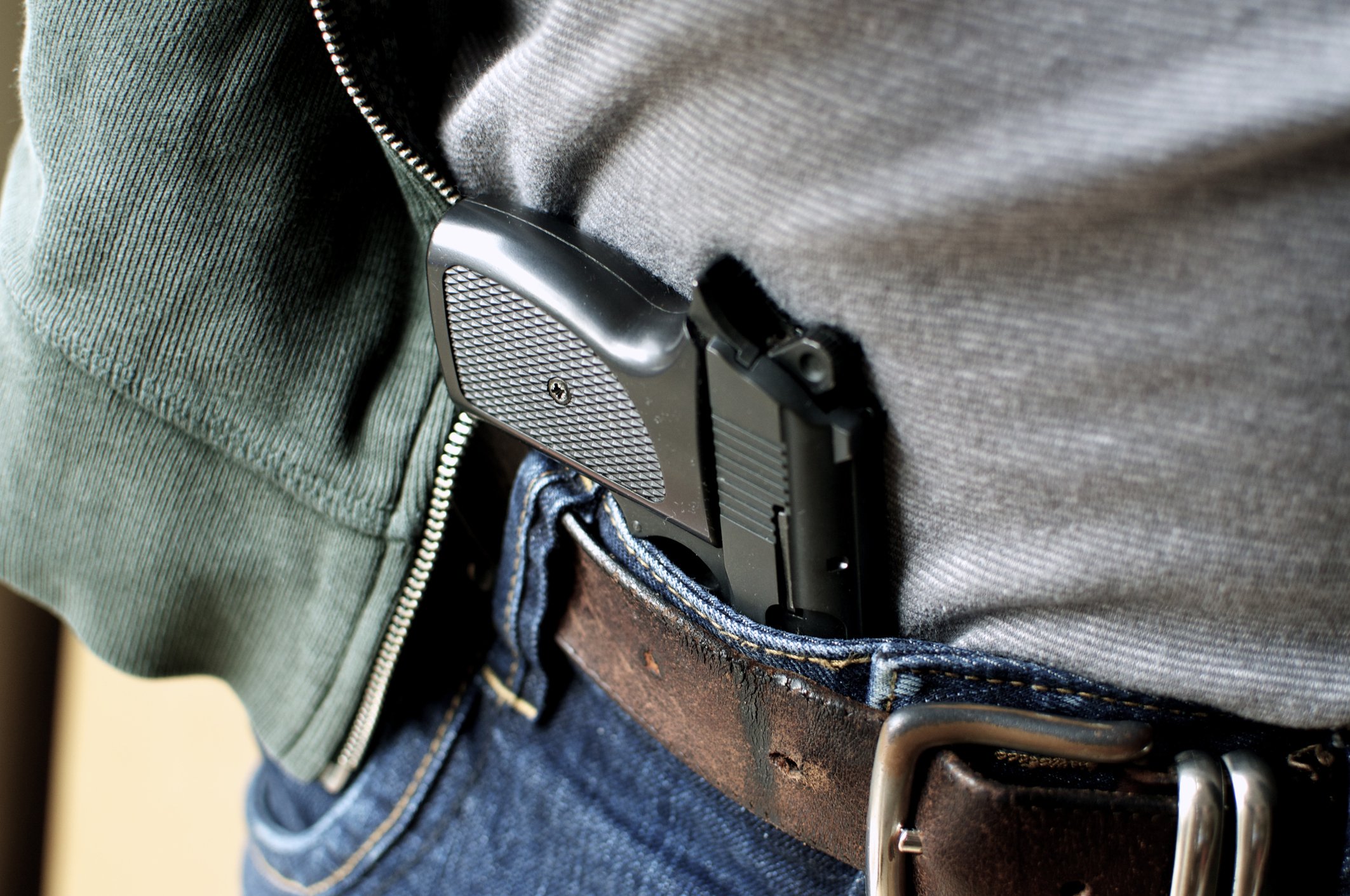
Attorney Goldstein Wins Motion to Suppress Firearm

Philadelphia Criminal Defense Lawyer Zak T. Goldstein, Esquire
Philadelphia criminal defense lawyer Zak T. Goldstein, Esquire, recently won a motion to suppress a firearm in the case of Commonwealth v. J.C. In J.C., the client was charged with carrying a firearm on the streets of Philadelphia (VUFA § 6108), possession of a concealed firearm without a license (VUFA § 6106), possession of a controlled substance (K&I), and possession of a firearm by a prohibited person (VUFA § 6105). Prosecutors claimed that J.C. had a firearm in the glovebox of his car and marijuana in a bag sitting on the back seat of the vehicle.
Attorney Goldstein filed a motion to suppress the physical evidence in the Philadelphia Court of Common Pleas, arguing that the police improperly searched J.G.’s car without first obtaining a search warrant. Although they later obtained a search warrant before actually removing the gun from the vehicle, the police had already seen the gun due to the initial search before they obtained the warrant.
At a hearing on the motion, the Commonwealth called one of the arresting officers to testify as to the circumstances of the stop and search. The officer testified that they attempted to pull J.C. over for window tint. He initially pulled over right away, but then he started driving again for about half of a block. The police then pulled behind him again and waited for backup. As they were sitting and waiting for backup, they observed J.C. moving around the car in a furtive manner as if he were reaching for something, attempting to conceal something, or about to take off. They also believed that he was going to flee based on the way he was looking around.
Accordingly, once backup arrived, the police surrounded the car. J.C. repeatedly asked why they had stopped him and why they were trying to search the car. He provided them with his driver’s license, and he insisted that he had the registration and insurance paperwork on his phone. The police began to pull him out of the car, and he did not immediately go with them, so they then tased him. Once they tased him, they put him in handcuffs, arrested him, and took him to the hospital for medical treatment. After he was out of the car and had been tased, the officer looked in the glove box and saw a gun. The police then held the vehicle until detectives arrived and obtained a search warrant. At that point, they recovered the gun and the marijuana. J.C. had a criminal record which prohibited him from carrying a firearm, and he also did not have a license to carry.
Attorney Goldstein moved to suppress the evidence, arguing that the initial warrantless search of the vehicle was unconstitutional under the Pennsylvania Constitution and tainted the search warrant which the police obtained later. Attorney Goldstein also argued that the police did not have exigent circumstances for the search that would justify failing to get the warrant first.
Through cross-examination and body camera footage, Attorney Goldstein established that the police had not seen J.C. do anything other than drive a car that may have had window tint, he pulled over on command, he moved the car only about half a block before pulling over again, he told them that he had moved not to flee but because he was blocking traffic, and that they could not see in the car to see if he was actually doing anything while they were waiting for backup. Additionally, J.C. did not attempt to flee, he did not drive away, the police did not see any contraband in the vehicle, and he gave them his driver’s license. Accordingly, there was no actual reason to believe he was armed and dangerous. Further, once J.C. was out of the car and had been tased and arrested, the police were obviously not going to let him get back in the car. Instead, they had to take him to the hospital. Accordingly, under the recent case of Commonwealth v. Camacho, any exigent circumstances which might have justified a “frisk” of the vehicle and checking the glove box for a weapon had dissipated.
In general, the police must obtain a search warrant prior to searching a car. There are some exceptions, however. For example, the police may conduct a “frisk” of the passenger compartment of a vehicle for weapons when they have conducted a legal stop and they have reasonable suspicion to believe that the suspect is engaged in criminal activity and armed and dangerous. The frisk cannot be a search for evidence; instead, it is a search for weapons for officer safety purposes during the stop. Nervousness alone does not justify the frisk of a car, but nervousness along with furtive movements or other strange behavior may sometimes justify a frisk.
In this case, however, any need to conduct the frisk before obtaining a warrant ended when J.C. was removed from the car, tased, handcuffed, and arrested. At that point, even if he had initially posed some sort of threat to the officers’ safety, the threat had ended, and there was nothing preventing the officers from simply waiting until detectives could obtain a warrant. The trial judge agreed and granted the motion to suppress. The Commonwealth then withdrew the charges.
Facing criminal charges or appealing a criminal case in Pennsylvania?
Goldstein Mehta LLC Criminal Defense Lawyers
If you are facing criminal charges or under investigation by the police, we can help. We have successfully defended thousands of clients against criminal charges in courts throughout Pennsylvania and New Jersey. We have successfully obtained full acquittals and dismissals in cases involving charges such as Conspiracy, Aggravated Assault, Rape, Violations of the Uniform Firearms Act, and First-Degree Murder. We have also won criminal appeals and PCRAs in state and federal court, including the successful direct appeal of a first-degree murder conviction and the exoneration of a client who spent 33 years in prison for a murder he did not commit. Our award-winning Philadelphia criminal defense lawyers offer a free criminal defense strategy session to any potential client. Call 267-225-2545 to speak with an experienced and understanding defense attorney today.

PA Superior Court: Police Need a Good Reason for a K9 Sniff, and the Commonwealth Must Actually Prove Inevitable Discovery with Evidence

Philadelphia Criminal Defense Lawyer Zak T. Goldstein, Esquire
The Pennsylvania Superior Court has decided the cases of Commonwealth v. Brinson and Commonwealth v. Flamer, holding that nervousness alone does not justify prolonging a traffic stop to bring a drug dog to the scene to have the dog smell the car for drugs. The Court also held that the mere fact that the police could have towed the car did not establish that the police would have inevitably discovered the contraband as the Commonwealth introduced no evidence or testimony that the police in fact would have towed the car and conducted an inventory search.
The Facts of the Case
A Philadelphia police officer conducted a traffic stop of a car after seeing the car fail to stop at a stop sign. Flamer was driving, and Brinson was in the passenger seat. During the stop, the officer felt that both men seemed nervous. Therefore, he called for a K9 unit. The dog alerted to the presence of narcotics, leading to a search of the car. Officers searched the car and discovered a firearm with an altered serial number and oxycodone pills.
The Commonwealth charged Brinson and Flamer with various offenses, including illegal possession of a firearm (VUFA) and controlled substances. Both defendants filed motions to suppress the evidence, arguing the stop was unlawfully prolonged without sufficient reasonable suspicion. The trial court granted the motion to suppress, finding that the police did not have reasonable suspicion to detain the defendants and extend the stop until a drug dog arrived. The court also found that the Commonwealth failed to show that the police would have inevitably discovered the contraband by towing the vehicle and conducting an inventory search. The prosecution appealed.
The Superior Court Appeal
The Superior Court affirmed. It agreed with the trial court on both issues, finding that the police did not have reasonable suspicion and that the Commonwealth failed to prove inevitable discovery with actual testimony or evidence. The Court addressed both issues:
Prolonged Traffic Stop:
The Court held that the stop, which extended 10–15 minutes before the K-9 unit was summoned, exceeded its permissible scope. The officer lacked specific and articulable facts (reasonable suspicion) to justify extending the stop beyond its original purpose of addressing a traffic violation.
Nervous behavior alone was insufficient to establish the necessary reasonable suspicion for detaining the defendants, extending the stop, and bringing a dog to the scene to conduct the search. The officer claimed he smelled marijuana, as well, but he did not smell the marijuana until later in the stop. Therefore, the officer’s detection of the marijuana odor occurred after the stop should have reasonably concluded, further undermining the justification for the K-9 search.
Inevitable Discovery Doctrine:
The Commonwealth argued that the evidence would have been discovered during an inventory search following impoundment due to lack of insurance. However, the court found this exception inapplicable. The Commonwealth failed to establish that the police unequivocally would have towed the car and found the contraband. Instead, the Commonwealth showed only that the police could have towed the car, which was not enough. The inevitable discovery doctrine is very limited under Pennsylvania law and rarely operates other excuse the failure to comply with the warrant requirement. The police testimony established that towing decisions were discretionary, and the officer failed to establish or present a clear policy regarding inventory searches. The absence of a concrete policy establishing that the car would have in fact been towed defeated the inevitable discovery claim.
The court reiterated that police must demonstrate reasonable suspicion based on a totality of circumstances and that any extension of a traffic stop must align with the mission of the stop. This is a great decision for privacy rights in terms of limiting the inevitable discovery doctrine. It is not enough to show that the police could have eventually conducted a legal search - the Commonwealth has to show that an eventual legal search was a true inevitability, not merely that it could have happened even had the police not violated the defendant’s rights by conducting an illegal search.
Facing criminal charges or appealing a criminal case in state or federal court in Pennsylvania? We can help.

Goldstein Mehta LLC Criminal Defense Attorneys
If you are facing criminal charges or under investigation by the police, we can help. We have successfully defended thousands of clients against criminal charges in courts throughout Pennsylvania and New Jersey. We have successfully obtained full acquittals in cases involving charges such as Conspiracy, Aggravated Assault, Rape, and Murder. We have also won criminal appeals and PCRAs in state and federal court, including the exoneration of a client who spent 33 years in prison for a murder he did not commit. Our award-winning Philadelphia criminal defense lawyers offer a free criminal defense strategy session to any potential client. Call 267-225-2545 to speak with an experienced and understanding defense attorney today.
PA Superior Court Upholds Criminalizing Firearm Possession for Felons on Parole for Robbery

Criminal Defense Lawyer Zak T. Goldstein, Esquire
The Pennsylvania Superior Court has just decided the case of Commonwealth v. Farmer. In Farmer, the Court upheld Pennsylvania’s felon in possession of a firearm statute (VUFA § 6105) against an unconstitutional as-applied challenge where the defendant was prosecuted for being a felon in possession of a firearm while on parole for robbery. It ultimately remains to be seen whether all felons may be permanently prohibited from possessing firearms for life following recent United States Supreme Court decisions like New York State Rifle & Pistol Ass’n v. Bruen expanding Second Amendment protections, but this was not a particularly close case as the defendant in this case was on parole for robbery at the time of his arrest for possessing a firearm.
The Facts of Farmer
The defendant was on parole for a robbery conviction when police obtained information that he possessed a firearm. Acting on a search warrant, officers found a .40 caliber Beretta in his house. Prosecutors charged him with a violation of 18 Pa.C.S.A. § 6105, which prohibits firearm possession by individuals with certain criminal convictions, including robbery. A jury convicted him of illegal gun possession, and he was sentenced to five to ten years’ incarceration.
The defendant appealed his conviction, arguing on appeal that § 6105 violated his Second Amendment rights. Specifically, he claimed the law was unconstitutional as applied to him. He cited the United States Supreme Court’s decision in Bruen. Bruen established a new framework for evaluating gun regulations but did not make it totally clear whether felon-in-possession statutes remain constitutional.
The Issues on Appeal
In Farmer, the Court addressed two issues as required by Bruen.
Does the Second Amendment apply to convicted felons like the defendant?
The Court found that the answer to this question is yes. The Court ruled that the defendant, as an American citizen, is included within "the people" protected by the Second Amendment. Drawing on District of Columbia v. Heller and Bruen, the Court rejected the Commonwealth’s argument that felons are categorically excluded from Second Amendment protections because they are not among “the people” to which the Second Amendment extends.Could the government restrict the defendant’s gun rights based on his prior conviction?
Again, the Court found in the affirmative. While the Second Amendment protects the defendant in general, the Court held that the restriction on his firearm rights is consistent with the nation’s historical tradition of firearm regulation. The Court compared § 6105 to historical laws, such as “going armed” statutes, which disarmed individuals who were considered dangerous. The defendant’s conviction for robbery—in his case, a violent felony involving a gun—fit squarely within this historical framework. The Court relied heavily on United States v. Rahimi in its analysis as there, the United States Supreme Court upheld the constitutionality of disarming protection from abuse order defendants based on a lower standard than a conviction obtained with proof beyond a reasonable doubt.
This decision highlights the limits of Second Amendment protections for individuals with criminal convictions. While courts recognize that the Second Amendment applies broadly, they continue to uphold restrictions when those laws have strong historical support, and the historical statutes need only be similar - they do not have to be identical. For individuals with felony convictions—particularly those involving violence or firearms—this case reaffirms that Pennsylvania’s prohibition on gun possession remains enforceable. The problem, however, is that no Pennsylvania state appellate court has yet addressed a challenge to a less serious, non-violent offense. The federal Third Circuit Court of Appeals held that an individual who had a thirty year old non-violent misdemeanor theft offense could possess a firearm even though Pennsylvania law prohibited it, but Pennsylvania courts have not yet determined what the limits are. It may be that some portions of the § 6105 statute are unconstitutional in that it may not be permissible under the Second Amendment to prohibit individuals from possessing firearms for life based on less serious or older convictions. But in this case, the defendant was actively on parole for a violent felony. Therefore, whether there are limits on disarming felons who have less serious or older criminal records will remain an open question. If you are charged with a violation of § 6105 based on a less serious criminal record, it may still be worth filing a motion to dismiss the charges on Second Amendment grounds.
Facing criminal charges or appealing a criminal case in Pennsylvania? We can help.

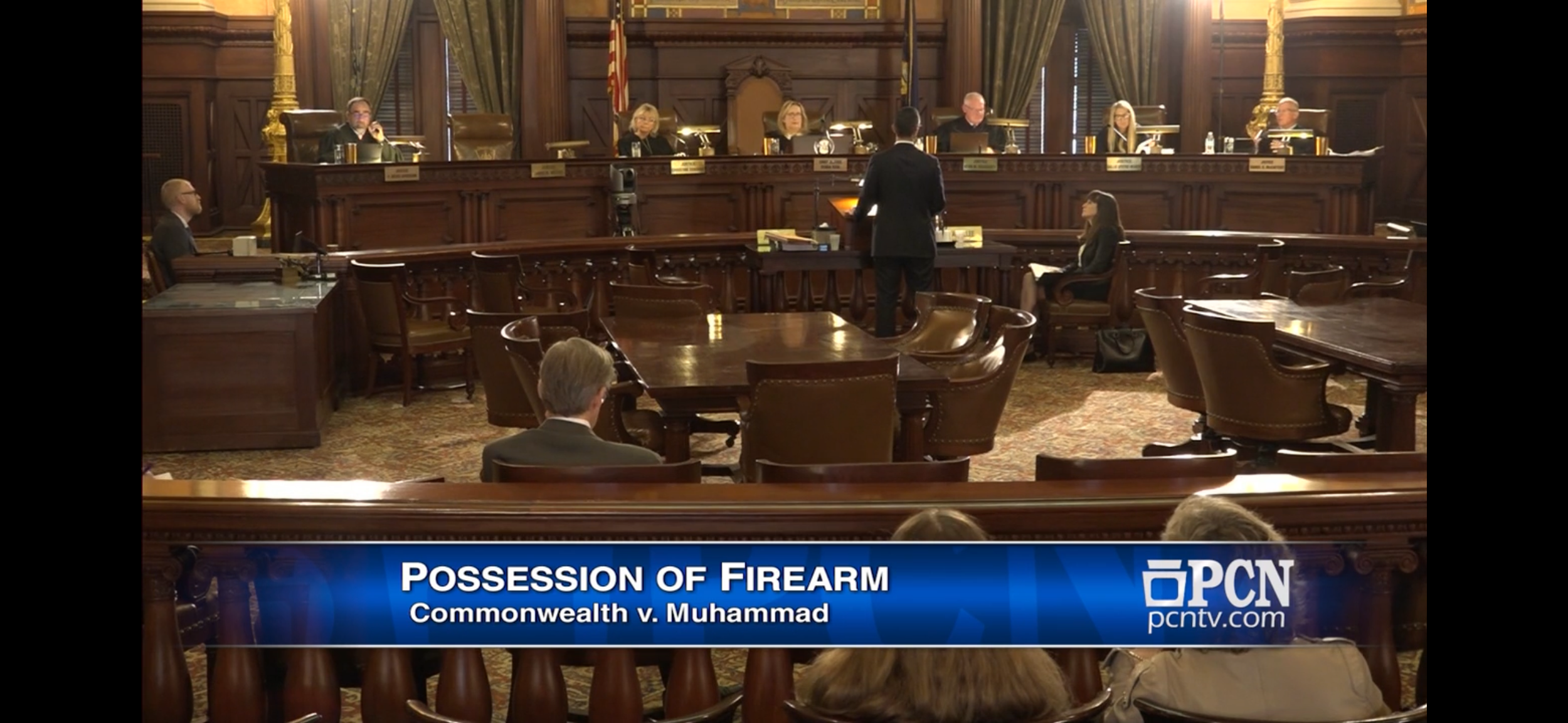
Philadelphia Criminal Defense Lawyer Zak T. Goldstein, Esquire Arguing before the Pennsylvania Supreme Court
If you are facing criminal charges or under investigation by the police, we can help. We have successfully defended thousands of clients against criminal charges in courts throughout Pennsylvania and New Jersey. We have successfully obtained full acquittals in cases involving charges such as Conspiracy, Aggravated Assault, Rape, and Murder. We have also won criminal appeals and PCRAs in state and federal court, including the exoneration of a client who spent 33 years in prison for a murder he did not commit. Our award-winning Philadelphia criminal defense lawyers offer a free criminal defense strategy session to any potential client. Call 267-225-2545 to speak with an experienced and understanding defense attorney today.