

Philadelphia Criminal Defense Blog

PA Superior Court: Police May Destroy Evidence So Long As They Do Not Do It In Bad Faith

Criminal Defense Lawyer Zak Goldstein
The Pennsylvania Superior Court has decided the case of Commonwealth v. Donoughe. This decision reaffirms established law that states a defendant must make a showing that the police acted in bad faith when they destroy “potentially useful” evidence. This decision is obviously frustrating given that we, as a society, should expect that the Commonwealth should keep and maintain all evidence that is gathered during a case. Unfortunately, as Donoughe shows, that is not the case and thus defendants have an additional hurdle to overcome when they allege violations of this kind.
Commonwealth v. Donoughe
Pennsylvania State Troopers were driving on Pennsylvania Route 30 in Westmoreland County when they noticed the defendant’s blue Jeep Cherokee traveling at a high rate of speed. The troopers initiated pursuit of the vehicle and at one point had to travel at 94 miles per hour (“mph”) to maintain contact with the defendant. The speed limit on that part of the road was 55 mph. After an unknown amount of time spent following the defendant, the troopers activated their overhead lights and conducted a traffic stop of the defendant’s jeep in an adjacent store parking lot. At this time, the dashcam located on the troopers’ car initiated a mobile video recording (“MVR”) of the stop.
According to the troopers, upon reaching the driver’s side window, they were able to detect a strong odor of alcohol emanating from both the jeep and the defendant’s breath. While speaking with the defendant and requesting his documents, the troopers also noticed that the defendant’s eyes were bloodshot and glassy and his movements were very slow. Additionally, the troopers saw a case of unopened beer on the backseat. When the defendant was asked how much he had been drinking that evening, the defendant answered that he had two beers prior to driving.
The troopers then ordered the defendant to exit his jeep to undergo a field sobriety test. However, the troopers decided that because the defendant was short and obese it would be unfair to administer the full set of physical performance tests and so they only had the defendant perform the horizontal gaze nystagmus test and a portable breath test. Based on the results of those tests, the defendant was placed under arrested for DUI. He was then taken to the Greensburg Barracks where he performed a “legal breath test” which registered a .107% BAC which is above the legal limit.
The defendant was subsequently charged with DUI, careless driving, and speeding. The defendant then applied for and was accepted into Westmoreland County’s Accelerated Rehabilitative Disposition (“ARD”) program and his charges were held in abeyance upon successful completion of the program. Unfortunately, the defendant was removed from the ARD program after he failed to complete the terms of his ARD sentence. Criminal charges were subsequently refiled against him and he was listed for a non-jury trial.
The defendant filed an omnibus pre-trial motion to dismiss the two DUI counts on grounds that the MVR was not provided to the defense and thus was “potentially exculpatory” and “represented critical evidence necessary to preparing a proper defense.” The trial court denied the defendant’s motion. The court’s reasoning was that the defendant only gets relief when “potentially useful” evidence is destroyed in bad faith. Westmoreland County has a policy to destroy MVR recordings 90 days after a defendant’s acceptance into the ARD program and thus there. In this case, more than a year had passed since the defendant was arrested and when his charges were refiled against him and thus the video was destroyed as a result of county policy and not because of any animus towards the defendant.
The defendant subsequently went to trial and was found guilty of the aforementioned charges with the exception of careless driving. The defendant then filed timely post-sentence motions which were denied. He then filed an appeal. On appeal, he raised two issues. For purposes of this blog, only the issue of whether the trial court’s denial of his omnibus motion violated his due process rights will be addressed because the Superior Court found that the defendant waived his other issue.
When Does a Brady Violation Occur?
Pennsylvania courts created a three-part test to determine whether a Brady violation has occurred. First, there must be evidence that is suppressed by the prosecutor. Second, it must be shown that the evidence is favorable to the defendant. This means that the evidence could be used to impeach a Commonwealth witness or it could be exculpatory for the defendant. Finally, there must be a showing that the defendant was prejudiced by the withholding and/or destruction of this evidence. In other words, there must be a showing that the outcome of his case could be affected if this evidence was presented at trial.
In the instant case, the MVR evidence was not Brady issue because it was unknown whether the MVR would have been helpful to the defendant. The defendant therefore could not meet the third prong of the test. This is why this MVR video was described as “potentially useful.” Therefore, in order to prevail on a claim of “potentially useful” evidence, the Pennsylvania courts have required that a defendant show that the evidence was destroyed in bad faith on the part of the police. This is different from whether a Brady violation has occurred because the law allows for a defendant to get relief for a Brady violation even if the evidence was inadvertently lost or destroyed.
The Superior Court’s Decision
The Superior Court affirmed the defendant’s convictions. The Superior Court followed the established law and found that the defendant must make a showing that there was bad faith involved when the police destroy “potentially useful” evidence. This case was not a good test case to try and create new law. Specifically, in this case, the defendant conceded that the police did not act in bad faith because the MVR was destroyed in accordance with Westmoreland County policy. Further, the defendant did not even submit any reason as to why the MVR footage would have been exculpatory. Therefore, it was unlikely that the Superior Court was going to overturn an established precedent based on this set of facts. Consequently, the defendant will not get a new a trial and he will be forced to serve his sentence.
Facing Criminal Charges? We Can Help.
Criminal Defense Lawyers
If you are facing criminal charges or under investigation by the police, we can help. We have successfully defended thousands of clients against criminal charges in courts throughout Pennsylvania and New Jersey. We have successfully obtained full acquittals in cases involving charges such as Conspiracy, Aggravated Assault, Rape, and Murder. Our award-winning Philadelphia criminal defense lawyers offer a free criminal defense strategy session to any potential client. Call 267-225-2545 to speak with an experienced and understanding defense attorney today.

PA Superior Court: Commonwealth Must Create Record of Preliminary Hearing to Survive Motion to Quash
Criminal Defense Lawyer Zak Goldstein
The Pennsylvania Superior Court has decided the case of Commonwealth v. Lambert, holding that the Commonwealth bears the burden of ensuring that a recording or transcript is created at the preliminary hearing. If the Commonwealth fails to do so, then an entire case could be dismissed pursuant to a defendant’s motion to quash (also called a petition for writ of habeas corpus in most suburban counties).
This case should affect the manner in which magisterial district courts conduct preliminary hearings. Currently, many of them, including courts in Montgomery County and Delaware County, do not provide court reporters or make recordings of the proceedings. Instead, they require the defense to bring a court reporter to the hearing at the defendant’s expense. With the Superior Court’s decision in this case, however, it is now clear that the Commonwealth has an obligation to make a recording of the proceedings so that a defendant may challenge whether the prosecution successfully established a prima facie case in the Court of Common Pleas.
The Facts of Lambert
In Lambert, the defendant was charged in Butler County with Aggravated Assault, Harassment, and Recklessly Endangering Another Person. Middlesex Township Police had responded to a report of a domestic disturbance at the defendant’s residence. When they arrived, her son was waiting outside of the house. He told the responding officers that he and the defendant had engaged in a verbal argument. She then picked up a gun, pointed it at him, and threatened to shoot him. The son told the officer this versions of events both verbally and in a written statement, leading to the criminal charges.
The son, however, did not appear for the preliminary hearing. Instead, relying on the now-overruled cases of Commonwealth v. McCllelland and Commonwealth v. Ricker, the magistrate permitted the police officer to testify about what the complainant told him. This is classic hearsay, and it is now clear that a preliminary hearing may not be based entirely on hearsay. Neither party brought a court reporter to the preliminary hearing, so the court did not make any record of the proceedings. Nonetheless, the magistrate held the entire case for court, and the case went to the Court of Common Pleas.
The Motion to Quash
The defendant then filed a motion to quash (petition for writ of habeas corpus) in the Court of Common Pleas, arguing that the Commonwealth had failed to prove its case because it had only presented hearsay at the preliminary hearing. The Commonwealth summarized the proceedings from the preliminary hearing for the trial judge, but the Commonwealth had no transcript to give to the court because it had not recorded the proceedings in the district court and the district court did not provide a court reporter. Accordingly, the trial judge granted the writ of habeas corpus and dismissed the charges. The Commonwealth appealed.
The Superior Court’s Decision
On appeal, the Commonwealth argued that it had no obligation to make a record of the proceedings at a preliminary hearing. It argued that it had presented sufficient evidence, the defendant had the obligation to record the proceedings because the motion was made by the defendant, and the magisterial district justice’s decision was evidence that a prima facie case had been established.
The Superior Court rejected this argument and affirmed the decision of the trial judge. The Superior Court reasoned that the Commonwealth bears the burden at a hearing on a motion to quash of proving that it in fact established a prima facie case at the preliminary hearing that the defendant committed the crimes charged. Because the Commonwealth could not provide any record of the preliminary hearing and did not present any new evidence at the evidentiary hearing in the Court of Common Pleas, the Commonwealth failed to meet its burden. Therefore, the Superior Court agreed that the trial court properly dismissed the charges.
This is an important case, and it continues the recent trend by Pennsylvania appellate courts of re-establishing that preliminary hearings are important and that many of the rules of procedure and evidence apply during a preliminary hearing. The preliminary hearing is a key safeguard in making sure that innocent people do not remain in jail for months or years waiting for trial and in establishing that a defendant should have to go to trial in the first place. Recent decisions had undermined the protections offered by the preliminary hearing. But following this decision, it is now clear both that the Commonwealth may not rely on hearsay alone at a preliminary hearing and that the Commonwealth must create a record of the proceedings. If it does not, then either the case will be dismissed in the trial court or the Commonwealth will have to put on a second preliminary hearing.
Facing criminal charges in the Philadelphia area? We can help.

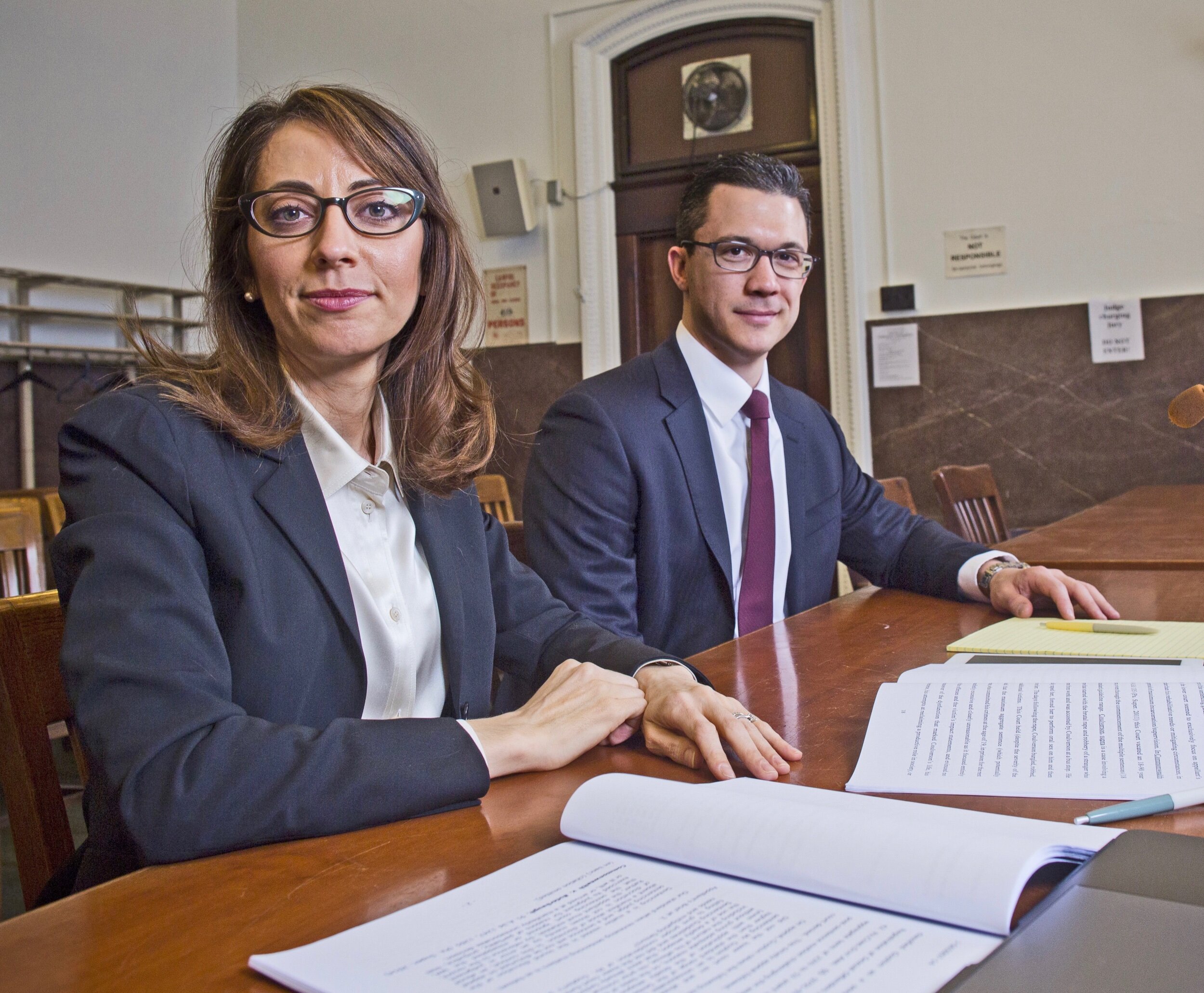
Criminal Defense Lawyers Zak Goldstein and Demetra Mehta
If you are facing criminal charges or under investigation by the police, we can help. We have successfully defended thousands of clients against criminal charges in courts throughout Pennsylvania and New Jersey. We have successfully obtained full acquittals in cases involving charges such as Conspiracy, Aggravated Assault, Rape, and Murder. Our award-winning Philadelphia criminal defense lawyers offer a free criminal defense strategy session to any potential client. Call 267-225-2545 to speak with an experienced and understanding defense attorney today.

Do the police need a search warrant to search a car in PA?
Criminal Defense Lawyer Zak Goldstein
The Pennsylvania Supreme Court has decided the case of Commonwealth v. Alexander, holding that police generally need a search warrant in order to search a motor vehicle in Pennsylvania. In this case, the Court overruled the case of Commonwealth v. Gary, in which a plurality of the Court had recently held that police did not need a search warrant to search a car in Pennsylvania. This is an important decision and significant victory for privacy rights as it prevents the police from searching a car without a warrant. It makes it more difficult for the police to search a car based merely on a hunch as they must now go through the process of drafting an affidavit of probable cause and presenting it to a judge prior to searching a car. In some cases, this can be done telephonically, but Philadelphia typically does not have those procedures in place.
Do the police need a warrant to search a car for a federal case?
It is important to note that federal law and Pennsylvania law are now very different in terms of whether the police need a search warrant prior to searching an automobile. The United States Supreme Court has repeatedly held that the police and federal agents do not need a warrant prior to searching a car pursuant to the federal automobile exception. Instead, officers only need probable cause. This means that if law enforcement officers at the state, federal, or local level may search your car without a search warrant and then use that evidence against you in federal court as long as they had probable cause cause for the search. In federal court, it is still possible to challenge an illegal search, but the police do not have to get a warrant first. However, the vast majority of cases are prosecuted in state court. Therefore, this opinion will affect most people.
Can the police ever search a car without a warrant in PA?
Under this new case, however, evidence from a warrantless search may not be used against you in Pennsylvania state court unless the police either obtain a search warrant based on probable cause or have exigent circumstances which justify their inability to obtain a search warrant in a timely manner. Exigent circumstances are something like an emergency - it means that there was something about the situation that made the search urgent either due to officer safety concerns or concerns that evidence could be lost. If the police have exigent circumstances, even under Alexander, they do not need a search warrant prior to searching a car so long as they have also probable cause. But in general, police in Pennsylvania should now obtain a search warrant prior to searching a car in most cases. If they do not get a search warrant and find some sort of contraband or incriminating evidence, that evidence could be suppressed by filing a motion to suppress prior to trial. Much of the litigation will likely now focus not only on whether police had probable cause but also whether it was really an emergency that they search the vehicle prior to presenting a warrant to a judge.
Philadelphia Criminal Defense Lawyers
Facing criminal charges? We can help.
It is also important to note that this case is likely retroactive - meaning that if you have charges pending against you from a search which took place prior to the case being decided, you may still be able to challenge the search based on this new case if the police did not get a warrant. Therefore, if you are facing criminal charges or are under investigation in Pennsylvania or New Jersey, you should speak with a Philadelphia criminal defense lawyer today. Call 267-225-2545 for a free criminal defense strategy session.

Third Circuit Court of Appeals: Fingerprints on Movable Object Insufficient for Criminal Conviction
Philadelphia Criminal Defense Lawyer Zak Goldstein
The Third Circuit Court of Appeals has decided the case of Travillion v. Superintendent Rockview SCI, granting the defendant’s petition for habeas corpus and holding that fingerprints on a movable object, without additional evidence showing how or when they got there, may not be sufficient to convict a defendant. This opinion is important both because it is relatively rare for a federal court to overrule a state court on sufficiency grounds and because it highlights the problems with fingerprint evidence. In addition to not being nearly as reliable as it appears on TV, fingerprint evidence also cannot always tell the judge or jury how or when the fingerprints got on an object. If the fingerprints could have been left on an object at some point other than when the crime was committed, then they are not sufficient to show the identity of the person woh committed the crime.
Commonwealth v. Travillion
The defendant was charged with robbery. At trial, the Commonwealth presented two witnesses to prove their case. The first witness was a manager of a clothing store. The manager testified that one day, she entered the store, but she was running late because of inclement weather. She was the first one to enter the store. After she entered the store, she turned around to lock the door when she noticed someone behind her. This person was wearing a winter jacket and was holding a Manila folder in his left hand. The manager told the individual that the store was not open yet, but he pushed his way inside. At this point, the alarm was going off and the individual instructed the manager to turn off the alarm.
The individual then grabbed the manager by the arm and told her to open the safe near the cash registers. While in the process of getting the money, the individual left the Manila folder on the ground. After he determined that there was no more money in this safe, the robber then instructed the manager to take him to another safe that was located in her office. The manager would later testify that “nobody, but the district manager and my other assistants knew about the second safe.” In the process of going to the office, the robber forcefully ripped a sliding accordion door almost off its hinges. In total, the robber took approximately $6,400. During the robbery, the manager began to cry and said that she had children to which the robber said “I know.” The individual then instructed the manager to escort him to the back door. The robber then ran from the building across a parking lot to a four-door Ford Taurus which had the motor running and entered the front passenger side of the vehicle and then pulled away.
Once the robber left, the manager locked the doors and called the police. She then noticed the Manilla folder that was on the ground. She was unable to identify the robber because his face had been covered. She described the robber as very well spoken and approximately 5’10. Additionally, he was in his mid-twenties, had an athletic built, and based on his voice “led [her] to believe that he could have been African-American” though she did not know for sure. It should be noted that at the time of his arrest the defendant was 6’1, weighed 170 pounds, African-American, and had a medium frame build.
After the police arrived, they were able to get fingerprints from the folder as well as some papers that were inside the folder. According to the Commonwealth, after comparing the lifts from the folder to the defendant’s, they were able to determine that they belonged to the defendant. The Commonwealth was also able to retrieve a fingerprint from the door, but the fingerprint did not come back as the defendant’s. At trial, the detective would testify that the only fingerprints identified as belonging to the defendant were those on the Manila folder and one of the papers in the folder. The detective would further testify that people can touch things without leaving a fingerprint, and that it was possible that someone other than the defendant touched the Manila folder, but did not leave fingerprints. It should also be noted that there was no evidence presented at his trial that the defendant had any connection to the store (i.e. he was not a current/former employee or had a friend/relative who worked there).
The defendant proceeded by way of jury trial and he was found guilty of robbery and was subsequently sentenced to a mandatory 10 to 20 years’ incarceration that was to run consecutively to the separate sentence of life without the possibility of parole that he was serving as a result of a second-degree murder conviction. The defendant then filed a post-sentence motion which was denied. He then filed an appeal with the Pennsylvania Superior Court arguing that the evidence was insufficient to convict him.
The Pennsylvania Superior Court denied his appeal and his request for re-argument before the Superior Court en banc was denied. He then filed a petition for allowance of appeal with the Pennsylvania Supreme Court which was also denied. He then filed a Post-Conviction Relief Act (“PCRA”) petition which was denied and the Superior Court affirmed the denial of his PCRA petition too.
After he exhausted all of his remedies with the Pennsylvania courts, the defendant then filed a pro se habeas petition in federal court. A Magistrate Judge issued a Report and Recommendation (“R&R”) recommending dismissal of the defendant’s petition. With regard to the insufficient evidence claim, the R&R pointed to the testimony that the robber carried the Manila folder with his left hand into the store and that the defendant’s fingerprints from the left hand matched those on the folder and paper. The District Court then adopted the R&R as the opinion of the court and dismissed the habeas petition. The defendant then filed an appeal with the Third Circuit Court of Appeal and requested a certificate of appealability. The Third Circuit granted the certificate of appealability on the issue of whether the state court’s decision finding sufficient evidence to convict was a clearly unreasonable application of constitutional law.
The Third Circuit’s Decision
The Third Circuit reversed the defendant’s conviction and held that he could not be retried for the charge of robbery. In its decision, the Third Circuit found that the only evidence against the defendant that actually linked him to the robbery were his fingerprints on the Manila folder and paper, which the Third Circuit described as “easily movable objects.” What stood out to the Third Circuit was what evidence was missing in the case against the defendant. Specifically, the Third Circuit found that it was significant that the defendant’s fingerprints were not found anywhere else at the crime scene. Additionally, “[t]here was no evidence that the folder and paper were unavailable to [the defendant] that the folder and paper were unavailable to the defendant prior to the robbery, no evidence as to the age of the prints, and no evidence as to how long the prints could remain on the folder and paper after their impression.” The Commonwealth was also unable to prove when the prints were placed on the folder and the paper. Further, the manager’s description did not match the defendant’s physical characteristics. Finally, despite there being ample evidence that this was an inside job, there was no evidence presented at trial that the defendant had any connection whatsoever to the store.
Accordingly, the Third Circuit found that the evidence was not sufficient to convict the defendant and that it was objectively unreasonable for the previous courts to hold that a rational juror could have convicted the defendant beyond a reasonable doubt. Further, because the Third Circuit found that the evidence was insufficient to convict him, the defendant does not need to worry about being prosecuted again for this crime because double jeopardy applies to his case.
This case illustrates that there are a number of different ways to appeal a criminal conviction. In general, appeals start out with a direct criminal appeal to the Pennsylvania Superior Court. If the Superior Court denies the appeal, then it is possible to file a Petition for Allowance of Appeal to the Pennsylvania Supreme Court and later potentially the United States Supreme Court. Both the Pennsylvania Supreme Court and the United States Supreme Court accept very few cases.
If the direct appeals are unsuccessful, then the next round of appeals comes in the form of a Post-Conviction Relief Act Petition with the trial judge in state court. Those petitions typically allege the ineffective assistance of counsel. In other words, a PCRA Petition will usually allege that a defendant should receive a new trial because of something that the trial lawyer or appellate lawyer did wrong. Again, if the trial court denies the PCRA Petition, then the PCRA can be appealed to the Superior Court and Supreme Court. If that is unsuccessful, there is one more round of appeals in federal court. It is then possible to file a federal habeas petition pursuant to 28 USC § 2254. In that petition, it may be possible to challenge the prior rulings of the state courts as well as the ineffective assistance of PCRA counsel. Here, the defendant was successful in getting the Third Circuit to find that the state courts have ignored the constitution by finding the defendant guilty and upholding his convictions despite insufficient evidence to show that he committed the crime beyond a reasonable doubt. If you or your loved one may have been improper.y convicted in state or federal court, our criminal appeals lawyers can help you understand your appeal rights.
Facing Criminal Charges? We Can Help.

Philadelphia Criminal Defense Lawyers Zak Goldstein and Demetra Mehta
If you are facing criminal charges or under investigation by the police, we can help. We have successfully defended thousands of clients against criminal charges in courts throughout Pennsylvania and New Jersey. We have successfully obtained full acquittals in cases involving charges such as Conspiracy, Aggravated Assault, Rape, and Murder. Our award-winning Philadelphia criminal defense lawyers offer a free criminal defense strategy session to any potential client. Call 267-225-2545 to speak with an experienced and understanding defense attorney today.