

Philadelphia Criminal Defense Blog

PA Superior Court: Fire Risk from Growing Marijuana at Home Does Not Support Conviction for Risking Catastrophe or Recklessly Endangering Another Person

Zak Goldstein - Criminal Defense Lawyer
The Pennsylvania Superior Court has decided the case of Commonwealth v. McCoy, holding that growing marijuana in one’s home and the corresponding risk of fire do not provide enough evidence to support a conviction for Risking a Catastrophe or Recklessly Endangering Another Person.
Commonwealth v. McCoy
On December 22, 2015, Philadelphia police officers were called to a residence in Philadelphia. At the location, they met the defendant, who was complaining about trespassers. These trespassers were relative’s of the defendant’s recently deceased girlfriend. The defendant claimed that they were on scene and taking his property. While speaking to individuals in the apartment, one of the officers was informed by the mother of the defendant’s late girlfriend that the defendant was growing marijuana in his apartment.
One of the officers then asked the defendant where the marijuana was, and the defendant showed the officer to a closet in the front bedroom. The closet door was closed, but the officer noticed bags of potting soil and fans in the bedroom. The defendant then opened the closet door, revealing the marijuana plants inside. The defendant stated that he just grew the marijuana as a hobby and did not sell it. The officer then placed Appellant under arrest and called for a search warrant to be prepared. The police subsequently recovered 31 marijuana plants and one heat lamp. Notably, the defendant’s home is about fifteen feet away from his neighbor’s home. There was also a first floor apartment in the house, but no one was living there at the time.
Police arrested the defendant and charged him with Risking a Catastrophe, Possession of Marijuana, and Recklessly Endangering Another Person (“REAP”). The defendant filed a pre-trial motion to suppress his statements and the physical evidence. The trial court denied the motions and convicted the defendant following a bench trial.
At this trial, the Commonwealth called a fire marshal who was qualified as an expert in the field of fire prevention. He testified that the defendant had used ordinary household extension cords to plug in the lamps in the closet. He opined that this created a dangerous condition because the lamp could draw a greater voltage than that which the cord could handle. Additionally, the fire marshal stated that in his expert opinion, the defendant’s marijuana growing operation represented a risk of causing a fire and that it was “an extreme fire hazard.” However, the fire marshal admitted that he was not familiar with the particular type of sun lamp used by the defendant, and he did not see evidence of transformers or an irrigation system in the operation.
The defendant also testified at his trial. He testified that he used a fluorescent lamp which did not generate heat in his marijuana growing operation. He also stated that the metal foil used in his closet was to reflect light, not heat, to the marijuana plants. He further stated that he watered the plants with a spray bottle and that he and his late girlfriend would monitor them in the morning and evening.
At the conclusion of the trial, the court found him guilty of Risking a Catastrophe, Possession of Marijuana, and REAP. He received a sentence three years’ reporting probation. He appealed, arguing that the Commonwealth presented insufficient to convict him of either Risking a Catastrophe or REAP.
What is Risking a Catastrophe?
Risking a Catastrophe is a serious felony charge in Pennsylvania. 18 Pa.C.S.A. § 3302(b) provides:
“[a] person is guilty of a felony of the third degree if he recklessly creates a risk of catastrophe in the employment of fire, explosives, or other dangerous means listed in subsection (a) of this section (i.e. radioactive or poison materials).”
The fact that a catastrophe did not occur is not a defense to this statute. A catastrophe is defined as widespread injury or damage. However, courts have previously held that a risk of fire involving a single residence is not sufficient to establish a “catastrophe” for purposes of the statute. However, courts have held that if one has a methamphetamine lab in his or her home it is sufficient to convict a defendant of Risking a Catastrophe.
What is REAP?
18 Pa.C.S.A. § 2705 provides:
“[a] person commits a misdemeanor of the second degree if he recklessly engages in conduct which places or may place another person in danger of death or serious bodily injury.”
To be convicted of REAP, one must have a conscious disregard of a known risk of death or great bodily harm to another person. The apparent ability to inflict harm is not sufficient to convict someone of REAP. Unlike most crimes, this is not a specific intent crime. As such, it is easier for the Commonwealth to prove the mens reas for REAP which is, unsurprisingly, recklessness.
The Superior Court Reverses the Convictions for REAP and Risking a Catastrophe.
After reviewing the record, the Superior Court reversed the convictions for REAP and Risking a Catastrophe. The Superior Court opined that though the defendant’s actions created a fire hazard, the record did not support that it had the potential for widespread injury or damage. Specifically, because he lived alone and the closest neighboring home was not in real danger of being engulfed by a potential fire from his house, he had not taken actions which sufficiently risked a catastrophe to justify a conviction under the statute.
The Superior Court further held that his actions were not “reckless.” Although the fire marshal described the defendant’s actions as “inadequate” to prevent a fire hazard, the Superior Court found that the defendant had taken steps that showed he was not being reckless. Specifically, the defendant watered the plants and monitored them twice a day. Further, the metal foil used in his closet was to reflect light, not heat. As such, according to the Superior Court, the defendant was not “reckless” and therefore was not guilty of REAP. Consequently, his convictions were reversed and he will be re-sentenced on his unchallenged possession of marijuana conviction.
Facing Criminal Charges? We Can Help.

Philadelphia Criminal Defense Lawyers Zak Goldstein and Demetra Mehta
If you are facing criminal charges or under investigation by the police, we can help. We have successfully defended thousands of clients against criminal charges in courts throughout Pennsylvania and New Jersey. We have successfully obtained full acquittals in cases involving charges such as Conspiracy, Possession with the Intent to Deliver, Robbery, Aggravated Assault, and Attempted Murder. Our award-winning Philadelphia criminal defense lawyers offer a free criminal defense strategy session to any potential client. Call 267-225-2545 to speak with an experienced and understanding defense attorney today.

Not Guilty – Attorney Goldstein Obtains Full Acquittal in Car Theft Case

Philadelphia Criminal Defense Lawyer Zak Goldstein
Recently, in the case of Commonwealth v. F.S., Criminal Defense Attorney Zak T. Goldstein, Esquire, obtained a full acquittal for a client charged with stealing a car. Specifically, F.S. was charged with Theft by Unlawful Taking (F3), Receiving Stolen Property (F3), Conspiracy (F3), and Unauthorized Use of an Automobile (M2). The Commonwealth alleged that shortly before New Year’s Eve, the complainant had met a woman at a restaurant in Philadelphia. They left the restaurant together, and on the way to their next destination, they stopped for gas. When the complainant went inside to pay for the gas, the woman drove off in his car. The complainant promptly reported the vehicle stolen.
Approximately two or three days later, Philadelphia Police Officers found the car in a South Philadelphia neighborhood. The car was pulled over on the side of the road. F.S. and the woman who had taken the car were both in the vehicle. F.S. was in the driver’s seat, and the woman who had stolen the car from the complainant was in the backseat. Police approached the vehicle and asked for an explanation from F.S. and the woman. The woman did not make any statements, but F.S. told the police that he was friends with the woman and that she had asked him to drive. He denied having any knowledge that the car was stolen, and there was also nothing about the car that should have given off any warning signs. It was not a luxury vehicle, the ignition and locks were intact, and there was no other damage which would suggest to a reasonable person that it was stolen. Nonetheless, police arrested F.S. and charged him with participating in the auto theft.
The Philadelphia Municipal Court held a preliminary hearing on the charges a few weeks later. At the preliminary hearing, Attorney Goldstein cross-examined the officer on whether there was anything about the vehicle that should have warned F.S. that he was driving a stolen car. By showing that there was nothing obviously wrong with the car and that F.S. did not run away, act nervous, or say anything incriminating, Attorney Goldstein was able to have the charges related to actually stealing the vehicle (Theft by Unlawful Taking and Receiving Stolen Property) dismissed at the preliminary hearing. The court then scheduled the case for a trial in the Municipal Court.
At the Municipal Court, Attorney Goldstein made similar arguments in defending against the Unauthorized Use of an Automobile (M2) and Conspiracy charges. F.S. was not involved in the actual theft of the vehicle, there was nothing which should have suggested to him that there was a problem with it, and the police did not know anything about the relationship between F.S. and the woman who had stolen the car or whether she had told him that it was stolen. Attorney Goldstein also introduced character evidence on behalf of F.S. – meaning that F.S. has a reputation in the community for being a peaceful, law-abiding citizen, and that reputation alone should be enough to find F.S. not guilty of the charges.
Ultimately, the Municipal Court judge agreed and found F.S. Not Guilty of both the Conspiracy and Unauthorized Use of an Automobile charges. In general, it is often difficult to defend against Unauthorized Use charges because the Unauthorized Use of an Automobile statute appears to contain no mens rea element. Receiving Stolen Property requires the prosecution to prove that the defendant knew or suspected that the car was stolen, but the Unauthorized Use of an Automobile statute suggests that it is illegally simply to operate someone else’s car without permission even if you do not know that you do not have permission. However, the Pennsylvania Supreme Court has concluded in an appellate opinion that even though the statute appears to impose strict liability, the Commonwealth must actually show that the defendant was reckless in choosing to operate the car – meaning the defendant actually knew of a substantial risk that he or she did not have permission to operate the car. Armed with this key case law and the character evidence, Attorney Goldstein was able to obtain a full acquittal on all charges.
This case also illustrates the importance of the Matthews factors in defending against theft charges and receiving stolen property charges. Although the police often arrest a suspect whenever he or she is found in possession of stolen property, the mere possession of stolen property is not a crime. Instead, the prosecution must be able to show that the defendant knew or suspected that the property was stolen. In a case called Commonwealth v. Matthews, the appellate courts provided some of the factors that a judge or jury should look at in deciding whether a defendant likely had knowledge that the property was stolen. These factors include: 1) the condition of the property – is there something about it that suggests that it was stolen, 2) the amount of time which has passed since the property was stolen, 3) the defendant’s behavior when confronted – did the defendant act nervous or attempt to flee, or did the defendant provide a reasonable explanation for the possession of the stolen property. This case illustrates that if the prosecution cannot prove that the defendant knew the property was stolen, then the prosecution cannot obtain a conviction.
Other Courtroom Wins
In addition to the full acquittal in Commonwealth v. F.S., our criminal defense attorneys were also able to obtain a number of important victories in the courtroom. First, we have recently successfully litigated motions for the early termination of probation in the Philadelphia Court of Common Pleas. In both cases, the clients were on probation for serious charges such as Robbery and illegal gun possession, and they had been sentenced years ago to significant periods of incarceration followed by lengthy probationary sentences. However, they had not been in trouble in a number of years. Our attorneys were able to file motions to terminate the probation early and convince their back judges that they were no longer in need of supervision by the Philadelphia Probation Department.
Second, we were also able to negotiate the decertification of adult criminal charges for a juvenile client. In this case, the juvenile client was charged in two separate cases with gunpoint robbery and strong-arm robbery as an adult even though he was under the age of 18 at the time of the offenses. He was also on probation with the juvenile court system. By obtaining information about the juvenile client’s background and presenting it to the District Attorney’s office, we were able to convince prosecutors to decertify the adult criminal charges to juvenile court, where the client was sentenced to a residential juvenile treatment facility instead of state prison.
Finally, our attorneys have also obtained entry into the ARD program for multiple clients charged with DUI, including clients who had prior records of misdemeanor convictions.
FACING CRIMINAL CHARGES? WE CAN HELP.



Goldstein Mehta LLC Criminal Lawyers
If you are facing criminal charges or under investigation by the police, we can help. We have successfully defended thousands of clients against criminal charges in courts throughout Pennsylvania and New Jersey. We have successfully obtained full acquittals in cases involving charges such as Conspiracy, Aggravated Assault, and Attempted Murder. Our award-winning Philadelphia criminal defense lawyers offer a free criminal defense strategy session to any potential client. Call 267-225-2545 to speak with an experienced and understanding defense attorney today.

I've been accused of sexual assault by my college. What is going to happen?
What is Title IX?

Title IX Defense Lawyer Demetra Mehta
Title IX is a federal civil rights law sighed by President Richard Nixon in 1972 as part of a larger Education bill. At its core Title IX prohibits discrimination on the basis of sex in educational institutions when those instructions receive federal aid.
No person in the United States shall, on the basis of sex, be excluded from participation in, be denied the benefits of, or be subjected to discrimination under any education program or activity receiving Federal financial assistance. 20 U.S.C. § 1681
This had an enormous effect in opening up higher education to woman in all fields of study as well as establishing a place for woman sport at any school that receives any federal money from the elementary to university level. Before the passage of Title IX, many schools had quotas for woman in the areas they were allowed to study, the places they were allowed to study, and the subjects they were allowed to study (including complete bans from “male” areas such as medicine). Even if a woman gained access to a restricted program she might not have been allowed to stay if she got married or became pregnant. A woman in medical school in 1960 would often have a curfew placed on her and a requirement that she live in a particular dorm and only be allowed into certain residencies.
How does Title IX relate to sexual assault allegations?
Title IX also makes schools responsible for taking steps to prevent sex-based harassment, including sexual harassment, and for responding quickly and effectively to harassment when it occurs. What this means has varied since the act’s inception, however. With increasing pressure stemming from recent sex-abuse scandals, schools have stepped up their response to sex allegations. The previous Presidential Administration decided to give more guidance and wrote what has become to be known as the “Dear Colleague” letter which spelled out a school’s obligations once a claim of sexual violence has been made:
Once a school knows or reasonably should know of possible sexual violence, it must take immediate and appropriate action to investigate or otherwise determine what occurred.
If sexual violence has occurred, a school must take prompt and effective steps to end the sexual violence, prevent its recurrence, and address its effects, whether or not the sexual violence is the subject of a criminal investigation.
A school must take steps to protect the complainant as necessary, including interim steps taken prior to the final outcome of the investigation such as issuing a no contact order.
A school must provide a grievance procedure for students to file complaints of sex discrimination, including complaints of sexual violence and sexual assault.
These procedures must include an equal opportunity for both parties to present witnesses and other evidence and the same appeal rights.
A school’s grievance procedures must use the preponderance of the evidence standard to resolve complaints of sex discrimination.
A school must notify both parties of the outcome of the complaint.
Due to the Obama administrations guidelines, many schools now provide very few protections for the accused. Once an accusation has been made, a school must investigate the claim. However, because the standard is currently one of “a preponderance of the evidence,” a school will sustain a claim (find the student responsible) if it is decided that “there is greater than fifty percent chance that the proposition is true.” Although schools will permit the accused to have an attorney present during the various stages of the investigation, many schools do not provide any sort of trial, hearing, or opportunity to cross-examine the accuser. Instead, an investigator retained by the school will often interview the parties, review any evidence, speak with some potential witnesses, and then make a finding as to whether a sexual assault has occurred. The investigator’s decision is usually not subject to challenge - meaning if the investigator has found that the accused is responsible, the school will not offer any type of appeal of the investigator’s factual findings.
The investigator’s decision may have permanent consequences for the accused. With very little due process, someone accused of sexual harassment or sexual violence could lose the right to their transcripts and the right to graduate. Even if the accused is permitted to graduate, the accused’s transcripts may contain an indicating that the accused was found responsible for an allegation of sexual assault.
Even worse, academic institutions use the natural inclination we all have to clear our names to endanger the accused with respect to potential criminal charges. Because a student who declines to make a statement or participate in this process will typically be found responsible, a student must choose between waiving his or her Fifth Amendment right to remain silent and losing the education for which the student has paid in time and money. Thus, the students accused of sexual misconduct will often make statements to their school in an effort to “clear their name,” but these statements are fair game to any police agency that may wish to investigate the charges levied by the student’s accuser.
One would think, given the many horrific miscarriages of justice in similar situations, schools would know to be careful, but the schools and the Department of Education appear to have learned nothing:
· Rolling Stone to Pay $1.65 Million to Fraternity Over Discredited Rape Story
· College student gets 1 year in prison for false rape accusation
· 60 Minutes investigates: The Duke rape case
· Exonerated of rape, Brian Banks now realizing NFL dream – in different capacity
How can a Title IX defense attorney help?
The current process gives very little thought to the rights of the accused. For that reason, anyone accused of sexual misconduct should not attempt to go it alone. Nor should they allow any kind of embarrassment they may feel to silence them. Someone accused in this sort of sexual misconduct must reach out to an attorney as quickly as possible. An attorney who has previously represented other defendants at one of these hearings can best guide the accused in how to defend themselves. The first days following an accusation are among the most important and if you have been informed you are under investigation, there are certain steps that must happen as quickly as possible. An experienced defense attorney may be able to help you with the following things:
Preparing to give a statement to the school’s Title IX Investigator
Reviewing and editing written submissions which may be required as part of the investigation
Conducting a thorough investigation into the allegations, including locating third-party witnesses and obtaining witness statements
Obtaining and preserving digital and social media evidence such as text messages, Facebook posts
Providing advice on how to avoid criminal charges while responding to the allegations
Helping you to understand the school’s procedures for the investigation and potential appeals and making sure that you understand all of your rights
Facing criminal charges or under investigation?
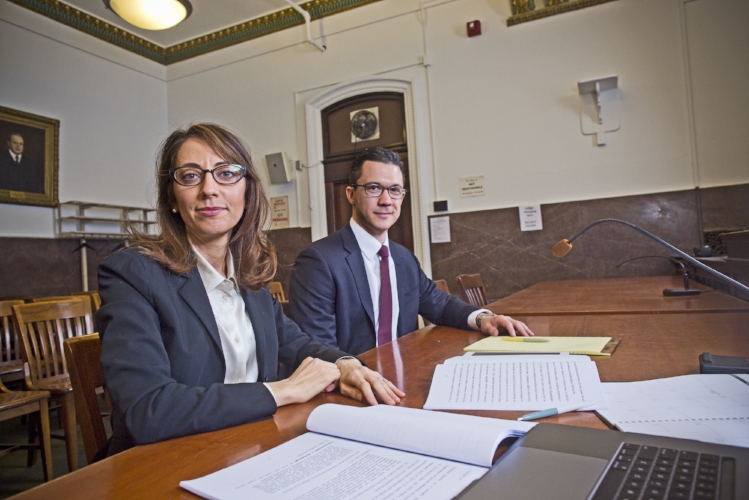
Goldstein Mehta LLC Criminal Defense Attorneys
If you are facing criminal charges or under investigation by the police or campus authorities, we can help. We have successfully defended thousands of clients against criminal charges in courts throughout Pennsylvania and New Jersey. We also have extensive experience defending clients against allegations of sexual misconduct in Title IX investigations. We have successfully obtained full acquittals and dismissals in cases involving charges such as Conspiracy, Aggravated Assault, Rape, and Attempted Murder. Our award-winning Philadelphia criminal defense lawyers offer a free criminal defense strategy session to any potential client. Call 267-225-2545 to speak with an experienced and understanding defense attorney today.
We can help with Title IX investigations at the following universities and more:
Bryn Mawr College
Cabrini University
Chestnut Hill College
Drexel University
Eastern University,
Holy Family University
La Salle University
Pierce College
Philadelphia College of Osteopathic Medicine (PCOM)
Rosemont College, St. Joseph's University
Temple University
Thomas Jefferson University
University Of Pennsylvania
University Of The Arts
University Of The Sciences
Villanova University
West Chester University
Widener University
Recent Criminal Defense Awards


PA Superior Court: Police Reasonably Conducted Warrantless Search of Defendant's Home After Defendant Fired Assault Rifle in Back Yard and Acted Crazy

Criminal Defense Attorney Zak Goldstein
The Pennsylvania Superior Court has decided the case of Commonwealth v. C.*, holding that police properly conducted a protective, warrantless sweep of the defendant’s home following corroborated reports that he had fired an assault rifle multiple times in the home. The Superior Court found that the police conduct in this case involved the emergency aid exception to the Fourth Amendment protection against warrantless entry into a home.
The Facts of C.
In August 2015, Philadelphia Police responded to a radio call indicating that multiple gun shots had been fired in the back yard of a residence in a high-crime area. The police peered into the back yard while perched upon a wall and saw a white male, the defendant, and numerous shell casings on the ground. They did not see a gun, but they secured the defendant and asked him if anyone was inside the house. He gave them inconsistent answers, so they performed a “protective sweep” of the home to make sure that no one had been injured. They found and seized an assault rifle on the second floor.
The police arrested the defendant, and the District Attorney’s Office charged him with a Violation of the Uniform Firearms Act (VUFA Sec. 6106), possessing instruments of crime, and recklessly endangering another person. The VUFA charge was ultimately dismissed because VUFA 6106 requires either that a gun be concealed or located in a car and that the defendant not have a license. There is an exception to the VUFA 6106 statute which provides that a defendant may conceal a gun in his or her home. Here, the evidence showed that the defendant lived in the house, so VUFA 6106 was not an appropriate charge.
Following the dismissal of the VUFA 6106 charge, the defendant filed a pre-trial motion to suppress the gun, which would help his case with respect to the possessing instruments of crime and recklessly endangering another person charges. The trial court granted the motion to suppress. It concluded that police searched the home solely because they wanted to find the gun; not because they were looking for injured people in the house. The court therefore found that police should have obtained a warrant prior to entering the house.
The Superior Court Appeal
The Commonwealth appealed the suppression of the gun to the Superior Court, and the Superior Court reversed. The Superior Court noted that in general, police may not search a house without a warrant. However, there are a number of exceptions to this general requirement. Although the warrantless entry and search of a home is presumptively unreasonable and illegal, there is an exigent circumstances requirement which may justify such a search. Exigent circumstances exist where the police reasonably believe that someone within a residence is in need of immediate aid. There are a number of factors which courts typically look at when determining whether exigent circumstances exist:
The gravity of the offense,
Whether the suspect is reasonably believed to be armed,
Whether there is above and beyond a clear showing of probable cause,
Whether there is strong reason to believe that the suspect is within the premises being entered,
Whether there is a likelihood that the suspect will escape if not swiftly apprehended
Whether the entry was peaceable, and
The time of the entry (entry at night is disfavored).
These factors apply in the typical case, but in this case, the real inquiry was whether the police reasonably believed someone inside the residence was in need of immediate assistance.
The Emergency Aid Exception and the Superior Court’s Decision
The Superior Court ultimately concluded that police acted reasonably in entering the house. They did not need ironclad proof of a likely, serious, life-threatening injury to invoke the emergency aid exception. Instead, they could err on the side of caution in this case given all of the circumstances. Here, the evidence showed that the defendant fired the gun multiple times in a neighborhood known for gun violence. The initial report suggested that he fired the gun in his back yard, but he also could have fired it in the home. When a witness flagged down the police, she told the police to be careful and described the defendant as acting crazy. Police corroborated the witness statement when they saw spent shells in the defendant’s backyard and by speaking with the defendant, who gave them inconsistent answers about whether anyone was inside. These inconsistent answers in particular suggested that maybe the defendant had a victim in the house who needed help. Therefore, under these circumstances, it was reasonably for police to confirm that he had not injured anyone by searching the house.
Ultimately, this case will likely be the subject of additional appeals as it conflicts with the Pennsylvania Supreme Court’s recent decision in Commonwealth v. Wilmer. For now, however, the case illustrates one of the rare circumstances in which police need not obtain a warrant prior to entering a residence. If police reasonably believe that someone inside may be in need of urgent assistance, then they may enter a house without a search warrant.
FACING CRIMINAL CHARGES? WE CAN HELP.

Goldstein Mehta LLC Criminal Defense Attorneys
If you are facing criminal charges or under investigation by the police, we can help. We have successfully defended thousands of clients against criminal charges in courts throughout Pennsylvania and New Jersey. We have successfully obtained full acquittals in cases involving charges such as Conspiracy, Aggravated Assault, and Attempted Murder. Our award-winning Philadelphia criminal defense lawyers offer a free criminal defense strategy session to any potential client. Call 267-225-2545 to speak with an experienced and understanding defense attorney today.
*The case name has been changed to an initial as the defendant’s case was ultimately dismissed following its remand to the trial court.