

Philadelphia Criminal Defense Blog

K9 Searches | When Can Police Use Drug Sniffing Dogs in PA?
Both the Philadelphia Police Department and the Pennsylvania State Police frequently use trained canines to detect drugs and combat drug trafficking. When the police find drugs based on the alert of a drug sniffing dog, there are often issues as to whether the police had the right to conduct the search in the first place. In some cases, it may be possible to challenge the search and seek suppression of the evidence if the police conducted the canine search without reasonable suspicion or probable cause. Pennsylvania and Federal law differ on the level of suspicion which police must have in order to conduct a K9 search. However, both federal and state law provide substantial protections to individuals from unlawful searches.
Pennsylvania Law on Drug Detection Dogs
The Pennsylvania Supreme Court has repeatedly recognized that a canine search constitutes a search under Article I, Section 8 of the Pennsylvania Constitution. Therefore, if police conduct a canine sniff without the required level of suspicion, the results of the search could be suppressed.
Canine Sniffs of the Person
Under Pennsylvania law, police are required to have different levels of suspicion depending on whether the search was of a person or a car. When the police want to use a drug sniffing dog to detect whether a person has drugs on them, the police are required to have probable cause for the search. In Commonwealth v. Martin, the Pennsylvania Supreme Court recognized that “an invasion of one’s person is, in the usual case, a more severe intrusion on one’s privacy interest than an invasion of one’s property.” While reasonable suspicion may justify a canine sniff of a place or a car, reasonable suspicion is too low of a standard for the search of a person.
When the sniff is of a person, the police must have probable cause to believe that a canine search will produce contraband or evidence of a crime. Probable cause means that it is more likely than not that some evidence or illegal contraband will be found. This means that if the police conduct a canine sniff without probable cause, the results of the search could be suppressed in court by filling a Motion to Suppress.
Canine Sniffs of a Car
When the police want to conduct a canine sniff of a car, they are only required to have reasonable suspicion. Reasonable suspicion is a lower standard than probable cause. Reasonable suspicion permits an officer to detain an individual in order to conduct an investigation if the officer reasonably suspects that the individual is engaging in criminal conduct. When evaluating whether an officer had reasonable suspicion, the court will look at the totality of the circumstances and whether the officer can provide specific, articulable facts as to why the officer believed the suspect was engaged in criminal activity. If the officer has reasonable suspicion of criminal activity, then the officer may conduct a K9 sniff.
Recently, the Pennsylvania Superior Court approved of a canine sniff in the case of Commonwealth v. Green. In Green, the Court found reasonable suspicion for an investigative detention and canine sniff based on the following factors:
The defendant was overly nervous for a routine traffic stop,
The vehicle belonged to an absent third party,
The defendant stated he was returning from Philadelphia, and the Trooper believed Philadelphia to be a source location for narcotics trafficking,
The Trooper had prior contacts with the defendant during which the Trooper found drugs, and
The defendant had numerous arrests and convictions for both violent crimes and drug offenses
Federal Limits on Police Canine Sniffs
There are other limits on police canine sniffs in addition to the requirement that police have either reasonable suspicion or probable cause for the decision to employ a canine. For example, police must still have reasonable suspicion or probable cause for the initial stop of the defendant that leads to the subsequent search. If the police pull a car over without any evidence of a crime or traffic offense, the results of a search could be suppressed even if the police later developed reasonable suspicion or probable cause for the canine search. Suppression would be required because of the illegality of the initial stop.
Recently, in Rodriguez v. United States, the United States Supreme Court held that police extension of a traffic stop in order to conduct a dog sniff violates the Constitution’s protections against unreasonable seizures. In Rodriguez, police stopped a car for driving on the shoulder of the highway. When police spoke with the driver, Rodriguez, he told them that he had swerved to avoid a pothole. The officer obtained the Rodriguez' paperwork and asked him to come with him to the patrol car. Rodriguez asked if he had to do so, and the officer said no. The officer returned to the patrol car to run the paperwork. After doing so, he returned to Rodriguez’ car. The officer questioned the front seat passenger, took his paperwork, and conducted a records check on that person. The officer then wrote a written warning and returned to the car to give it to Rodriguez.
After giving Rodriguez the warning, the stop should have been over. Instead, the officer asked Rodriguez for permission to conduct a canine sniff. Rodriguez politely declined, and the officer detained him anyway while he waited for backup. Once backup arrived, the officer conducted a canine sniff, the dog alerted for drugs, and police then searched the car and found drugs. Approximately eight minutes elapsed between the time when the officer finished issuing the warning and when the officer conducted the canine sniff.
Under federal law, a canine sniff is not considered a search and does not require reasonable suspicion or probable cause. However, the United States Supreme Court found that the police did not have reasonable suspicion to detain Rodriguez for the additional eight minutes before they conducted the canine sniff. The Court concluded that police may not prolong an ordinary traffic stop in order to conduct a canine sniff without reasonable suspicion. Although police may decide whether to issue a traffic ticket and check the driver’s paperwork, the police may not detain the car for additional time without a basis for doing so. Therefore, the Court reversed the conviction and ordered that the drugs be suppressed.
The Effect of Canine “Alerts”
The courts have held that canine sniffs where the canine ‘”alerts” provide police with probable cause to conduct a full blown search of a person or vehicle. Under Pennsylvania and Federal law, police are not required to get a warrant prior to searching a vehicle. Instead, they are required only to have probable cause prior to conducting a search. Therefore, if a trained police dog alerts to the presence of drugs, police may search the car or person. However, as the case law illustrates, there are still significant limits on canine searches. The courts have held that the initial stop must still be justified by reasonable suspicion or probable cause and the Pennsylvania courts have found that police must have reasonable suspicion or probable cause for the search of a car or a person. If the police make an illegal stop, improperly extend a traffic stop, or conduct a canine sniff without the required level of suspicion, then the results of the search should be suppressed.
Philadelphia Criminal Defense Lawyers for Drug Cases

Philadelphia Criminal Defense Attorneys Zak T. Goldstein, Esq. and Demetra Mehta, Esq.
The Philadelphia criminal defense attorneys of Goldstein Mehta LLC have successfully represented hundreds of clients in drug possession and drug trafficking cases. We are experienced and understanding defense attorneys who will use our high level of skill and expertise on your behalf. We have successfully litigated pre-trial motions and obtained pre-trial dismissals and acquittals at trial. If you are facing drug possession charges, call 267-225-2545 for a free criminal defense strategy session.

PA Superior Court: Defendant Entitled to New Trial Where Instructions Permitted Jury to Find Aggravated Assault on Officer Based on Mens Rea of Recklessness
The Difference Between Aggravated Assault and Simple Assault on Law Enforcement
There is a common misconception in Pennsylvania courts that a Simple Assault on a police officer, medical professional, or other protected class who is acting in the course of their official duties automatically becomes a felony two Aggravated Assault due to the Aggravated Assault on law enforcement statute. In normal circumstances, Aggravated Assault as a first-degree felony requires that the defendant cause or attempt to cause serious bodily injury to the complainant. Aggravated Assault may also be a second degree felony either when the defendant causes or attempts to cause bodily injury with a deadly weapon or when the defendant causes or attempts to cause bodily injury to a member of a protected class. Protected classes under the F2 Aggravated Assault statute include most forms of law enforcement officers, paramedics, nurses, SEPTA employees, prosecutors, public defenders, judges, and other government officials who are acting in the course of their official duties. Thus, punching a police officer is often going to be an F2 Aggravated Assault instead of a Simple Assault. This assumes that the officer was on duty at the time of the punch.

Demetra Mehta, Esq. - Philadelphia Criminal Lawyer
In the case of an obvious punch or a kick to an officer, a criminal defendant may be properly charged with Aggravated Assault as a felony of the second degree. However, where the intent to cause bodily injury is less clear – such as in the case of a defendant who is resisting, fleeing, flailing, and just otherwise being difficult and ends up elbowing or bumping into an officer, the defendant’s actions may not constitute an Aggravated Assault. This is because the F2 Aggravated Assault on law enforcement statute requires that the defendant act either knowingly or intentionally to cause or attempt to cause bodily injury. The Aggravated Assault statute is more limited than the Simple Assault statute because the Simple Assault statute can be violated when the defendant acts recklessly. This means that it could be Simple Assault to elbow a police officer while flailing about and resisting arrest instead of a felony Aggravated Assault. Of course, we still do not recommend that you resist arrest or do anything that could be construed as an assault on an officer.
Commonwealth v. Domek
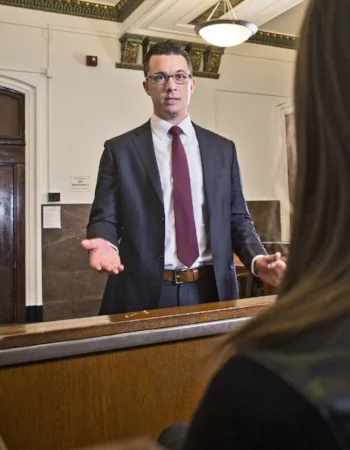
Zak T. Goldstein, Esq. - Philadelphia Criminal Defense Lawyer
In the recent case of Commonwealth v. Domek, the Pennsylvania Superior Court granted a new trial to the defendant, finding that the trial court had improperly dismissed his Post-Conviction Relief Act (“PCRA”) Petition. Domek’s PCRA Petition alleged that his trial attorney had been ineffective in failing to object when the trial court instructed the jury that Domek could be convicted of F2 Aggravated Assault on law enforcement if the jury found that he recklessly caused bodily injury.
In Domek, police transported the defendant to the Allegheny County jail. When the defendant arrived, he refused to cooperate with a search of his mouth and began to yell profanity at the correctional officers. Officers repeatedly warned him that they would use force to open his mouth, and he continued resisting. When one of the officers reached towards his mouth, the defendant smacked her hand away. At that point, the officers began struggling with the defendant. One of them punched him, and they took him to the ground. Once on the ground, he refused to put his hands behind his back, and the officers eventually tazed him. Officers testified at trial that the defendant had tried to push and punch the officers. Additionally, one of the officers suffered a shoulder injury which required surgery and led to missing ten months of work.
F2 Aggravated Assault Requires Knowing or Intentional Conduct
A jury convicted the defendant of F2 Aggravated Assault, and the defendant appealed. The Pennsylvania Superior Court affirmed the conviction, and the defendant did not appeal to the Pennsylvania Supreme Court. Instead, within one year of the conviction becoming final, he filed a Post-Conviction Relief Act Petition alleging that trial counsel had been ineffective for failing to object to the erroneous jury instruction. Generally, a PCRA allows a defendant who has been convicted and is still serving a sentence to seek a new trial or new sentencing where the defendant can show that his or her lawyer was ineffective in the representation at trial or on appeal and that the defendant suffered prejudice as a result.
In this case, the trial court dismissed the PCRA as meritless. However, the defendant appealed the dismissal of the PCRA to the Superior Court. The Superior Court reversed, finding that the jury instructions were erroneous in that they specifically permitted the jury to find that if the defendant had caused the injury recklessly, the jury could convict him of Aggravated Assault instead of Simply Assault. Because Aggravated Assault requires a defendant to have acted knowingly or intentionally, this instruction was not correct.
The trial court had agreed that the instruction contained an error, but the court argued that the evidence was overwhelming that the defendant committed an Aggravated Assault. Therefore, the trial court adopted the prosecution’s position and dismissed the PCRA. The Superior Court disagreed. It found that “the inclusion of an erroneous mens rea reducing the level of culpability required to find Appellant guilty of aggravated assault was a critical mistake that ‘could have reasonably had an adverse impact on the outcome of the proceedings.’” Given that the jury acquitted the defendant of an offense that required the knowing or intentional causation of injury, the Court found that it was very possible the jury convicted based on the recklessness jury instruction. Further, the injured officer testified at trial that she suffered the injury when the defendant fell backwards onto her, which is potentially consistent with recklessness. Therefore, because the issue raised a question of law, the Court reversed the conviction for F2 Aggravated Assault and remanded the case for trial.
Domek illustrates the difference between Simple Assault and Aggravated Assault, and it also provides an example of the type of claim that can be raised in a Post-Conviction Relief Act Petition. A PCRA Petition alleging ineffectiveness of counsel allows the defendant to seek relief in the form of a new trial where the defendant's lawyer was ineffective. Had the defendant's trial lawyer recognized the differences between the statutes and made a timely objection, the trial court likely would have realized that the instruction was incorrect and instructed the jury properly. In that case, the jury may very well have acquitted the defendant of felony Aggravated Assault. Therefore, the PCRA Petition was the proper place to raise this type of claim.
Philadelphia Criminal Defense Lawyers for Assault Charges and PCRA Petition

Goldstein Mehta LLC Philadelphia Criminal Defense Attorneys
If you are facing criminal charges or are interested in appealing a conviction, we can help. Our award-winning Philadelphia criminal defense lawyers have successfully resolved countless cases at trial and on appeal. We offer a 15-minute criminal defense strategy session to any potential client, so call 267-225-2545 to discuss your case with an experienced and understanding criminal defense attorney today.

PA Supreme Court Finds Car Passenger Entitled to Suppression of Contraband in Illegally Stopped Car
Commonwealth v. Shabezz
In the case of Commonwealth v. Shabezz, the Pennsylvania Supreme Court has affirmed on appeal that a passenger in a vehicle may successfully move to suppress evidence which is recovered from the vehicle where the vehicle was illegally stopped. The passenger may move for suppression even if the passenger did not have a reasonable expectation of privacy in the contents of the vehicle.
This means that if you are the passenger in a car you do not own and the police stop and search the car and find something illegal, you may move to suppress the contraband due to the initial illegal stop. Previously, it was unclear whether a passenger had a reasonable expectation of privacy in the contents of someone else’s car, and trial judges would frequently use that line of argument in order to deny motions to suppress.
Motions to Suppress
The first line of defense to gun charges and in drug cases is often the motion to suppress. In cases where the prosecution cannot show that the police legally recovered the evidence in question, it may be possible to have the evidence excluded at trial and the case dismissed by litigating a motion to suppress. In Pennsylvania, it is typically not enough for the defendant to show only that some sort of illegal search occurred. The defendant must also show both that he or she has standing to challenge the search and that he or she had a reasonable expectation of privacy in the place that was searched.
What is a Reasonable Expectation of Privacy?
Standing is generally not an issue because Pennsylvania appellate courts have held that any defendant charged with a possessory offense has automatic standing to challenge the search and seizure that led to the recovery of the evidence. Reasonable expectation of privacy, however, is frequently an important issue. The defendant must show that he or she had a reasonable expectation of privacy in the place searched. If the defendant cannot show that he or she had a reasonable expectation of privacy which the police violated, then the court will deny the motion to suppress even if the police did something illegal. The prosecution bears the burden of showing that the police obtained the evidence in a lawful manner, but the defendant bears the burden of first showing that the defendant had a reasonable expectation of privacy.
In many cases, reasonable expectation of privacy is relatively easy to understand. If you have drugs in your pocket, reasonable expectation of privacy is not going to be an issue because everyone will agree that you had a reasonable expectation of privacy in the contents of your pocket. In other cases, it is clear that you do not have a reasonable expectation of privacy. If the police search your friend’s house when you are not in it and recover evidence which connects you to a crime, you will not be able to have that evidence suppressed even if police did not first obtain a search warrant. You simply do not have a reasonable expectation of privacy in someone else’s house where you are not present or staying. Therefore, although the police may have violated your friend's constitutional rights, they have not violated your rights, and you have no remedy.
Appellate courts have recognized that the basis test for reasonable expectation of privacy is as follows:
An expectation of privacy will be found to exist when the individual exhibits an actual or subjective expectation of privacy and that expectation is one that society is prepared to recognize as reasonable. In determining whether a person’s expectation of privacy is legitimate or reasonable, the totality of the circumstances must be considered and the determination will ultimately rest upon a balancing of the societal interests involved. The constitutional legitimacy of an expectation of privacy is not dependent on the subjective intent of the individual asserting the right but on whether the expectation is reasonable in light of all the surrounding circumstances.
Thus, a defendant generally does not have a reasonable expectation of privacy in houses or cars belonging to other people or in public places. At the same time, a defendant may have a reasonable expectation of privacy in certain places at work or in a restroom.
In Commonwealth v. Shabezz, the Supreme Court held that a defendant-passenger need not show a reasonable expectation of privacy in a car which has been stopped illegally in order to have drugs or guns suppressed. In Shabezz, officers testified at a motion to suppress hearing that they observed what they believed to be a drug transaction and therefore stopped the car in which Shabezz was a passenger. Shabezz ran, and the police quickly caught him. They found marijuana and cash on him. They then searched the car from which he fled and found more marijuana, scales, packaging, some pills, and a gun. Prosecutors charged Shabezz with Possession with the Intent to Deliver.
The trial court, however, did not believe the police as to the reasons why they stopped the car. Although police testified to observing a drug transaction prior to stopping the car, they had completely failed to mention the drug transaction in any of the police reports which they prepared at the time of the arrest. They also testified that they were able to see the exchange of money for small objects from 45 feet away at night without binoculars. Therefore, the court granted the motion to suppress, finding that the initial stop of the vehicle was illegal.
The prosecution appealed, and the appeal eventually reached the Pennsylvania Supreme Court. On appeal, the Commonwealth argued that the motion should have been denied because Shabezz was merely a passenger in a vehicle, and as a passenger, he did not have a reasonable expectation of privacy in the car.
What Happens if the Police Illegally Stop a Car?
The Pennsylvania Supreme Court rejected that argument. It noted that there is a difference between standing and reasonable expectation of privacy. In order to prevail in a motion to suppress, the defendant must typically be able to show both. As explained, standing is easy – if you are charged with a possessory offense, you have standing. But reasonable expectation of privacy is often more complicated. In this situation, however, the Pennsylvania Supreme Court found that no reasonable expectation of privacy was required. The defendant must simply show that he was a passenger in the car and that the car was stopped illegally prior to the police finding the evidence which the prosecution wants to use. Here, the Court found that the initial police illegality of unlawfully stopping the vehicle tainted all of the subsequently recovered evidence. That evidence became fruit of the poisonous tree, and therefore, the trial court properly granted the motion to suppress.
The Court's opinion simplifies the remedy for challenging an illegal car stop. If the police stop a car illegally and find contraband, it does not matter if the defendant is the driver or the passenger. Both the driver and the passenger have had their rights violated by being seized without reasonable suspicion or probable cause. Therefore, both the driver and the passenger now have the same remedy.
Charged with a crime? We Can Help

If you are facing criminal charges in Pennsylvania or New Jersey, our Philadelphia criminal defense lawyers can help. We have successfully litigated countless motions to suppress in gun and drug cases, and we have helped clients favorably resolve all types of criminal charges. We offer a 15-minute criminal defense strategy session to anyone who is facing criminal charges or who may be under investigation. Call 267-225-2545 to speak with an award-winning defense attorney today.

PA Supreme Court: Retroactive Application of SORNA (Megan's Law) Unconstitutional
BREAKING NEWS: In the case of Commonwealth v. Muniz, the Pennsylvania Supreme Court has ruled that Pennsylvania’s Sex Offender Registration and Notification Act (SORNA) may not be applied retroactively without violating the Pennsylvania and United States Constitutions. In this new ruling, the Court held:
SORNA’s registration provisions constitute criminal punishment;
Retroactive application of SORNA’s registration provisions violates the federal ex-post facto clause, and
Retroactive application of SORNA’s registration provisions also violates the ex-post facto clause of the Pennsylvania Constitution.
I will write more about the reasoning of this ruling in a later blog post, but for now, the ruling is so ground breaking that we wanted to post this news as quickly as possible.
As some readers have learned through terrible experience, Pennsylvania law required many people to register as sex offenders either a) long after they had completed their sentence and probation, or b) to start registering as a sex offenders even when the offense to which pleaded or were found guilty was not an offense that required registration at the time. Many others found that they had pleaded or been found guilty to offenses which required ten years of registration or even no registration only to learn after a few years that ten years of registration had become a lifetime of Megan's Law registration.
Prior to this new opinion, the Pennsylvania Superior Court repeatedly found that SORNA’s registration provisions should not be considered punishment. Therefore, retroactive application of registration requirements for those convicted of sex offenses prior to SORNA’s effective date did not violate either the federal or state ex-post facto clauses.
As anyone who has been required to register knows, sex offender registration is one of the most severe punishments the law can impose. It is second only to incarceration, and in many cases, may be worse. Sex offender registration requires regular meetings with the State Police, prohibits contact with children (even when the original conviction had nothing to do with children and may not have even involved a sexual act of any kind), and results in the offender's image, place of employment, address, and vehicles being placed on the State Police website for the world to see. Given the severity of the punishment, particularly in the case of lifetime registration, countless people would have taken their cases to trial had they known at the time of the plea that they would later be required to register for life instead of for ten years or not at all. The risk of trial may have been well worth the reward of avoiding lifetime registration. This new ruling should bring relief to those in the position.
This ruling should also help those who were originally required to register as Tier I & Tier II offenders but who have now been informed their offense is now a Tier III offense (required lifetime registration and check-ins with the state police every three months.)
If you pleaded guilty to a crime and were originally not required to register at all or were required to register only for a limited period of time and later found out that your tier changed, call us. We may very well be able to assist you. Your consultation is 100% free and confidential. Call 267-225-2545 to speak with a Philadelphia criminal defense lawyer today.