

Philadelphia Criminal Defense Blog

PA DUI Update: New Ignition Interlock Law Changes Driver’s License Suspensions in DUI Cases
About a year ago, Governor Wolf signed new legislation into law which will change the way a DUI conviction will affect your driver’s license. The new law, which focuses primarily on ignition interlock devices, goes into effect in August. The law requires many DUI offenders to obtain ignition interlock devices for their vehicles even for a first offense DUI conviction. At the same time, it will also allow many people to keep their driver’s licenses who would have otherwise lost their licenses for a year. The intended effect is that the law will prevent DUI offenders from driving drunk while at the same time allowing them to keep their licenses so that they do not lose employment.
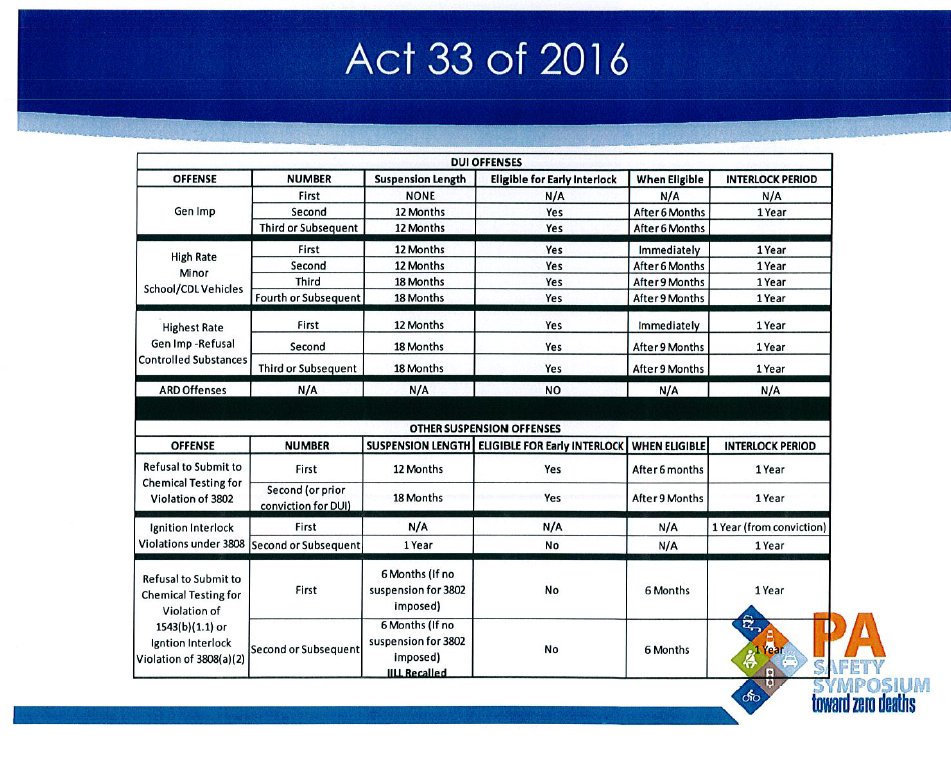
Under the previous DUI law, a judge could not order a defendant convicted of DUI to obtain an ignition interlock device for his or her car for a first offense. Further, a first-offense DUI conviction for driving under the influence of alcohol would result in a mandatory one-year license suspension for BACs above .10. Once the law goes into effect, motorists convicted of DUI will have to obtain an ignition interlock for their cars for at least one year. The devices require the driver to blow into a tube that measures the driver’s blood alcohol content (“BAC”). If the driver’s BAC is too high, then the car will not start. However, if the driver submits proof that he or she obtained the ignition interlock device to PennDOT, then the driver will be permitted to drive with an ignition interlock driver’s license instead of having their license suspended for a year. This means that it will be possible to completely avoid the previously-mandatory driver’s license suspension for a first-offense DUI conviction. The law also shortens the mandatory suspension for second and subsequent offenses as it allows the defendant to apply for the ignition interlock license after serving a portion of the license suspension.
These ignition interlock devices will be expensive. PennDOT has contracted with a number of companies which will install the devices in an offender’s car. The cost to the driver will range from $650 to $1100 for the ignition interlock. However, PennDOT does offer a program for defendants who are unable to afford the device. If the defendant can show that they are below a certain income level, then the state will pay for the ignition interlock. Additionally, if the defendant drives an employer-owned vehicle for work, the defendant may submit the appropriate documentation to PennDOT in order to apply for a waiver of the ignition interlock requirement for the employer-owned vehicle.
The devices will not be required for first-time offenders who are accepted into the ARD program. Under the terms of the ARD program, the defendant must complete a period of probation, pay fines and costs, attend classes, and the defendant may have his or her driver’s license suspended for up to two month depending on the BAC level at the time of the offense. However, if the defendant successfully completes the program, then the case will be dismissed and the record of the arrest can be expunged.
The chart below shows the effect of the law on DUI offenders based on the nature of the offense.
As always, if you are facing DUI charges or any other criminal charges, call 267-225-2545 to speak with an award-winning Philadelphia criminal defense lawyer today.

What is Recklessly Endangering Another Person?
We just updated our section on misdemeanor crimes in Pennsylvania and the Philadelphia Municipal Court to include a discussion of Recklessly Endangering Another Person. Recklessly Endangering Another Person, often referred to as REAP, is commonly charged along with Simple Assault and Aggravated Assault. Prosecutors typically bring this charge whenever the defendant is alleged to have been involved in any kind of fight or assault. However, there may be defenses to a Reckless Endangerment charge. Click here to learn more.

PA Superior Court: Judge May Not Announce Defendant's Sentence Prior To Sentencing Hearing
The Superior Court has held that it is reversible error for a sentencing judge to announce prior to a defendant’s sentencing hearing that the judge plans to send the defendant to jail. Under Pennsylvania law, criminal defendants are entitled to individualized sentences based both on the background of the defendant and the nature of the offense. Therefore, the Superior Court reversed the sentence of a man who received 6-12 months in jail for misdemeanor drug possession after the judge told him that he would be going to jail prior to the sentencing hearing.
In Commonwealth v. Luketic, the defendant pleaded guilty to knowing and intentional possession of a controlled substance. The prosecution alleged that he drove a friend to buy drugs from another gentleman, purchased the crack cocaine himself, and then gave it to his friend, who was a passenger in his vehicle. Under Pennsylvania law, even serving as an intermediary and giving the drugs to a friend immediately after buying them could qualify as Possession with the Intent to Deliver, and Luketic was originally charged with drug delivery. However, given the circumstances, the prosecution permitted Luketic to plead guilty to a misdemeanor count of knowing and intentional possession of a controlled substance instead. The defense and prosecution were unable to reach an agreement as to the recommended sentence, so the defendant entered an “open plea” under which both sides were permitted to make their own sentencing recommendations and leave the final decision up to the judge who accepted the plea.
Both Luketic’s sentencing and the drug seller’s sentencing were listed at the same time, and the judge held the sentencing hearing for the seller first. The judge sentenced the seller to three to six years in state prison. During the sentencing, the judge said to the seller, “You want to sell dope. You have dope fiends like him [indicating Luketic]. He is going to jail, too. He is not walking out of here, either.” The judge reiterated a number of times during the hearing that Luketic would be going to jail.
The judge then ordered that the defendant be tested for drugs, and while he was being tested, the defendant’s lawyer objected to the judge’s pre-sentencing statement that the defendant would be going to jail. Defense counsel did not actually move for the judge to recuse himself, but he did object multiple times. When Appellant returned from the drug test, the court held the sentencing hearing.
Despite defense counsel’s multiple objections, the court proceeded with the sentencing on the misdemeanor drug charge. The judge heard from both sides, and he permitted defense counsel to introduce evidence of mitigation such as ongoing drug treatment, employment status, and the lack of a significant record. Despite the mitigation evidence and guidelines which typically would have called for probation or a shorter sentence, the judge refused to recuse himself and sentenced the defendant to 6-12 months in jail for the drug possession conviction.
The defendant appealed, and the Superior Court reversed the sentence. On appeal, the defendant raised two grounds: First, he argued that the judge erred in failing to recuse himself. Second, he argued that the trial court violated Pennsylvania law requiring that defendants receive individualized sentences when the judge decided on jail prior to the sentencing hearing.
The Superior Court rejected the first argument, and the Superior Court’s analysis illustrates the dangers of Pennsylvania’s punishing waiver doctrine. Pennsylvania case law requires that issues be clearly raised in the trial court and that motions must be very specific or they are waived on appeal. Despite defense counsel’s repeated objections to the judge, the Superior Court concluded that Luketic waived the recusal issue on appeal because defense counsel failed to use the magic words “recusal” when objecting to the judge’s sentence. This doctrine leads to absurd results in cases like this where the issue was clearly litigated, but appellate courts are often eager to find waiver. The result is that even where a clear error has occurred, the defendant cannot obtain relief on appeal. Instead, the defendant must file a Post Conviction Relief Act Petition once the appeals have been exhausted arguing that counsel was ineffective for failure to object or make a specific motion.
Despite finding waiver on the recusal issue, the Superior Court found merit in the second issue and reversed the defendant’s sentence. The court noted that “a sentencing court abuses its discretion when it considers the criminal act, but not the criminal himself.” The Sentencing Code prescribes individualized sentencing by requiring the sentencing court to consider the protection of the public, the gravity of the offense in relation to its impact on the victim and the community, and the rehabilitative needs of the defendant. It also prohibits a sentence of total confinement without consideration of “the nature and circumstances of the crime and the history, character, and condition of the defendant.”
Accordingly, the code requires the sentencing court to consider the characteristics of both the defendant and the crime. When a court orders a sentence based solely on the nature of the crime, the sentence must be reversed. The court cannot correct an error by going through the motions and appearances of a full sentencing hearing. Instead, when it is clear from the record that the sentence was pre-determined based only on the nature of the crime, the sentence must be vacated.
In Luketic’s case, the Superior Court found that the court had made its intention to send the defendant to jail clear and unequivocal without hearing any evidence about the defendant. Additionally, the court erred in considering the sentence for the drug seller when sentencing the defendant because it is an abuse of discretion to base one defendant’s sentence on the sentence imposed on another defendant. Finally, the Superior Court was very concerned about the fact that the trial court failed to order and consider a Pre-Sentence Investigation prior to sending the defendant to jail on an open guilty plea for a misdemeanor drug conviction which typically carries probation. Therefore, the Superior Court vacated the sentence and remanded it to the trial court for re-sentencing. The Superior Court did not order that the trial judge recuse himself, but defense counsel would be expected to make a motion for recusal in the lower court.

Philadelphia Criminal Defense Lawyers
Award-Winning Philadelphia Criminal Defense Lawyers
If you are facing criminal charges, contact the criminal defense lawyers of Goldstein Mehta LLC today. We offer a free 15-minute criminal defense strategy session to anyone who is under investigation or facing a potential criminal charge. Call 267-225-2545 to speak with one of our top-rated defense attorneys today about defenses at trial or the possibility of an appeal.

Despite Partial Decriminalization, Marijuana Possession Provides Philadelphia Police Authority to Arrest and Search
Observing or Smelling Marijuana Often Gives Police Probable Cause to Search
As a general rule, both state and federal prosecutors may not use illegally obtained evidence against a defendant in a criminal trial. There are exceptions, but if the police search a defendant illegally and recover drugs, guns, or other contraband, the evidence may not be used in court. The defense may move to exclude the illegally seized evidence by filing a motion to suppress. Once the defendant moves to suppress the evidence, the court will hold an evidentiary hearing, and the Commonwealth must show that that the police obtained the evidence pursuant to a lawful search and seizure. In a recent case from the Superior Court, Commonwealth v. Edward Young, the Superior Court held that the trial court erred in suppressing a gun and marijuana because Philadelphia police officers were free to conduct a full search of the defendant after the defendant admitted that he had marijuana on him.
Commonwealth v. Young
In Young, plain clothes officers were patrolling what they described as a high crime area in Philadelphia. They observed the defendant standing outside of a corner store. When officers returned an hour later, they saw that the defendant was still standing in front of the store despite the fact that it was raining. The three officers got out of their unmarked car and approached the defendant. They identified themselves as police officers and asked him what he was doing. He told them he was waiting for a bus, and one of the officers then asked the defendant if he had anything on him which could harm the officers. The defendant responded that he did not have anything that could harm the officers, but he did have “two bags of weed.”
After the defendant admitted to possessing marijuana, the officers went into the defendant’s pockets and found both a gun and a small amount of marijuana. The defendant moved to suppress the gun and marijuana, and the trial court granted the motion to suppress. The court found that the police had conducted an investigatory detention (“Terry stop”) which required them to have probable cause. Although it was a little fishy that the defendant would stand outside in the rain and claim to be waiting for the bus for over an hour, it did not actually establish that the defendant was engaged in criminal activity. Therefore, the trial court found that the police had conducted an illegal stop when three officers identified themselves as police and demanded to know if the defendant had any weapons on him. Accordingly, the trial court suppressed the evidence.
The Commonwealth appealed the trial court’s ruling to the Superior Court, and the Superior Court reversed. The Superior Court noted that there are three different legal standards which govern encounters between pedestrians and police officers. The court held that because police had only asked two questions of the defendant, they had simply engaged in a mere encounter which did not require them to have reasonable suspicion prior to interacting with the defendant. Further, once the defendant voluntarily admitted to having marijuana, the police had full probable cause to conduct a search of the defendant and recover the gun.
LEGAL STANDARDS FOR POLICE ENCOUNTERS
The Superior Court explained that under the Pennsylvania and United States constitutions, there are three legal standards which govern interactions between the police and pedestrians. First, police may always engage in a mere encounter with a person on the street. This means that even if they have not seen someone do anything illegal, police officers may approach a person, ask them some questions, and attempt to have a conversation with the person. The police may do that even if they suspect the person is engaged in criminal activity without any solid basis for that belief. If the subject of the mere encounter volunteers something incriminating or hands over contraband, then that evidence may be used in court. Here, the Superior Court rejected the trial court's reasoning that the fact that there were three officers involved and that they immediately asked about weapons converted the interaction into something more than a mere encounter.
Second, police may conduct a Terry stop and frisk when they have reasonable suspicion. Police officers have reasonable suspicion when they can state specific, articulable facts which lead them to believe that criminal activity may be ongoing. Reasonable suspicion is a fairly low standard, but it requires a showing that the police had more than just a hunch that the suspect was involved in a crime. If police have reasonable suspicion, then they may conduct a stop of a person in which that person is not free to leave or disengage from the interaction. In some cases, the police may also conduct a frisk of the suspect. However, in order to properly conduct a frisk, the police must have not only reasonable suspicion of criminal activity, but also reasonable suspicion that the person is armed and dangerous. Even then, the frisk is limited to a pat down of the person’s outer clothing. The officers may pat the suspect down and feel for weapons, but they may not go into the person’s pockets or manipulate or squeeze any bulges. Further, a Terry stop must be limited and brief or it could escalate into the equivalent of an arrest.
An arrest or its equivalent requires the police to have probable cause. A stop becomes an arrest or its equivalent when a reasonable person would believe that they were under arrest. Important factors in evaluating whether a stop was the equivalent of an arrest may include whether police use handcuffs, provide Miranda warnings, point their guns at the person, transport the person in the patrol car or require them to go to the police station, and the number of officers involved in the encounter. If a police encounter rises to the level of an arrest, then the police must have probable cause that the defendant committed a crime. Probable cause requires a showing that it was more likely than not that the defendant committed a crime. If the police have probable cause, then they may fully arrest the defendant. They may also conduct a search incident to arrest, meaning they may conduct a full search of the defendant.
In Young, the Superior Court held that the police had not exceeded the scope of a mere encounter when they simply approached the defendant, asked him what he was doing, and asked if he had any weapons on him. The police are always free to walk up to someone and ask the person some questions. Then, once the defendant admitted to having marijuana on him, the police were free to conduct a full search of the defendant because they had probable cause to make an arrest. Once they had probable cause to make an arrest, they were legally authorized to conduct a full search incident to arrest. Therefore, the police did not do anything illegal in finding the gun. The police did not surround the defendant or indicate that they were going to search him; thus, they did not do anything that made the interaction into something more than a mere encounter.
MARIJUANA STILL PROVIDES PROBABLE CAUSE TO ARREST AND SEARCH
It is important to note that police still had probable cause to arrest and search the defendant despite Philadelphia’s recent city ordinances providing police with the authority to issue citations for marijuana possession instead of making arrests. Although the police do not arrest most people who are caught with 30 grams of marijuana or less, possession of even a small amount of marijuana remains a crime under both state and federal law. Therefore, the police still have the discretion to make an arrest, which gives them the authority to conduct a full search of someone who admits to possessing marijuana.
Award-Winning Philadelphia Criminal Defense Attorneys

Philadelphia Marijuana Lawyers
If you are facing criminal charges for drugs, guns, or other contraband, our Philadelphia criminal defense lawyers can help. We have won countless motions to suppress in the Philadelphia Municipal Court, Court of Common Pleas, and in the surrounding counties. Call 267-225-2545 for a free criminal defense strategy session.