

Philadelphia Criminal Defense Blog

DUI Defense Update: Challenge to Blood Draw Refusal Evidentiary Presumption Waived by Failure to Raise Issue in Trial Court
DUI Litigation Following Birchfield v. North Dakota
The United States Supreme Court’s decision in Birchfield v. North Dakota created a number of issues in DUI litigation which have not yet been resolved. The Birchfield Court held that at a minimum, states may not impose criminal penalties on motorists who refuse to consent to a blood draw unless police first obtain a search warrant. As a result, much of Pennsylvania’s DUI law has been thrown into disarray, and there are a number of legal issues which still need to be resolved. These issues include the types of warnings and advice that police must provide to DUI suspects prior to requesting consent to a blood draw, whether a suspect’s refusal to consent to a blood draw without a warrant may be used against them as evidence of consciousness of guilt, and whether the police may draw blood from an unconscious Driving Under the Influence suspect.
Evidentiary Consequences of a Blood Draw Refusal
The Pennsylvania Superior Court has just declined to address one of these issues on appeal, finding that a DWI defendant who had not raised an evidentiary issue at trial could not raise it for the first time on appeal. Prior to Birchfield, it was well-accepted that the prosecution could use evidence of a motorist’s refusal to consent to a blood draw against them as evidence of consciousness of guilt. Although the refusal alone would not be enough to convict a criminal defendant, the trial judge or jury could infer from the defendant’s refusal that the defendant believed that evidence of intoxication would show up in the blood results. Thus, a refusal combined with other factors such as poor driving, an odor of alcohol or marijuana, and other evidence of that nature could combine to provide evidence of drunk driving or drugged driving beyond a reasonable doubt.
The Effect of Birchfield
Now that the United States Supreme Court (and Pennsylvania appellate courts) have held that blood draw refusals may not be used to increase the penalties or create new criminal penalties for DUI defendants, there have been a number of challenges to whether the previously mentioned evidentiary presumption of a refusal complies with the requirements of the United States and Pennsylvania Constitutions. In the case of Commonwealth v. Napold, the Pennsylvania Superior Court declined to decide this issue. The Court found that the issue was waived because Napold had not raised the issue by filing a motion in limine prior to trial or objecting to the evidence at trial. Thus, the Superior Court found that Napold had waived the issue by failing to properly preserve it by asking the trial judge to rule on the issue first.
Waiver Doctrine in Pennsylvania Criminal Appeals
Napold provides an illustration of Pennsylvania’s punishing waiver doctrine. Under Pennsylvania law, if the defense fails to object to something or have an issue resolved by the trial court either prior to trial or during trial, then the issue will be forever waived on appeal regardless of how patently inadmissible the evidence may have been. For example, if the prosecution attempts to introduce inadmissible hearsay testimony and the defense fails to object, the defendant cannot then argue that he or she was prejudiced by inadmissible hearsay on appeal. This is because the issue was not raised in the trial court, so the trial judge had no opportunity to correct the error. Most other jurisdictions provide some leeway in terms of an appellate court’s ability to review obvious or clear errors, but Pennsylvania does not.
Notably, the decision in Napold finding that the issue had been waived is different from many of the other Birchfield-related cases which dealt with sentencing. The issue of an illegal sentence may always be raised on appeal regardless of whether the issue was raised in the trial court. Therefore, challenges to Pennsylvania’s statutory mandatory minimum scheme for blood draw refusals were permitted despite the failure to raise those issues in the trial court.
As illustrated by Napold, evidentiary issues must be properly preserved, and whether or not the blood draw refusal can be used as evidence against a defendant will not be resolved by the appellate courts until a later date. Napold illustrates why it is critical even for criminal defense lawyers who only handle trials to be aware of what is happening in the appellate courts so that the defense attorneys can preserve issues in case the appellate courts rule in favorable ways for the defense.
Award-Winning Philadelphia Criminal Defense Attorneys and DUI Defense Lawyers

Philadelphia Criminal Defense Lawyer Zak T. Goldstein, Esq.
If you are facing DUI charges or under investigation for any criminal defense, you need the assistance of one of our award-winning Philadelphia criminal defense lawyers. We have successfully represented thousands of clients, and we will use our skill and experience to help you achieve the best possible result. Call 267-225-2545 for a free criminal defense strategy session with one of our top-rated defense attorneys today.

PA Superior Court: Summary Traffic Offenses May Be Charged Separately From Serious Offenses in Philadelphia
For many years, it was the routine practice of the Philadelphia Police Department to charge summary traffic offenses and more serious charges like DUI or possessory offenses separately. For example, if police pulled a car over for speeding and ultimately found a gun in the car or ended up charging the driver with DUI, then the Commonwealth would bring the summary speeding charge in Philadelphia Traffic Court and the more serious gun charge or DUI charge in either the Municipal Court or the Court of Common Pleas. Thus, a defendant who wished to challenge the traffic citation would be required to attend twice as many court dates and hire a defense attorney twice.
This practice arguably violates Pennsylvania's compulsory joinder statute. Pennsylvania has a compulsory joinder statute which is codified at 18 Pa C.S. § 110. At its most basic level, a compulsory joinder statute requires the prosecution to bring charges which arise out of the same incident together in a single prosecution. This spares the defendant the additional time, expense, and stress of defending against two separate cases, and in this sense, compulsory joinder is very similar and related to the idea of Double Jeopardy – that a defendant may not be prosecuted for the same crime twice. Pennsylvania appellate courts had repeatedly ruled that under a prior version of Section 110 (the joinder statute), summary offenses were just different and did not count because the Court of Common Pleas held jurisdiction over misdemeanors and felonies and the Magisterial District Courts had jurisdiction over summaries. Therefore, the prosecution and police could bring summary traffic prosecutions in traffic court and misdemeanor and felony prosecutions in the Municipal Court and Court of Common Pleas.
In 2002, the Pennsylvania Legislature amended the statute to change language requiring compulsory joinder where the offenses occurred within courts of the same jurisdiction to offenses which occurred within the same judicial district. This language arguably has a dramatic impact. Instead of summaries being different due to the differing jurisdictions of the courts, the question became whether the offense occurred in the same judicial district. This issue became even more important approximately ten years later when the Philadelphia Traffic Court became enmeshed in scandal and was abolished. After the court was abolished, its functions were merged into the Philadelphia Municipal Court – Traffic Division. Thus, any argument that summary offenses were not within the same judicial district or that the Municipal Court did not have jurisdiction became extremely weak, and defense lawyers began to successfully move for cases to be dismissed due to the fact that summary traffic cases arising out of the same stop had already been resolved.
In the vast majority of cases, the traffic ticket would be resolved much faster than the criminal case. The traffic court hearings were scheduled more quickly, and if a defendant failed to appear for court, the defendant would be found guilty in absentia. Further, many defendants pay their traffic tickets online, by phone, or through the mail rather than going to court to fight them. This meant that a traffic court case could be disposed of within a month or two, and the defense could then move to dismiss the criminal case as violating the compulsory joinder rule. Once prosecutions realized they had a potential problem, Philadelphia Police quickly changed their procedures and stopped issuing traffic tickets in cases where they also intended to charge the defendant with a more serious crime. However, many existing cases were successfully dismissed because the traffic tickets had already been resolved.
Although this issue is not as prevalent today because a large number of the cases in which this happened have already been resolved, the Superior Court has just held that the unique rules establishing the Philadelphia Municipal Court – Traffic Division trump the compulsory joinder rule and allow the traffic citations to be issued separately from the criminal charges.
On August 30, 2017, the Pennsylvania Superior Court issued its decision in Commonwealth v. Perfetto. The Superior Court overturned the trial court’s decision granting Mr. Perfetto’s Motion to Dismiss. Although this decision is limited to Philadelphia, it could potentially affect a large number of defendants who are charged with Driving Under The Influence (“DUI.”)
Commonwealth v. Perfetto
In July 2014, Mr. Perfetto was arrested in Philadelphia and charged with three counts of “DUI.” Mr. Perfetto was also charged with the summary offense of driving without lights as required, a traffic citation. Although traffic citations are not considered very serious, they are still summary offenses, and all summary offenses are crimes under Pennsylvania law. In September 2014, Mr. Perfetto was found guilty of the traffic citation by the Philadelphia Municipal Court – Traffic Division. In June 2015, Mr. Perfetto filed a motion to dismiss in his DUI case, arguing that § 110 barred the prosecution. The trial court agreed with Mr. Perfetto and dismissed the DUI case. The court granted the motion because Mr. Perfetto’s case satisfied the four requirements of § 110. Shortly thereafter, the Commonwealth filed an appeal, arguing that Mr. Perfetto’s subsequent DUI prosecution was not barred by § 110.
What is Double Jeopardy and § 110?
Double Jeopardy is mentioned in both the United States Constitution (5th Amendment) and the Pennsylvania Constitution (Article 1, Section 10). Double Jeopardy is the rule that the same government cannot put you on trial for the same charges twice. For example, let’s say a defendant is accused of punching a complainant in the face and is charged with Simple Assault and Recklessly Endangering Another Person (REAP). If the defendant was acquitted of these charges, the same government could not put that defendant on trial again for those charges because Double Jeopardy would forbid it. This rule does not always apply against other levels of government. For example, a federal prosecution will prevent the Commonwealth of Pennsylvania from bringing a subsequent prosecution, but a Pennsylvania prosecution will not prevent the United States from bringing a federal prosecution.
The idea of compulsory joinder is similar and arises out of many of the same concerns of Double Jeopardy. As previously explained, Section 110 provides Pennsylvania’s compulsory joinder rule. § 110 is similar to the Double Jeopardy clauses of the Pennsylvania and U.S. Constitutions, but more nuanced. § 110 is the codification of the rule announced in the Pennsylvania Supreme Court decision of Commonwealth v. Campana, 304 A.2d 432 Pa. 1973). In Campana, the Court held that ‘the Double Jeopardy Clause requires a prosecutor to bring, in a single proceeding, all known charges against a defendant arising from a single criminal episode.” Id. at 374. This is known as compulsory joinder. Using the same example above, let’s say that in addition to punching the complaining witness, the defendant also told said this person that he was going to kill him (arguably a Terroristic Threat), however the government only charged him with Simple Assault and REAP. Assuming this defendant is acquitted again, the defendant could not subsequently be tried for the crime of Terroristic Threats. The reason is because the “terroristic threat” came from the same criminal episode as the assault. Again, this would only prevent Pennsylvania from bringing a second prosecution; the federal government may still be able to bring federal charges.
In order to be successful when bringing a § 110 motion to dismiss, the defense must show four things: 1) the former prosecution resulted in an acquittal or conviction; 2) the current prosecution was based on the same criminal conduct or arose from the same criminal episode; 3) the prosecutor in the subsequent trial was aware of the charges before the first trial; and 4) all the charges are within the same judicial district as the former prosecution. The key issue in Mr. Perfetto’s case was the fourth prong of this analysis because it was the fourth prong that changed in the 2002 amendment to the compulsory joinder rule.
The Pennsylvania Superior Court Holds that Philadelphia’s Traffic Division of Municipal Court is a Separate Judicial District
In overturning the trial court’s decision, the Pennsylvania Superior Court made a very technical finding. First, the Court looked to 42 Pa C.S.A. § 1302, a statute which addresses traffic courts. In analyzing the statute, the Court held that when a traffic offense is resolved in a jurisdiction with a traffic court, there is no violation of § 110 if the more serious criminal charges are filed separately. In other words, if a jurisdiction does not have a traffic court, then § 110 would apply if a defendant resolved the traffic offense prior to their criminal offense, but the same is not true when the jurisdiction has a traffic court.
Unfortunately, Philadelphia is different than other jurisdictions in Pennsylvania because its traffic court is specifically mentioned in § 1302. In 2013, Philadelphia’s traffic court merged with Philadelphia’s Municipal Court. This created two divisions: the General Division and the Traffic Division. Therefore, the Municipal Court has jurisdiction over both traffic and criminal offenses. Thus, prior to Perfetto, defense attorneys would argue that because Philadelphia does not have a separate traffic court, §110 applied for traffic offenses.
The Superior Court has now rejected this argument at least as it applies to Philadelphia courts. The Superior Court noted that the Pennsylvania Supreme Court has the power to create rules for the general practice and procedure of the Courts. With this in mind, the Superior Court focused on a May 2014 comment to Pennsylvania Rule of Criminal Procedure 1001(D) which addresses Philadelphia Municipal Court. The comment stated:
This rule, which defines “Municipal Court case,” is intended to ensure that the Municipal Court will take dispositive action, including trial and verdict when appropriate, in any criminal case that does not involve a felony, excluding summary cases under the Vehicle Code. The latter are under the jurisdiction of the Municipal Court Traffic Division, the successor of the Philadelphia Traffic Court.
Pa.R.Crim.P. 1001(D), cmt.
As such, the Superior Court held that the Supreme Court’s intent was for the traffic division of the Municipal Court to exclusively hear the traffic offenses. Thus, the Superior Court held that, in essence, Philadelphia’s Municipal Court traffic division is analogous to a jurisdiction with its own separate traffic court. Consequently, the Superior Court held that § 110 does not bar subsequent prosecution of a criminal offense when there has been a prior disposition of a traffic offense in Philadelphia. The Superior Court reversed the ruling of the trial court, and Mr. Perfetto’s case was remanded back to the Philadelphia Municipal Court for trial.
DUI Cases
At this point, the impact of Perfetto is relatively limited. For a number of years, unpublished opinions of the Pennsylvania Superior Court reached the opposite conclusion, so a large number of cases have already been dismissed and cannot be reinstated. For those cases which were on appeal and awaiting the decision in Perfetto, the defendants will now face prosecution once again. However, the Philadelphia Police Department stopped issuing separate traffic citations a number of years ago due to this rule, so the decision is not likely to substantially affect newly charged defendants. Certainly, Perfetto will likely be appealed to the Pennsylvania Supreme Court, and the issue may not be resolved.
Philadelphia Criminal Defense Lawyers

Philadelphia Criminal Defense Attorneys
As always, DUI cases can be very technical and there are a number of ways to beat them. If you are charged with DUI, you need an attorney who has the knowledge and expertise to fight your case. Our award-winning Philadelphia criminal defense lawyers have successfully fought countless cases at trial and on appeal. We offer a 15-minute criminal defense strategy session to any potential client. Call 267-225-2545 to discuss your case with an experienced and understanding criminal defense attorney today.

DUI Update: PA's New Ignition Interlock Law Takes Effect
Pennsylvania’s new Driving Under the Influence (“DUI”) Ignition Interlock Law took effect on Friday, August 25, 2017. We have written about the pros and cons of the new law previously, but prior to taking effect, the Pennsylvania Legislature modified the law so that it would bring many of the same advantages and disadvantages to recipients of the Accelerated Rehabilitative Disposition (“ARD”) Program. Unfortunately, the changes to make ARD defendants eligible for the Ignition Interlock License will not go into effect until October 2018. Additionally, most defense lawyers believed that the law would be applied retroactively to motorists who were already serving their suspensions when the law took effect. Based on recent guidance from PennDOT, it now seems clear that the DUI Ignition Interlock Statute will apply retroactively. This means that many motorists who are already serving DUI-related suspensions will be immediately eligible to obtain an Ignition Interlock device and have their driver’s licenses reinstated.
Pros and Cons of the New DUI Ignition Interlock Law
There are some significant pros and cons to the new law. In general, the law makes Driving Under the Influence Convictions more expensive by requiring even some first-time offenders to install ignition interlock devices on their vehicles. These devices can be costly, but the law does allow for subsidized interlock installations upon a showing of financial hardship. At the same time, the law provides many motorists with a way to keep their licenses or serve shorter driver’s license suspensions than those statutorily required in the absence of the law.
One of the biggest problems with Pennsylvania’s DUI statute is that it requires a one year driver’s license suspension for many first-time offenders, and Pennsylvania does not really offer the kinds of work licenses offered in other states. This means that a DUI would ordinarily cause many people to lose their jobs if they drive for a living or need to drive to and from work. This is a problem even for criminal defendants who are accepted into the ARD program as even ARD requires a sixty day driver’s license suspension for a motorist who blew above a .16 or had drugs in their system. The law solves some of these problems by allowing many drivers to keep their licenses while at these are time protecting the public from drunk drivers by requiring them to obtain ignition interlock devices.
Changes to the DUI Statute
Now, even first-time offenders in the highest tier (meaning they had a BAC above .16 or drugs in their system while driving) can obtain a special Ignition Interlock license which will permit them to keep driving during the period of suspension. This will result in many DUI defendants being able to keep their jobs. At the same time, it makes the roads safer by requiring those convicted of DUI to obtain these ignition interlock devices. The devices prevent a car from starting if the device detects the presence of alcohol in the driver’s breath. Notably, the devices have no way of detecting the presence of any kind of drugs. Additionally, the legislature recently amended the statute so that defendants who are diverted into the ARD program will be eligible for ignition interlock licenses. This portion of the statute will not go into effect until October 2018, so ARD currently still requires the license suspension. The law also does not help criminal defendants who have had their driver's licenses suspended due to convictions for drug possession or possession with the intent to deliver.
We Can Help With DUI Cases and Ignition Interlock Licenses

Goldstein Mehta LLC - Philadelphia Criminal Defense Lawyers
You can learn more about the law and its benefits on PennDOT’s website. If you have questions about your eligibility for an ignition interlock license or the procedure for applying for this type of license, call one of our award-winning Philadelphia criminal defense lawyers at 267-225-2545 for a free consultation. We can also help with DUI and driving with a suspended license charges in Philadelphia and the surrounding counties.

PA DUI Update: New Ignition Interlock Law Changes Driver’s License Suspensions in DUI Cases
About a year ago, Governor Wolf signed new legislation into law which will change the way a DUI conviction will affect your driver’s license. The new law, which focuses primarily on ignition interlock devices, goes into effect in August. The law requires many DUI offenders to obtain ignition interlock devices for their vehicles even for a first offense DUI conviction. At the same time, it will also allow many people to keep their driver’s licenses who would have otherwise lost their licenses for a year. The intended effect is that the law will prevent DUI offenders from driving drunk while at the same time allowing them to keep their licenses so that they do not lose employment.
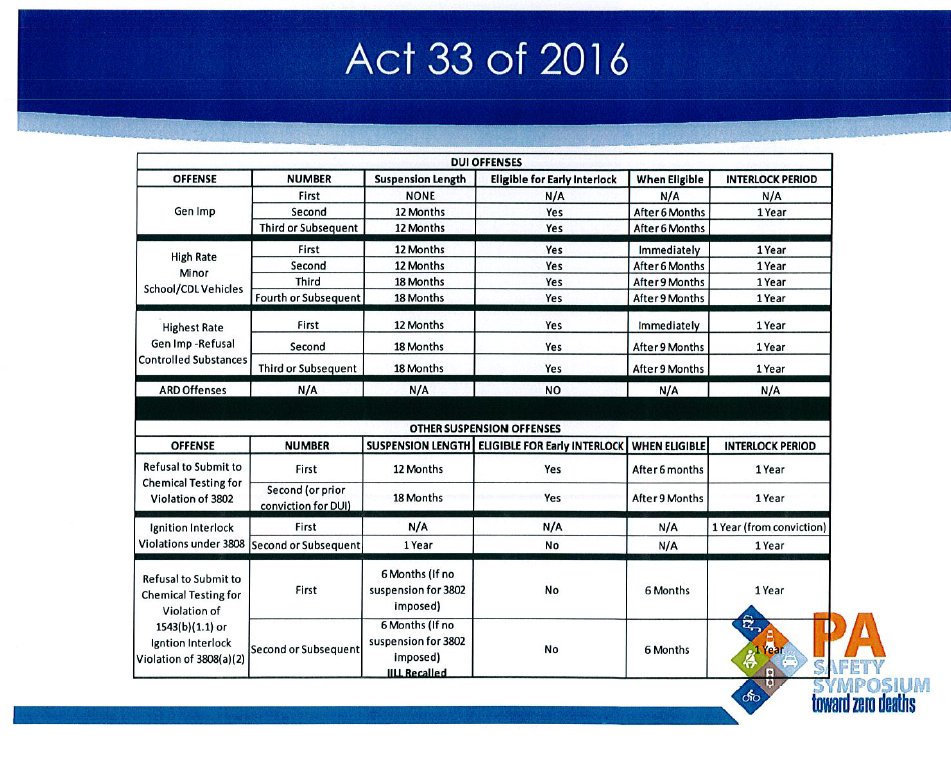
Under the previous DUI law, a judge could not order a defendant convicted of DUI to obtain an ignition interlock device for his or her car for a first offense. Further, a first-offense DUI conviction for driving under the influence of alcohol would result in a mandatory one-year license suspension for BACs above .10. Once the law goes into effect, motorists convicted of DUI will have to obtain an ignition interlock for their cars for at least one year. The devices require the driver to blow into a tube that measures the driver’s blood alcohol content (“BAC”). If the driver’s BAC is too high, then the car will not start. However, if the driver submits proof that he or she obtained the ignition interlock device to PennDOT, then the driver will be permitted to drive with an ignition interlock driver’s license instead of having their license suspended for a year. This means that it will be possible to completely avoid the previously-mandatory driver’s license suspension for a first-offense DUI conviction. The law also shortens the mandatory suspension for second and subsequent offenses as it allows the defendant to apply for the ignition interlock license after serving a portion of the license suspension.
These ignition interlock devices will be expensive. PennDOT has contracted with a number of companies which will install the devices in an offender’s car. The cost to the driver will range from $650 to $1100 for the ignition interlock. However, PennDOT does offer a program for defendants who are unable to afford the device. If the defendant can show that they are below a certain income level, then the state will pay for the ignition interlock. Additionally, if the defendant drives an employer-owned vehicle for work, the defendant may submit the appropriate documentation to PennDOT in order to apply for a waiver of the ignition interlock requirement for the employer-owned vehicle.
The devices will not be required for first-time offenders who are accepted into the ARD program. Under the terms of the ARD program, the defendant must complete a period of probation, pay fines and costs, attend classes, and the defendant may have his or her driver’s license suspended for up to two month depending on the BAC level at the time of the offense. However, if the defendant successfully completes the program, then the case will be dismissed and the record of the arrest can be expunged.
The chart below shows the effect of the law on DUI offenders based on the nature of the offense.
As always, if you are facing DUI charges or any other criminal charges, call 267-225-2545 to speak with an award-winning Philadelphia criminal defense lawyer today.