

Philadelphia Criminal Defense Blog

DUI Update: PA's New Ignition Interlock Law Takes Effect
Pennsylvania’s new Driving Under the Influence (“DUI”) Ignition Interlock Law took effect on Friday, August 25, 2017. We have written about the pros and cons of the new law previously, but prior to taking effect, the Pennsylvania Legislature modified the law so that it would bring many of the same advantages and disadvantages to recipients of the Accelerated Rehabilitative Disposition (“ARD”) Program. Unfortunately, the changes to make ARD defendants eligible for the Ignition Interlock License will not go into effect until October 2018. Additionally, most defense lawyers believed that the law would be applied retroactively to motorists who were already serving their suspensions when the law took effect. Based on recent guidance from PennDOT, it now seems clear that the DUI Ignition Interlock Statute will apply retroactively. This means that many motorists who are already serving DUI-related suspensions will be immediately eligible to obtain an Ignition Interlock device and have their driver’s licenses reinstated.
Pros and Cons of the New DUI Ignition Interlock Law
There are some significant pros and cons to the new law. In general, the law makes Driving Under the Influence Convictions more expensive by requiring even some first-time offenders to install ignition interlock devices on their vehicles. These devices can be costly, but the law does allow for subsidized interlock installations upon a showing of financial hardship. At the same time, the law provides many motorists with a way to keep their licenses or serve shorter driver’s license suspensions than those statutorily required in the absence of the law.
One of the biggest problems with Pennsylvania’s DUI statute is that it requires a one year driver’s license suspension for many first-time offenders, and Pennsylvania does not really offer the kinds of work licenses offered in other states. This means that a DUI would ordinarily cause many people to lose their jobs if they drive for a living or need to drive to and from work. This is a problem even for criminal defendants who are accepted into the ARD program as even ARD requires a sixty day driver’s license suspension for a motorist who blew above a .16 or had drugs in their system. The law solves some of these problems by allowing many drivers to keep their licenses while at these are time protecting the public from drunk drivers by requiring them to obtain ignition interlock devices.
Changes to the DUI Statute
Now, even first-time offenders in the highest tier (meaning they had a BAC above .16 or drugs in their system while driving) can obtain a special Ignition Interlock license which will permit them to keep driving during the period of suspension. This will result in many DUI defendants being able to keep their jobs. At the same time, it makes the roads safer by requiring those convicted of DUI to obtain these ignition interlock devices. The devices prevent a car from starting if the device detects the presence of alcohol in the driver’s breath. Notably, the devices have no way of detecting the presence of any kind of drugs. Additionally, the legislature recently amended the statute so that defendants who are diverted into the ARD program will be eligible for ignition interlock licenses. This portion of the statute will not go into effect until October 2018, so ARD currently still requires the license suspension. The law also does not help criminal defendants who have had their driver's licenses suspended due to convictions for drug possession or possession with the intent to deliver.
We Can Help With DUI Cases and Ignition Interlock Licenses

Goldstein Mehta LLC - Philadelphia Criminal Defense Lawyers
You can learn more about the law and its benefits on PennDOT’s website. If you have questions about your eligibility for an ignition interlock license or the procedure for applying for this type of license, call one of our award-winning Philadelphia criminal defense lawyers at 267-225-2545 for a free consultation. We can also help with DUI and driving with a suspended license charges in Philadelphia and the surrounding counties.

PA DUI Update: New Ignition Interlock Law Changes Driver’s License Suspensions in DUI Cases
About a year ago, Governor Wolf signed new legislation into law which will change the way a DUI conviction will affect your driver’s license. The new law, which focuses primarily on ignition interlock devices, goes into effect in August. The law requires many DUI offenders to obtain ignition interlock devices for their vehicles even for a first offense DUI conviction. At the same time, it will also allow many people to keep their driver’s licenses who would have otherwise lost their licenses for a year. The intended effect is that the law will prevent DUI offenders from driving drunk while at the same time allowing them to keep their licenses so that they do not lose employment.
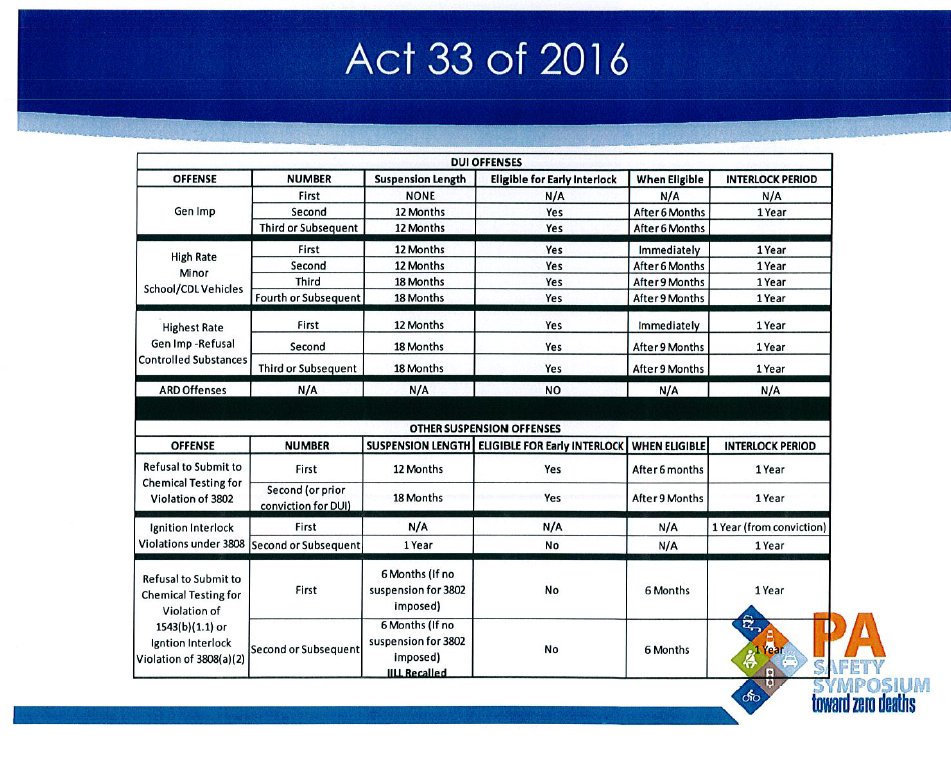
Under the previous DUI law, a judge could not order a defendant convicted of DUI to obtain an ignition interlock device for his or her car for a first offense. Further, a first-offense DUI conviction for driving under the influence of alcohol would result in a mandatory one-year license suspension for BACs above .10. Once the law goes into effect, motorists convicted of DUI will have to obtain an ignition interlock for their cars for at least one year. The devices require the driver to blow into a tube that measures the driver’s blood alcohol content (“BAC”). If the driver’s BAC is too high, then the car will not start. However, if the driver submits proof that he or she obtained the ignition interlock device to PennDOT, then the driver will be permitted to drive with an ignition interlock driver’s license instead of having their license suspended for a year. This means that it will be possible to completely avoid the previously-mandatory driver’s license suspension for a first-offense DUI conviction. The law also shortens the mandatory suspension for second and subsequent offenses as it allows the defendant to apply for the ignition interlock license after serving a portion of the license suspension.
These ignition interlock devices will be expensive. PennDOT has contracted with a number of companies which will install the devices in an offender’s car. The cost to the driver will range from $650 to $1100 for the ignition interlock. However, PennDOT does offer a program for defendants who are unable to afford the device. If the defendant can show that they are below a certain income level, then the state will pay for the ignition interlock. Additionally, if the defendant drives an employer-owned vehicle for work, the defendant may submit the appropriate documentation to PennDOT in order to apply for a waiver of the ignition interlock requirement for the employer-owned vehicle.
The devices will not be required for first-time offenders who are accepted into the ARD program. Under the terms of the ARD program, the defendant must complete a period of probation, pay fines and costs, attend classes, and the defendant may have his or her driver’s license suspended for up to two month depending on the BAC level at the time of the offense. However, if the defendant successfully completes the program, then the case will be dismissed and the record of the arrest can be expunged.
The chart below shows the effect of the law on DUI offenders based on the nature of the offense.
As always, if you are facing DUI charges or any other criminal charges, call 267-225-2545 to speak with an award-winning Philadelphia criminal defense lawyer today.

Recent Court Decisions Create More Problems for Blood Testing in PA DUI Cases
PA DUI Update: Even New, Revised Blood Test Warnings May Be Unconstitutional
Pennsylvania courts have already found that large chunks of Pennsylvania’s DUI laws are unconstitutional. Recently, judges on both the Pennsylvania Superior Court and the Philadelphia Municipal Court have found that even police warnings which do not explicitly mention increased criminal penalties for refusing a blood draw could be unconstitutionally coercive and require the suppression of the test results. As written, the state’s DUI law creates an enhanced criminal penalty for motorists who refuse blood testing and are subsequently convicted of DUI. In DUI cases where the defendant is convicted both of driving under the influence and refusing to consent to blood testing, the defendant would be sentenced as a Tier III offender instead of a Tier I offender.
Differences in Sentencing for DUI Tiers
The differences between the mandatory minimums for Tier I DUIs and Tier III DUIs are enormous. For example, a first offense, Tier I DUI requires the court to impose a sentence of six months of probation, fines, classes, and other conditions. However, there is no mandatory minimum jail sentence, and there is no required PennDOT driver’s license suspension. On the other hand, a first offense, Tier III DUI conviction requires the court to impose 72 hours of incarceration and a one year driver’s license suspension in addition to enhanced fines and other conditions. Thus, the difference between a Tier I and a Tier III can be real time in jail and a significant driver’s license suspension which could lead to the defendant losing his or her employment.
Recent Court Decisions in Pennsylvania DUI Cases

Demetra Mehta, Esq - DUI Lawyer in Philadelphia
Recently, courts have begun to strike down the enhanced criminal penalties for refusing a blood test. First, in Birchfield v. North Dakota, the United States Supreme Court held that states may not penalize a motorist for refusing a blood test in cases where the police have not obtained a search warrant for the motorist’s blood. This is because the blood test is an intrusive search of the defendant’s body which falls under the Fourth Amendment and requires a search warrant. According to the Supreme Court, breath tests do not pose the same privacy concerns because the use of a breathalyzer is far less intrusive than a blood test. Of course, this is a problem for DUI enforcement because a breathalyzer cannot detect the use of drugs.
Prior to Birchfield, various Pennsylvania appellate court opinions and laws required police officers to provide DUI suspects with O’Connell warnings prior to requesting a blood draw. The O’Connell warnings inform the motorist that the motorist will face an increased criminal penalty for refusing the test should the motorist be convicted of both the DUI and refusal. More recently, in Commonwealth v. Evans, the Pennsylvania Superior Court held that the O’Connell warnings as implemented prior to Birchfield could be unconstitutionally coercive because the state can no longer punish blood test refusals with additional criminal sanctions. Accordingly, Evans held that defendants who were read the O’Connell warnings prior to consenting to a blood test may be entitled to have the results of the blood test excluded from evidence.
Now, in Commonwealth v. Gaetano and Commonwealth v. Bush, judges of the Pennsylvania Superior Court and Philadelphia Municipal Court have ruled that even warnings which do not explicitly reference criminal penalties could be unconstitutionally coercive and require suppression of the evidence. Last week, in Gaetano, the court addressed a situation in which a police officer informed a DUI suspect that the suspect would face a license suspension and “enhanced penalties through PennDOT” if the suspect refused to consent to a blood draw during a DUI stop. Mr. Gaetano consented to the blood test, and the test results showed the presence of a controlled substance in Gaetano’s blood.
Motions to Suppress in DUI Blood Test Cases
Gaetano’s criminal defense attorneys filed a motion to suppress the blood results prior to the Birchfield decision. The trial court denied the motion to suppress. Because the case was pre-Birchfield, the trial court did not consider whether the warnings were unconstitutionally coercive as the law at the time did not support such an argument. After denying the motion to suppress, the trial court found Gaetano guilty of DUI, and Gaetano appealed.
On appeal, Gaetano was permitted to raise the issue of whether the warnings were unconstitutionally coercive because of the change in constitutional law brought about by Birchfield. Birchfield had not been decided at the time of the motion to suppress, so there were no findings on the record by the trial judge as to whether the warnings provided by the officer were unconstitutionally coercive. Therefore, the Superior Court reversed the conviction and remanded the case to the trial court for an evidentiary hearing on the coercive effect of the warnings. The court noted that whether consent is voluntarily obtained depends on the totality of the circumstances. The court opined:
In this case, a crucial component of the “totality of the circumstances” surrounding Gaetano’s consent is the warning given by Sergeant Watkins concerning the consequences of refusal. Unlike the warning we recently addressed in Evans, Sergeant Watkins did not expressly state that Gaetano would face enhanced criminal penalties if he refused consent. Instead, he referenced “enhanced penalties through PennDOT.” The record does not reveal what those enhanced penalties might be, beyond license suspension. In Evans, after concluding that the more explicit warning there was “partially inaccurate,” we “remand[ed] the case to the trial court to ‘reevaluate [Appellant’s] consent . . . [, based on] the totality of all the circumstances . . . [and] given the partial inaccuracy of the officer’s advisory.’” Here, we must do the same, recognizing that Sergeant Watkin’s warning was less blatantly inaccurate than the warning in Evans.
Therefore, although the Superior Court did not find that the warnings of enhanced penalties through PennDOT were definitively illegal, the Court did recognize that under the totality of the circumstances, they could have rendered Gaetano’s consent involuntary and therefore require suppression of the incriminating blood result evidence.
As Gaetano illustrates, police departments throughout the state of Pennsylvania began revising their warnings following the Birchfield decision. For example, the Philadelphia Police currently read two sets of warnings. First, Philadelphia Police Officers read a standard set of warnings which have been created by the State Police. The State Police warnings read:
It is my duty as a police officer to inform you of the following:
You are under arrest for driving under the influence of alcohol or a controlled substance in violation of Section 3802 of the Vehicle Code.
I am requesting that you submit to a chemical test of blood.
If you refuse to submit to the blood test, your operating privilege will be suspended for at least 12 months. If you previously refused a chemical test or were previously convicted of driving under the influence, you will be suspended for up to 18 months.
You have no right to speak with an attorney or anyone else before deciding whether to submit to testing. If you request to speak with an attorney or anyone else after being provided these warnings or you remain silent when asked to submit to a blood test, you will have refused the test.
Second, the Philadelphia Police have created their own set of warnings which they provide in conjunction with the State Police warnings. The Philadelphia Police warnings provide:
It is my duty as a police officer to inform you of the following:
You are under arrest for driving under the influence of alcohol or a controlled substance in violation of Section 3802 of the Vehicle Code, and I am requesting that you submit to a chemical test of your blood.
You have the right to refuse to submit to a chemical test of your blood. If you refuse to submit to a chemical test of your blood, your operating privilege will be suspended for at least 12 months. If you previously refused a chemical test or were previously convicted of driving under the influence, you will be suspended for up to 18 months.
Additionally, the fact that you refused to submit a chemical test of your blood may be admitted into evidence in subsequent legal proceedings.
You have no right to speak with an attorney or anyone else before deciding whether to submit to testing. If you request to speak with an attorney or anyone else after being provided these warnings or you remain silent when asked to submit to a blood test, you will have refused the test.
The Philadelphia Police warnings are very similar, but they also include the critical provision that the refusal may be submitted into evidence in subsequent legal proceedings.
Motions to Suppress in Philadelphia Municipal Court DUI Cases
In Bush, which actually consolidated four DUI cases, the defendants argued that even the revised warnings were unduly coercive and that the admission of the refusal into evidence against the defendant as evidence of a guilty conscience violates due process. The Municipal Court mostly agreed. The court recognized that “the base of information necessary to make a knowing refusal requires an awareness· of the consequences of that refusal.” This requires giving the suspect both accurate information and adequate information regarding the consequences of a refusal. Therefore, the Municipal Court was concerned that both the Philadelphia Police warnings and State Police warnings do not contain adequate information because they do not inform the defendant that the defendant will not face enhanced criminal penalties. This is particularly problematic because the statute which codified the O’Connell warnings requires the police to inform the motorist of the enhanced criminal penalties which are now unconstitutional following the Birchfield decision. Thus, a defendant who has actually read the law would believe that he or she would face additional criminal penalties for a refusal. Likewise, the fact that the warnings do not indicate whether silence could be used in civil or criminal proceedings but simply says subsequent legal proceedings is confusing and vague. Therefore, the court concluded that both the Philadelphia and State Police warnings are not sufficiently adequate or accurate and could lead to an unconstitutional level of coercion.
Finally, the Municipal Court also expressed concerns that the use of silence against the defendant at a subsequent criminal prosecution could violate due process and the Fifth Amendment. Both the Pennsylvania and United States constitutions provide protections against self-incrimination – meaning that a defendant cannot be compelled to say incriminating things. However, the warnings inform the defendant that silence will constitute a refusal, and a refusal will be used as evidence against the defendant. Therefore, the Municipal Court also found that this provision of the warnings could violate due process because it essentially compels the defendant to give evidence against himself or herself.
Clearly, the court found a number of potential problems with the warnings which could lead to a successful motion to suppress. However, like the court in Gaetano, the Municipal Court concluded that the coercive effect of the warnings must be evaluated on a case-by-case using a totality of the circumstances test. Therefore, the trial court which hears the motion to suppress must look at the warnings which are actually given to the defendant and whether the defendant understood the warnings or believed that the defendant would face criminal penalties for refusing testing or remaining silent.
A Philadelphia DUI Defense Lawyer Can Help
It is clear from these opinions that Pennsylvania DUI law with respect to blood testing is a mess. Unfortunately, Gaetano is not entirely binding on lower courts because it is currently an unpublished opinion. However, it may be cited for its persuasive value. Likewise, Bush is not binding on other courts because it is only a trial court opinion. However, it is clear that there are serious issues to be raised in any case where the police have obtained a blood draw. In many cases where police do not obtain a search warrant prior to seeking a blood test, there may be strong grounds for a motion to suppress the results of the test. A successful motion to suppress in a DUI case will often lead to the dismissal of the charges or a strong chance for an acquittal at trial. If you or a loved one are facing DUI charges in Pennsylvania, it is critical that you retain an experienced criminal defense attorney who is aware of these recent decisions and changes in the law and able to use them to your advantage. Call 267-225-2545 for a free, 15-minute criminal defense strategy session.

Zak T. Goldstein, Esq. - DUI Defense Lawyer

Are DUI checkpoints constitutional? An update on recent checkpoint caselaw.
We frequently represent clients who have been arrested and charged with DUI after being stopped at a DUI checkpoint and allegedly failing field sobriety tests. The first question we typically receive is whether or not these police DUI checkpoints are constitutional. The answer depends on the procedures that the police followed in deciding where to place the checkpoint and how they operated the checkpoint.
ARE DUI CHECKPOINTS LEGAL?
In general, the Pennsylvania and United States Constitutions do not prohibit the use of DUI checkpoints or even seatbelt and other motor vehicle checkpoints. However, because checkpoints constitute a search and seizure for purposes of the Fourth Amendment, the appellate courts have established strict guidelines which the police must follow in order to legally conduct a checkpoint. A recent case from the Superior Court, Commonwealth v. Menichino, slightly loosens the requirements on the type of data police have to gather prior to conducting a checkpoint. However, it establishes that there are still strict rules which the police must follow. If the Commonwealth cannot show that the police followed those rules, then the results of the checkpoint such as field sobriety tests, the observations of the officer, and the results of chemical testing could be suppressed and excluded from evidence at trial.
LIMITS ON DUI CHECKPOINTS IN PENNSYLVANIA
In Pennsylvania, the general rules that the police must follow when setting up and conducting a DUI checkpoint are called the Tarbert-Blouse guidelines. The guidelines require the police to substantially comply with the following five criteria:
(1) vehicle stops must be brief and must not entail a physical search;
(2) there must be sufficient warning of the existence of the checkpoint;
(3) the decision to conduct a checkpoint, as well as the decisions as to time and place for the checkpoint, must be subject to prior administrative approval;
(4) the choice of time and place for the checkpoint must be based on local experience as to where and when intoxicated drivers are likely to be traveling; and
(5) the decision as to which vehicles to stop at the checkpoint must be established by administratively pre-fixed, objective standards, and must not be left to the unfettered discretion of the officers at the scene.
If the police do not “substantially comply” with the Tarbert-Blouse guidelines, then the results of the stop, such as blood or breath testing results, could be subject to a successful motion to suppress, and the court could dismiss the case.
Many of requirements are relatively simple for the police to follow and typically do not lead to litigation. Most Pennsylvania police departments generally seem to understand that that the stops must be brief and they cannot search the car, that there must be warning of the existence of the checkpoint, and that the checkpoint and number of cars which will be stopped must be planned in advance. That is not to say that they always follow those rules, but those issues are less likely to arise in a DUI checkpoint case. The fourth requirement, however, is often the subject of litigation and motions to suppress because the police, particularly in Philadelphia, simply do not obtain the necessary data to justify the location of the DUI checkpoint. Of course, if the police do not follow the other four requirements, then that could be the basis for a motion to suppress, as well.
In at least two appellate cases, the Pennsylvania Superior Court has ruled in favor of the defendant and excluded the results of the DUI checkpoint because the police departments in question failed to properly justify the locations of the checkpoints.
MOTIONS TO SUPPRESS IN DUI CHECKPOINT CASES
First, in Commonwealth v. Blee, 695 A.2d 806 (Pa. Super. Ct. 1997), the Superior Court upheld the granting of the motion to suppress because the police testified at the hearing that they simply established the checkpoint on one of the busier roads in their jurisdiction. At the motion to suppress hearing, the police officer who planned the checkpoint was unable to provide any specific data of any kind with respect to the number of DUI arrests or alcohol-related accidents at the actual location of the checkpoint. Therefore, the Superior Court held that when the Commonwealth fails to introduce evidence concerning the number of DUI-related arrests and/or accidents for a checkpoint’s location, then a checkpoint will be deemed unconstitutional.
Second, in Commonwealth v. Garibay, 106 A.3d 136 (Pa. Super. Ct. 2014), the Pittsburgh police conducted a seatbelt checkpoint on a relatively busy road in Pittsburgh. They advertised the checkpoint on billboards and in radio advertisements, and they also erected signs seventy-five yards prior to the checkpoint which alerted motorists to the checkpoint. The defendant in that case attempted to go through the checkpoint, and after police observed obvious problems with his car, they eventually arrested him and charged him with DUI.
Mr. Garibay moved to suppress the results of the chemical testing at trial, arguing at the seatbelt checkpoint was unconstitutional. The Garibay court held that the standards for a DUI checkpoint and seatbelt checkpoint are the same. For both types of checkpoints, the Commonwealth must present sufficient evidence and data to show that the checkpoint complies with the Tarbert-Blouse guidelines, and the guidelines require more than general testimony that the police picked a busy road.
In Garibay, the officer who designed the checkpoint testified only that he had picked a busy roadway. The officer provided generalized testimony lacking in any “specifics whatsoever regarding accidents, arrests, citations, violations, etc., regarding seatbelt usage or non-usage at the specific checkpoint location, nor did it present any insight into the selection of the checkpoint time and duration.” Therefore, the Superior Court reversed the trial court’s order denying the motion to suppress and excluded the results of the checkpoint.
In both Blee and Garibay, the courts referred to a requirement that the Commonwealth present data relating to the specific checkpoint location. In the most recent case addressing this issue, however, the Superior Court appears to have loosened the requirement.
In Commonwealth v. Menchino, the Superior Court loosened the requirement by holding that the specific checkpoint location should not be read so narrowly as to require the trial court to consider only DUI arrests at the exact unit block of the DUI checkpoint. Instead, where the Commonwealth presents significant data about the number of DUI arrests in the jurisdiction and the roadway at large, the Commonwealth may substantially comply with the Tarbert-Blouse guidelines. The police may consider DUI arrests and alcohol-related accidents in the general area, and the checkpoint is not limited to a specific block when deciding where to place a checkpoint. Therefore, the Superior Court reversed the decision of the trial court granting the motion to suppress.
Although Menchino loosens the standard at least a little bit, the data presented by the police in Menchino was substantial. The officer testified both to the exact number of arrests on a certain road as well as the number of arrests in the larger jurisdiction. Ultimately, the Commonwealth was able to show that 50% of all DUI arrests in that jurisdiction occurred somewhere along the road on which the police established the checkpoint. Therefore, the Superior Court recognized that police have at least some flexibility in deciding where to put the checkpoint in terms of exact placement along the road. For this reason, Menchino likely does not dramatically loosen the requirements on the police in terms of the data needed to plan a DUI checkpoint.
Given the strict requirements of the Tarbert-Blouse guidelines, our Philadelphia criminal defense lawyers are often able to successfully litigate motions to suppress based on challenges to the placement of the checkpoint and the procedures followed while operating the checkpoint. In many Philadelphia DUI checkpoint cases, the level of data presented simply does not comply with the requirements of the state and federal constitutions. Therefore, it is often possible to challenge Philadelphia DUI checkpoints using the Superior Court’s decisions in Blee and Garibay. Likewise, if police in the suburban counties do not follow the rules, then it may be possible to successfully challenge those checkpoints based on a lack of data, as well.
YOU HAVE RIGHTS - WE CAN HELP YOU PROTECT THEM

Philadelphia DUI Checkpoint Lawyer - Zak T. Goldstein, Esq.
The Pennsylvania courts have found that you do not surrender all of your constitutional rights when you decide to operate a vehicle on a public street. Instead, the Tarbert-Blouse guidelines provide a number of requirements with which the police must substantially comply. When the police do not follow the law and violate your constitutional rights by conducting an illegal stop or an illegal checkpoint, they may not use the results of their illegal actions in a prosecution against you. The bottom line is that our Philadelphia criminal defense lawyers have tried and won countless DUI cases. In many cases, there are pre-trial motions to be litigated and potential defenses at trial. You should not assume that just because you have been arrested, you have to plead guilty. Instead, you should call one of our DUI lawyers for a free 15-minute DUI defense strategy session. Each case is different. Call 267-225-2545 to speak with one of our Philadelphia DUI defense lawyers.